Last Updated on February 10, 2026 by Becky Halls
Want to boost your SEO without triggering penalties? The secret lies in anchor text ratios. Here’s what you need to know:
- Anchor text ratios refer to the mix of branded, exact match, partial match, and generic links pointing to your site.
- Overuse of exact match anchors (more than 5%) can hurt rankings. Competitors focus on branded and natural anchors (80%-95%).
- Homepages prioritize branded and URL anchors, while product pages use a balanced mix of targeted and non-targeted anchors.
- Tools like 3Way.Social help automate anchor text diversification, keeping your profile natural and penalty-free.
- Regular audits every 4-6 weeks ensure your anchor text aligns with top-ranking competitors.
Key takeaway: A balanced, natural-looking anchor text profile is essential for sustainable SEO success.
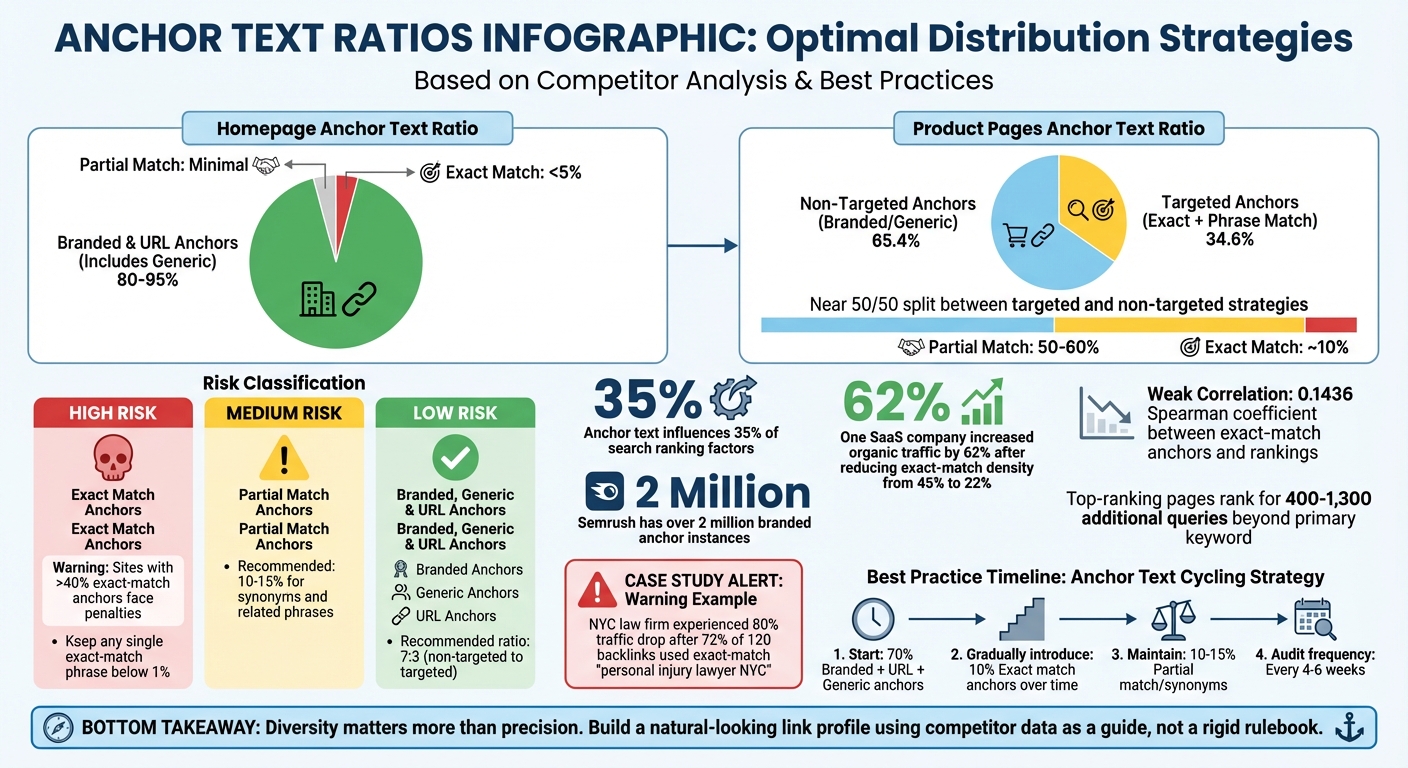
Optimal Anchor Text Distribution Ratios for SEO Success
Anchor Text Ratios – Exact Match, Partial Match, Naked URL, Brand, Title, Generic, and More
1. Competitor Anchor Text Patterns
Examining competitor strategies reveals how they balance anchor text distribution and manage risks to create effective and sustainable SEO tactics.
Anchor Text Distribution
Top-ranking competitors prioritize branded and natural anchors on their homepages, reserving keyword-rich anchors for inner pages. The strategy shifts further for product pages and blog posts, where partial match anchors often account for 50% to 60% of links, with exact match usage hovering around 10%. For instance, a study of major ecommerce brands showed that only 34.6% of links to category and product pages used targeted anchors (exact or phrase match), while the rest relied on branded or generic anchors. Product pages, in particular, exhibited a near 50/50 split between targeted and non-targeted anchor strategies. This indicates that successful competitors avoid overloading pages with keyword-heavy anchors, instead focusing on creating natural-looking link profiles.
This careful distribution also ties directly to how competitors manage risk in their anchor text strategies.
Risk Management
Competitors classify anchor text types by their associated risks: exact match anchors are high risk, partial match anchors fall into the medium-risk category, and branded, generic, or URL anchors are considered low risk. Sites with more than 40% exact-match anchors are prone to algorithmic penalties. One SaaS company reduced its exact-match anchor density from 45% to 22%, resulting in a 62% increase in organic traffic.
“Unnatural anchor text ratios are one of the easiest ways to trip a spam filter.” – Web20Ranker
To minimize risk, leading competitors stick to a 7:3 ratio of non-targeted to targeted anchors. They also follow a cycling strategy: starting with branded, URL, and generic anchors before gradually introducing partial and exact match terms. This approach mirrors organic link growth and avoids triggering spam filters.
Understanding these risk levels sets the stage for exploring how contextual factors influence anchor text performance.
Contextual Relevance
Competitors also recognize the importance of the surrounding text in links. According to a Google patent, the text near a link plays a significant role in shaping its contextual relevance. This means even generic anchors like “check out this platform” can pass topical signals if the surrounding content is well-optimized.
Analysis of 384,614 web pages revealed only a weak correlation (0.1436 Spearman coefficient) between exact-match anchor percentages and rankings. Interestingly, top-ranking pages often rank for 400 to 1,300 additional queries beyond their primary keyword. This highlights the importance of broad topical relevance over strict keyword matching. Competitors now allocate 10% to 15% of their anchor profiles to synonyms and related phrases, ensuring they capture semantic variations and align with entity-based modifiers.
SEO Performance Impact
Anchor text influences about 35% of search ranking factors, but the effect isn’t straightforward. Overusing targeted anchors can lead to diminishing returns – or worse, harm rankings. Companies like Semrush illustrate the power of branded anchors, with over two million branded instances in their link profile. This underscores how brand authority often outweighs keyword-focused strategies.
Experts suggest keeping any single exact-match phrase below 1% of the total link profile. To maintain this balance, competitors routinely audit their anchor text distributions every four to six weeks, ensuring their ratios align with top-performing sites in their niche. Regular monitoring helps prevent over-optimization and supports the natural link profiles that search engines reward, reinforcing the importance of a balanced, thoughtful approach to anchor text strategy.
2. 3Way.Social

3Way.Social takes competitor insights and turns them into an automated solution for anchor text optimization. By leveraging AI for precise matching and quality control, the platform helps users create natural-looking link profiles without the hassle of manual adjustments.
Anchor Text Distribution
Using an AI-powered domain matching system, 3Way.Social identifies contextually relevant partners in your niche. This makes it easier to distribute anchor text naturally across different types of links. The platform connects users with guest posting opportunities and diverse exchange partners based on topical relevance, ensuring varied anchor usage. Each permanent do-follow link is validated to avoid “sponsored” labels. This system supports maintaining a branded anchor ratio of 80%–95%, while using keyword-rich anchors sparingly. The result? A balanced and effective distribution strategy, all handled automatically.
Risk Management
To minimize risks, the platform evaluates potential partners based on Spam Score, Domain Authority (DA), and Traffic Volume. This ensures low-quality links are filtered out, reducing the chance of penalties. Users can also fine-tune their searches with filters for topics, DA, and traffic, guaranteeing high-quality matches. Additionally, 3Way.Social’s vetted professional network and proactive monitoring system – which automatically restores dead links – help maintain a stable and reliable SEO profile.
SEO Performance Impact
With anchor text playing a role in about 35% of ranking factors, 3Way.Social’s approach directly boosts SEO performance. Its contextual matching ensures even generic anchors send strong topical signals through surrounding content, aligning with Google’s focus on link context. By connecting users with authoritative and relevant domains, the platform helps create natural link profiles that search engines favor, avoiding the pitfalls of over-optimization and diminishing returns.
sbb-itb-88880ed
Pros and Cons
Using fixed ratio methods – like sticking to 80–95% branded anchors for homepages – offers beginners a simple starting point for managing anchor text distribution. On the other hand, gap analysis strategies dive deeper, analyzing the top 10 competitors for a specific keyword to fine-tune anchor ratios based on current SERP trends. While this approach is more tailored, it can be time-intensive.
Some experts, however, advocate for a more natural approach, suggesting that trying to manipulate anchor text ratios could backfire. Joshua Hardwick, Head of Content at Ahrefs, explains:
“Your best bet for creating a natural anchor text ratio in your backlink profile – which is what Google wants to see – is simple: Don’t try to manipulate your anchor text ratios at all.”
This hands-off strategy reduces the risk of penalties but may lead to slower ranking progress compared to more structured optimization efforts.
Another method, anchor text cycling, involves starting with 70% branded anchors in the early stages and gradually incorporating about 10% exact match anchors over time. This approach mirrors organic growth patterns and minimizes risk, but it demands consistent, long-term execution. Interestingly, a study of 384,614 web pages found only a 0.1436 Spearman correlation between exact-match anchor percentages and high rankings. This suggests that overemphasizing precise ratios might not yield significant results, reinforcing the importance of balancing short-term gains with sustainable growth.
Automated solutions like 3Way.Social aim to simplify the process. By using contextual matching and quality control, these tools handle anchor text distribution without requiring manual adjustments. However, even with automation, it’s crucial to account for niche-specific trends, as no system can fully replace strategic decision-making tailored to individual SERPs.
One universal takeaway is the importance of avoiding excessive exact-match anchors, which is a common trigger for penalties. For example, an NYC law firm saw an 80% drop in traffic after 72% of its 120 backlinks used the exact-match keyword “personal injury lawyer NYC”. To maintain sustainable SEO results, whether through manual efforts or automated tools, keeping anchor ratios balanced is non-negotiable.
Conclusion
When it comes to anchor text distribution, there’s no universal formula that guarantees success. What works best depends on your niche, the type of page you’re optimizing, and the competitive landscape. However, competitor analysis reveals a clear trend: a natural mix of anchor types – primarily branded and generic, with limited use of exact match anchors – tends to align with search engine guidelines and avoid penalties.
To fine-tune your strategy, reverse engineer the top 5–10 ranking pages for your target keyword. This method provides a data-driven approach to determine the anchor text balance that Google rewards, especially since anchor text influences about 35% of ranking factors. By analyzing current SERP trends, you can eliminate the guesswork and develop a framework tailored to your goals.
Regular audits are essential. Review your link profile every three to six months to ensure your anchors remain diverse and well-balanced. When building new links, consider using an “anchor text cycling” strategy. Start with branded and naked URL anchors, then gradually incorporate partial and exact match anchors. This approach mimics natural link growth and reduces the risk of penalties.
For those seeking an automated solution, tools like 3Way.Social can simplify the process. Their AI-driven system manages anchor text distribution by diversifying anchor types across your link-building efforts while maintaining natural variation. This directly applies the competitor-informed strategies discussed throughout this analysis.
As a former Google Webmaster Trends Analyst aptly noted:
“Anchor text is one of the most powerful relevancy signals we have. But when we see a profile that is overly optimized, it’s a red flag that the links may not be earned organically”.
The key takeaway? Diversity matters more than precision. Build a link profile that looks organic and natural, using competitor data as a guide – not as a rigid rulebook. This approach ensures sustainable SEO success while staying in line with search engine expectations.
FAQs
What’s the best way to find the right anchor text ratio for my website?
Finding the right anchor text ratio is all about balance and strategy. A well-rounded anchor text profile typically combines branded, URL, and generic anchors, which should make up the bulk of your backlinks – about 80-95%. Meanwhile, exact-match keywords should be used sparingly, keeping them below 20% to avoid the pitfalls of over-optimization.
To start, analyze the backlink profiles of your top-ranking competitors using tools like Ahrefs or SEMrush. Pay attention to how their anchor texts are distributed and aim to emulate a natural mix of anchor types. It’s also important to keep an eye on your own link profile over time, ensuring it remains diverse and aligns with these benchmarks. The key to success? Diversify and stay moderate to maintain a strong, healthy anchor text strategy.
What happens if you use too many exact match anchor texts?
Using too many exact match anchor texts can backfire on your SEO strategy. Search engines often interpret this as over-optimization, which can lead to penalties and a drop in your rankings. To avoid this, it’s essential to build a natural and varied link profile that maintains credibility and steers clear of spam signals.
The key is balance. Incorporate a mix of anchor text types, such as branded, generic, and partial match anchors. This variety not only strengthens your site’s authority but also ensures your optimization efforts align with search engine guidelines.
What role does anchor text play in SEO?
Anchor text plays a key role in SEO by giving search engines clues about the topic and relevance of the linked page. When done right, it can help improve a page’s rankings for specific keywords. For example, using descriptive anchor text like “top SEO strategies” clearly indicates the subject of the linked content, making it more relevant.
That said, it’s important to keep your anchor text profile natural and varied. Relying too much on exact match keywords can lead to penalties. Instead, aim for a mix that includes branded terms, generic phrases, partial match keywords, and even plain URLs. This balanced approach not only follows search engine guidelines but also strengthens your backlink profile, helping you rank better and attract steady, reliable traffic.