Anchor Text Diversity: Why It Matters
Use a balanced mix of branded, generic, partial-match and exact anchors to avoid penalties, boost rankings, and widen keyword visibility.

Last Updated on October 9, 2026 by Becky Halls
Anchor text diversity is essential for SEO. Search engines, like Google, favor websites with varied anchor text in backlinks. Overusing the same keyword-rich phrases can lead to penalties, harming your rankings and traffic. A balanced anchor text strategy helps avoid these risks while improving your site’s authority and ranking for multiple search terms.
Here’s what you need to know:
- Avoid over-optimization: Repeated exact-match anchor text raises red flags with search engines, risking penalties.
- Balance your anchor profile:
- Branded anchors (e.g., your company name) should make up 40–50% of links.
- Exact-match anchors (e.g., specific keywords) should stay below 5–10%.
- Use generic phrases like “click here” and naked URLs for variety.
- Benefits of diversity: A natural mix of anchor text improves rankings, protects against penalties, and boosts visibility for related search terms.
To maintain a healthy profile:
- Audit your anchor text distribution regularly using tools like Ahrefs or SEMrush.
- Diversify links by combining branded, generic, and partial-match anchors.
- Use platforms like 3Way.Social to automate link-building while ensuring anchor text variety.
Anchor text diversity isn’t just about avoiding penalties – it’s a key part of building a strong, sustainable SEO strategy.
The Problem: Over-Optimization and Its Risks
What is Over-Optimization?
Over-optimization happens when you overuse keyword-heavy or repetitive anchor text in backlinks to manipulate search rankings. This can show up in a few ways: keyword stuffing, where you cram too many relevant terms into the anchor text; exact match overuse, where the same keyword appears repeatedly across backlinks; or unnecessarily long anchors that feel unnatural in context.
“Over-optimized anchor text refers to anchor texts that are used to manipulate search engine rankings artificially.” – Joel Cariño, Writer, LinkStorm
A study of large e-commerce sites revealed that 34.6% of links to category and product pages were “targeted” (exact or phrase match), compared to a healthier 7:3 ratio of non-targeted to targeted anchor text in a normal link profile. When your backlinks lean too heavily on exact-match keywords, search engines may see it as manipulation instead of genuine linking. This not only misguides search engines but also puts your site at risk for penalties.
Risks of Using the Same Anchor Text
Using over-optimized anchor text can lead to immediate consequences. The most direct threat? Search penalties. Google’s algorithms, especially after the 2012 Penguin update, are built to detect unnatural linking patterns. If they spot a high volume of exact-match anchors, they can trigger automatic ranking drops. In extreme cases, violations of Google’s spam policies can result in de-indexing, where your site or specific pages are completely removed from search results.
“Too many exact match anchor links will likely lead to Google penalizing your website.” – Rand Fishkin, Founder, Moz
But penalties aren’t the only problem. Over-optimized links also harm user experience – they feel awkward, spammy, and make content harder to read, which erodes trust. Sites that rely on these tactics often face ranking instability, with their positions plummeting whenever algorithms shift to prioritize natural language. Before 2012, keyword-rich anchors were considered a smart strategy. However, the Penguin update changed everything, and websites that didn’t adapt saw their traffic vanish almost overnight.
These risks highlight the importance of maintaining a diverse and natural anchor profile.
The Solution: Why Anchor Text Diversity Matters
How Anchor Text Diversity Improves SEO
A diversified anchor text strategy is one of the best ways to avoid the risks of over-optimization. By varying your anchor text, you create a more natural backlink profile, which search engines like Google interpret as organic growth rather than manipulation. This means using a mix of branded terms, generic phrases, and keyword variations to signal authenticity. The result? Your pages can rank for multiple related queries, not just one competitive keyword.
“Anchors often provide more accurate descriptions of web pages than the pages themselves.” – Sergey Brin and Larry Page, Founders, Google
Data backs this up. Research on 23 million internal links found that URLs with more anchor text variations saw higher Google search traffic. Interestingly, only 22% of traffic typically comes from the primary keyword, while the remaining 78% is driven by diverse, long-tail anchors. This mix not only expands your keyword reach but also strengthens your site’s overall authority.
SEO Benefits of a Balanced Anchor Profile
A well-balanced anchor profile offers both protection and performance. First and foremost, it helps you avoid algorithmic penalties. Google’s Penguin update specifically targets unnatural linking patterns, so maintaining a natural distribution is key to staying on the right side of the algorithm. Experts recommend keeping exact-match anchors to less than 5% of your total profile, with branded anchors making up 40–50%.
“Diverse anchor text performs better than exact-match optimization. A natural approach also increases traffic while avoiding penalties.” – Cyrus Shepard, SEO Researcher
Branded anchors and naked URLs form what experts call a “trust foundation”. These low-risk anchor types signal legitimacy to search engines, giving you room to strategically use keyword anchors without raising red flags. As a Google Representative explained during the 2023 SEO Office Hours, “In general, yes, we don’t trust links from sites we know are spam. This helps us maintain the quality of our anchor signals”.
Modern search algorithms also analyze the surrounding text to understand relevance. This means that varied, contextually appropriate anchors can boost your rankings and bring in steady traffic over time.
Detailed Anchor Text Strategy that Nobody Talks About
Types of Anchor Text for a Balanced Profile
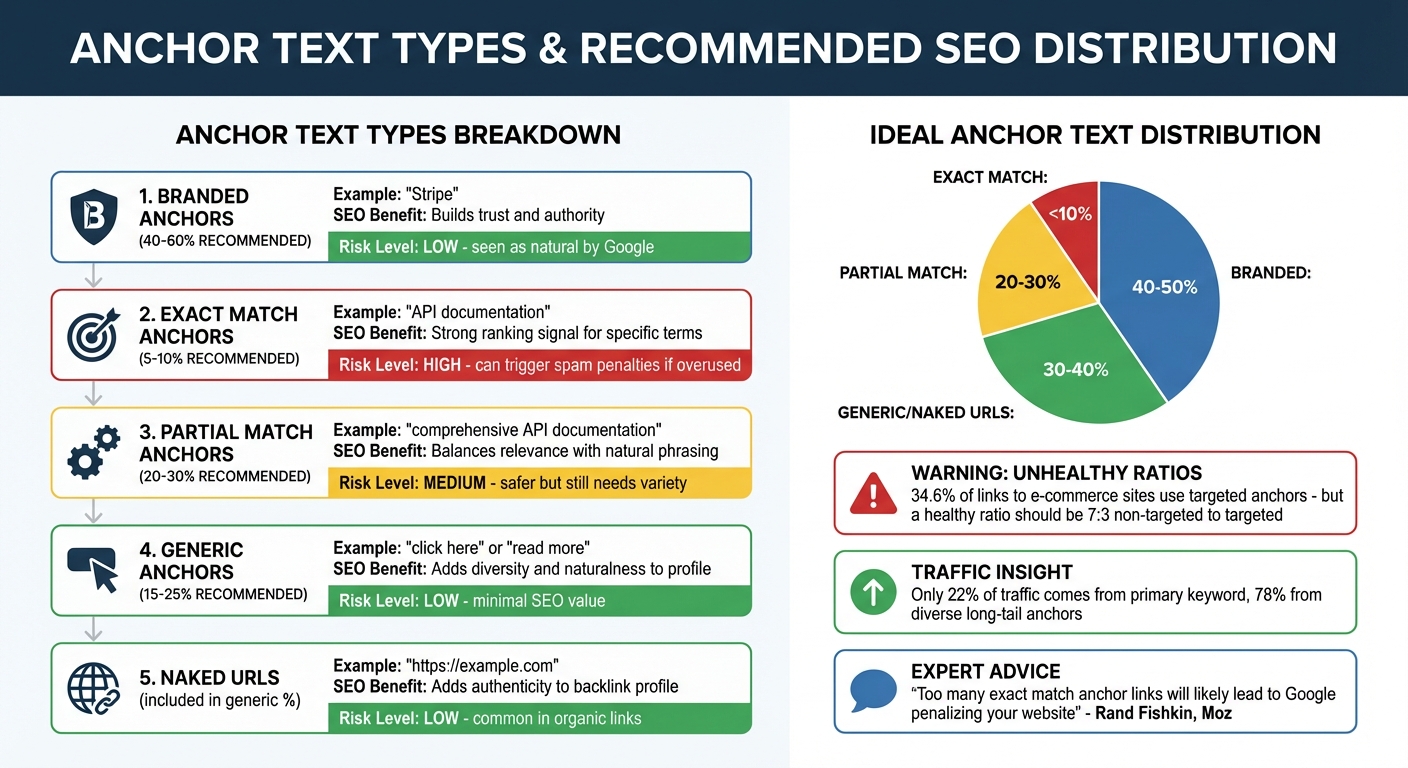
Anchor Text Distribution Guide: Recommended Percentages for SEO
Common Anchor Text Types
Understanding the different types of anchor text can help you create a well-rounded backlink profile. Branded anchors – which use your company name, like “Stripe” – are considered the most trustworthy and natural. These should form the backbone of your profile, ideally making up 40–60% of your total backlinks.
Exact match anchors use your target keyword word-for-word, such as “API documentation.” While they can significantly boost rankings, overusing them can lead to penalties. Keep these to around 5–10% of your profile. On the other hand, partial match anchors combine your keyword with other terms, like “comprehensive API documentation”, offering a safer way to maintain relevance while sounding more natural.
Generic anchors – phrases like “click here” or “read more” – may not offer much SEO value, but they’re essential for creating a natural-looking profile. Aim for these to account for 15–25% of your links. Naked URLs (e.g., “https://example.com”) are also important. They lend credibility and often appear in forums or technical references. Lastly, long-tail anchors (e.g., “how to build effective API documentation”) target specific queries and feel more organic to search algorithms.
Anchor Text Types Comparison
| Type | Description | SEO Benefit | Risk if Overused |
|---|---|---|---|
| Exact Match | Direct keyword usage | Strong ranking signal for specific terms | High; can trigger spam penalties |
| Branded | Brand or company name | Builds trust and authority | Low; seen as natural by Google |
| Partial Match | Keyword with additional words | Balances relevance with natural phrasing | Medium; safer but still needs variety |
| Generic | Phrases like “click here” | Adds diversity and naturalness to the profile | Low; minimal SEO value |
| Naked URL | The raw web address | Adds authenticity to the backlink profile | Low; common in organic links |
Use this breakdown to guide your anchor text strategy.
Best Practices for Mixing Anchor Text
Diversification is key to avoiding over-optimization. Start with a strong base of branded anchors, followed by naked URLs and generic anchors. Introduce exact match anchors sparingly and only after building a trustworthy profile.
Incorporate natural modifiers to make your anchors sound more conversational. For instance, instead of just “water bottles”, you could use phrases like “this water bottle here” or “special deals from [Brand]”. If your domain name matches your target keywords, be cautious – using identical branded and keyword anchors too often could flag spam signals.
For homepages, aim for 60–70% branded links, while blog posts can include a higher ratio of partial match anchors, around 20–30%. To avoid patterns that could trigger penalties, vary your phrasing even within the same category. For example, use “managing messages” in one link and “inbox tools” in another. Also, ensure your anchor text accurately reflects the content being linked to – misleading anchors can confuse both users and search engines.
sbb-itb-88880ed
Auditing and Improving Anchor Text Distribution
How to Audit Your Anchor Text Distribution
Keeping your anchor text profile natural and balanced is crucial to avoid over-optimization. Tools like Ahrefs Site Explorer or SEMrush Backlink Analytics can help you export your dofollow link data and generate detailed anchor text reports. When auditing, take a two-pronged approach: examine patterns at the domain level and focus on specific high-priority pages, especially those experiencing ranking shifts.
Pay close attention to repeated identical anchor phrases, as they can signal manipulation. SEMrush highlights “Money anchors” (exact match keywords) and “Compound anchors” (brand combined with keywords) as risky when used excessively. Also, keep an eye out for irrelevant or spammy terms like “poker” or “casino”, which could indicate a negative SEO attack.
Set benchmarks that align with your industry norms. A typical balanced profile might include 20–30% branded anchors, 30–40% generic or naked URLs, and less than 10% exact-match anchors. If competitors rely heavily on branded anchors (e.g., over 50%) and rank well, it might be worth adjusting your strategy to reduce reliance on exact-match anchors. To stay ahead of potential issues, review your anchor text distribution monthly or after significant link-building campaigns. This regular auditing helps maintain a diverse and natural anchor profile, preventing over-optimization and ensuring long-term stability.
Steps to Improve Anchor Text Diversity
Once your audit highlights areas needing improvement, focus on diversifying your anchor text. Start by adding new links with a mix of branded, generic, or naked URL anchors to gradually rebalance your profile. Avoid deleting links abruptly, as this could raise red flags with search engines. Instead, use semantic expansion – replace repetitive anchors with related terms or synonyms. For instance, instead of repeatedly using “SEO reporting tools”, try alternatives like “automated marketing analytics”.
Adopt an anchor text rotation strategy over time. For example:
- Begin with 70% branded, 20% generic, and 10% URL anchors in the first two months.
- Transition to 50% branded, 25% partial match, and 15% generic anchors in the next phase.
- Gradually introduce 10% exact-match anchors once your link profile is well-established and trustworthy.
When working on guest posts or outreach, suggest a variety of natural anchor options, such as “this platform” or your brand name, instead of pushing for specific keywords.
Don’t overlook internal links. Use a pivot table to match anchor phrases with destination URLs and identify pages that are over-linked with the same anchor text. For larger websites, CMS plugins can scan your content and recommend varied internal anchors. If you encounter spammy or irrelevant domains linking to you with manipulative anchors, and other solutions don’t work, the Google Disavow tool can be a last resort.
Using 3Way.Social for Anchor Text Diversity
3Way.Social Features Overview
3Way.Social takes a fresh approach to link building with its AI-powered domain matching, connecting your site to niche-specific partners. Instead of relying on the typical reciprocal linking – where Site A links to Site B and vice versa – it uses an ABC link exchange model. This method creates a more natural backlink profile, steering clear of patterns that search engines might flag as manipulative.
The platform delivers permanent do-follow links, which pass link equity and contribute to long-term rankings. It also integrates guest posting opportunities, allowing you to secure high-quality contextual links with a variety of anchor texts embedded naturally in editorial content. To ensure quality, all partners are carefully vetted, giving you access to a trusted network of SEO professionals and reputable websites. This setup helps you build a diverse and balanced link profile, perfect for enhancing anchor text variety.
How 3Way.Social Helps with Anchor Text Diversity
3Way.Social simplifies the process of creating a balanced anchor text strategy by automating link exchanges. When using the platform for exchanges or guest posts, you can easily maintain diversity by mixing branded, partial-match, and minimal exact-match anchors. Save exact-match anchors for your most authoritative domains and lean toward descriptive phrases that naturally include your target keywords. This approach not only improves how users perceive the content but also reduces the risk of algorithm penalties, keeping your backlink profile safe and effective. These features align seamlessly with best practices, ensuring your anchor text strategy remains steady and adaptable.
Benefits of Using 3Way.Social
The ABC exchange model offers a stronger backlink profile compared to traditional manual outreach, which can be both time-consuming and prone to over-optimization. By automating the process with AI, 3Way.Social helps you avoid red flags like having an excessive percentage of exact-match anchors. For example, if 72% of your links use the same exact-match keyword, algorithm updates could cause your organic traffic to drop by as much as 80%.
Additionally, the platform’s secure network connects you with verified sites, safeguarding your domain authority while boosting rankings and driving traffic. A user-friendly dashboard makes it easy to track anchor distribution, allowing you to adjust your strategy if any non-branded anchor exceeds 20%. This level of control ensures your backlink profile stays balanced and effective.
Conclusion
Using diverse anchor text is essential for avoiding algorithm penalties and creating a natural, credible backlink profile. Overusing exact-match keywords can lead to steep traffic losses, as flagged by search engines. To mitigate this risk, aim for a well-rounded anchor text strategy: branded anchors should make up 30–50% of your profile, partial-match phrases should account for 20–30%, and exact-match keywords should be reserved for selective, high-authority placements where they fit naturally.
Google’s algorithms are designed to spot unnatural linking patterns, such as multiple links to the same page using identical anchor text. These patterns can harm your rankings. A balanced anchor profile avoids these pitfalls while maintaining SEO strength.
It’s also important to regularly review your anchor text distribution. If non-branded anchors exceed 20%, take immediate steps to create new links using branded or generic text. This proactive approach keeps your backlink profile looking organic and reduces the risk of penalties.
To make this process easier, automation tools can be a game-changer. Platforms like 3Way.Social simplify diversification by using an AI-powered matching system and the ABC link exchange model. Instead of manually tracking percentages or searching for guest post opportunities, these tools allow you to monitor your anchor distribution in real time and fine-tune your strategy. This blend of automation and oversight helps keep your backlink profile penalty-proof and effective in boosting rankings and traffic.
At its core, anchor text diversity mirrors how users naturally link to valuable content – using varied, descriptive, and contextually relevant phrases. By adopting a balanced strategy and leveraging the right tools, you can safeguard your SEO efforts against algorithm updates while steadily building authority.
FAQs
What is anchor text diversity, and why does it matter for SEO?
Anchor text diversity means using a mix of different words or phrases as the clickable text in hyperlinks that point to your website. Instead of sticking to exact match keywords, it includes a variety of options like branded terms, generic phrases, partial matches, and even plain URLs. This mix helps create a backlink profile that looks natural, which search engines tend to trust more.
Why does this matter? Search engines like Google keep an eye out for over-optimization. If too many of your backlinks use the same keyword-heavy anchor text, it can come across as manipulative. This could hurt your rankings. On the flip side, a diverse anchor text profile suggests your links are earned naturally. It not only boosts your site’s authority but also improves search visibility – all while keeping you on the right side of SEO guidelines.
What’s the best way to avoid over-optimizing anchor text?
To avoid going overboard with your anchor text, aim for a varied and natural mix of anchor types. Incorporate branded anchors (like your company name), partial keyword matches, generic phrases (such as “click here”), and plain URLs. Steering clear of overusing exact-match keywords is essential – search engines might flag this as suspicious behavior.
Your anchor text should flow naturally within the content. If it feels forced or repetitive, it can come across as manipulative and may harm your SEO performance. Packing content with keyword-heavy anchors or using overly long phrases can backfire. Striking a balance helps maintain a healthy backlink profile while staying in line with search engine rules.
If managing link diversity feels overwhelming, AI-driven tools can make the process easier, helping you build a well-rounded and effective backlink strategy.
What are the best practices for maintaining a diverse and natural anchor text profile?
To keep your anchor text profile diverse and natural, use a mix of anchor text types like branded terms, partial match keywords, generic phrases, naked URLs, and related keywords. Steer clear of overusing exact-match keywords, as this can come across as manipulative to search engines and might result in penalties.
Make sure your anchor texts flow naturally within the content and align with the surrounding context. This not only creates a better experience for readers but also signals credibility to search engines. Strive for a balanced variety of anchor text types across your backlinks to maintain a profile that feels organic and trustworthy.
Focusing on quality, relevance, and variety can strengthen your SEO efforts, boost user confidence, and encourage better engagement.