Last Updated on February 10, 2026 by Becky Halls
Guest posting in 2026 is all about quality over quantity. It’s no longer just a link-building tactic – it’s a way to establish authority, improve search visibility, and boost brand recognition. But outdated methods like keyword-stuffed posts or low-quality link farms can harm your rankings. Instead, focus on these key strategies:
- Relevance matters: Links from niche-specific, authoritative sites outperform generic placements.
- E-E-A-T is critical: Experience, Expertise, Authoritativeness, and Trustworthiness are essential for SEO success.
- AI visibility is rising: Guest posts can help your brand appear in AI-generated search summaries, driving higher-quality traffic.
- Quality over quantity: A single link from a well-chosen domain can be more impactful than dozens of low-quality links.
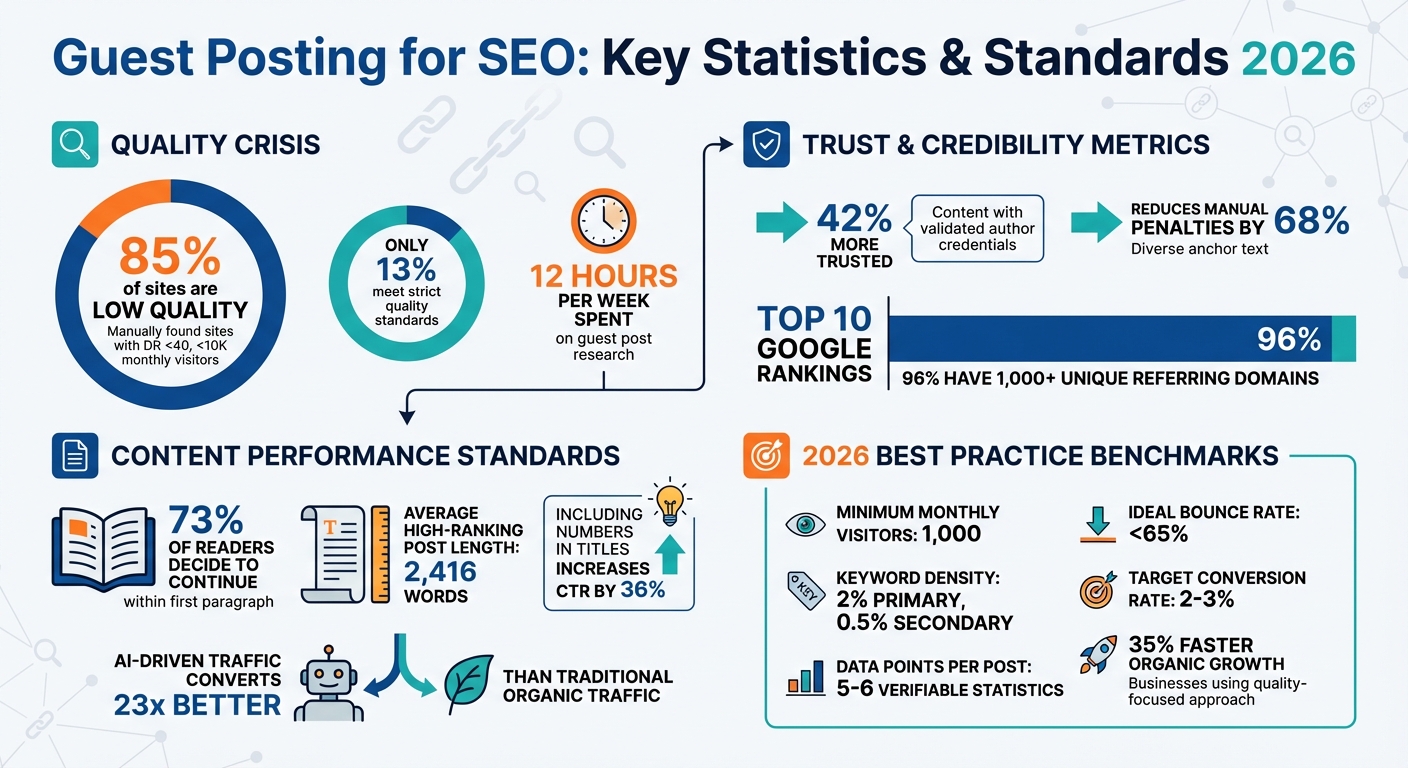
Guest Posting Quality Standards and SEO Impact Statistics 2026
Guest Blogging for SEO: The Strategy That Still Works in 2026
sbb-itb-88880ed
How to Find Quality Guest Posting Sites
Finding the right guest posting sites is what separates an effective SEO strategy from wasted effort. The real challenge isn’t locating sites that accept guest posts – it’s identifying the ones that actually deliver results. According to research, 85% of manually found guest posting sites are considered low quality, often with a Domain Rating (DR) below 40 and fewer than 10,000 monthly organic visitors. This means manual research can easily turn into a time sink, filtering out sites that won’t move the needle.
The trick is knowing what to look for before you start pitching. High-quality sites share specific traits that make them worth your time and resources.
Evaluating Website Authority and Relevance
When assessing potential sites, prioritize organic traffic over authority scores. A site should have at least 1,000 monthly visitors to be worth your effort. Unlike metrics like Domain Authority and Domain Rating, which can sometimes be artificially inflated, organic traffic shows that Google trusts the site enough to rank it for relevant keywords.
Pay close attention to the site’s traffic history to spot any warning signs. A sudden, steep drop in traffic over the past 6-12 months could indicate penalties from Google’s algorithms. Additionally, make sure the traffic aligns with your target audience. For example, if your business focuses on U.S. customers, a site with most of its traffic coming from other countries won’t be very helpful.
Relevance matters more than ever. Google now focuses on how closely the host site’s topic aligns with your own. For instance, a plumbing supplier linking to a plumber is considered “short distance,” which passes authority effectively. On the other hand, a tech blog linking to the same plumber is “long distance,” and Google may devalue that link. Use the search operator site:domain.com [your topic] to confirm the site has covered your niche consistently.
“Relevance is no longer optional. It determines whether a link contributes authority or disappears into the noise.” – Stellar SEO
Next, check the site’s outbound link profile. Review 5-10 recent articles to see where they’re linking. Avoid sites that link to questionable industries like casinos, essay writing services, or unregulated supplements. If every article has 5-15 links to unrelated niches, you’re likely dealing with a link farm.
Look for E-E-A-T signals – expertise, experience, authority, and trustworthiness. Real author bios with verifiable credentials, consistent formatting, and clear editorial guidelines are key indicators. Content with validated author credentials is 42% more trusted by both users and search algorithms. Be cautious with sites that label guest posts as “sponsored” or “contributed”, as these tags can reduce the SEO value of your link.
Finally, trust your instincts with the “eye test.” If a site is overloaded with ads, has a cluttered layout, or covers random, unrelated topics (like “nursing tops” and “SaaS” on the same blog), it’s probably not worth your time. One guest post placement service reports that they accept fewer than 13% of sites due to strict quality standards.
Once you’ve established these criteria, the next step is to streamline the vetting process with advanced tools.
Using 3Way.Social for Domain Matching

Manual vetting takes time – marketers spend an average of 12 hours per week researching and reaching out for guest posts. That’s where AI tools like 3Way.Social come in.
3Way.Social uses AI-powered domain matching to connect you with vetted guest posting opportunities. The platform evaluates sites based on topical relevance and security metrics, automatically filtering out toxic or deindexed domains. Instead of manually digging through traffic stats, outbound links, and relevance checks, the platform handles these tasks for you.
The domain matching feature ensures topical relevance (sites in your niche) and contextual relevance (links that fit naturally within specific articles). This means your backlinks won’t just come from related sites – they’ll appear in content where they make sense. The platform’s network includes pre-vetted SEO professionals and publishers, ensuring ethical practices and high-quality placements.
For businesses juggling multiple campaigns, 3Way.Social offers a dashboard to track link value, placement status, and performance – all in one place. This eliminates the need for multiple tools to manage competitor research, traffic checks, and outreach efforts, saving you time and simplifying your workflow.
How to Write Effective Guest Posts
Creating a strong guest post takes more than just good writing – it requires content that aligns with SEO standards and delivers real value. In 2026, Google’s algorithms emphasize Experience, Expertise, Authoritativeness, and Trustworthiness (E-E-A-T). This means content lacking depth or insight won’t cut it. Your goal? Establish yourself as a credible expert first, and let link-building happen naturally.
The approach has shifted. Editors now prioritize collaboration over transactional exchanges. Your guest post should feel like it belongs on the site, not like a thinly veiled advertisement.
Optimizing Content for Search Engines
To ensure your post performs well, focus on keyword placement and structure. Aim for a 2% primary keyword density and 0.5% for secondary keywords. Use clear headings (H2 and H3) and keep paragraphs short – 2 to 4 sentences max. This format works particularly well for mobile readers and fast scrollers. Writing at an 8th- to 10th-grade reading level also makes your content more accessible.
Google’s Search Generative Experience (SGE) now favors content that directly answers common questions, particularly those found in “People Also Ask” sections. Adding an FAQ section with concise, 40- to 60-word answers can improve your chances of appearing in AI-powered search results. For instance, if your post is about email marketing, you could include a question like, “What’s the best time to send marketing emails?” and follow it with a short, data-backed answer.
Support your post with 5 to 6 specific data points or original research. Including numbers in your title can increase click-through rates by 36%. For example, framing your content around a compelling statistic or case study can grab attention. Additionally, include 1 to 2 internal links to the host site’s existing content. This not only enhances their SEO but also shows you’re invested in their success.
| Element | 2026 Best Practice Standard |
|---|---|
| Word Count | 1,000 – 3,000 words (Long-form preferred) |
| Keyword Density | ~2% Primary; 0.5% Secondary |
| Paragraph Length | 2 – 4 sentences |
| Reading Level | 8th – 10th Grade |
| Data Points | 5 – 6 verifiable statistics or citations per post |
Once your SEO foundation is solid, shift your focus to creating content that genuinely connects with readers.
Writing Content That Readers Want
SEO is important, but it’s the human element that keeps readers engaged. Did you know that 73% of readers decide whether to continue reading within the first paragraph? Your opening should grab attention by addressing a specific problem or benefit instead of relying on vague introductions.
Match your tone and complexity to the host site’s style. Browse their recent articles to get a feel for what works. For expert audiences, use advanced tips and industry jargon. For beginners, break concepts into simple, actionable steps.
Longer posts tend to perform better. On average, high-ranking posts on trusted sites are 2,416 words long and feature 7 to 8 headings. This not only signals depth to search engines but also gives you space to provide actionable insights. Editors also favor multimodal content – think short explainer videos, podcast snippets, or infographics. Including custom screenshots, charts, or other visuals can make your submission stand out.
While AI can help with topic ideas, it’s your personal insights that set your content apart. Share first-hand experiences, new data, or a fresh perspective that automated tools can’t replicate. As Leury Pichardo, Senior Director of Digital Marketing and PR at Digital Ceuticals, explains:
“I care less about someone’s paper credentials and more about whether they are a genuine partner in promotion. I once rejected a brilliant article from a Ph.D. because he… just wanted the backlink.”
- Leury Pichardo
Lastly, customize your author bio for each site. A business blog might call for a productivity-focused bio, while a lifestyle site might suit a travel-oriented one. Keep it brief – 2 to 3 sentences – and include verifiable credentials with a link to a landing page tailored for the host’s audience. Posts with credible author bios see 42% higher trust scores from both readers and search engines.
Adding Do-Follow Links Naturally
Once your content is polished, it’s time to incorporate do-follow links. These should be added thoughtfully, enhancing the content rather than distracting from it.
Place links within paragraphs of at least 2 to 3 sentences where they naturally fit. For example, if you’re writing about email personalization, link to a guide on advanced techniques instead of using generic anchor text like “click here”.
Using diverse anchor text is key. Mix branded terms, partial-match phrases, and semantic variations to avoid penalties – this approach reduces the risk of manual penalties by 68%. Avoid clustering links too closely together, as this can trigger spam filters.
Save promotional links for your author bio. Use the body of your article for editorial links that cite data, research, or in-depth guides. For example, if you’re referencing a study, link directly to the research rather than your homepage.
A balanced link profile also includes nofollow, UGC, or sponsored attributes where appropriate. If linking to affiliate content or paid resources, use rel="sponsored" to stay within Google’s guidelines.
Before submitting your post, double-check all links. Make sure they use HTTPS, avoid broken redirects, and don’t include unnecessary affiliate tracking. If you’re tracking performance, add UTM parameters to your links.
| Link Type | Best Practice | Purpose |
|---|---|---|
| Contextual (Body) | Use descriptive, keyword-rich anchors naturally. | Adds editorial value and passes link equity. |
| Internal (Host Site) | Link to 1–2 relevant articles on the host’s blog. | Builds goodwill and supports their SEO. |
| Author Bio | Link to a targeted landing page or social profile. | Drives leads and establishes authority. |
| Source/Citations | Link to original research or third-party data. | Validates claims and boosts credibility. |
Think of links as tools to educate and inform, not just as SEO boosters. If a link doesn’t genuinely add value, it’s better left out. As Dmitry Dragilev, Founder of JustReachOut, puts it:
“Any backlinks you get through guest posts should be a by-product of your content, not its sole reason.”
Guest Posting Mistakes to Avoid
Guest posting, when done incorrectly, can cause more harm than good. Take the case of a financial services company in January 2026: they discovered over 500 backlinks from low-quality directories in Eastern Europe and Asia. These links featured foreign-language anchor text and exact-match commercial keywords, creating an unnatural link pattern. The result? A 40% drop in organic visibility in just two weeks. A single misstep like this can undo months of hard SEO work.
Knowing what not to do is just as critical as understanding best practices. Google’s algorithms are highly adept at identifying manipulative link patterns, and the penalties can range from reduced rankings to complete removal from search results. The good news? Most of these mistakes are avoidable if you know where the pitfalls lie.
Using Low-Quality or Irrelevant Links
Low-quality links can damage your SEO far more than having no links at all. These links often come from sites with minimal traffic, poor oversight, or spammy connections to industries like gambling or payday loans. Google views these “bad neighborhoods” as a red flag, eroding the trust signals your site relies on.
Relevance is just as important as quality. For instance, placing a nursing-related link on a graphic design blog or a finance link on a parenting site offers no SEO value. Worse, it signals manipulative intent. With tools like Google AI Overviews and ChatGPT evaluating source credibility in 2026, manipulative linking can even lead to exclusion from search results.
Before pitching a site, take a moment to inspect its content. Check five random articles and examine their outbound links. If you spot links to questionable industries or an excessive number of unrelated domains, it’s likely a link farm. Also, ensure the site has consistent or growing organic traffic – not just inflated metrics or high social shares.
When it comes to paid placements, be cautious. Placements costing under $100 often indicate link farms and provide little to no value. If you do pay for links, always use rel="sponsored" or rel="nofollow" attributes to stay compliant with Google’s guidelines.
Skipping Host Site Guidelines
Overlooking a host site’s editorial rules is one of the quickest ways to have your post rejected – or worse, published with your do-follow links removed. Many sites have specific requirements for formatting, internal linking, promotional content, and even anchor text. Ignoring these rules wastes your time and can harm your relationship with the editor.
To avoid this, carefully review the site’s submission page or contributor guidelines. Pay attention to details like word count, internal link requirements, and restrictions on promotional language. Some sites may limit you to one or two outbound links or require all external links to use nofollow attributes. Treat editors as collaborators, not obstacles. Personalized pitches and a focus on long-term partnerships can lead to better opportunities on high-authority sections.
If a site requests internal links to its content, integrate them naturally into your article. This demonstrates that you’re invested in their success, not just chasing backlinks. Following these practices helps diversify your backlink sources in a way that feels organic and mutually beneficial.
Getting Links from Too Few Sources
Relying on a small number of sites for backlinks creates an unnatural footprint that search engines can easily detect. Since search engines typically count only one link per referring domain for ranking purposes, additional links from the same site add little value. Over-reliance on a few sources can also raise suspicions of manipulative linking or paid partnerships, rather than genuine editorial endorsements.
To maintain a healthy link profile, diversify your sources. A mix of follow and nofollow links, varied anchor texts (branded, naked URLs, and partial-match), and different types of websites helps mimic natural growth. Research shows that diverse anchor text distributions are linked to 68% fewer manual penalties from search engines.
Limit direct link exchanges to no more than 13 to 15 per month to avoid detection. Instead of simple reciprocal links (Site A links to Site B), consider ABC link exchanges, where Site A links to Site B, Site B links to Site C, and Site C links back to Site A. This approach creates a less obvious linking pattern. Tools like 3Way.Social can help you implement these strategies by connecting you with vetted SEO professionals.
Recycling the same topics across multiple blogs doesn’t add value either. Search engines have already indexed those ideas, so they bring no additional context or authority. Always verify that your target site has active social media, stable organic traffic, and a dedicated team. This ensures you’re working with a legitimate business, not a site created solely to sell links.
Measuring Guest Posting Results
Guest posting can be a powerful tool, but without tracking its impact, you’re left guessing whether it’s actually working. By focusing on the right metrics, you can determine if your efforts are boosting authority, driving traffic, or falling flat.
One key metric to watch is referring domains, not just total backlinks. Google values links from different domains more than multiple links from the same site. For example, one link each from 10 quality domains holds more weight than 10 links from a single domain. To gauge link equity, track metrics like Domain Authority (DA), Domain Rating (DR), or Authority Score (AS). Interestingly, 96% of websites ranking in Google’s top 10 have over 1,000 unique referring domains.
However, authority isn’t the whole picture. In 2026, AI visibility is becoming increasingly important. This means tracking whether your backlinks help your brand appear in Google AI Overviews or are cited in tools like ChatGPT and Perplexity. Why does this matter? Visitors from AI search tools convert 23 times better than traditional organic traffic and explore 12% more pages. As search behavior shifts from traditional funnels to AI-driven loops, your measurement strategy needs to keep up.
Let’s break down the key metrics to evaluate both authority and traffic from your guest posts.
Monitoring Backlink Metrics
Keeping tabs on your backlink profile is essential. Start by confirming that each guest post page is indexed by search engines – links from non-indexed pages won’t contribute to your SEO. Use tools to check your Toxicity Score, flagging any links rated 60–100 for disavowal. Also, monitor your link velocity (the rate at which you gain backlinks) to detect any unusual spikes that could indicate manipulative practices.
Pay attention to link placement and anchor text. Links embedded in the body of an article carry more weight than those in sidebars or footers. For anchor text examples, aim for a natural mix of branded, generic, and keyword-rich phrases. Overusing exact-match keywords could trigger spam filters. To supplement your own tracking, ask host site editors for performance data like page views or social shares.
While link quality is crucial, visitor behavior provides deeper insight into the effectiveness of your campaigns.
Tracking Traffic and Conversions
Traffic and engagement metrics show if your guest posts are reaching the right audience. Add UTM parameters to your links so you can track traffic sources in Google Analytics 4 (GA4). In GA4, use the Traffic Acquisition reports to identify the host sites sending the most engaged visitors.
Metrics like bounce rates and pages per session are also telling. If visitors from a guest post leave your site quickly, it might mean the audience isn’t connecting with your content. A good bounce rate for guest post traffic is below 65%. To measure impact more directly, set up conversion goals in GA4 – whether it’s newsletter sign-ups, downloads, or purchases. Aim for a conversion rate between 2% and 3%.
“Link building campaigns can have a real, measurable impact on a client’s business goals – by looking at Google Analytics we can also see how much traffic a campaign drives into the site or a specific page.”
- Aoife O’Connor, Aira
Using 3Way.Social Analytics
To simplify the process, platforms like 3Way.Social bring all these metrics together in one dashboard. It tracks referring domain growth, link placement quality, and the authority scores of linking sites, so you don’t have to juggle multiple tools.
With its AI-powered domain matching, 3Way.Social ensures you’re connecting with high-quality, vetted sites, reducing the risk of toxic backlinks. The dashboard also monitors link velocity and anchor text diversity, helping you maintain a balanced profile. By integrating backlink data with traffic and conversion metrics, the platform enables you to calculate ROI and fine-tune your strategy. Its quality control features and secure network support SEO efforts that are built to last, ensuring your guest posting campaigns contribute to long-term success.
Conclusion
Guest posting in 2026 is all about prioritizing genuine authority and producing ethical, high-quality content. The days of chasing sheer link volume are fading, replaced by a focus on building meaningful relationships and creating value for your audience. Businesses that embrace this approach report 35% faster organic growth compared to those sticking with outdated methods, but only when they emphasize relevance, expertise, and delivering real value.
“If you want to crush it with guest blogging today, you’ve got to be an expert first, link builder second.” – Backlinko
This shift highlights the importance of expertise over volume. A single placement on a high-authority, niche-specific site can outperform ten low-quality ones. To build trust and credibility, demonstrate E-E-A-T by showcasing verifiable credentials, which can boost trust scores by 42%. Structuring your content with clear headings and FAQ sections also improves visibility in AI-driven search results.
Steer clear of common mistakes like manipulative anchor text or relying on link farms. Using diverse anchor text can reduce the risk of manual penalties by 68%. Instead of focusing solely on link counts, track advanced metrics like referral traffic quality, branded search volume, and mentions in AI-driven search results to gauge the true impact of your efforts.
Platforms like 3Way.Social make it easier to adapt to these evolving strategies by using AI to match you with the right domains. By leveraging vetted do-follow links and diversifying anchor text, you can ensure your SEO strategy remains effective and adaptable to future changes.
FAQs
How can guest posting improve my brand’s visibility in AI-driven search results?
Guest posting is an excellent strategy to increase your brand’s visibility, especially in AI-driven search engines. By sharing top-notch content on well-regarded websites, you not only showcase your expertise but also gain valuable backlinks. These backlinks play a key role in how search algorithms evaluate your site’s trust and authority.
When you secure contextually relevant, do-follow links from trusted websites, your chances of appearing in AI-generated search snippets and summaries improve. Beyond the SEO benefits, guest posting also introduces your brand to fresh audiences and helps build your domain authority – two essential factors for thriving in AI-powered search results. Done consistently and ethically, this approach can amplify your online presence and support lasting SEO growth.
How can I find high-quality websites for guest posting?
To identify high-quality guest posting sites, you’ll want to focus on a few critical elements. Start by seeking out relevant websites in your niche that also carry strong domain authority. These sites not only align with your industry but also offer backlinks that can drive meaningful traffic and enhance your SEO.
Next, dig into the site’s engagement metrics. Look for platforms with steady traffic and an audience that actively interacts with their content. A site with an engaged readership can extend your content’s reach and create a stronger impact. Additionally, check their editorial standards – sites that emphasize well-researched and polished content are more credible and less likely to face penalties from search engines.
By zeroing in on sites that combine authority, relevance, active engagement, and stringent editorial practices, you can make your guest posting efforts more impactful and elevate your SEO game.
How can I make sure my guest post meets E-E-A-T standards for SEO?
To align with E-E-A-T standards – Experience, Expertise, Authority, and Trustworthiness – your content needs to showcase genuine knowledge, thorough research, and credibility.
Start by sharing personal insights or real-life examples to highlight your experience. This makes your content relatable and proves you’ve been in the trenches. Then, back up your points with reliable, well-researched information to establish expertise. Citing credible sources or data helps reinforce this.
Building authority takes consistency. Regularly publish high-quality, relevant content that sticks to industry norms and best practices. Over time, this positions you as a go-to resource in your field.
Finally, focus on creating trust. Be transparent – don’t overpromise or exaggerate. Double-check your facts and keep your content current. These steps not only boost your credibility but can also improve your SEO performance.