Last Updated on February 19, 2026 by Becky Halls
Algorithmic Link Quality Scoring is how search engines evaluate backlinks to determine their impact on rankings. It goes beyond counting links and uses AI to assess factors like:
- Authority: How reputable the linking site is.
- Relevance: How closely the link aligns with your content’s topic.
- Placement: Where the link appears on the page (e.g., main content vs. footer).
- Context: The surrounding text and its meaning.
- Trust: Proximity to trusted sites and spam likelihood.
Modern algorithm updates like Google’s Penguin and SpamBrain analyze links in real-time, rewarding high-quality, relevant links while devaluing manipulative ones. Tools like Moz, Ahrefs, and Semrush help measure link quality using metrics like Domain Authority, Trust Flow, and Spam Score. The goal? Build a backlink profile that improves rankings without risking penalties.
How To Set A Link Building Criteria / Quality Threshold And Why It Matters
sbb-itb-88880ed
How Algorithmic Link Quality Scoring Works
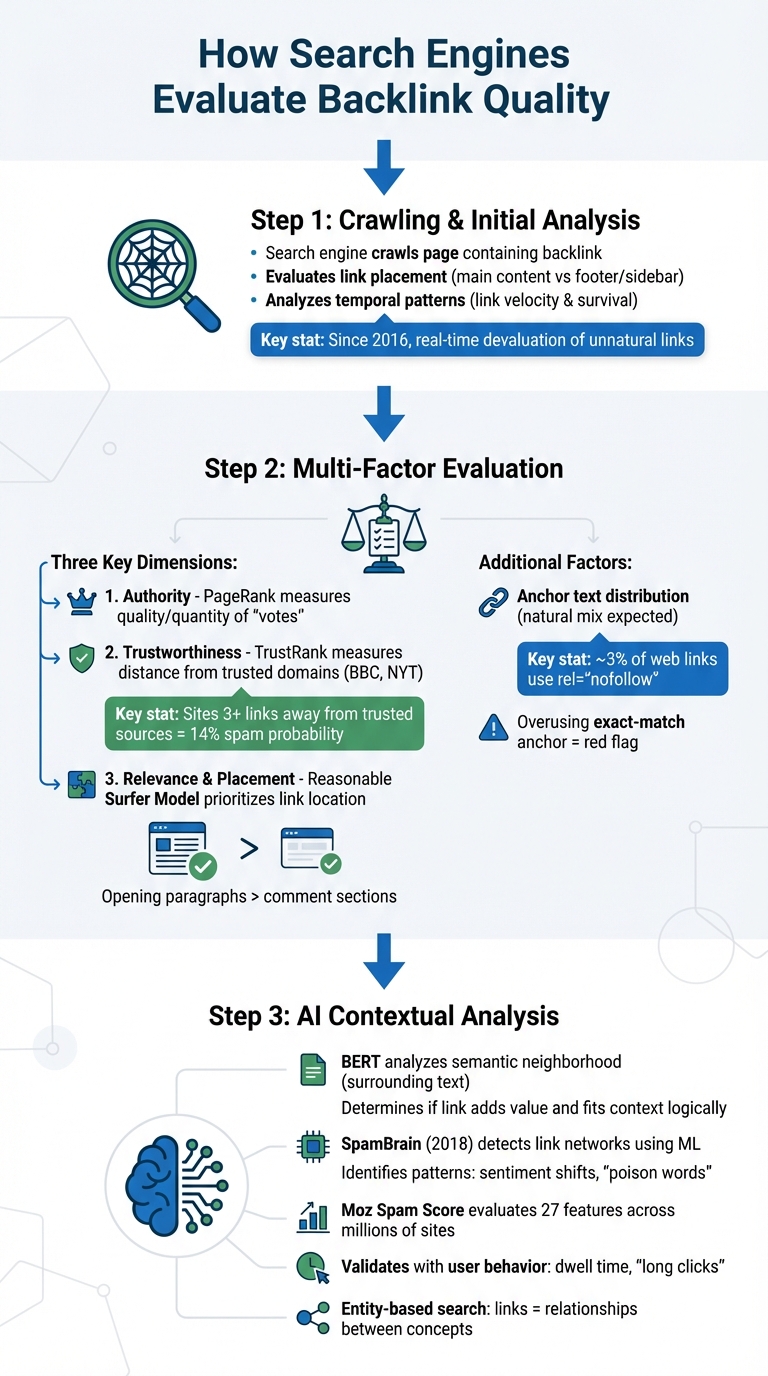
How Search Engines Evaluate Backlink Quality: 3-Step Algorithmic Process
This section dives into the mechanics of how search engines assess the quality of backlinks, building on the earlier overview.
Search engines don’t just tally up backlinks – they scrutinize them. Each link undergoes a detailed analysis that factors in authority, context, placement, and user behavior to assess its quality.
The process begins when the search engine crawls a page containing your backlink. It evaluates key aspects like the link’s placement, the authority of the linking site, and the surrounding content. For example, links embedded in the main body of an article carry more weight compared to those in footers or sidebars, as they are more likely to attract genuine user clicks. Temporal patterns also come into play. Metrics like link velocity (how quickly links are gained) and link survival help distinguish organic growth from manipulative tactics.
Modern algorithms operate in real-time. Since 2016, systems like Penguin have been able to devalue unnatural links as soon as they’re flagged. This means low-quality links can harm rankings almost immediately, while high-quality editorial links can provide a quick boost.
Factors Behind Link Evaluation
The evaluation framework revolves around three key dimensions: authority, relevance, and trustworthiness.
- Authority: Metrics like PageRank measure the quality and quantity of “votes” a page receives. However, authority alone doesn’t guarantee value – a high-authority link from an unrelated niche may offer limited benefits.
- Trustworthiness: TrustRank measures how “close” a site is to trusted domains like the BBC or New York Times. Sites more than three links removed from these trusted sources are significantly more likely to be flagged as spam. Algorithms also account for independence by minimizing influence from sites with overlapping IPs, hosting, or ownership.
- Relevance and Placement: The Reasonable Surfer Model prioritizes links based on location. For instance, links in the opening paragraphs of an article are valued higher than those in comment sections. Factors like font size and visibility also impact how likely a link is to be noticed and clicked.
Anchor text distribution is another critical piece. Search engines expect a natural mix of branded terms, naked URLs, and partial-match keywords. Overusing exact-match anchor text can raise red flags for over-optimization. Additionally, around 3% of web links use the rel="nofollow" attribute, signaling to search engines that these links may be paid or user-generated.
These foundational evaluations pave the way for AI to add deeper contextual analysis.
Role of AI in Link Scoring
While traditional metrics focus on authority and placement, AI brings a new level of sophistication by analyzing the semantic context of links. Systems like BERT evaluate the “semantic neighborhood” – the words and sentences surrounding a link – to determine whether its inclusion is logical and adds value.
“Where early algorithms saw text, BERT understands subtext. It can discern whether a link is placed in a positive or negative review, if it’s cited as a source in an authoritative report, or if it’s merely mentioned in a passing list.”
– Webbb.ai
Google’s SpamBrain, introduced in 2018, uses machine learning to detect link networks before they can influence search rankings. It identifies patterns in language and behavior – such as sudden sentiment shifts or the use of high-risk “poison words” – that might go unnoticed by humans. Similarly, Moz’s Spam Score evaluates 27 features across millions of sites to estimate spam probability, factoring in user behaviors like dwell time and “long clicks” to validate link quality.
The shift toward entity-based search has further transformed link evaluation. Links are no longer just URL connections; they’re viewed as relationships between concepts. This approach allows algorithms to build a Knowledge Graph of topical authority, where the value of a link depends on how well it aligns with the broader entity profiles of both the linking and target sites.
Key Metrics Used in Algorithmic Link Quality Scoring
Understanding backlink quality boils down to specific metrics that measure a link’s influence on a website’s SEO performance. These metrics help quantify how much impact a backlink can have.
Domain Authority and Trust Scores
Metrics like Domain Authority (DA) from Moz and Domain Rating (DR) from Ahrefs estimate a site’s ability to rank based on its backlink profile. These scores range from 0 to 100 on a logarithmic scale, meaning that improving from 80 to 90 is exponentially harder than moving from 10 to 20. For link prospecting, aim for these thresholds: DA/DR of 20+ for entry-level, 40+ for solid quality, and 60+ for premium links.
Trust scores such as TrustRank and Trust Flow (from Majestic) assess how closely a site is linked to verified, high-quality sources like the New York Times or BBC. The farther a site is from these trusted sources in the link graph, the more likely it is to be flagged as spam. For example, sites just three links away from trusted sources can have a 14% spam probability. A balanced Trust Flow to Citation Flow ratio (close to 1.0) suggests that the site’s authority stems from quality links rather than sheer volume.
“The PageRank algorithm does not incorporate any knowledge about the quality of a site… In contrast, our TrustRank is meant to differentiate good and bad sites.” – Stanford/Yahoo Research Paper
Spam scores should remain below 5–10% to avoid penalties. Before acquiring a link, inspect the site’s outbound links. If they point to questionable niches like gambling or unregulated supplements, it’s a red flag. These metrics ensure that you focus on links that genuinely boost your SEO efforts.
Relevance and Niche Alignment
Backlinks from sites within your niche carry far more weight than those from unrelated domains. Search engines analyze semantic proximity, which measures whether the linking site operates in the same field or serves a similar audience. For instance, a plumbing supplier linking to a plumber reinforces topical authority much better than a random blog link, strengthening your relevance signals in the eyes of search engines.
This goes beyond simple keyword matching. Modern algorithms use entity graphs to map relationships between brands, people, and concepts. A backlink now acts as a contextual signal, helping search engines understand how entities are connected. Even for local businesses, geographic relevance matters – a local bakery linking to a local plumber boosts location-based authority, even if the topics don’t overlap. Additionally, diversifying your anchors and sources enhances your backlink profile.
Anchor Text and Link Diversity
A strong backlink profile features a mix of anchor types, including branded terms (like your company name), naked URLs, generic phrases like “click here”, and partial-match keywords. Regularly monitor your anchor text distribution to ensure it looks natural. If exact-match anchors surpass 10% of your total links, it may signal manipulation, requiring adjustment in your strategy.
“Natural anchor text on the web is naturally varied.” – Cyrus Shepard, Founder, Zyppy SEO
Link diversity goes beyond anchor text. The number of unique linking root domains plays a critical role – earning links from various websites is more impactful than getting multiple links from the same source, which leads to diminishing returns. Incorporate a mix of HTML text and image links (with descriptive alt text) while balancing dofollow and nofollow attributes to maintain a well-rounded profile.
Role of Algorithmic Link Scoring in SEO Link Building
Algorithmic link scoring has reshaped how SEO professionals approach backlink acquisition. Instead of chasing sheer numbers, modern strategies focus on meeting quality benchmarks that safeguard against penalties while building lasting authority. This shift is crucial, especially when 52% of digital marketers identify link building as the most challenging aspect of SEO. The reason? Manually evaluating links at scale is nearly impossible.
Prioritizing quality over quantity delivers tangible results. High-quality links from trusted, editorial sites tend to hold their value even through algorithm updates, ensuring consistent rankings rather than fleeting gains. Moreover, websites with strong backlink profiles often see frequent brand mentions in AI-generated content. A great example of this is NAV43’s work in early 2025. They helped a financial services client recover from a Google Penguin penalty by using algorithmic audits to pinpoint and remove 37 toxic links from a private blog network. By replacing these with relevant, authoritative links, the client saw a 67% increase in organic traffic within just 90 days. These methods not only improve backlink strategies but also make decision-making more efficient.
Improving Backlink Profiles with Scoring
Link scoring systems simplify the process of evaluating backlink quality, allowing SEO teams to make quicker, more reliable decisions. By assessing factors like domain authority, organic traffic, and outbound link quality, these tools eliminate much of the guesswork during audits. For example, establishing a baseline quality score – such as 60 out of 100 – for new backlinks ensures that every link strengthens the overall profile, avoiding dilution.
Another key benefit is risk reduction. Scoring systems can identify harmful links, such as those with high Spam Scores or other red flags, helping to protect websites from penalties and future algorithm changes. Moz’s Spam Score is a good example, as it uses machine learning to analyze 27 common traits found in penalized sites. Modern link scoring goes beyond just authority metrics, evaluating factors like spam signals, link power, and organic traffic trends. This ensures that backlinks are not only impactful but also natural-looking. When combined with automation, these scoring techniques elevate the efficiency and precision of link-building efforts.
Automation Tools and Scoring Integration
AI-powered automation has taken link evaluation to the next level, making it scalable and efficient. With the marketing automation industry expected to grow from $6.65 billion in 2024 to $15.58 billion by 2030, automation is becoming indispensable. AI-driven scoring tools can analyze search results and competitor backlinks to predict the suitability of potential links at scale. This allows SEO teams to concentrate on strategy and relationship-building instead of manual link prospecting. Reflecting this trend, 70% of marketing leaders plan to increase automation investments in 2025 to improve scoring efficiency and link-building results.
Platforms like 3Way.Social are revolutionizing ABC link exchanges by integrating algorithmic scoring into their systems. Using AI-powered domain matching, the platform evaluates potential link partners based on quality metrics, ensuring that exchanges provide real value while steering clear of risky practices. By applying strict quality filters and maintaining a secure network of SEO experts, 3Way.Social enables users to build backlink profiles that align with modern algorithmic standards. This approach balances automation’s efficiency with the quality focus that search engines reward, offering a smarter way to manage link-building efforts.
How to Use Algorithmic Scoring to Build Better Backlinks
Algorithmic scoring brings precision to link building by turning it into a data-driven process. By systematically applying quality metrics, you can pinpoint links that strengthen your SEO efforts while steering clear of those that could harm your rankings. The trick lies in setting up a clear workflow that includes auditing, strategic link acquisition, and ongoing monitoring.
Conducting a Backlink Audit
Start your audit by selecting your root domain to capture the broadest range of backlinks, including subdomains and both www and non-www versions. Integrate tools like Google Search Console and Google Analytics with your algorithmic scoring setup to access real-time backlink data. This approach helps you identify links driving traffic while also addressing potential toxicity concerns.
Pay close attention to two key metrics: Authority Score (AS), which rates domain quality on a scale of 0–100, and Toxicity Score (TS), where 0–44 is considered safe, 45–59 requires monitoring, and 60–100 signals immediate action. Tools like Ahrefs, Majestic, and Semrush can help you spot harmful links, such as those from link networks, comment spam, or low-quality sites.
Organize your backlinks into these categories:
- Whitelist: Links that are safe and valuable.
- Remove: Links to request removal from site owners.
- Disavow: Links to report to Google as a last resort.
Google advises disavowing links only when manual penalties or a large volume of harmful links are involved. Before disavowing, try manual removal by contacting site owners. Also, confirm a linking page is indexed by Google using the site:https://example.com/linking-page search operator – unindexed pages offer no SEO value.
Aim for a diverse range of linking domains to boost credibility. Keep an eye on your anchor text distribution, especially for “money” keywords, to avoid over-optimization, which could trigger spam filters.
Once harmful links are dealt with, shift your focus to acquiring high-quality, relevant backlinks.
Building High-Quality Backlinks
The most effective backlinks are editorially placed within the main content, are contextually relevant to your target page, and use natural anchor text that isn’t overloaded with keywords. Search engines prioritize these in-content links over those in footers or sidebars.
Develop a scoring system to evaluate potential links based on factors like:
- Domain Authority (30%)
- URL Rating (20%)
- Link Type (15%)
- Linking Root Domains (15%)
- Link Location (10%)
- Anchor Text (10%).
Don’t dismiss links from sites with lower Authority Scores if they’re highly relevant to your niche – they can still add value. Keep your link growth steady to avoid triggering spam signals. Additionally, maintain a balance between follow and nofollow links; an overly high percentage of dofollow links (above 90%) may raise red flags with search engines.
For a streamlined approach, platforms like 3Way.Social use AI to match domains, apply strict quality filters, and manage vetted link exchanges, ensuring safer and more valuable link-building practices.
Monitoring and Adjusting Strategies
Once your backlink profile is built, regular monitoring ensures long-term quality and flags new risks. Keep track of metrics like Authority Score and Toxicity Score, which some tools update every two weeks to reflect the latest data. Monitor the longevity of your links – stable links indicate trust, while links that disappear frequently may signal manipulation.
Pay attention to your link acquisition curve. A steady upward trend suggests healthy growth, while a declining curve could signal to Google that your content is losing relevance. After major link-building campaigns, expect a temporary dip in rankings before improvements stabilize. This delay, known as Google’s Rank Transition Function (RTF), ensures growth appears organic.
“With link building campaigns, links and the Domain Authority of linking sites are frequently used as KPIs to indicate ‘success,’ but when you look at the value and measurement of a campaign, we can go beyond this too.”
- Aoife O’Connor, Aira
Keep an eye out for “poison words”, high CPC anchor text, and spam-associated domains like .download or .biz. Moz’s Spam Score, which evaluates 27 signals common to penalized sites, can help you identify risky links. Finally, compare your backlink profile to up to five competitors to identify “backlink gaps” – instances where high-authority sites link to them but not to you. This kind of competitive analysis, powered by real-time data, can uncover new opportunities and help you refine your outreach strategy.
Conclusion
Algorithmic link quality scoring has transformed how search engines evaluate backlinks. Gone are the days of simply counting links. Now, advanced AI analyzes the context and intent behind each link, making it harder for manipulative tactics to succeed. This shift emphasizes that link building is no longer about quantity – it’s about securing authentic editorial links from respected sources that fit your niche.
This evolution has reshaped link-building strategies. For instance, 48.6% of SEO professionals now lean toward digital PR as their go-to method for building links, signaling a clear move toward relationship-focused approaches. Links that drive actual user engagement – measured by metrics like dwell time and click-through rates – carry far more weight than links created solely for SEO purposes. As SEO Analyst Dan Akeju explains:
“A page can survive weak links and slow speed if users stay, but a page cannot survive strong links if users consistently leave”.
Building a strong backlink profile takes consistent effort. Google’s Rank Transition Function often causes temporary ranking dips before stabilizing, which highlights the importance of gradual, steady link growth over chasing quick results. Regular audits are also crucial to avoid spam networks and ensure your links remain active – an approach often referred to as “link survival.”
To simplify this process, tools like 3Way.Social use AI to match domains and filter for quality, streamlining curated link exchanges. With features like permanent do-follow links and diversification options, 3Way.Social reduces the manual workload of vetting partners and managing relationships. This aligns perfectly with the modern SEO principles discussed here.
Ultimately, focusing on quality over quantity is the cornerstone of sustainable SEO. Aim to earn links placed within main content, surrounded by relevant context, and capable of driving real referral traffic. This strategy not only meets algorithmic standards but also builds trust and authority for long-term search visibility.
FAQs
How can I tell if a backlink is helping or hurting my rankings?
To figure out whether a backlink is boosting or damaging your rankings, take a close look at its quality. Key factors to examine include how relevant the link is to your content, the authority of the linking site, and its level of trustworthiness. It’s also a smart move to routinely audit your backlink profile. This helps you spot harmful or toxic links that might hurt your SEO efforts or even lead to penalties.
What does “natural” anchor text look like in practice?
Natural anchor text fits smoothly into the flow of the content, using language that feels relevant and natural rather than forcing specific, overly optimized keywords. Instead of relying heavily on exact-match or branded anchors, it incorporates a variety of types – like branded, generic, and contextual phrases. This mix mirrors how links are naturally shared, signaling to search engines that the links are genuine endorsements. As a result, it can positively impact SEO performance.
When should I remove links vs. disavow them?
If you come across links that are harmful, low-quality, or violate Google’s guidelines – such as spammy or unnatural links – it’s important to address them. Start by trying to remove these links, as they can negatively affect your rankings or even lead to penalties. If removal isn’t an option, use Google’s disavow tool to handle toxic backlinks, especially if you’ve received a manual action or are dealing with a large number of spammy links. Always aim to remove links first, but disavow when you have no control over them.