Last Updated on April 7, 2026 by Ian Naylor
Want more backlinks? Here’s the truth: most content fails to earn any. Studies show that 94% of blog posts get zero backlinks, and 96.55% of web pages receive no organic traffic. To succeed, you need linkable content – content that others naturally want to cite and reference.
Here’s how to do it:
- Start with strong research: Use tools like Ahrefs or Semrush to find keywords and understand user intent.
- Choose topics that others will cite: Focus on original research, data studies, or evergreen resources.
- Optimize your content: Write clear titles, use proper headings, and include visuals like charts or infographics.
- Build links strategically: Add internal links, reference trusted sources, and promote your content through guest posts, directories, and social media.
- Track and update: Use tools like Google Analytics to monitor backlinks and traffic, then refresh outdated content regularly.
The key is creating content that fills gaps, offers unique insights, and is easy to reference. A single standout piece can attract dozens of backlinks and boost your search rankings.
Want to learn the full process? Keep reading for a step-by-step guide.
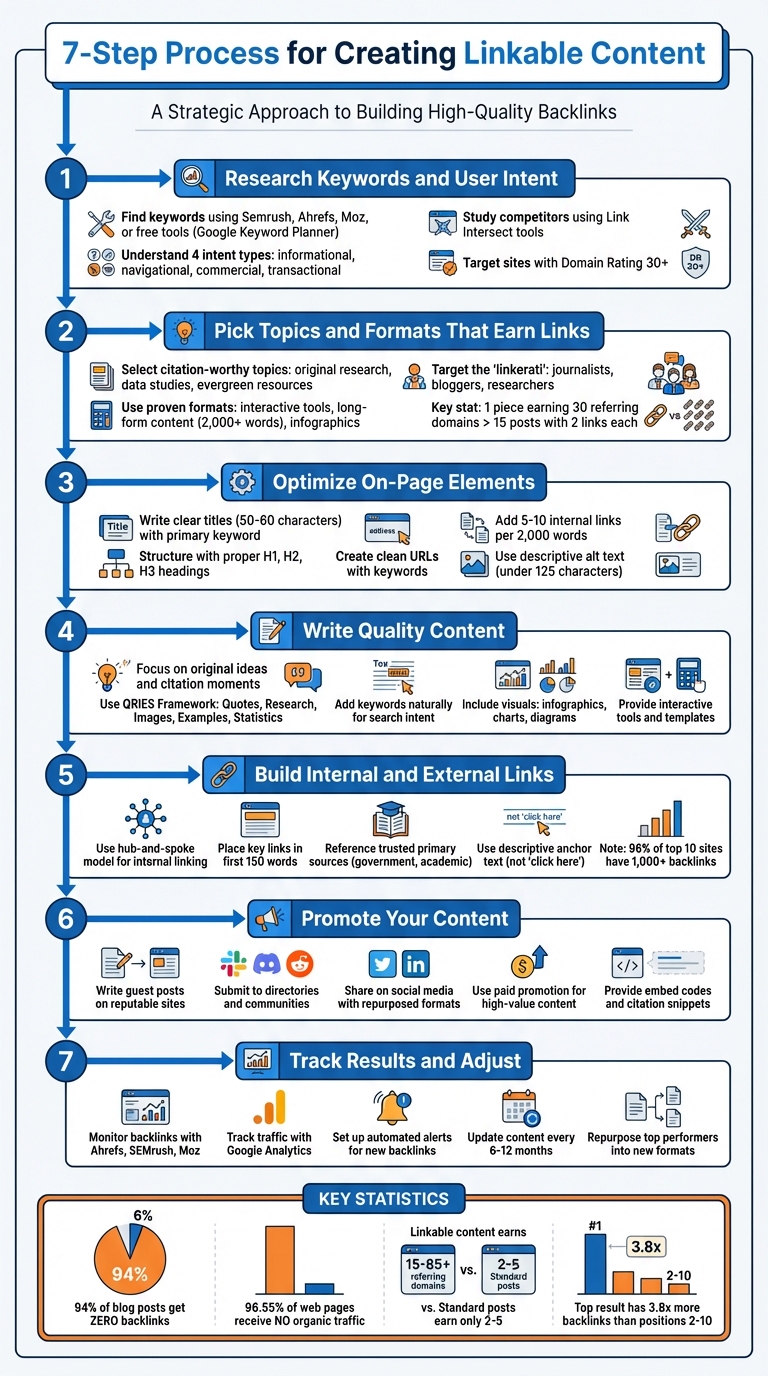
7-Step Process for Creating Linkable Content That Earns Backlinks
How To Create Linkable Assets In 6 Easy Steps 🧲
sbb-itb-88880ed
Step 1: Research Keywords and User Intent
Creating linkable content starts with thorough keyword research and understanding user intent.
Find the Right Keywords
SEO tools like Semrush, Ahrefs, and Moz are great for evaluating search volume, keyword difficulty, and identifying gaps in your competitor’s strategy. If you’re working with limited resources, free options like Google Keyword Planner and Google Search Console provide direct insights from search engine data.
When choosing keywords, focus on primary terms, secondary phrases, and long-tail keywords. While long-tail keywords often have lower search volumes, they tend to be less competitive and align with specific user queries. Tools like Answer The Public can help uncover the exact questions people are searching for.
Once you’ve identified the right keywords, the next step is to figure out the intent behind them.
Understand What Users Want
Search intent typically falls into four categories: informational, navigational, commercial, and transactional. Knowing the intent behind your keywords helps you decide what type of content to produce. For example, a query like "how to start a blog" reflects informational intent, while "buy Semrush subscription" clearly indicates transactional intent.
"Google’s goal is to provide relevant results for users. So, understanding intent can help you create content that’s more likely to rank." – Carlos Silva, Content Marketer, Semrush
Tools like Semrush’s "Intent" filter can quickly classify keywords by intent. You can also manually analyze the search engine results page (SERP) for clues. For instance, featured snippets or "People also ask" boxes usually signal informational intent, while high CPC (Cost Per Click) bids often indicate commercial or transactional intent. For example, the CPC for "WordPress hosting" can reach $37.41, compared to just $2 for more informational terms like "writing tips".
Once you’ve nailed down keywords and intent, it’s time to dive into competitor analysis to uncover content gaps and backlink opportunities.
Study Your Competitors
Competitor research is essential for spotting backlink opportunities and high-performing content. Focus on three types of competitors: direct competitors, organic competitors (ranking for your target keywords), and aspirational competitors (larger sites with strong backlink profiles).
SEO tools like Ahrefs and Semrush offer features like the "Link Intersect" tool, which helps identify websites linking to multiple competitors but not your site. These domains are likely to be interested in your niche and make great outreach prospects.
Review the top 20–50 competitor pages with the most backlinks to understand what formats are driving results. Whether it’s original research, interactive tools, or detailed guides, look for areas where competitor content is outdated or lacks depth. Prioritize opportunities with sites that have a Domain Rating of 30 or higher and link to at least two of your competitors.
To stay ahead, set alerts to track when competitors gain new high-authority backlinks (Domain Rating 50+). This allows you to identify emerging trends and adapt your strategy in real time. Competitor analysis not only highlights content gaps but also pinpoints opportunities to secure quality backlinks for your site.
Step 2: Pick Topics and Formats That Earn Links
Once you’ve nailed down your keywords and used a link building planner to study your competitors, it’s time to focus on topics and formats that naturally pull in backlinks. Not all content is created equal – some ideas and approaches consistently outperform others when it comes to earning links.
Select Topics Worth Citing
The best topics for backlinks are those that others want to cite. Think about content that provides real value – research, data, or insights that people need to back up their own arguments. For example, original research or data studies often attract a large number of high-quality backlinks.
Start by identifying gaps in your industry. Are there claims floating around that lack a solid source? Or maybe the existing data is outdated? Create content that fills these gaps. Whether it’s offering specific statistics, defining technical terms, or showcasing proprietary methods, your goal is to make your content indispensable. Go deeper than others, offer unique data, or bring a fresh take to familiar topics. And focus on evergreen ideas – content that remains relevant over time.
"A single piece of content earning 30 referring domains delivers more ranking power than 15 standard posts with two links each – and concentrates that authority on one URL instead of diluting it across fifteen." – THE SEO ENGINE Editorial Team
Once you’ve chosen the right topics, the next step is to think about how to present them in a way that naturally encourages sharing.
Use Formats People Share
Some formats are just better at earning backlinks. Interactive tools, like calculators or comprehensive guides, are a great example – they’re not only helpful but also highly shareable. Long-form content, especially articles over 2,000 words, tends to attract more backlinks than shorter pieces.
Visual content is another winner. Infographics and custom charts can simplify complex ideas, making them easier to understand and more appealing to link to. For instance, a well-designed chart can earn far more links than the same data presented as plain text.
"HubSpot’s inbound marketing ‘flywheel’ visual has earned over 34,000 backlinks by offering an embeddable graphic that explains a complex business process."
Other formats that perform well include glossaries for industry-specific terms and data-driven benchmarks. These kinds of resources are often cited by professionals looking for reliable references.
Match Topics to Your Knowledge
While proven formats are essential, it’s equally important to align your topics with your expertise. Focus on areas where you can bring something unique to the table. Target the "linkerati" – journalists, bloggers, and researchers who are likely to link to your content – rather than just general readers.
To do this effectively, differentiate between content designed to answer user questions and content aimed at being cited by industry professionals. For instance, a highly detailed technical guide will likely attract more backlinks from experts than a basic how-to article. Before investing time and resources, check if the top-ranking pages for your chosen topic are being cited by others.
You can also use social listening tools on platforms like Reddit, X, and LinkedIn to spot trending questions or topics that lack definitive answers. By focusing on topics that showcase your expertise and fill gaps in your industry, you’ll position your content as a go-to resource for backlinks.
Step 3: Optimize On-Page Elements
Once you’ve nailed down the right topics and formats, it’s time to fine-tune your page’s structure. Why? Because even the best content can fall flat without a polished presentation. Well-optimized on-page elements make your content easier to share, reference, and rank.
Write Clear Titles and Meta Descriptions
Your title tags should grab attention and improve visibility. Keep them concise – ideally between 50–60 characters – and start with your primary keyword. This simple tweak can make a big difference. For example, Brian Dean’s 2025 title update propelled a blog post from the 4th spot to 1st place, even snagging a featured snippet. Including power words like "Data", "Study", or "Blueprint", or even adding the current year (e.g., "2026"), can help your content stand out in a crowded field.
Meta descriptions, while not a direct ranking factor, are crucial for driving clicks. Think of them as your content’s sales pitch. Keep them between 120 and 155 characters, and focus on what benefit or outcome readers can expect.
"It’s often the primary piece of information people use to decide which result to click, so it’s important to use high-quality title text on your web pages." – Google Search Central
Structure Content with Proper Headings
Headings do more than just break up text – they guide readers and search engines alike. Use a single H1 that includes your main keyword, then organize your content with logical H2 and H3 headings. This approach makes your content easier to scan, especially on mobile devices. Plus, structuring headings as questions or direct answers increases your chances of landing in "People Also Ask" boxes.
Create Clean URLs and Image Text
Short, descriptive URLs are a must. Include your primary keyword and separate words with hyphens for clarity. For images, filenames and alt text matter. Use descriptive, keyword-rich filenames and keep alt text under 125 characters to improve accessibility and SEO.
Don’t forget internal links. Aim for 5–10 internal links per 2,000 words, using descriptive anchor text. This not only helps distribute authority across your site but also makes it easier for readers to discover related content worth exploring.
Step 4: Write Quality Content
Once your pages are optimized, the next step is crafting content that naturally attracts backlinks. Quality content is the backbone of any successful link-building strategy. For your site to earn high-quality links, your content needs to stand out – being original, useful, and something others want to reference. Most blog posts don’t achieve this. The difference lies in creating content that genuinely adds value and sparks interest.
Focus on Original Ideas
The internet is overflowing with repetitive advice, so to grab attention, your content must offer fresh perspectives. Whether it’s introducing new data, creating unique frameworks, or sharing insights that aren’t already saturating search results, originality is key. For example, Brian Dean’s article on the "Skyscraper Technique" coined a new industry term and garnered 7,700 backlinks from 2,100 domains. That’s the kind of impact originality can have.
To make your content citation-worthy, focus on citation moments – those specific elements others want to reference. This could be a unique chart, an insightful definition, or a compelling data point. Use the QRIES Framework to guide your content creation:
- Quotes from experts
- Research with detailed data
- Images to enhance understanding
- Examples from practical applications
- Statistics backed by verifiable sources
In an age of AI-generated content, human-driven insights and relatable examples help your work stand out.
"The best way to earn links without chasing them is to stop writing ‘another blog post’ and start publishing what people actually cite." – Peyman Khosravani, Industry Expert
Once your unique ideas are in place, weave in keywords naturally to enhance your content’s authority without compromising its flow.
Add Keywords Naturally
When writing, always prioritize your audience over algorithms. Google’s 2024 core updates have significantly rewarded content that prioritizes user needs, reducing the visibility of low-quality, unoriginal content by 45%. The focus now is on addressing search intent – whether users are looking for information, navigation, products, or transactions – rather than just stuffing keywords into your text.
Integrate keywords naturally into your content by using clear, descriptive headings that address user questions. Build topical authority by covering related subtopics uncovered during your research. The goal is to make keywords a seamless part of the narrative, ensuring they don’t disrupt readability or feel forced.
"Instead of just targeting keywords, create content that addresses the underlying needs and questions of your target audience." – Julia McCoy, Founder, FirstMovers.ai
To further enrich your keyword-driven content, pair it with visuals and real-world examples that make your points more engaging and credible.
Add Visuals and Real Examples
Visuals like infographics, charts, and diagrams are powerful tools for simplifying complex ideas and making them more digestible. High-quality visuals not only help your audience understand the content better but also encourage others to embed or link back to your assets as references.
Including original data, benchmarks, and practical examples adds credibility. These elements provide the "proof" other writers need when supporting their own arguments. Interactive tools – like ROI calculators, templates, or free resources – are especially effective at earning backlinks because they solve specific problems and are highly shareable.
Make it simple for others to cite your visuals by providing embed codes and clear attribution guidelines. When you combine visually appealing elements with actionable, measurable examples, your content becomes more shareable and linkable, helping you achieve your goal of earning citations.
Step 5: Build Internal and External Links
Linking – both within your site and to external sources – plays a critical role in improving SEO and enhancing user experience. Internal links connect your pages, making navigation easier and distributing SEO value across your site. External links, on the other hand, establish credibility by showing your content is backed by solid research. Together, they signal to search engines that your content is well-informed and part of a larger, relevant conversation.
Link to Related Pages on Your Site
Internal linking is one of the easiest ways to boost SEO without relying on external tools or outreach. A hub-and-spoke model works well here: a central "pillar" page links to related, detailed articles, and those articles link back to the hub. This strategy not only organizes your content into clear topics but also establishes your site’s authority on those subjects.
When adding internal links, focus on placing key links in the first 150 words of your content. This helps search engine crawlers prioritize those connections. For a standard blog post, aim for 5–10 internal links. For more comprehensive pillar pages, you can include 15–20 links.
Another crucial step is addressing orphan pages – those that have no internal links pointing to them. Research shows that 94% of blog posts have no backlinks at all, making internal links essential for spreading authority throughout your site. To find pages you can link to, use the search operator site:yourdomain.com "topic keyword".
"Internal links are one of the simplest SEO levers you can control – no outreach, no tools required, no dependencies." – Niyati Mahale, Content Writer, Writesonic
While internal linking strengthens your site’s structure, external links help validate your content.
Reference Trusted External Sources
Linking to authoritative external sources adds credibility to your content. Always prioritize primary sources – the original creators of data or research – over secondary summaries. Government websites, academic institutions, and well-respected industry leaders are great places to find trustworthy information that aligns with E-E-A-T principles (Experience, Expertise, Authoritativeness, and Trustworthiness).
For example, if you’re citing a statistic from a roundup post, track down the original study to ensure your reference is as accurate and credible as possible. When explaining complex industry terms, link to reliable glossaries or in-depth guides to help your audience better understand the topic. It’s worth noting that over 96% of websites ranking in the top 10 search results have more than 1,000 backlinks from unique domains, underscoring the importance of external validation.
"The best link building strategy is creating content so valuable that people link to it because they want to, not because you asked." – SEO Backlinks Team, SEO Backlinks Grid
With both internal and external links in place, the next step is to ensure your anchor text is clear and descriptive.
Use Descriptive Link Text
Generic phrases like "click here" or "read more" don’t provide any context for users or search engines. Instead, use anchor text that clearly describes the content of the linked page. For example, instead of writing "click here", use something like "see our step-by-step SEO guide".
For internal links, ensure the anchor text reflects the primary keyword of the target page. When linking externally, descriptive phrases help readers understand what they’ll find before clicking. If you’re creating linkable assets, consider including a "How to cite this" section with pre-written snippets that suggest specific anchor text.
Finally, audit your site for vague or unclear anchors and replace them with text that naturally describes the destination page. This not only helps readers navigate with confidence but also improves how search engines interpret the relationships between your pages.
Step 6: Promote Your Content
After refining your content with optimization and link-building strategies, the next step is to ensure it gets noticed. Even the most well-crafted resource won’t attract backlinks if it stays under the radar. Promotion is all about putting your content in front of the right people – journalists, bloggers, and industry leaders – who are more likely to reference and link to it. Now that your content foundation is solid, it’s time to focus on amplifying its visibility.
Write Guest Posts
Guest posting remains a powerful way to build credibility and earn backlinks. The key is targeting reputable websites in your niche where your expertise can genuinely contribute. Start by using tools like Ahrefs or SEMrush to analyze competitor backlinks, and search for opportunities with Google operators like "your keyword" + "write for us" or "your keyword" + "resource page".
When reaching out, personalize your pitch. Reference a recent article from the website and explain how your content fills a specific gap. As Andrew Morton, Outreach and Content Team Leader at Equator, advises:
"If you can research your target person and reach out via a personalised message on LinkedIn, you are more likely to get a response".
LinkedIn often proves more effective than cold emails for outreach. Remember to follow up – most responses come after a second or even third attempt. A good timeline is to follow up 5–7 days after your first message and again 7–10 days later if needed.
Submit to Directories and Communities
Guest posts aren’t the only way to promote your content. Industry-specific directories and communities can also boost visibility. Join relevant Slack channels, Discord servers, and subreddits where professionals in your field gather. By contributing meaningful answers and sharing your content as a helpful resource, you can naturally attract links.
Reaching out to resource pages is another effective tactic. Use search terms like "your keyword" + "resource page" to find sites that curate content for educational or industry purposes. Additionally, pitch your work to newsletter curators in your niche – they’re often looking for fresh resources to share with their audience. If you’ve created original research or data studies, offering early access to influencers in your industry can generate initial buzz and citations.
Share on Social Media
Social media is another essential tool for extending your content’s reach. Repurpose your long-form content into engaging formats like infographics, videos, or carousel posts to appeal to different audiences. This approach not only increases visibility but also creates more opportunities for backlinks. Interestingly, pages with six or more images are shown to attract up to 5.5 times more backlinks.
Consider using platforms like SlideShare for slide decks or Pinterest for visual content like charts and infographics. When syndicating your content on platforms such as Medium, LinkedIn Articles, or Dev.to, always include canonical tags to point back to your original source. This avoids duplicate content issues. Also, wait until your content is indexed by search engines before syndicating to ensure the original version gets SEO priority.
For particularly high-value content, paid promotion can be a game-changer. Social media ads or sponsored newsletter placements can target specific audiences effectively. If your content includes original research or data, create press-friendly kits with key statistics, charts, and headlines to make it easier for journalists to cite. Providing embed codes for visuals or pre-written citation snippets can further simplify the linking process.
| Promotion Method | Target Audience | Primary Benefit |
|---|---|---|
| Guest Posting | Niche-relevant blogs | Builds backlinks and authority |
| Digital PR | Journalists & news sites | Earns high-authority editorial links |
| Resource Page Outreach | Educational/industry sites | Stable, long-term backlinks |
| Community Sharing | Practitioners & peers | Drives referral traffic and citations |
| Social Media Ads | Content consumers | Expands reach through targeted ads |
Step 7: Track Results and Adjust
Once your content is out in the world, it’s time to figure out how it’s performing. Without tracking, you’re left guessing which strategies are working and which ones aren’t. Tools like Ahrefs, SEMrush, and Moz can help you monitor your backlink profile, track referring domains, and evaluate link quality. For traffic insights, Google Analytics shows referral and organic trends, while Google Search Console highlights search performance and sites linking to your content.
Monitor Backlinks and Traffic
Set up automated alerts with tools like Ahrefs or SEMrush to get real-time updates on new backlinks. This lets you quickly identify which campaigns or pieces of content are gaining traction. Pay attention to link velocity to monitor steady growth. Additionally, check the domain authority of linking sites to assess the quality of your backlinks. Don’t forget to look for toxic or spammy links and use the Google Disavow Tool to maintain your SEO health.
It’s not just about backlinks, though. Keep an eye on referral traffic from specific links and engagement metrics like time spent on the page. For example, if a piece of content earns a lot of links but doesn’t drive traffic, your keyword strategy might need tweaking. On the other hand, if it generates traffic but no links, you may need to rethink the format or presentation. These insights help you refine your approach for better results.
"A well-structured approach is the cornerstone of successful SEO".
Find What Works Best
Use the data you’ve gathered to pinpoint the content types and formats that deliver the strongest results. For instance, original research and surveys can attract 40–85 referring domains within the first year, while tools and calculators often bring in 30–100+ referring domains. To measure efficiency, calculate your cost per link by dividing total production and outreach costs by the number of referring domains.
Dive into your analytics to see which blog posts attracted the most backlinks and identify the top-performing formats, whether they’re guides, tools, or infographics. Competitor analysis using tools like Ahrefs Content Explorer can also offer insights into what’s working well in your niche. Keep in mind that some content takes 3–6 months to build significant backlink traction, so patience is key.
Update and Reuse Content
Perform regular audits of your high-performing content every 6–12 months. Look for pieces with declining traffic or those ranking between positions 11–30 for your target keywords. Update outdated information, add fresh case studies, or expand sections to address new trends and questions. This kind of optimization ensures your content remains relevant and continues to attract backlinks.
"Content refresh involves strategically updating and optimizing your work to meet current search intent, incorporate new information, and align with evolving SEO best practices."
Repurposing content is another smart move. For example, turn a research report into an infographic, break a long-form guide into a video series, or create social media graphics from data studies. When you update content, provide new embed codes and citation snippets to make it easier for others to link back. This keeps your content appealing and ensures it continues to earn backlinks long after its initial release.
Conclusion
Creating content that attracts backlinks requires a clear process and consistent effort. This guide outlines every step – from researching keywords and understanding user intent to tracking results and updating your work. The difference between content that earns backlinks and content that gets overlooked lies in its real, citable value. Most blog posts, unfortunately, generate little to no backlinks. That’s why it’s essential to deliberately craft assets that people want to reference.
The numbers speak for themselves. Content designed for link building typically earns between 15 and 85+ referring domains within 12 months, compared to just 2 to 5 for standard SEO-focused posts. Not only that, but the top-ranking result in Google tends to have an average of 3.8 times more backlinks than the pages ranked two through ten. A single well-executed, standout piece each quarter can often bring more authority than publishing a dozen average posts.
"The best link building strategy is creating content people actually want to link to." – SEO Backlinks Grid
To recap the key strategies: prioritize creating linkable assets such as original research, interactive tools, or in-depth guides that offer genuine citation value. Make your content easy to cite by including features like embed codes, clear attribution instructions, and anchor links. Regularly refreshing data and examples every 6–12 months keeps your work relevant and prevents link decay.
For a more efficient approach, platforms like 3Way.Social can simplify the process. Their AI-powered domain matching and vetted network help you secure quality do-follow links and guest posting opportunities without the hassle of manual outreach. This way, you can focus on producing exceptional content while minimizing time spent chasing links.
FAQs
What makes content “linkable”?
Content becomes "linkable" when it offers real value – whether that’s through reliable information, practical utility, fresh perspectives, trustworthiness, entertainment, or educational insights. These elements make it naturally attractive for others to reference or share.
Which content formats earn the most backlinks?
Content that attracts the highest number of backlinks often includes original research, data-driven studies, and practical tools such as calculators. Additionally, in-depth and authoritative resources that offer unique insights and long-lasting relevance tend to perform exceptionally well. The key is to craft high-quality, shareable material that delivers real value and grabs your audience’s attention.
How long does it take to start getting backlinks?
The timeline for receiving backlinks depends on a few key factors, like the quality and relevance of your content. If your content is well-crafted, stands out, and targets the right audience, you could start seeing backlinks within a few weeks – especially if you’re actively promoting it.
However, other elements, such as how competitive your niche is and the strength of your outreach strategy, can influence how quickly links come in. While some backlinks might show up relatively fast, building a solid, long-term backlink profile typically requires steady effort over several months. Consistency is key.