Last Updated on April 9, 2026 by Ian Naylor
Guest posts and on-page SEO are two sides of the same coin when it comes to improving search rankings. Here’s the bottom line:
- Guest Posts: They build authority by earning backlinks from relevant, high-quality domains. These links help boost your site’s credibility and visibility.
- On-Page SEO: Ensures your website is optimized for keywords, user experience, and search engine algorithms. Without this, backlinks won’t deliver their full potential.
Key insights:
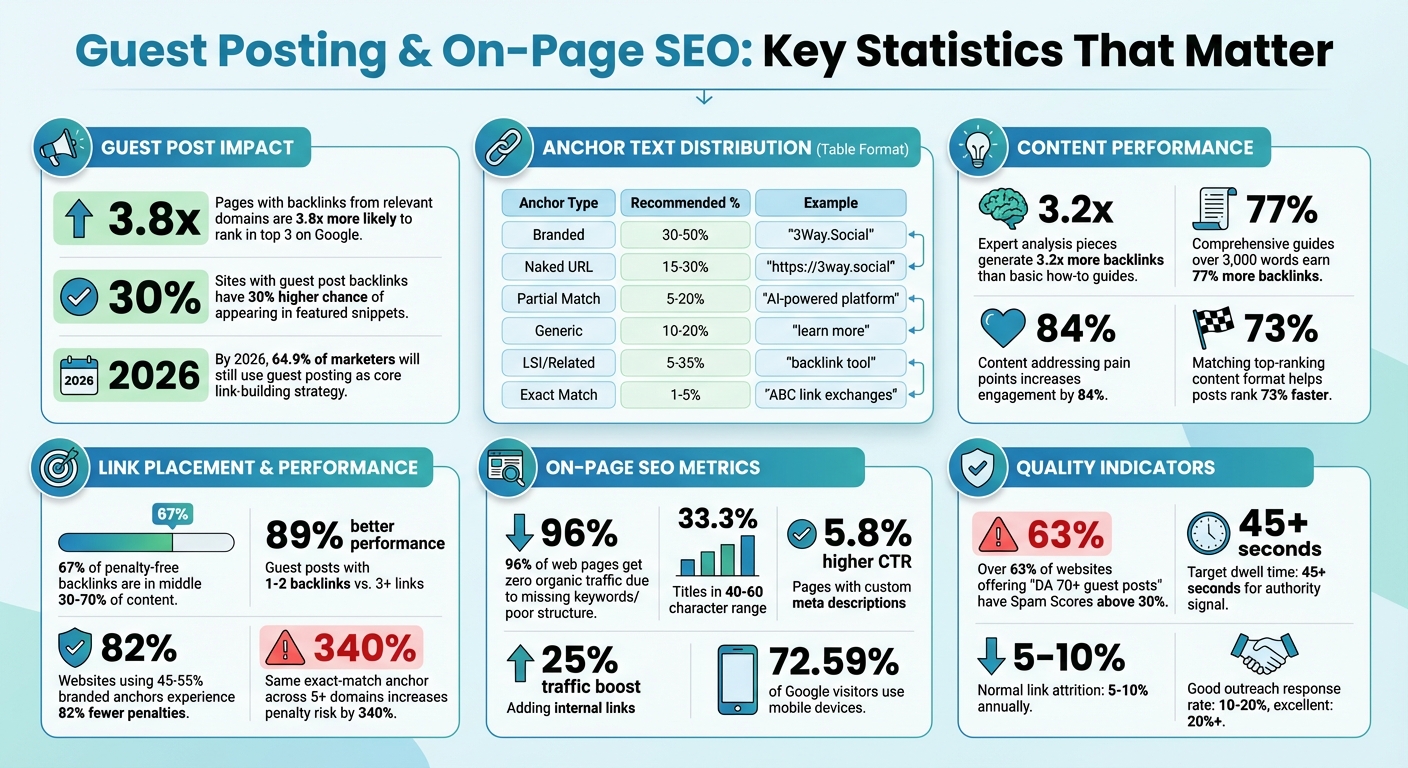
- Pages with backlinks from relevant domains are 3.8x more likely to rank in the top 3 on Google.
- By 2026, 64.9% of marketers will still use guest posting as a core link-building strategy.
- Sites with guest post backlinks have a 30% higher chance of appearing in featured snippets.
How to Succeed:
- Choose the Right Sites: Focus on relevance over metrics like DA. Links from niche-relevant sites often outperform links from high-DA, irrelevant domains.
- Write for Engagement: Craft guest posts that match the host site’s audience and SEO goals. Use natural anchor text and avoid over-optimized keywords.
- Optimize Landing Pages: Ensure the pages receiving backlinks are well-optimized with proper title tags, meta descriptions, internal links, and quality content.
Pro Tip: Tools like 3Way.Social can streamline guest posting by finding high-quality opportunities and monitoring backlinks.
When guest posts and on-page SEO align, they create a powerful synergy that drives rankings, traffic, and authority.
Guest Posting and On-Page SEO Statistics: Key Performance Metrics
My Guest Posting Strategy – Get More Out Of Your Guest Posts
sbb-itb-88880ed
How to Choose Guest Post Opportunities That Match Your SEO Goals
Selecting the right guest post opportunities is just as important as optimizing your own website for SEO. In today’s SEO world, search engines emphasize topical authority over sheer link quantity. This means it’s not just about how many backlinks you have, but where they come from and how relevant they are to your niche and expertise.
Prioritize Relevance Over Metrics
A link from a site with a lower Domain Authority (DA) but strong niche relevance can be far more impactful than one from a high-DA site that’s unrelated to your industry. As Search Engine Journal puts it:
"Relevance > DA. A contextual link from a DA 40 niche site is infinitely more valuable than a link from a DA 80 site about casino gambling."
The numbers back this up: over 63% of websites offering "DA 70+ guest posts" have Spam Scores above 30%, which puts them at risk for Google penalties. So, it’s worth digging deeper than just surface-level metrics to ensure your backlinks come from legitimate, trustworthy sources.
Check Website Relevance and Authority
Start by verifying that the host site publishes content related to your business. Skim through 5–10 recent posts to confirm they’re high-quality and relevant. Ideally, target posts in the 2,000–3,000 word range, as these tend to perform well in search rankings.
Make sure the site’s audience aligns with your ideal customer profile. The content should address similar questions and topics as your own site. Aim for websites that cater specifically to your niche.
When assessing authority, check that Moz’s Domain Authority and Ahrefs’ Domain Rating are within 10 points of each other. This helps weed out low-quality or manipulated sites. For most niches, look for a DA of 30 or higher. In competitive industries like finance or SaaS, a DA of 50 or more is often necessary.
Avoid sites that are less than a year old – they haven’t had enough time to build trust with search engines. Sites with at least three years of history typically have more credibility and a clean track record.
Lastly, keep an eye on the Moz Spam Score. Stick with sites in the "Green Zone" (1%–5%) and steer clear of anything above 31%. Tools like MozBar, Ahrefs, and SEMrush can give you a well-rounded view of a site’s quality.
Evaluate On-Page SEO of Target Sites
Once you’ve confirmed a site’s relevance and authority, take a closer look at its on-page SEO. This helps you identify genuine publishers versus link farms.
Look for basic SEO elements like meta descriptions, image alt text, and well-structured headlines with clear H2 and H3 tags. Avoid sites that publish "thin" content – posts under 500 words that lack depth or value.
Check the site’s outbound links. Quality sites link to authoritative sources to support their content. Be cautious of sites with irrelevant topics or excessive outbound links, as these could indicate a link farm.
Engagement is another key factor. Look for active comments, social shares, and discussions on recent posts. Sites with no engagement may exist solely to sell backlinks rather than to serve an audience.
You should also check how quickly Google indexes new content on the site – ideally within 3–10 days. This shows that search engines actively crawl the site, which is critical for your guest post to be discovered.
Finally, examine the diversity of the site’s anchor texts. A natural backlink profile includes a mix of branded, generic, and keyword-rich anchors. If more than 80% of the anchors are exact-match keywords, it’s a red flag for manipulation.
Avoid sites that charge for guest posts. These "pay-to-play" setups often violate Google’s guidelines and could harm your own site’s rankings.
Writing Guest Post Content That Strengthens On-Page SEO
Once you’ve secured the perfect guest posting opportunity, the next step is crafting content that benefits both the host site’s audience and your SEO strategy. Striking a balance is key – your links should feel like an organic part of the article, not like a promotional insert. This approach not only builds quality backlinks but also reinforces your site’s SEO.
Modern search engines, like Google, don’t just focus on anchor text alone. They evaluate the entire "context stack", which includes the anchor text, the sentences around it, and the overall theme of the page. This means your backlinks should seamlessly fit into the article’s flow, avoiding any hint of being overly promotional.
Use Natural Anchor Text and Keywords
Your anchor text should feel like it belongs in the article, serving the reader rather than trying to manipulate search algorithms. Bradley Bernake from OutreachFrog explains it well:
"The safest anchors aren’t engineered for algorithms – they’re written for readers."
Diversify your anchor text. A strong backlink profile includes a mix of branded terms, naked URLs, partial-match keywords, and related phrases. According to research, websites that use 45–55% branded anchors in their profile experience 82% fewer penalties. On the other hand, using the same exact-match anchor across five or more domains increases penalty risk by 340%.
Here’s a recommended breakdown for anchor text distribution:
| Anchor Type | Recommended % | Example |
|---|---|---|
| Branded | 30–50% | "3Way.Social" |
| Naked URL | 15–30% | "https://3way.social" |
| Partial Match | 5–20% | "AI-powered link exchange platform" |
| Generic | 10–20% | "this article" or "learn more" |
| LSI/Related | 5–35% | "backlink diversification tool" |
| Exact Match | 1–5% | "ABC link exchanges" |
Keep exact-match anchors below 5% of your total profile. Instead of repeating the same keyword, use variations based on LSI (Latent Semantic Indexing). For instance, instead of always using "SEO tools", you could alternate with phrases like "search optimization software" or "ranking improvement platforms".
Where you place your links is just as important as the words you use. The sweet spot for embedding links is within the middle 30–70% of your content, where 67% of penalty-free backlinks are typically found. Aim to include one contextual link for every 800–1,500 words, supported by 2–3 explanatory sentences. Research shows that guest posts with only 1–2 backlinks perform 89% better in rankings than those with three or more.
Avoid generic phrases like "click here" or "visit this site", which can come across as overly promotional. Instead, opt for descriptive, intent-driven phrases that clearly explain what readers will find when they click.
Match Content to the Host Site’s Audience and SEO Goals
Once your anchor text strategy is in place, focus on aligning your content with the host site’s audience and SEO objectives. The priority should always be creating value for their readers. If your content doesn’t meet their expectations or editorial guidelines, it’s unlikely to be published – or perform well if it is.
Start by analyzing the top 10 search results for your target keyword. If listicles dominate the results, create a listicle. If detailed guides are more common, go for a comprehensive approach. Matching the format of the top-ranking content can help your post rank 73% faster.
Content length and depth should also align with the industry you’re targeting. For example:
- B2B SaaS: 2,000+ words with data-backed insights
- E-commerce: 1,200–1,800 words with actionable tips
- Finance or Legal: 2,500+ words with extensive citations
Expert analysis pieces are particularly effective, generating 3.2x more backlinks than basic how-to guides. Similarly, comprehensive guides over 3,000 words tend to earn 77% more backlinks than shorter articles.
To tailor your content to the host site’s audience, use tools like Reddit, Quora, and Google’s "People Also Ask" section. These platforms can help you identify the specific questions and challenges their readers face. Structuring your content to address these pain points can increase reader engagement by 84%.
Lastly, avoid creating patterns across your guest posts. Vary your writing style, author bios, and keyword targets to keep your content unique. Search engines actively look for signs of manipulative link-building, so the more natural and diverse your posts appear, the better.
Optimizing Your Landing Pages That Receive Guest Post Links
High-quality guest post backlinks can lose their impact if they lead users to poorly optimized landing pages. While guest posts enhance your site’s authority, their full potential is realized only when the landing pages receiving those links are polished and ready to perform.
Here’s a staggering fact: 96% of web pages get zero organic Google traffic due to missing keywords or poor structure. If you’re putting effort into guest posting, you can’t afford to let your landing pages fall into this category. On-page optimization is one of the easiest and most effective ways to amplify the value of your backlinks.
Add Proper Title Tags and Meta Descriptions
Your title tag is the first thing users notice in search results, making it a key factor in both rankings and click-through rates. To make it work harder for you, place your primary keyword at the beginning of the title. This signals relevance to search engines and catches the eye of potential visitors. Keep the title between 35–60 characters – titles in the 40–60 character range see a 33.3% higher click-through rate (CTR) compared to those that are too short or too long.
Every landing page should have a unique title tag that sets it apart. For instance, if your page focuses on "AI-powered link building", a good title might be "AI-Powered Link Building: Automate Your SEO Strategy" instead of something generic like "Link Building Tips."
While meta descriptions don’t directly influence rankings, they play a huge role in enticing users to click. Interestingly, Google rewrites about 63% of meta descriptions to better match search queries. However, pages with custom meta descriptions still see a 5.8% higher CTR than those without. Aim for descriptions between 105–155 characters, include your target keyword (Google often bolds it in results), and add a clear call-to-action.
| Element | Best Practice | Target Metric |
|---|---|---|
| Title Tag | Front-load keyword | 35–60 characters |
| Meta Description | Include CTA | 105–155 characters |
| H1 Tag | One per page | Matches/expands on Title |
| URL Slug | Use hyphens | Short & keyword-focused |
In addition to titles and descriptions, use header tags (H1–H6) to structure your content logically. A single H1 tag should reflect or expand on your title tag, while H2 and H3 tags can organize supporting content. This makes it easier for search engines to understand your page’s layout.
Improve Content Quality and Internal Links
Once your meta elements are in place, focus on creating content that aligns with user intent and supports internal linking.
Your landing page content should match what users are looking for – whether it’s informational, navigational, commercial, or transactional. To show relevance quickly, include your primary keyword within the first 100 words. Regular updates are also important; refreshing your content every six months helps maintain its relevance.
Internal linking is another powerful tool. It spreads PageRank, improves crawlability, and guides users to other key pages on your site. When a landing page gains a guest post backlink, use internal links to pass some of that authority to other important pages. In A/B testing, adding internal links led to a 25% traffic boost, and underlinked posts saw an 18% traffic increase within 30 days after adding links.
For internal links, use descriptive, keyword-rich anchor text instead of vague phrases like "click here." Place these links within the main body of your content, as contextual links carry more weight.
Adrian Dąbrowiecki, SEO Growth Leader, advises:
"Link your highest-quality pages to the homepage. This is where PageRank is strongest, where crawlers visit most frequently, and where you can positively influence how search engines perceive your entire website."
Don’t overlook image optimization. Use descriptive file names and alt text (under 125 characters) to improve accessibility and help search engines understand the image content. You can also implement structured data like FAQ or HowTo Schema to enhance search results visibility. Google’s Rich Results Test can help you validate your schema setup.
Finally, monitor your Core Web Vitals, such as Largest Contentful Paint (LCP), Interaction to Next Paint (INP), and Cumulative Layout Shift (CLS). Use tools like PageSpeed Insights and Google Search Console to track performance. Since 72.59% of Google’s visitors use mobile devices, ensuring fast load times and responsive design is critical for maximizing the impact of guest post backlinks on your landing pages. From meta tags to performance metrics, every detail matters.
Using 3Way.Social for Guest Posts and SEO Alignment
Manually managing guest post opportunities and backlinks can be a huge drain on time. That’s where 3Way.Social steps in, offering an AI-powered platform that simplifies the entire process. This tool uses artificial intelligence to find domains that align with your niche and SEO objectives. All you need to do is submit your URL, and you’ll instantly receive a curated list of potential link partners. Advanced filters – like Domain Authority, traffic volume, and topic relevance – help you zero in on the best matches to support your on-page SEO efforts.
Another standout feature is the platform’s automated link monitoring. It ensures your backlinks stay active, permanent, and free from "sponsored" tags. If a link goes dead, the system proactively restores it. This hands-off approach complements your optimized title tags, meta descriptions, and internal linking strategies, giving your SEO performance a solid boost. Plus, it sets the stage for more advanced tools like domain matching and link diversification.
Domain Matching and Link Diversification with 3Way.Social
3Way.Social takes domain matching to the next level by analyzing both contextual relevance and authority – not just keywords. The free preview tool allows you to audit potential partners, giving you insights into metrics like Domain Authority and traffic trends before committing to a campaign.
The platform also prioritizes link diversification. Instead of concentrating backlinks from a single source – which could raise red flags with search engines – you can spread your links across multiple high-quality domains. Transactions are handled through a credit-based system, with payment options via Stripe and PayPal. If you’d rather skip the manual work, the Done-For-You packages deliver results in 7–14 days, backed by a 100% backlink guarantee.
Benefits of a Vetted Network for Guest Posting
Beyond domain matching, 3Way.Social enhances your strategy with a secure, pre-screened network. One of the biggest risks in guest posting is ending up with spammy backlinks, which could harm your site. 3Way.Social eliminates much of that risk by connecting users to a trusted network of SEO professionals. This extra layer of vetting reduces the likelihood of penalties and streamlines the entire process.
Sophia Martinez, an SEO Manager, shared her experience:
"3Way.Social revolutionized our SEO approach. Our site’s rankings have significantly improved thanks to its innovative ABC link exchange system. The platform’s high-quality partner network is unmatched."
This vetted network also helps you build long-term relationships with reputable site owners. Search engines increasingly value relevance and credibility over sheer backlink volume, and 3Way.Social aligns with this trend. By securing links from trusted sources and pointing them to well-optimized landing pages, you can enjoy both immediate traffic gains and lasting authority improvements.
Tracking and Improving Your Guest Post and On-Page SEO Strategy
Once your guest posts are live and backlinks are in place, the next step is crucial: monitoring performance and using the insights to fine-tune your approach. Without consistent tracking, it’s hard to identify what’s working and what isn’t. The data you gather will guide you in improving both your guest post and on-page SEO strategies.
Monitor Referral Traffic and Keyword Rankings
Start by adding UTM parameters to your guest post links. These tracking codes help you measure the exact amount of traffic each guest post drives to your site. In Google Analytics, head over to Acquisition → All Traffic → Referrals to see which host sites are sending the most visitors. This data is essential for calculating ROI and identifying which placements are worth focusing on.
Google Search Console is another powerful tool for monitoring backlinks and keyword performance. Keep an eye on new referring domains, as they’re a strong indicator of link-building success. If your guest posts are bringing in traffic but you aren’t seeing improvements in rankings, it’s time to dig deeper. Look for potential issues with your landing pages, such as technical SEO errors or content quality gaps.
Pay attention to user engagement metrics like dwell time. Aim for an average dwell time of more than 45 seconds – this signals that your content holds authority. If visitors are bouncing quickly, it could mean the content isn’t resonating with the host site’s audience, or your on-page SEO needs tweaking. For a more comprehensive analysis, consider using privacy-focused tools like Matomo alongside Google Analytics.
Set clear, measurable goals for your efforts. For example, aim to acquire 15 new referring domains each month and track your link velocity to ensure consistent progress. Keep in mind that losing 5% to 10% of your acquired links annually is normal, so account for this natural attrition when setting targets.
Adjust Future Guest Post and On-Page Strategies
Use the performance data you’ve collected to adjust your strategies. This includes improving both the quality of backlinks and the effectiveness of your landing pages. Data-driven adjustments are key to aligning your guest post efforts with your broader SEO goals.
One way to refine your approach is by implementing a relevance scoring system. Rate each guest post link on a scale of 1 to 5 (1 = not relevant, 5 = highly relevant). This helps you prioritize high-quality links that align with your content strategy, ensuring you focus on relevance rather than sheer volume.
If your guest posts are generating backlinks but not improving rankings, take a closer look at your anchor text distribution. A balanced profile typically includes 40% branded anchors, 30% naked URLs or generic text, 20% topical phrases, and 10% exact match keywords. Deviating too much from this balance can trigger spam filters and reduce the effectiveness of your SEO efforts.
Your outreach performance also matters. A response rate of 10% to 20% for guest post pitches is considered solid, while rates above 20% are excellent. If your response rates are dropping, it might be time to revisit your messaging or targeting. Similarly, if rankings are slipping despite active link building, consider whether increased competition or technical SEO issues might be at play.
As your site grows, consider reallocating your budget to maximize your ROI. For websites with more than 500 backlinks, it often makes sense to invest 70% of your budget into boosting existing guest posts – using tactics like Tier 2 links, social signals, and traffic – rather than acquiring new ones. This approach can be more cost-effective, with authority amplification costing $200 to $500 per ranking position gained, compared to $800 to $1,500 for new link acquisition.
To stay on top of your strategy, review performance regularly – weekly, monthly, and quarterly. This schedule allows you to respond to short-term changes while staying focused on long-term goals. Aligning your guest post efforts with on-page SEO is a powerful way to boost rankings. As SEO expert Usman Chughtai explains:
"Tracking performance helps you understand which strategies work, where you need improvement, and how to increase the traffic, leads, or revenue generated from your guest posts."
Conclusion
Guest posts and on-page SEO go hand in hand when it comes to building long-term authority. As Daniel Hamilton, Director of SEO at Zero Gravity Marketing, explains:
"The real value of guest posting is cumulative rather than instantaneous".
The backlinks you earn today can continue to provide value for years – if you treat them as assets that require ongoing care and attention.
To make the most of these strategies, stick to proven methods. Place backlinks strategically within important sections of your content, use anchor text thoughtfully, and limit each guest post to 1-2 links for the best results. These steps help create a link profile that search algorithms are more likely to reward.
Also, ensure that the traffic coming from guest posts lands on pages with optimized titles, high-quality content, and strong internal linking. Modern algorithms now consider clickstream intelligence, which tracks engagement and traffic patterns from your guest posts. Without traffic, even the best-placed link won’t hold much value in Google’s eyes.
For websites with 500+ backlinks, shifting your focus to improving existing posts can deliver better ROI than chasing new links. By concentrating PageRank and enhancing content you’ve already invested in, you can maximize the returns from your existing placements.
FAQs
Which pages should I link to from guest posts?
Linking to key pages on your website, like your homepage, service pages, or related articles, can significantly boost SEO while also offering value to your readers. The key is to ensure these links are relevant to the guest post’s content. This not only keeps the user experience seamless but also strengthens the connection between your post and the rest of your site.
How can I tell if a guest post site is safe and relevant?
To determine if a guest post site is trustworthy and relevant, focus on its niche relevance and overall quality. Look for sites that publish well-written, original content, have a polished and professional design, and maintain a solid reputation. Steer clear of spammy platforms or those riddled with duplicate content. Links from reputable, niche-specific sites are not only safer from potential Google penalties but also offer stronger SEO advantages.
How long does it take for guest post links to improve rankings?
Guest post links typically take 3 to 6 months to influence search rankings. However, this timeframe can shift based on factors such as the authority of the site providing the link and how well your overall SEO strategy is performing. If other aspects of your SEO aren’t fully optimized, it might take even longer to see noticeable results.