Last Updated on March 11, 2026 by Becky Halls
Lets discuss high-authority backlinks vs. low-quality links… High-authority backlinks are one of the most powerful tools for improving your website’s SEO. These links come from trusted, relevant sources and can significantly boost your rankings, drive targeted traffic, and strengthen your site’s reputation. On the other hand, low-quality links – often from irrelevant or spammy sources – can harm your SEO efforts, trigger penalties, and even result in a loss of search visibility.
Key Takeaways:
- High-Authority Backlinks: Editorial links from credible, niche-relevant sites. They improve rankings, bring quality traffic, and align with Google’s guidelines.
- Low-Quality Links: Links from spammy, irrelevant, or low-authority sites. They offer little to no value and can lead to penalties.
- Google’s E-E-A-T Framework: Backlinks are critical for establishing expertise, authoritativeness, and trustworthiness in Google’s eyes.
- Quality vs. Quantity: A few high-quality links are far more effective than thousands of low-quality ones.
Quick Comparison:
| Factor | High-Authority Backlinks | Low-Quality Links |
|---|---|---|
| Source Authority | Trusted, high DA (35–90+), niche-relevant | Spammy, low DA (<20), irrelevant |
| Placement | Naturally embedded in content | Footers, sidebars, or automated comments |
| SEO Impact | Long-term ranking stability and growth | Risk of penalties or no impact |
| Traffic Value | Targeted, engaged referral traffic | Often bot-driven, low-quality traffic |
| Risk | Minimal, aligns with guidelines | High, potential for manual penalties |
To succeed in SEO, focus on earning high-authority backlinks through ethical practices like outreach, link exchange vs guest posting, and creating valuable content. Avoid shortcuts like buying links or using spammy tactics – they’ll hurt more than help.
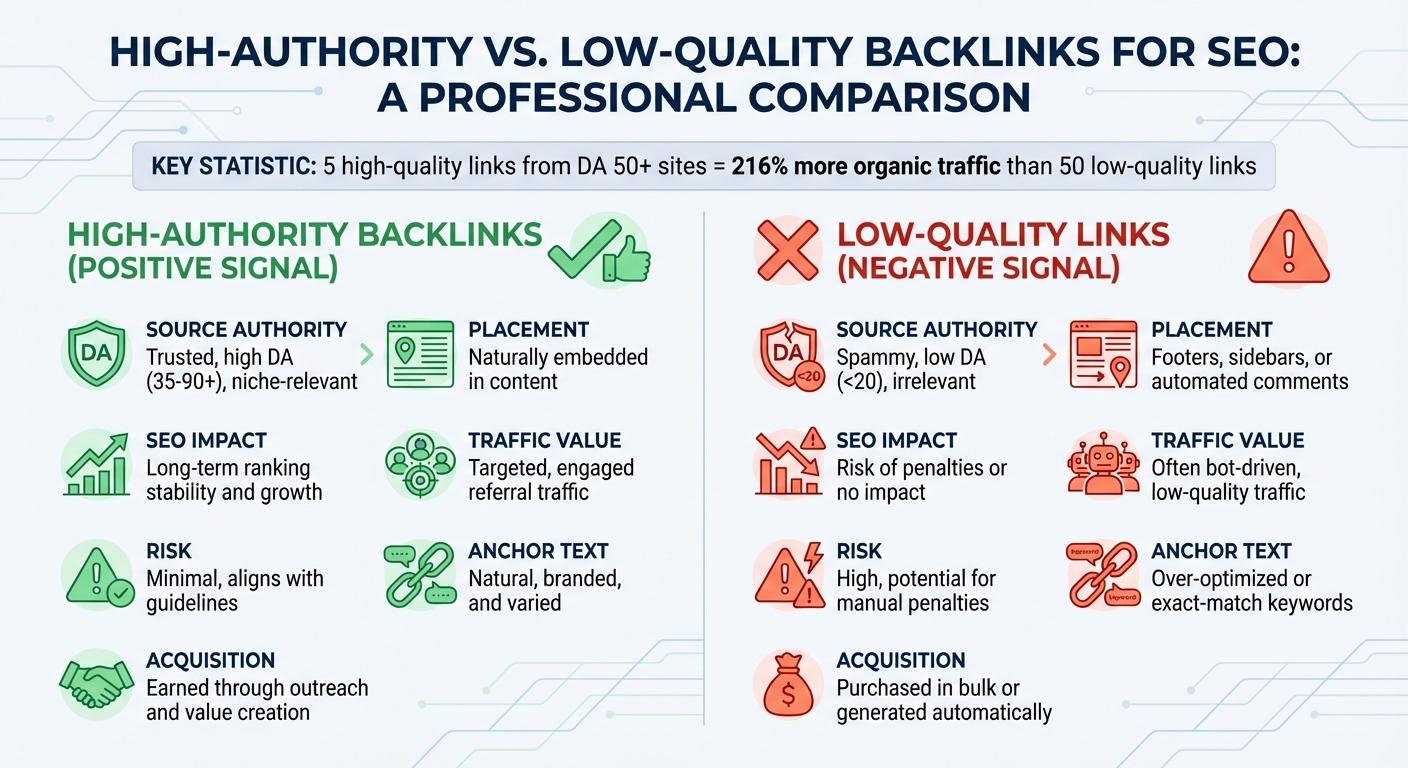
High-Authority vs Low-Quality Backlinks: SEO Impact Comparison
I Ranked the Best Ways to get Backlinks for SEO [TIER LIST]
sbb-itb-88880ed
What Are High-Authority Backlinks?
High-authority backlinks are editorial links from trusted, relevant websites that naturally fit into the content. These links are added by human editors to enhance the content’s credibility, not to manipulate search rankings, and search engines rely on them to evaluate a page’s authority within its niche.
What makes these backlinks stand out is their precise relevance. The linking website and the target page must share a clear connection in terms of industry or subject matter. For instance, if you run a fitness blog, a backlink from publications like Men’s Health or Runner’s World will carry far more weight than one from a tech blog. As Jeremy Ellens explains:
High authority backlinks are not defined by DR or DA alone – they are editorial links from trusted, topically relevant websites.
These links typically come from websites with a strong track record of producing reliable content. A study of over 14 billion web pages revealed that 96.55% of them get no organic traffic from Google, often due to a lack of quality backlinks. This highlights how even a few high-authority links can significantly boost your SEO efforts. Let’s break down the key traits and benefits of these links.
Characteristics of High-Authority Backlinks
High-authority backlinks have several defining traits. While metrics like Domain Authority (DA) and Domain Rating (DR) are important – sites with DA above 60 or DR above 70 are often considered authoritative – topical relevance often outweighs these numbers. Dmytro Sokhach, CEO of Editorial.Link, explains:
A relevant backlink from a site with a lower DA score can be more valuable than an irrelevant link from a high-DA site.
This means a link from a smaller, niche site that aligns with your topic can sometimes outperform one from a large but unrelated site. Placement also matters. Links embedded naturally within the main body of an article carry more weight with Google than those tucked into footers, sidebars, or author bios. Do-follow links are particularly valuable because they pass “link juice” (or PageRank) directly to your site, though even nofollow links from respected sources can drive referral traffic and boost brand visibility. These qualities are what make high-authority backlinks so impactful for SEO.
SEO Benefits of High-Authority Backlinks
The unique traits of high-authority backlinks lead to measurable SEO improvements. These links act as endorsements, signaling to Google that your content is trustworthy and valuable, which aligns with its E-E-A-T (Experience, Expertise, Authoritativeness, and Trustworthiness) framework.
The impact on rankings is undeniable. In a two-year study, five high-quality contextual links from sites with DA over 50 led to a 216% increase in organic traffic compared to 50 lower-quality links from sites with DA between 20 and 30.
But the benefits go beyond rankings. High-authority backlinks also bring in referral traffic from engaged readers and help secure long-term stability in search results. As Max Desiak, Senior SEO Strategist at Takeoff, puts it:
Once the site’s backlink profile becomes robust enough, Google’s core algorithm updates stop impacting it nearly as hard as smaller sites. Once you’re big enough, things just get a lot easier.
What Are Low-Quality Links?
Low-quality links are incoming hyperlinks created with the sole purpose of manipulating search rankings. Unlike high-authority backlinks that come from trusted sources and naturally integrate into content, these links violate Google’s spam guidelines and can harm your site’s reputation with search engines. The difference lies in intent: high-authority links are added to benefit readers, while low-quality ones are designed to exploit ranking systems. Google makes its stance clear:
“Links obtained primarily for artificial manipulation of Search rankings are link spam. Our algorithms and manual actions aim to nullify these unnatural links at scale.”
– Google Spam Policies
These manipulative links can appear suddenly, often in large numbers, and sometimes without your awareness. Below, we’ll explore the telltale signs of low-quality links and the risks they pose.
Traits of Low-Quality Links
Low-quality links have several characteristics that make them stand out. One of the most obvious signs is topical irrelevance. For instance, a gambling website linking to a children’s education site lacks any logical or editorial connection, signaling manipulation. Without contextual relevance, these links hold no real value.
Source quality is another key factor. These links often come from sites with little authority, featuring thin or machine-generated content, excessive ads, or pages that aren’t even indexed by Google. To check if a page is indexed, you can use the site:URL operator in Google – if the page doesn’t appear in search results, it offers no SEO value. You can also use specialized tools to find backlinks Google has already indexed for your competitors.
Unnatural patterns also raise red flags. Examples include sudden spikes in backlinks, clusters of links from similar IP addresses, or repeated use of exact-match keywords in anchor text. These patterns suggest automated link-building efforts or participation in link schemes.
Placement plays a role too. Links embedded in footers or sidebars carry far less weight than those naturally placed within the main content.
Common sources of low-quality links include:
- Private Blog Networks (PBNs)
- Link farms
- Low-quality directories
- Automated comment spam
- Hacked websites repurposed for link schemes
These sources prioritize selling or exchanging links, ignoring content quality and user experience. Recognizing these traits helps you better understand the risks associated with low-quality links.
Risks of Low-Quality Links
The dangers of low-quality links go beyond wasting resources – they can significantly harm your site’s performance. Google’s SpamBrain, a machine learning system launched in 2018, detects and neutralizes link spam at scale. As Timothy Carter, CRO at Link.Build, notes:
“SpamBrain does not demote sites based on spammy links. It simply ignores and deindexes sites and pages that are considered spammy.”
While many low-quality links are ignored algorithmically, deliberate patterns of manipulation can trigger more serious consequences. For example, a financial services company once gained over 500 backlinks in a single weekend from low-quality directories in Eastern Europe and Asia. These links, featuring foreign-language anchor text and exact-match keywords, caused a 40% drop in organic visibility within two weeks. Unable to remove the links manually, the company had to use Google’s Disavow Tool to reject them.
The most severe consequence is a manual action. If Google’s webspam team identifies systematic link schemes, they may penalize specific pages or even remove your entire site from search results. In one case, an ecommerce retailer targeted by a negative SEO attack received over 1,000 spammy backlinks from adult content sites and pharmaceutical forums. Google applied a manual penalty, forcing the retailer to document the issue, submit a disavow file, and wait 45 days for recovery.
Low-quality links also affect visibility in AI-driven search platforms like Google AI Overviews, Perplexity, and ChatGPT. These systems evaluate source credibility broadly, and persistent patterns of low-quality links can result in exclusion from AI-generated summaries. In short, these links don’t just hurt current rankings – they can jeopardize your site’s future in search.
High-Authority Backlinks vs. Low-Quality Links: Direct Comparison
Now that we’ve broken down each type of backlink, let’s put them side by side. This comparison highlights why quality always outweighs quantity when it comes to SEO. Google sums it up best:
“Google interprets a link from page A to page B as a vote by page A for page B. Votes cast by pages that are themselves ‘important’ weigh more heavily.”
The top-performing websites consistently rely on a network of diverse, high-quality backlinks. These typically come from sources with Domain Authority (DA) scores of 35 or higher, along with steady organic traffic of at least 1,000 visitors per month. This sets them apart from sites relying on low-quality links.
Tamara Novitovic, Head of SEO at Bazoom, explains this dynamic perfectly:
“A few well-placed backlinks from authoritative and relevant sites can drive more impact than dozens of links from low-quality sources.”
This underscores the importance of ethical and targeted link-building strategies, as discussed earlier.
Here’s a practical example: a website with 10,000 low-quality backlinks from irrelevant sources may struggle to even break into Page 3 of search results. Meanwhile, a site with just 500 high-quality backlinks can secure a spot on Page 1. The difference in results is anything but small.
Comparison Table: Quality vs. Quantity
The table below breaks down the key differences between high-authority backlinks and low-quality links:
| Factor | High-Authority Backlinks | Low-Quality Links |
|---|---|---|
| Source Authority | High (DA 35–90+); trusted, established domains | Low (DA <20); often link farms or expired domains |
| Relevance | Closely related to your niche or industry | Random or irrelevant sources |
| Placement | Editorial, in-content | Footers, sidebars, or automated blog comments |
| Ranking Impact | Long-term stability and growth | Short-term spikes or no impact |
| Penalty Risk | Minimal; aligns with search engine guidelines | High; risk of penalties or de-indexing |
| Traffic Value | Delivers targeted, converting referral traffic | Offers no real traffic value; often bot-driven |
| Anchor Text | Natural, branded, and varied | Over-optimized or exact-match keywords |
| Acquisition | Earned through outreach and value creation | Purchased in bulk or generated automatically |
This comparison highlights a critical point: context and credibility matter far more than sheer numbers. As of 2026, tools like Google’s SpamBrain and other AI-powered systems are adept at identifying authentic editorial links versus manipulative schemes. The days of gaming the system with mass-purchased links are long gone. What works now – and will continue to work – is building genuine, authoritative connections that both search engines and users can trust.
Building a High-Quality Backlink Strategy
Now that you understand the differences between backlinks, it’s time to put together a strategy that delivers results. The goal isn’t just to rack up links – it’s about earning backlinks that bring real traffic, strengthen your authority, and remain effective over time. Focus on ethical practices that align with what modern search engines reward.
Finding and Securing High-Authority Backlinks
To start, prioritize websites with Domain Authority (DA) scores of 50 or higher that are directly relevant to your niche. Relevance often outweighs sheer authority – after all, a backlink from a niche-related site with a DA of 60 can outperform one from an unrelated site with a DA of 80. Using tools like Ahrefs or Moz can help you identify these opportunities by analyzing competitor backlinks and finding resource pages, industry blogs, or educational institutions with strong organic traffic.
Guest posting is a tried-and-true method. When reaching out, personalize your emails by referencing specific articles and offering unique, high-value content. Following up after 5–7 days and building relationships through social media or industry events before pitching can significantly improve your chances of success. It’s an investment of time, but one that pays off in the long run.
Neil Patel puts it best:
Quality backlinks are like votes from credible sources. They’re harder to get but are worth the effort because they drive long-term SEO success.
For a more streamlined approach, consider using tools like 3Way.Social to simplify link-building efforts with ethical exchanges.
Using 3Way.Social for Ethical Link Exchanges
Cold outreach can be time-consuming and unpredictable, but platforms like 3Way.Social offer a more efficient alternative through AI-powered ABC (three-way) link exchanges. Unlike direct reciprocal linking – which search engines might flag as manipulative – ABC exchanges involve a triangular structure (A → B → C → A), which mimics natural linking patterns and reduces the risk of detection.
This platform uses AI to match domains based on topical relevance, connecting you with a vetted network of SEO professionals whose sites align with your niche. You’ll gain permanent do-follow links through guest posting opportunities, and its advanced tools help diversify your anchor text and link placements, ensuring a natural profile. This approach aligns with Google’s focus on quality over quantity, allowing you to grow your Domain Authority steadily without risking penalties.
Monitoring and Maintaining Your Backlink Profile
Even after building a strong backlink profile, regular monitoring is essential to maintain its health. Keeping an eye on your links ensures you catch toxic or low-quality backlinks before they become a problem. Perform backlink audits at least quarterly using tools like Ahrefs, SEMrush, or Google Search Console. These tools help you track new backlinks, spot red flags, and address any suspicious activity. Setting up real-time alerts can help you quickly detect new, lost, or broken links.
When auditing, watch for warning signs like links from sites with a DA under 20, non-relevant sources, or deindexed sites and link farms. If you find harmful links, export them and submit a disavow file through Google Search Console. While search engines often ignore low-quality links automatically, taking proactive steps can help you avoid manual penalties.
Keep an eye on key metrics like Domain Authority growth (aim for a 5–10 point increase quarterly), referral traffic from backlinks, and ranking improvements for target keywords. Research shows that quality backlinks can drive 2–3 times more consistent traffic than focusing on sheer quantity. To maintain a natural backlink profile, diversify your sources – include blogs, industry directories, and news sites – and avoid relying too heavily on one type of link.
Conclusion
The gap between high-authority backlinks vs. low-quality links boils down to building a foundation that lasts. High-quality links from respected and relevant sources not only provide long-term ranking stability but also drive meaningful referral traffic and enhance your site’s trustworthiness with search engines. In contrast, low-quality links do more harm than good. They waste your resources, risk triggering Google’s SpamBrain filters, and could even lead to manual penalties that devastate your rankings overnight.
In a 2-year study, 5 high-quality contextual links from sites with a Domain Authority (DA) of 50+ outperformed 50 lower-quality links, driving 216% more organic traffic and boosting conversion rates by 89%. This underscores a simple but critical truth: quality links are not just a good practice – they’re the key to staying visible in search results.
“When Google can’t decide which of several pages has the best content, it often defaults to considering which site has earned the most trust through quality backlinks.” – Magnus Schmidt, International Link Building Specialist
Throughout this discussion, one thing remains clear: ethical link-building is essential. Search engines today reward honest, merit-based link-building strategies. To stay ahead, focus on creating content that naturally earns citations, use diverse anchor text, and keep a close eye on your backlink profile to identify and address harmful links before they cause issues. Tools like 3Way.Social can simplify this process with ABC link exchanges powered by AI, connecting you to vetted, relevant sites while maintaining natural linking patterns.
The decision is straightforward: prioritize quality links for sustainable SEO growth, or risk everything by chasing shortcuts. Your rankings, traffic, and long-term success depend on making the right choice.
High-authority Backlinks vs. Low-quality Links – FAQs
How can I tell if a backlink is truly high-authority?
To spot a high-authority backlink, look for links originating from reputable and relevant websites with strong domain authority. These links should feel natural, appearing in valuable, contextually relevant content, and use anchor text that makes sense within the flow of the text. The best backlinks are editorially placed – meaning they’re earned, not purchased or artificially created – and come from trustworthy sources known for consistently publishing credible content.
What should I do if my site gets spammy backlinks?
If your website ends up with spammy backlinks, the first step is to identify and evaluate them. Tools like Google Search Console or other backlink analysis platforms can help you spot these harmful links. After identifying them, try reaching out to the site owners and request that they remove the links. If that doesn’t work, you can use Google’s Disavow Tool to distance your site from these problematic backlinks.
To keep your SEO strategy on track and avoid penalties from search engines, make it a habit to regularly monitor your backlink profile. Staying proactive can save you from unnecessary trouble down the line.
How many quality backlinks do I need to see SEO results?
When it comes to SEO, the number of quality backlinks you need to see results isn’t a fixed number – it depends on factors like relevance and authority. A handful of backlinks from trusted, credible sources can make a big difference in your rankings. But for long-term success, it’s about more than just numbers. You’ll need to surpass certain thresholds in areas like trustworthiness, relevance to your niche, and minimizing risk.
Instead of chasing sheer quantity, aim to build a solid base of authoritative links. Quality always beats quantity when it comes to backlinks.