Last Updated on March 29, 2026 by Ian Naylor
Linking domain relevance is the key to improving your website’s SEO. It focuses on how well a referring site aligns with your content’s topic, ensuring links are contextually relevant. Search engines value relevance over sheer link quantity, making this concept essential for effective link-building.
Key Takeaways:
- What it is: Measures how well a linking domain’s theme matches your site’s niche.
- Why it matters: Relevant links improve rankings, avoid penalties, and build authority.
- Factors to focus on:
- Domain authority paired with niche alignment.
- Anchor text and surrounding content relevance.
- Avoiding irrelevant or manipulative links.
- Best practices:
- Prioritize links from highly relevant or closely related domains.
- Use natural anchor text and avoid over-optimization.
- Build links ethically – avoid black-hat tactics like link buying or PBNs.
By understanding and applying these principles, you can create a strong, relevant backlink profile that supports long-term SEO success.
Factors That Determine Linking Domain Relevance
Domain Authority and Niche Alignment
Domain Authority (DA) is a scoring system, ranging from 1 to 100, that predicts how well a website might rank in comparison to others. Since DA is a comparative measure, it’s most useful for evaluating your site against direct competitors rather than chasing an arbitrary "high" score. The scale is logarithmic, meaning it gets harder to improve your score as it climbs.
However, DA alone isn’t enough. The real magic happens when authority is paired with niche alignment. For example, a link from a respected health website to a fitness brand is far more impactful than a link from a general news site. Phil Roskams, an SEO and Link-Building Expert at The Link Builder, sums it up well:
"Authority metrics are convenient. Relevance is decisive".
Focus on quality over quantity. A handful of contextually relevant links will outperform a large number of links that lack alignment. Steer clear of websites that primarily sell links, feature thin or AI-generated spam content, or engage in link schemes like site-wide footer links.
And remember, it’s not just about where the link comes from – it’s also about how it fits into the surrounding content.
Content Context and Anchor Text Relevance
Search engines don’t just look at the link itself – they analyze the entire content surrounding it. They evaluate how the linking page’s topic, the text around the link, and your target page’s content all relate to one another. This assessment happens on multiple levels: the page’s overall relevance, the site’s niche, and whether the link genuinely adds value for readers. Together, these factors amplify the link’s relevance in the eyes of search engines.
Anchor text plays a key role here. Google uses the words in the anchor text, along with the nearby sentences and paragraphs, to understand the relationship between the linked pages. A natural mix of branded, naked URL, and contextually relevant anchors is essential for a balanced link profile.
"When the language used in the link matches the subject matter on both sides, the relationship strengthens. When the language drifts, the association weakens, even if the link originates from a trusted domain." – Stellar SEO
Instead of relying on generic best practices, analyze anchor text ratios of top-ranking competitors in your niche to guide your strategy.
White-Hat vs. Black-Hat Linking Strategies
The method you use to acquire links is just as important as their relevance. White-hat strategies focus on earning links naturally by creating high-quality content, such as original research or expert guides. These ethical approaches build lasting SEO value. On the other hand, black-hat tactics – like buying links, using private blog networks (PBNs), or participating in link schemes – can lead to penalties and hurt your site’s credibility.
Google’s 2022 link spam update cracked down on manipulative practices that distort PageRank. As a result, natural, editorial links now carry far more weight than sheer link volume. For instance, a site with 500 high-quality, relevant links can easily outperform a site with 10,000 low-quality or irrelevant ones. Links from sites that treat outbound linking as an editorial decision, rather than a commodity, are particularly impactful.
It’s also crucial to monitor your link profile regularly. Watch out for links from "link farms" or sites with no clear niche alignment, as these can harm your rankings. If you notice over-optimization – like too many exact-match anchors – focus on adding branded and generic links to balance things out rather than removing older links, which can destabilize rankings.
These strategies highlight the importance of consistently evaluating and refining your link-building efforts.
sbb-itb-88880ed
Relevant Links: Why They Matter and How to Build Them
Levels of Linking Domain Relevance
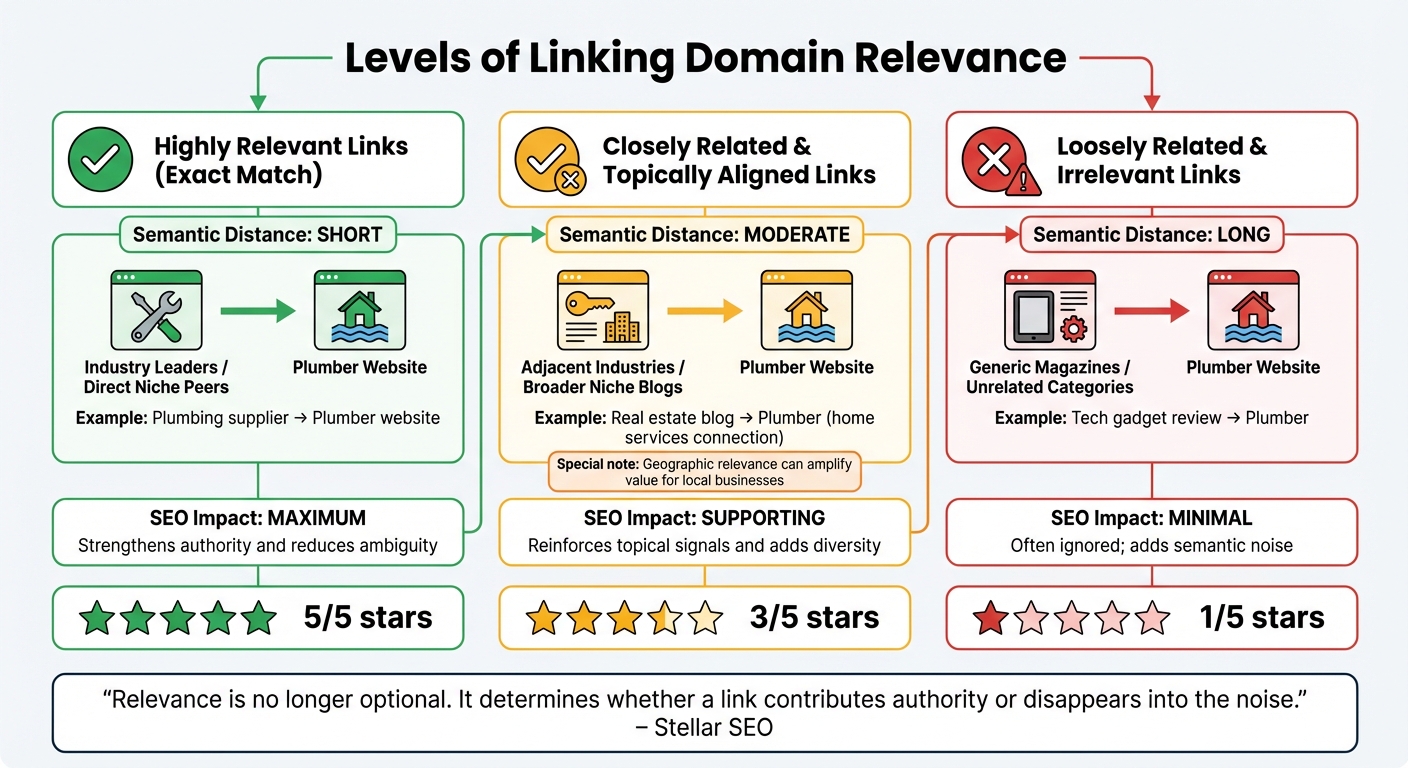
Three Levels of Linking Domain Relevance and Their SEO Impact
Search engines like Google assess how closely a linking domain’s topic aligns with your website. This "topical closeness" plays a big role in determining whether a link strengthens your authority or fades into irrelevance.
By understanding these levels, you can focus your link-building efforts where they matter most and avoid chasing links that won’t make a difference. Let’s dive into the three main categories and their impact on your SEO performance.
Highly Relevant Links (Exact Match)
The gold standard of links comes from domains that directly match your niche. These links pack the most punch because they reinforce your authority within Google’s entity graph and SEO search intent clusters. Think of a plumbing supplier linking to a plumber’s website or a fitness equipment retailer linking to a personal training blog – these are prime examples.
Websites with highly relevant links tend to weather algorithm updates better and bounce back faster when rankings dip. Why? Because these links send a crystal-clear signal to search engines about your site’s purpose and expertise.
"Relevance is no longer optional. It determines whether a link contributes authority or disappears into the noise." – Stellar SEO
To figure out if a potential link source is highly relevant, try using the search operator site:domain.com [your topic]. If the site consistently covers your niche, you’ve likely found a strong candidate.
Now, let’s look at how links from closely related fields can also enhance your authority.
Closely Related and Topically Aligned Links
While links from your exact niche are ideal, links from related industries can still provide meaningful support. These come from broader fields that naturally connect to your topic – like a real estate blog linking to a plumber or a nutrition website linking to a fitness coach. Even though the connection isn’t direct, these links still carry contextual value.
The difference lies in the "semantic distance." A real estate blog, for example, might link to a plumber because it makes sense for readers who need home services. Search engines recognize this logical connection, so the link still passes value – just not as much as an exact-match link.
Interestingly, geographic relevance can sometimes amplify the value of these links, especially for local businesses. For instance, a bakery linking to a restoration company in the same city creates a shared local context that search engines pick up on, even if the topics don’t fully align.
Loosely Related and Irrelevant Links
At the other end of the spectrum are links from unrelated or barely related sources, like a tech gadget review site linking to a plumber. While these links might get indexed, modern search systems often ignore them because they create "semantic noise" rather than adding clarity.
Google has become adept at filtering out irrelevant links using tools like SpamBrain. These links typically offer no return on investment, making them a poor use of your time.
Be especially cautious of links from sites with no clear topical alignment or from "bad neighborhoods" – sites that link to unrelated niches like casinos or essay-writing services. These can dilute your relevance signals and even harm your credibility. Before pursuing a link, ask yourself: "Will this link attract engaged, qualified visitors to my site?" If not, it’s probably not worth the effort.
| Relevance Level | Semantic Distance | Typical Source | SEO Impact |
|---|---|---|---|
| Highly Relevant | Short | Industry leaders, direct niche peers | Maximum; strengthens authority and reduces ambiguity |
| Closely Related | Moderate | Adjacent industries, broader niche blogs | Supporting; reinforces topical signals and adds diversity |
| Loosely Related | Long | Generic magazines, unrelated categories | Minimal; often ignored; adds semantic noise |
How to Evaluate and Acquire Relevant Backlinks
Getting relevant backlinks requires a mix of smart tools, manual checks, and building relationships. The key is to focus on links that boost your authority instead of wasting time on ones that won’t make a difference.
Evaluating Relevance Using Tools and Manual Checks
When assessing potential links, think about relevance on multiple levels: the overall domain theme, the specific page, and even the exact placement of the link. This layered approach helps you see the bigger picture.
Metrics like Domain Rating (DR), Domain Authority (DA), and Trust Flow can guide you, but they only tell part of the story. For example, a site with a DA of 60 might look good at first glance, but if it links to unrelated niches like casinos or pharmaceuticals, that’s a red flag.
It’s crucial to visit the site and do a manual audit. Look for content that’s well-written, serves a real audience, and isn’t just there for link building. Check if the site has genuine organic traffic and avoid sites with too many outbound links to unrelated topics.
A quick evaluation trick? Ask yourself if you’d proudly show this link to your boss or client. If the answer is no, the backlink likely isn’t worth it. A strong backlink should meet four key criteria: Authority (the site’s credibility), Relevance (topic alignment), Trust (non-spammy), and Placement (editorial context).
Considering that about 66% of web pages have no backlinks, competition for high-quality links is tough. Google now prioritizes quality over quantity, meaning a handful of highly relevant links can outperform thousands of low-quality ones.
Once you’ve identified quality links, the next step is to build relationships to secure them.
Building Relationships and Guest Posting
Relationships are at the heart of earning quality backlinks. Guest posting remains a top strategy, with nearly 65% of link builders calling it their go-to method.
Focus on reputable sites with a DA or DR of 40 or higher and a Spam Score under 3%. To find opportunities, use search operators like "[your niche]" "write for us" or intext:"submit a guest post" along with your keywords.
Build connections before pitching. Engage with editors on LinkedIn or X, comment on their posts, and establish rapport. Tools like Hunter.io can help you find contact details for editors or content heads. When pitching, use tools like Ahrefs or Semrush to identify content gaps on their site – offering ideas that fill those gaps makes your pitch hard to ignore.
A well-planned guest posting campaign can deliver results, with successful efforts often landing 13–15 high-authority links per month on respected sites like Search Engine Journal and Moz.
When writing guest posts, aim for in-depth content (1,500–2,000 words) with original visuals, expert quotes, and clear headings. Use descriptive anchor text that’s relevant and relevant to the linked page, and avoid overusing the same keywords to keep your link profile diverse. Even if a link is tagged as "no-follow", Google now considers these as ranking signals, so they still hold value.
"Before pitching an idea to a site, it’s fundamental that you do your research. Go through their posts and see if there’s a topic that hasn’t been covered or an angle you could take to complement their existing posts." – Sara McGuire, Content Marketing Lead, Venngage
Using AI-Powered Platforms Like 3Way.Social
Manual outreach can fall flat if your emails lack relevance or focus. AI-powered tools streamline this process by automating the evaluation of link relevance, ensuring both domains and pages align.
Platforms like 3Way.Social (https://3way.social) use AI to match you with relevant link exchange opportunities across four levels: Domain-to-Domain, Domain-to-Page, Page-to-Page, and Link-to-Page. This automation helps you avoid shady practices and focus on natural, editorial-style links that Google rewards.
The platform also connects you with a vetted network of SEO professionals, reducing risks like link manipulation penalties. With features like permanent do-follow links and advanced diversification, 3Way.Social helps you build a backlink profile that grows stronger over time without triggering spam filters. This aligns perfectly with the goal of creating a robust, contextually relevant backlink strategy.
Common Mistakes in Linking Domain Relevance to Avoid
Even experienced SEOs can trip up their link-building efforts by falling into common traps. These missteps often come from relying on outdated methods or focusing too much on surface-level metrics. Knowing what to avoid is just as important as mastering the right strategies when refining your approach.
Ignoring Page-Level Relevance
One of the biggest mistakes is focusing solely on domain-level metrics like Domain Authority (DA) or Domain Rating (DR) while neglecting the specific page where the link appears. Search engines evaluate links at the page level, not just the domain level.
A link from a high-authority site loses value if it’s placed on a page unrelated to your content. For instance, a DA 70 news site linking to a B2B software site within a celebrity gossip article doesn’t offer meaningful relevance. The lack of topical connection makes the link far less effective.
"A moderately authoritative page that sits firmly within the same subject area often sends a clearer signal than a stronger site with no contextual alignment." – Phil Roskams, SEO and Link-Building Expert
When evaluating a potential link, ensure the page’s content aligns with your niche. Check the surrounding links and entities – if the page looks like a "link dumping ground" filled with unrelated outbound links, it’s better to pass. Context matters too. Google considers not just the linking page but also the surrounding text and overall content to determine relevance.
Prioritizing High-DA Irrelevant Links
Chasing high-DA links from irrelevant domains is another common pitfall. Metrics like DA and DR are estimates and don’t measure how well a link aligns with your topic.
Google’s "Reasonable Surfer" model gives more weight to links that users are likely to click. A high-DA link from an unrelated site often fails this test, as it lacks topical clarity. Worse, focusing on quantity over quality can trigger Google’s suspicion of link manipulation, potentially leading to penalties.
"Irrelevance is driven by the pressure to build large volumes of links… but Google wants us more focused on relevant themes because ultimately, they want us to deserve any links that we get." – Paddy Moogan, Co-founder, Aira
For example, a link from a niche-specific site with a DA of 35 can outperform one from a DA 60 general news site if the smaller site’s topical signals are more aligned with your content. Use authority metrics as a secondary filter to weed out low-quality sites – not as your primary decision-making factor.
And here’s a reality check: nearly two-thirds of all web pages have no backlinks at all. This highlights how competitive it is to secure high-quality links.
Neglecting Anchor Text Optimization
Anchor text plays a critical role in signaling your page’s topic to search engines, yet it’s often mishandled. Some site owners either ignore anchor text entirely or over-optimize it, both of which can harm rankings.
Generic phrases like "click here" fail to reinforce relevance. On the flip side, stuffing anchor text with exact-match keywords can trigger penalties under Google’s Penguin algorithm, potentially causing ranking drops or even domain suppression. A balanced backlink profile typically limits exact-match keywords to 1%–5% of total anchors, while branded and naked URL anchors should make up about 50%–80% of the profile.
Irrelevant or misleading anchor text can also backfire. If users click a link expecting one thing but find something completely different, they’re likely to bounce. Google tracks this behavior, and it can reduce the link’s effectiveness.
"If a page links to you using the anchor text ‘hipster pizza,’ there’s a good chance your page is about pizza – and maybe hipsters." – Cyrus Shepard, Founder, Zyppy SEO
To avoid over-optimization, try the "Read Aloud" test: read the sentence containing your anchor text out loud. If it sounds awkward or forced, revise it for a more natural flow. Regular audits using tools like Ahrefs or SEMrush can help keep single keywords under 10%. If your anchor profile is already over-optimized, don’t panic. Instead of removing links, focus on building new ones with branded, naked URL, or generic anchors to restore balance.
Conclusion: Building a Strong Backlink Profile Through Relevance
Creating a solid backlink profile isn’t about chasing high Domain Authority scores or collecting a pile of random links. It’s about focusing on relevance first and authority second. Google’s algorithm prioritizes links that naturally signal trust and usefulness, steering clear of links that look like they’re trying to manipulate the system.
One highly relevant link can easily outperform a large number of unrelated ones. Why? Because relevant links build topical confidence – a signal that tells search engines your site is the go-to resource for specific topics. Plus, this approach protects your site from algorithm updates since your links align with actual user behavior and expectations rather than artificial link-building tactics.
To succeed, keep everything aligned across three key layers: domain (your site’s industry niche), page (the specific content or subject), and anchor text (how the link communicates relevance to search engines). Regularly audit your profile to catch off-topic links or mismatched anchor texts that could weaken your topical authority. Before pursuing a link, ask yourself: Would the readers of the host site naturally click through to my page and find value? If the answer is no, it’s better to pass. Sticking to these principles lays the foundation for a backlink strategy that’s both effective and future-proof.
FAQs
How do I tell if a backlink is truly relevant?
To figure out if a backlink is relevant, start by checking how well the linking site or page matches your website’s topic or industry. A relevant backlink usually comes from a site that shares similar themes or attracts a comparable audience.
Also, take a close look at how the link is placed within the content. Does it flow naturally, or does it feel forced? Finally, consider the overall focus of the linking site – does it complement your niche? If it does, the backlink can enhance both your site’s authority and its SEO performance.
What’s a safe anchor text mix for SEO?
A well-rounded anchor text strategy is all about balance. To keep things natural and avoid penalties, aim for the following mix:
- Branded anchors: 25-45% (e.g., your brand name or variations of it)
- Naked URLs: 15-20% (e.g., www.example.com)
- Generic anchors: 12-18% (e.g., "click here", "learn more")
- Partial match anchors: 8-15% (e.g., a mix of your keyword and other text)
- Exact match anchors: 1-5% (e.g., your exact keyword phrase)
Be cautious with exact match anchors – overusing them can set off red flags for search engines. A diverse anchor text profile not only looks natural but also aligns with SEO best practices.
Should I disavow irrelevant links or just build better ones?
Disavowing harmful or irrelevant links is a crucial step when dealing with spammy, low-quality, or unrelated backlinks that could damage your site’s reputation. However, be cautious – over-disavowing might lead to the loss of links that actually benefit your site. The key is to carefully evaluate your backlink profile, disavow only the harmful links, and prioritize building strong, relevant backlinks. Tools like 3Way.Social can assist in acquiring vetted links to enhance your SEO efforts.