Last Updated on January 13, 2026 by Becky Halls
Anchor text over-optimization can harm your website’s rankings and even lead to penalties. This happens when links overuse exact-match keywords, making your profile look unnatural to search engines like Google. To fix this, you need to:
- Audit your backlinks: Identify overused exact-match anchors.
- Balance anchor text types: Aim for a mix of branded, generic, naked URLs, partial, and exact-match anchors.
- Limit exact-match anchors: Keep them under 10% of your profile.
- Diversify new links: Use varied anchor text and focus on natural-sounding phrases.
- Monitor regularly: Use tools like Google Search Console, Ahrefs, or Semrush to track your anchor text distribution.
A balanced link profile protects your site from penalties and ensures better long-term SEO performance.
How Anchor Text Over-Optimization Affects SEO
Google Penalties and Deindexing Risks
When Google’s algorithms identify an overuse of exact-match anchor text, they don’t take it lightly. The Penguin update specifically targets unnatural patterns in linking behavior.
The fallout from anchor text over-optimization typically falls into two categories: algorithmic penalties and manual actions. Algorithmic penalties happen automatically when Google’s systems flag your link profile as suspicious. On the other hand, manual actions are issued by human reviewers who determine that you’ve intentionally manipulated rankings – such as buying links with identical, keyword-rich anchors. These manual penalties will show up in the “Manual Actions” section of Google Search Console.
“If Google detects a pattern of too many such links pointing to a site, they may take it as evidence that the site owner intentionally placed or paid for those links… Google may place a manual penalty on the site.” – Mark Traphagen, Hive Digital
In extreme cases, Google might completely remove pages or even your entire website from its search index. This means your site won’t appear in search results at all, resulting in zero organic visibility. Even if full deindexing doesn’t occur, spammy links lose their value as Google discounts them. These penalties not only push your pages off the search radar but can also lead to a steady decline in rankings over time.
Lower Rankings and Traffic Loss
Even without direct penalties, over-optimization can quietly chip away at your site’s performance. When Google detects manipulative linking practices, it suppresses the affected pages, leading to a drop in rankings for your target keywords.
The impact on traffic can be dramatic. Research analyzing 23 million internal links revealed that URLs with more diverse anchor text received significantly more organic traffic compared to those relying on repetitive exact-match anchors. Google’s algorithms now evaluate not just the anchor text but also the surrounding context to determine how natural the link appears. When anchors seem forced or overused, the algorithm flags them as manipulative.
Recovering from these setbacks can be a long, painstaking process. It often involves removing bad links, submitting disavow files, and waiting months for rankings to recover. During this time, your site could lose valuable traffic, potential customers, and revenue – all while competitors with healthier link profiles thrive. Cutting corners with anchor text can ultimately leave your site struggling to regain momentum.
| Anchor Text Type | Example | Risk to Rankings |
|---|---|---|
| Exact Match | “buy backlinks” | High |
| Partial Match | “how to buy quality backlinks” | Medium |
| Branded | “BlueTree Digital” | Low |
| Naked URL | “https://example.com” | Low |
| Generic | “click here” | Low |
How to Fix Anchor Text Problems (Over-Optimized Backlinks)
How to Identify Anchor Text Over-Optimization
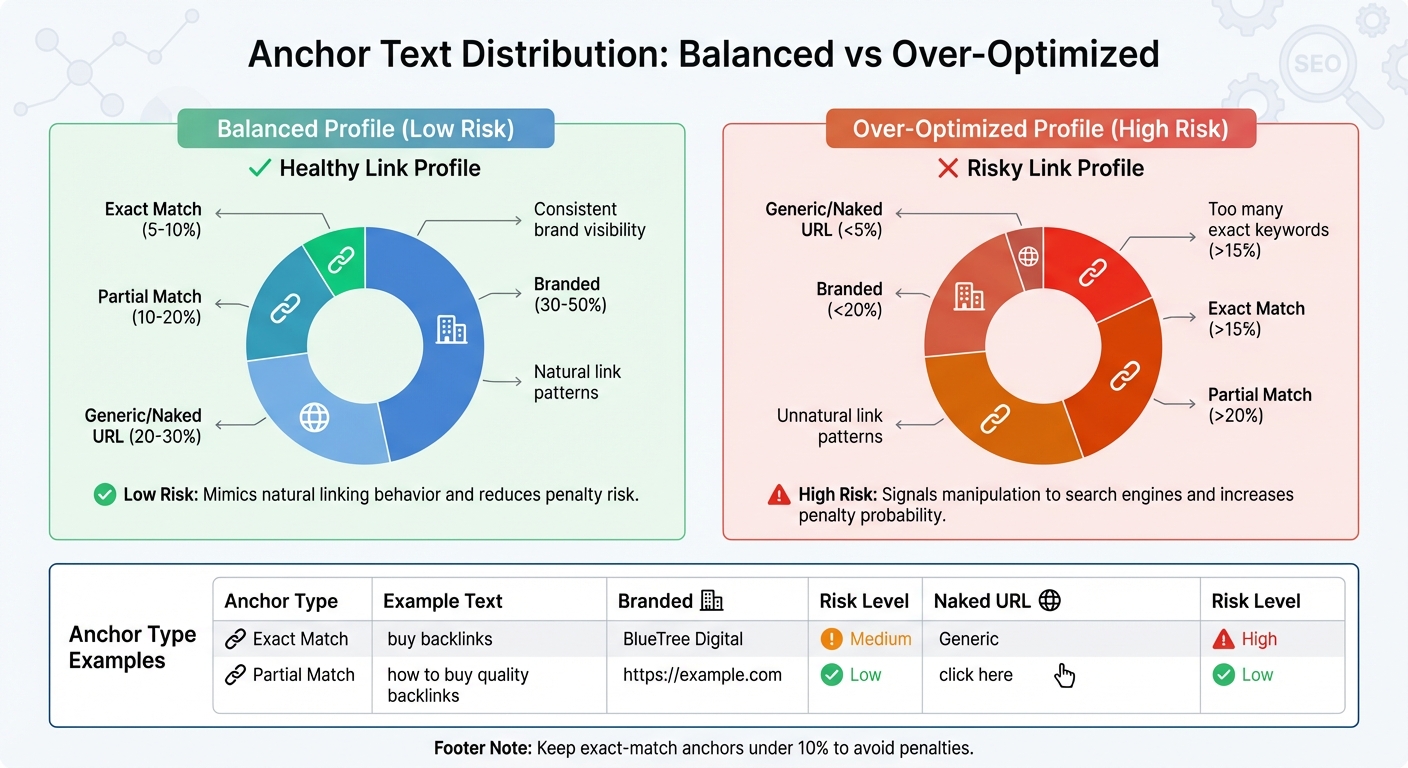
Balanced vs Over-Optimized Anchor Text Distribution Guide
Run a Backlink Audit
Start by exporting your backlink data. A great free option is Google Search Console – head to the “Links” section to see which sites are linking to you and the anchor text they’re using. For more detailed insights, consider tools like Semrush, Ahrefs, or Moz Link Explorer, which allow you to filter for “Follow” and “Active” links.
Once you’ve got the data, categorize the anchor text into specific groups: Branded (e.g., your company name), Naked URL (plain web addresses like https://example.com), Generic (phrases like “click here” or “read more”), Partial Match (phrases that include your target keyword), and Exact Match (anchors that are an exact match to your keyword). This classification helps uncover any problematic trends. Tools like Semrush’s Backlink Audit can even flag “Money Anchors” – exact-match anchors aimed at ranking for specific keywords – that may pose a risk.
“Anchor text manipulation was the most predictive factor in link penalties.” – Russ Jones, Principal Search Scientist, Moz
For deeper analysis, combine your anchor text list with your target keywords using Excel’s VLOOKUP function. This will highlight any commercial keywords that are overused as anchors. Don’t forget to review image links too – alt text serves as the anchor for these, and keyword-stuffed alt text is a common but often ignored issue. Finally, assess the distribution of these anchor categories to pinpoint any imbalances.
Analyze Anchor Text Distribution
Once your anchors are categorized, calculate the percentage each type makes up in your overall link profile. A balanced profile is key to avoiding penalties. For example, an exact-match anchor ratio exceeding 5–10% increases your risk of being flagged. Ratios above 15% are especially risky. On the other hand, branded anchors should make up 30–50% of your profile. If they fall below 20%, that’s a red flag.
To ensure your audit is thorough, compare your anchor text distribution to that of your top competitors – ideally 3–5 of them. Different industries have different norms; for instance, affiliate sites may naturally have a higher exact-match percentage, while SaaS companies often lean heavily on branded anchors. This benchmarking helps you set realistic targets instead of relying on generic guidelines.
| Anchor Type | Balanced Profile (Low Risk) | Over-Optimized Profile (High Risk) |
|---|---|---|
| Branded | 30% – 50% | < 20% |
| Generic / Naked URL | 20% – 30% | < 5% |
| Partial Match | 10% – 20% | > 20% |
| Exact Match | 5% – 10% | > 15% |
Lastly, use a pivot table to map anchor phrases to their destination URLs. This step helps identify if certain pages are being repeatedly targeted with the same anchor text. Even if your overall anchor profile looks balanced, excessive repetition on specific pages can indicate manipulation.
sbb-itb-88880ed
How to Fix Anchor Text Over-Optimization
Reduce Exact-Match Keyword Usage
Start by auditing your backlinks to identify over-optimized anchor text, especially exact-match keywords. If more than 10% of your anchor text profile consists of exact-match keywords, you’re treading into risky territory that could lead to penalties.
To fix this, replace exact-match anchors with related phrases or synonyms. For instance, instead of repeatedly using “best SEO software for ecommerce websites”, switch to alternatives like “SEO tools for online stores.” When using generic anchors such as “click here”, make sure the surrounding text provides clear context about the linked content.
Dilute Over-Optimized Anchors
Diluting over-optimized anchors means creating new links with varied, non-targeted anchor text to balance your profile. Focus on adding:
- Branded text (e.g., your company name)
- Naked URLs (plain web addresses)
- Generic phrases like “learn more” or “read this article”
Studies involving 23 million internal links suggest that using a mix of anchor text types can help boost search traffic more effectively than relying heavily on exact-match keywords.
A good rule of thumb is to aim for a 7:3 ratio of non-targeted to targeted anchor text. For domains not directly matching your main keyword, branded anchors should make up 60% to 70% of your profile. Avoid removing existing links; instead, focus on adding high-quality, diverse ones to rebalance your anchor text naturally.
Diversify Your Anchor Text Mix
A well-rounded anchor text profile relies on using different types of anchors. Each type serves a specific purpose and contributes to a natural-looking link profile. Here’s a breakdown:
| Anchor Type | Recommended % | Pros | Cons |
|---|---|---|---|
| Branded | 30% – 70% | Enhances brand authority and appears natural | Limited direct impact on keyword rankings |
| Naked URL | 10% – 20% | Looks highly natural with minimal risk | Lacks topical context |
| Generic | 5% – 15% | Safe and useful for calls-to-action | Limited SEO keyword value; can feel spammy |
| Partial Match | 15% – 25% | Balances relevance with natural phrasing | Moderate risk if overused |
| Exact Match | < 10% | Strong ranking signal for specific terms | High penalty risk if overused |
When crafting anchors, ensure they flow naturally within the content. Aim for anchors that are 3 to 7 words long to maintain clarity and avoid appearing forced.
Use AI-Powered Platforms for Link Diversification
To further diversify your anchor text and links, consider using AI-driven platforms. Manual link-building efforts can sometimes create noticeable patterns that search engines may flag. Tools like 3Way.Social simplify this process by matching your site with relevant domains. These platforms use AI to ensure links come from contextually related websites, rather than random directories, which strengthens your SEO efforts.
Monitoring and Preventing Future Over-Optimization
Once you’ve addressed over-optimization issues, the next step is maintaining those improvements through regular monitoring and preventive measures. Without consistent oversight, you risk falling back into the same patterns that led to penalties in the first place.
Create Internal Guidelines for Anchor Text
To avoid repeating mistakes, establish clear internal guidelines for anchor text usage. Start with a content-first approach, ensuring that links fit naturally within the flow of your writing. Set specific anchor text ratios to guide your team. For example, Neil Patel recommends keeping the target keyword in no more than 10% of your anchor text links. This helps create a diverse and balanced link profile.
Keep anchor texts concise – aim for 3 to 7 words – and use at least eight different anchor text types throughout your content. Regular team briefings can reinforce these practices, reducing the likelihood of accidental over-optimization.
Schedule Regular Backlink Audits
Routine backlink audits are a proactive way to spot issues early. For larger websites, consider weekly audits; for smaller ones, monthly reviews should suffice. At a minimum, all sites should undergo a thorough audit twice a year.
Use tools like Google Search Console, Ahrefs, and Semrush for comprehensive data. Start by filtering out dead links (e.g., 404s or 410s) and nofollow links, so you can focus on active, followed links that pass link equity. Comparing your anchor text distribution with your top-ranking competitors can provide valuable insights into what’s considered “natural” within your niche.
As Modestos Siotos, Technical SEO Director at iCrossing UK, wisely points out:
“A reasonable site owner would rather invest today into minimizing the risks and sacrifice growth for a few months rather than risk the long-term sustainability of their business”.
Use Automated Tools for Monitoring
Automation can be a game-changer for identifying and addressing anchor text issues before they lead to penalties. Schedule reviews of your anchor text profile every 90 days, using tools that offer real-time alerts. Combine data from Google Search Console with platforms like Ahrefs, which updates its index every 15 minutes, and Semrush, which offers automated toxicity scoring.
For ongoing link diversification, consider tools like 3Way.Social. These platforms use AI to connect your site with contextually relevant domains while maintaining a natural anchor text distribution. This approach minimizes repetitive patterns often seen in manual link-building efforts.
Finally, a simple but effective tip: read your content aloud. If any link feels awkward or forced, it’s a clear sign of over-optimization. By combining regular monitoring with smart automation, you can keep your anchor text profile balanced and aligned with your broader SEO goals.
Conclusion
Taking the steps outlined above can significantly improve your site’s SEO and protect it from penalties. Over-optimizing anchor text puts your site’s visibility and traffic at risk. The Google Penguin update, for example, impacted around 3.1% of sites guilty of anchor text overuse, with penalties now applied directly to specific pages.
To avoid such issues, aim for a balanced link profile by mixing non-targeted and targeted anchors. Industry research supports this approach. As Google advises:
“If it feels like you’re forcing keywords into the anchor text, then it’s probably too much”.
A diverse anchor text profile can improve your search performance. Regularly audit your backlinks and ensure variety in your anchor text by following the strategies discussed here. Limit exact-match anchor ratios and include a mix of branded, generic, and contextually relevant anchor texts. Ideally, keep anchors concise – between 3 to 7 words – and ensure they fit naturally within your content.
For continued link diversification, tools like 3Way.Social can help maintain contextually relevant links and avoid repetitive patterns. By implementing these practices, you can build a natural link profile and set your site up for long-term SEO success.
FAQs
What are the dangers of over-optimizing anchor text for my website?
Overusing or over-optimizing anchor text can backfire, potentially damaging your website’s SEO. When search engines detect manipulative patterns, it can trigger manual penalties or algorithmic actions from Google. The consequences? Lower rankings, reduced traffic, or even having your pages removed from search results altogether.
To steer clear of these pitfalls, focus on keeping your anchor text natural, diverse, and relevant to the content it links to. Striking this balance is crucial for maintaining a strong SEO profile while safeguarding your site from penalties.
How can I tell if my website has anchor text over-optimization issues?
Over-optimizing anchor text often becomes apparent when a backlink profile has an excessive number of exact-match or keyword-stuffed anchors, minimal variety in anchor phrases (like repeatedly using money keywords or overly specific terms), or unnaturally lengthy anchor text. This can lead to warning signs such as abrupt ranking drops or even manual penalties from search engines.
To spot these red flags, use SEO tools to analyze your anchor text distribution. Pay attention to patterns such as frequent repetition of keywords or an uneven ratio of branded versus non-branded anchors. Resolving these issues can help restore your site’s SEO performance and safeguard it from further penalties.
How can I diversify my anchor text to avoid over-optimization penalties?
Diversifying your anchor text is an essential strategy for building a natural backlink profile and keeping SEO penalties at bay. To achieve this, mix up your anchor text by using different types, such as:
- Branded anchors (e.g., “3Way.Social”)
- Partial-match anchors (e.g., “AI-powered link exchange”)
- Generic phrases (e.g., “click here”)
- Naked URLs (e.g., “https://3way.social”)
- Image alt text
This variety creates a balanced linking pattern that search engines recognize as organic.
When planning your anchor text, prioritize branded and generic anchors for most of your links. Use partial-match and exact-match anchors sparingly to avoid over-optimization. It’s also a good idea to keep your anchor text short – around five words or fewer – so it stays clear and relevant. Regularly auditing your backlink profile can help you spot overused terms and swap them out for synonyms or related phrases.
For a more efficient way to manage this process, platforms like 3Way.Social can be a game-changer. They connect you with high-authority websites and ensure your links are placed contextually and editorially. These tools not only make diversifying anchor text easier but also boost your site’s authority and SEO performance.