How Content Quality Impacts Domain Authority
Well-researched, user-focused content attracts authoritative backlinks and, combined with ethical link building, raises Domain Authority over time.

Last Updated on October 9, 2026 by Becky Halls
Content quality doesn’t directly affect Domain Authority (DA), but it plays a pivotal role by attracting high-quality backlinks, which are the primary factor in DA growth. Here’s the core idea: when your content is well-researched, original, and engaging, it naturally earns backlinks from reputable websites. These backlinks increase your DA over time.
Key takeaways:
- Domain Authority (DA): A Moz metric (1-100) predicting how well a site can rank.
- Backlinks: The quality and number of links to your site are the biggest drivers of DA.
- Content Quality: While not a direct DA factor, excellent content attracts backlinks, improving DA indirectly.
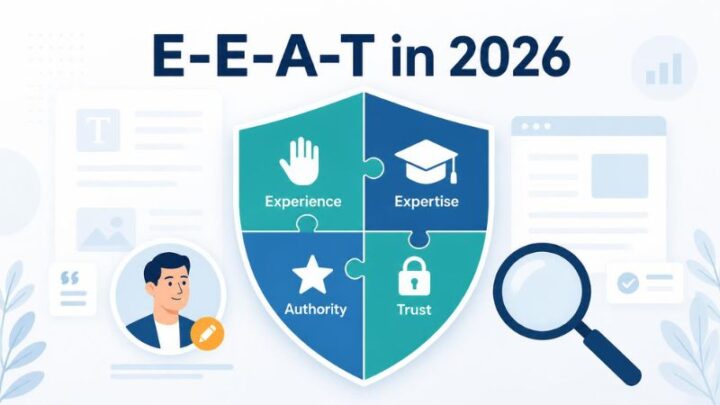
- Google’s E-E-A-T Framework: Content that reflects Experience, Expertise, Authoritativeness, and Trustworthiness is more likely to gain backlinks.
For example, sites like EpicGardening.com and Kineon successfully boosted their traffic and authority by creating targeted, high-quality content that earned natural backlinks.
Improving DA requires two things:
- Create Linkable Content: Original research, detailed guides, or tools that others want to reference.
- Ethical Link Building: Secure backlinks from authoritative, niche-relevant websites.
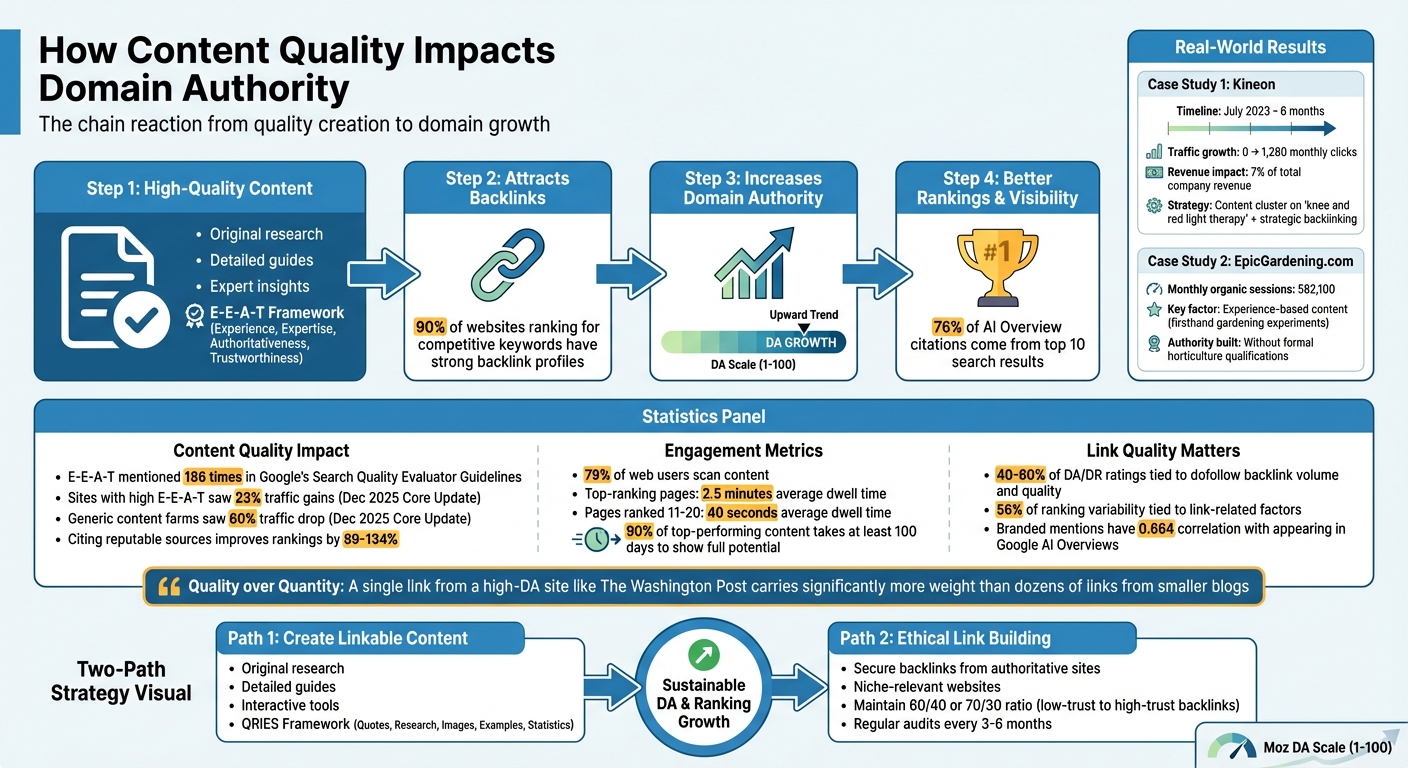
How Content Quality Impacts Domain Authority – The Complete Chain Reaction
Domain Authority: What It Is and How To Improve It #shorts
sbb-itb-88880ed
How Better Content Increases Domain Authority
While better content doesn’t directly impact your Domain Authority (DA) score, it sets off a chain reaction that can. High-quality content attracts authoritative backlinks, which are the real drivers behind DA growth. Let’s dive into how this works.
How Backlinks Drive DA Growth
When your content offers original data, thorough research, or expert insights, it becomes a magnet for backlinks. Journalists, bloggers, and industry leaders naturally link to credible sources. For example, the red light therapy brand Kineon demonstrated this in July 2023. By creating a detailed content cluster on “knee and red light therapy” and pairing it with strategic backlinking, they grew their blog traffic from zero to 1,280 monthly clicks in under six months. Even more impressive, that single content cluster accounted for 7% of the company’s total revenue during that time. This illustrates how targeted, well-crafted content can attract authoritative links and boost DA.
It’s worth noting that 90% of websites ranking for competitive keywords have strong backlink profiles. But it’s not just about quantity – the quality of those links matters even more. A single link from a high-DA site like The Washington Post carries significantly more weight than dozens of links from smaller blogs. Additionally, using visuals like infographics and videos can increase engagement, which often leads to more natural backlinks.
E-E-A-T: Google’s Content Quality Framework
Google evaluates content using its Experience, Expertise, Authoritativeness, and Trustworthiness (E-E-A-T) framework. While not a direct ranking factor, E-E-A-T outlines the qualities that Google’s algorithms reward. Sites that embody these traits are more likely to earn recognition – and backlinks – from reputable sources, which can positively influence DA.
“E-A-T is largely based on links and mentions on authoritative sites. i.e. if the Washington Post mentions you, that’s good.” – Gary Illyes, Trends Analyst, Google
Among these factors, Trustworthiness is the cornerstone. Without it, even high levels of expertise or experience won’t make up for the deficit. Google’s Search Quality Evaluator Guidelines emphasize this by referencing “E-A-T” 186 times. In December 2022, Google added “Experience” to the mix, prioritizing firsthand knowledge over generic or recycled content. This shift aims to spotlight human-created content in a world increasingly filled with AI-generated material.
Take Kevin Espiritu, founder of EpicGardening.com, as an example. Despite lacking formal horticulture qualifications, he built his authority by sharing personal gardening experiments and firsthand insights. His focus on “Experience” helped his site grow to an estimated 582,100 monthly organic sessions. This shows that lived experience can rival formal credentials in establishing authority.
User Engagement Signals and DA
Strong user engagement is another way to boost your site’s perceived authority. When users spend time on your site, interact with your content, and return for more, it signals to search engines that your content is valuable. While engagement metrics don’t directly impact DA, they create a snowball effect. Higher engagement leads to better search rankings, which increases visibility and draws in more authoritative backlinks.
The December 2025 Core Update underscored this. Generic content farms saw a 60% drop in traffic, while sites with high E-E-A-T and strong engagement enjoyed 23% gains. Additionally, studies show that citing reputable sources and using authoritative language can improve search rankings by 89-134%.
AI visibility also ties into this equation. 76% of AI Overview citations come from the top 10 search results, which are often dominated by sites with strong user engagement and authority. Moreover, branded mentions have a 0.664 correlation with appearing in Google’s AI Overviews. This highlights the importance of engagement-driven authority signals in today’s SEO landscape.
How to Improve Your Content Quality
Creating high-quality content does more than just enhance user experience – it also attracts backlinks and boosts engagement. Here’s how you can take your content to the next level.
Match Content to User Intent
Understanding user intent is key to creating content that resonates. Start by reviewing the top-ranking pages for your target keyword. Google prioritizes content that answers the “why” behind a search query. To align your content, analyze the 3 Cs:
- Content type: Is it a blog post, product page, or video?
- Content format: Does the search favor listicles, how-to guides, or comparisons?
- Content angle: Who is the audience – beginners, advanced users, or budget-conscious buyers?
For example, if search results for “best running shoes” are dominated by listicles, a technical guide on shoe materials might miss the mark. Search intent typically falls into four categories: Informational (learning something), Navigational (finding a specific site), Commercial (researching options before buying), and Transactional (ready to purchase). Matching your content to one of these intent types increases its relevance and appeal, which in turn attracts backlinks.
Google also evaluates semantic relevance – the use of related terms that demonstrate deep subject knowledge. For instance, if you’re writing about “Apple”, mentioning terms like “iPhone”, “iOS”, and “MacBook” signals expertise about the brand, not the fruit. Including fresh insights that other pages lack can boost rankings through Google’s “information gain score”.
Once your content aligns with intent, ensure it’s easy to digest.
Make Content Easy to Read
Most users don’t read every word – they scan. In fact, 79% of web users scan content. To make your content scannable:
- Use short paragraphs (1–4 sentences).
- Break up sections with H2 and H3 subheadings.
- Highlight key points with bold text.
Engagement metrics matter too. Pages with higher dwell times (average of 2.5 minutes for top-ranking pages) outperform those with lower engagement (40 seconds for pages ranked 11–20). To keep readers engaged, include visual elements like images, charts, or quotes every 300–400 words.
Readability plays a big role in user satisfaction. Aim for a Flesch Reading Ease score between 60 and 80, which makes your content accessible to readers at an eighth-grade level. Simplifying complex ideas doesn’t mean compromising on expertise – it’s about clarity.
“Quality content in 2025 means demonstrating genuine expertise while prioritizing user satisfaction above all else – including SEO tactics.” – Google Search Quality Rater Guidelines
To further engage readers, incorporate multimedia elements.
Add Videos, Images, and Graphics
Multimedia elements like videos, images, and infographics are not just visually appealing – they also boost engagement and attract backlinks. These elements can drive traffic from Google Image and Video searches, opening up new opportunities for visibility.
The QRIES Framework is a handy checklist for creating high-quality content:
- Quotes: Include expert opinions.
- Research: Back up claims with solid data.
- Images: Use visuals to complement your points.
- Examples: Provide practical applications.
- Statistics: Support arguments with verified facts.
Each element serves a purpose: visuals break up text, quotes add credibility, and statistics strengthen your claims.
Update Old Content Regularly
Keeping content fresh is essential for staying relevant. Google’s “Query Deserves Freshness” (QDF) system prioritizes updated information, especially for time-sensitive topics like technology or trends. For instance, a title like “Best Tools 2023” will lose appeal in 2026. Google factors in Click-Through Rate (CTR) when re-ranking pages, so outdated content can hurt your performance.
Here’s an example: In August 2024, Ahrefs Content Marketer Louise Linehan updated a 2018 post on “link reclamation”, tripling its organic traffic within months. But don’t just change the publish date – Google can spot superficial updates. Instead, focus on meaningful improvements like:
- Updating outdated statistics.
- Adding new sections to cover recent developments.
- Filling gaps by comparing your content to top-ranking competitors.
Prioritize the top 20% of your pages that drive the most traffic and include a “Last Updated” date to signal freshness.
“Content updates have gone from necessary evil to SEO trend, thanks to a few significant studies showing AI assistants favor fresh content.” – Louise Linehan, Content Marketer, Ahrefs
78% of businesses conduct content audits annually to ensure quality and relevance. Regular updates not only keep your content accurate but also help maintain visibility, especially in AI-driven search, where fresher URLs are favored by 25.7% on average.
How to Track Content Quality’s Effect on DA
Improving your content is just the beginning – you need to measure whether those changes are actually boosting your Domain Authority (DA). Tracking the right metrics helps you see if your content is connecting with users and attracting authoritative links.
Tools for Tracking DA Changes
When it comes to monitoring DA, Moz Link Explorer is a top choice. Since Moz developed the DA metric, their tool provides a “Metrics Over Time” feature that lets you track DA changes over a 12-month period. This makes it easier to spot trends after updating your content.
For real-time insights, Ahrefs tracks Domain Rating (DR), updating every 15–30 minutes. It’s worth noting that 44% of SEO professionals rely on Ahrefs’ DR as their main authority metric. Another option is ChatSEO, which offers AI-powered authority analysis and integrates with Google Search Console for $29/month.
It’s important to compare your DA to your direct competitors rather than viewing it as an isolated number. DA is a relative metric – what matters is whether you’re gaining ground in your niche. You should also keep an eye on Page Authority (PA) for specific high-quality content pieces, as these scores often have a stronger correlation with rankings than domain-wide metrics. Lastly, review your backlink profile to ensure your content improvements are attracting valuable links.
Track Backlink Growth and Quality
Your backlink profile provides immediate feedback on whether your content upgrades are working. Earning backlinks is one of the clearest indicators of success. Focus on linking root domains – the number of unique websites linking to you – rather than the total number of links, as this better reflects genuine popularity.
Tools like Moz Link Tracking Lists can help you monitor when new backlinks are discovered on specific pages. In 2026, a high-quality backlink typically comes from pages with steady organic traffic – ideally, at least 1,000 monthly visitors – and strong keyword visibility. Links placed in the body content carry more weight than those in sidebars or footers.
To evaluate link quality, consider using Majestic‘s Trust Flow. The ratio of Trust Flow to Citation Flow is particularly telling – a ratio close to 1.0 indicates high-quality links, while a lower ratio suggests a focus on quantity over quality. Keep in mind that 40%–60% of DA and DR ratings are tied to the volume and quality of do follow links.
“With link building campaigns, links and the Domain Authority of linking sites are frequently used as KPIs to indicate ‘success,’ but when you look at the value and measurement of a campaign, we can go beyond this too.” – Aoife O’Connor, Aira
Monitor User Engagement Data
User engagement metrics reveal whether your content updates are resonating with real people. Google Analytics 4 defines “Engaged Users” as visitors who stay longer than 10 seconds, view multiple pages, or complete a conversion. High engagement often leads to more authoritative backlinks, indirectly boosting DA.
Key benchmarks include time on site and pages per session – aim for at least two pages per session to indicate genuine interest. Watch exit rates on specific pages to pinpoint where your content might need improvement. Social engagement also plays a role: track shares, likes, and comments using tools like BuzzSumo, as these interactions often lead to future backlinks.
Patience is essential. 90% of the top-performing content takes at least 100 days to fully show its organic potential. Allow three to five months for engagement data to mature before making any final judgments.
Combining Quality Content With Link Building
Why Ethical Link Building Matters
Creating quality content is just one piece of the puzzle – it needs authoritative backlinks to truly gain visibility in search rankings. Think of high-quality links as “votes of confidence” that signal to search engines that your content is trustworthy and deserves attention.
But here’s the key: it’s all about quality over quantity. A study using Spearman Correlation analysis revealed that metrics like Moz Domain Authority (0.328) and Page Authority (0.307) are better predictors of ranking positions than simply having a high number of links (0.259). As Eric Enge, Principal and Founder of Enge Consulting, puts it:
“This data confirms that obtaining links from more authoritative sites has more value than obtaining a large quantity of links”.
Ethical link building focuses on permanent, do-follow links from reputable pages that align with your niche and maintain low spam scores. Research backs this up, showing that 56% of ranking variability is tied to link-related factors like their count and authority.
How 3Way.Social Helps Increase DA
If you’re looking for a streamlined way to build ethical backlinks, 3Way.Social offers a solution. It uses AI to manage ABC link exchanges and ABC link exchanges, which go beyond simple reciprocal linking. Instead, it sets up three-way exchanges that appear more natural to search engines.
The platform’s AI-powered domain matching ensures that your link partners are relevant to your niche and authority level, giving you permanent do-follow links that genuinely boost your rankings. It also supports advanced link diversification, helping you maintain a natural backlink profile. With tools like quality control filters and a network of vetted SEO professionals, 3Way.Social simplifies ethical link building, making it easier to combine smart content strategies with effective link placements.
Using Both Strategies Together
The best results come from blending linkable content assets with a targeted link-building strategy. Start by creating content that naturally attracts citations – think original research, in-depth guides, or interactive tools. Then, leverage platforms like 3Way.Social to secure authoritative backlinks that amplify your content’s reach.
| Content Strategy | Primary Benefit for DA | Link-Building Application |
|---|---|---|
| Original Research | High citation potential; earns editorial links | Pitch to journalists and niche editors |
| Ultimate Guides | Becomes a “bookmarked” reference; high PA | Ideal for contextual link insertions |
| Interactive Tools | High referral traffic and repeat usage | Attracts natural, diverse backlinks |
| ABC Link Exchange | Increases referring domains without footprints | Secure permanent do-follow links via 3Way.Social |
To maintain a healthy backlink profile, aim for a 60/40 or 70/30 ratio of low-trust to high-trust backlinks. Regular backlink audits – every 3 to 6 months – are also crucial for identifying and disavowing harmful links.
Conclusion
Main Points About Content and DA
While Domain Authority (DA) isn’t a direct ranking factor for Google, it serves as a reliable indicator of your site’s ranking potential. High-quality content directly impacts DA by attracting authoritative backlinks. Search engines today evaluate content using the E-E-A-T framework – Experience, Expertise, Authoritativeness, and Trustworthiness – alongside user engagement metrics like page speed and mobile-friendliness. Building topical authority through content clusters and strategic internal linking also enhances your site’s overall link equity. As Dr. Peter Meyers from Moz explains:
“DA is an indicator of your aggregate link equity”.
To improve DA, focus on creating linkable content assets – such as original research, detailed guides, and free tools – and pair them with ethical link-building strategies. Tools like 3Way.Social simplify this process with AI-driven ABC link exchanges, helping you secure permanent do-follow links from vetted, relevant domains. These strategies are essential for boosting your DA effectively.
Your Next Steps for Better DA
To enhance your DA, start by benchmarking your current score against 3–5 competitors using tools like Moz, Semrush, or Ahrefs. Next, audit your content for topical gaps and opportunities to create linkable assets. Use the QRIES Framework to ensure your content includes Quotes from experts, thorough Research, engaging Images, real-world Examples, and supporting Statistics. Conduct quarterly backlink audits to identify and remove toxic links. Keep in mind that a niche-relevant backlink from a moderately authoritative site can often provide more value than a high-authority link from an unrelated industry.
Track your progress monthly, focusing on backlink growth and SEO, user engagement, and relative DA improvements. By combining engaging content with strategic link-building, you can outpace competitors and strengthen your site’s overall performance. This dual approach is what separates successful sites from those that struggle to rank.
FAQs
How long does it take for better content to raise DA?
Improving your content can start to impact domain authority in as little as 4 to 6 months, but it often takes 6 to 12 months to see more noticeable results. The timeline depends on factors like the quality of your content and the strength of your backlink profile. To see lasting improvements, focus on consistently creating relevant, high-quality content and building a strong network of backlinks.
What type of content earns the most backlinks?
Creating content that truly connects with your audience is the key to earning backlinks. When your material is informative, engaging, and relevant, it naturally draws attention. Content sourced from credible and well-regarded sources tends to perform even better, as it not only attracts links but also enhances your website’s authority.
How can I tell if my backlinks are helping or hurting DA?
To figure out whether your backlinks are boosting or dragging down your domain authority, take a close look at their quality and relevance. Links from well-regarded, relevant websites can give your DA a solid lift. On the flip side, backlinks from spammy or unrelated sites might actually do more harm than good. The goal? Build a robust backlink profile by targeting trustworthy sources that align with your content.