AI vs Manual Link Building: Pros and Cons
A hybrid link-building strategy wins: AI scales outreach and cuts costs, while manual outreach preserves quality, relevance, and long-term SEO trust.

Last Updated on October 9, 2026 by Becky Halls
Choosing between AI and manual link building comes down to your goals, budget, and resources.
- AI link building is faster, scalable, and reduces costs by 35%. It can process hundreds of prospects weekly, automate outreach, and boost Domain Ratings by 29%. However, it risks inaccuracies (39% report errors) and lower personalization, which can harm response rates.
- Manual link building focuses on precision and building relationships, producing high-quality, niche-relevant links with a lower penalty risk. But it’s time-intensive, costly, and hard to scale, with weeks of effort often needed for just a few links.
- The hybrid approach combines AI’s efficiency for repetitive tasks with human oversight for quality control and relationship management. This balance improves results while minimizing risks.
Quick Comparison
| Factor | Manual Link Building | AI-Powered Link Building |
|---|---|---|
| Time Investment | 8 hours for 40 prospects | 45–60 minutes for 40 prospects |
| Scalability | Limited (<10 links/month) | 400–500 prospects/week |
| Accuracy | High (human judgment) | Variable (39% report errors) |
| Cost | High (labor-intensive) | 35% lower than manual |
| Penalty Risk | Very low | Moderate (over-automation risk) |
| Response Rate | 15–20% with personal outreach | 2% if fully automated, up to 18% with human QA |
| Domain Quality | Depends on outreach skill | 29% higher average Domain Rating |
“We’ve seen AI speed up the boring parts of link building – prospecting, categorising sites, drafting outreach – but humans still win on relationship and judgment.” Becky Halls, Strategist at 3Way Social
Bottom line: AI is ideal for scaling, while manual methods excel in quality and trust-building. A hybrid strategy often delivers the best results when following a proven SEO link building checklist.
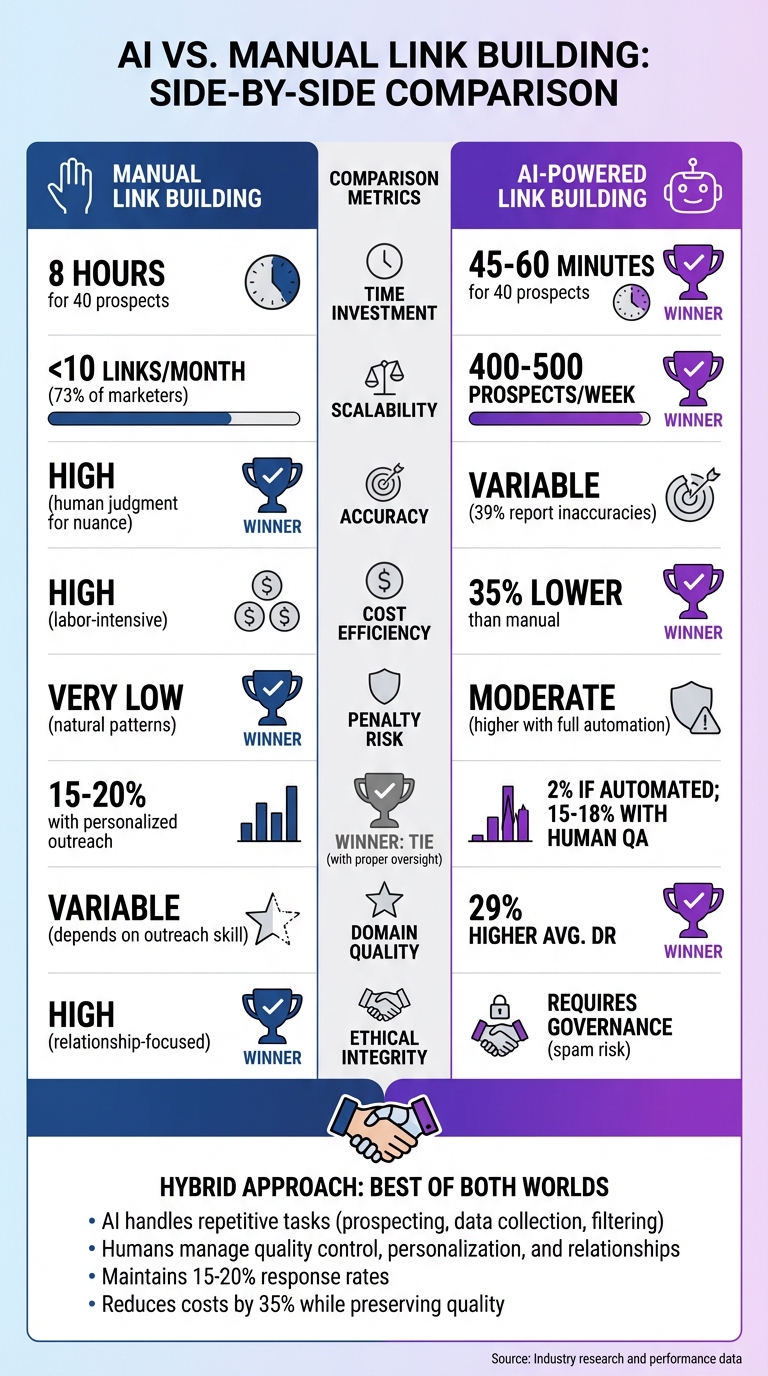
AI vs Manual Link Building: Complete Performance Comparison
Manual Link Building: Pros and Cons
Benefits of Manual Link Building
Manual link building focuses on securing high-quality, niche-specific links that not only elevate your brand but also reduce the risk of Google penalties associated with unnatural linking practices. By fostering authentic relationships with site owners and influencers, this approach opens the door to long-term partnerships and recurring opportunities for valuable backlinks. These links also enhance your website’s EEAT – Experience, Expertise, Authoritativeness, Trustworthiness – which is a key factor in modern search engine algorithms. Unlike automated methods that might yield short-lived results or risk penalties, manual link building creates a solid foundation that can endure algorithm updates.
Real-world success stories underline the effectiveness of this approach. For instance, a law firm that focused on relationship-building strategies saw a 551% surge in organic search traffic between 2022 and 2024. Similarly, SentryOne, a software company, used manual guest blogging on industry-relevant sites to establish itself as a thought leader, improving both organic traffic and keyword rankings. Another example is Cycling News, which curated a detailed Tour de France resource page featuring live updates and in-depth reporting. This effort resulted in over 64,000 backlinks from 1,500 unique referring domains.
“Manual link building is like investing steadily in a diversified portfolio. It requires discipline and patience, but the compound growth it generates is sustainable and real.” Richmond Regional
Beyond rankings, manual links also drive targeted referral traffic, as they are placed on reputable sites with engaged audiences. Following Google’s March 2024 core update, which targeted low-quality content, websites employing manual strategies demonstrated remarkable resilience. While these links provide a strong SEO foundation, they do come with a significant investment of time and effort.
Drawbacks of Manual Link Building
Despite its advantages, manual link building does have its downsides. The most notable challenge is the time and effort it requires. This process involves intensive prospecting, personalized outreach, and high-quality content creation, all of which demand considerable human resources. Securing just a few quality links can take weeks, making this strategy less suitable for businesses looking for quick ranking boosts. As Eric Siu, founder of Single Grain, explains:
“Manual outreach breaks down at scale because prospecting, personalization, and deliverability each take time and specialized skill.” Eric Siu, Founder, Single Grain
Success in manual link building also hinges on deep industry knowledge and refined outreach techniques. The content produced must meet strict editorial standards, adding another layer of complexity. This labor-intensive process increases costs, with managed services often starting at $500 per campaign and achieving a relatively low success rate of one in ten. Limited team capacity further restricts scalability, making rapid growth difficult. Additionally, maintaining relationships with partners requires ongoing effort, adding to the overall resource investment.
“We’ve noticed manual link building isn’t ‘better’ by default. It’s only better when the process is disciplined. Without systems, manual outreach turns into messy spreadsheets and inconsistent quality.” Ian Naylor, Founder of 3Way Social
Manual Link Building: Summary Table
Here’s a quick breakdown of the pros and cons of manual link building:
| Factor | Advantages | Disadvantages |
|---|---|---|
| Quality | High-quality, niche-relevant links from reputable sources | Requires expertise to identify truly valuable links |
| Control | Full control over placement, context, and anchor text in SEO | Time-consuming verification and negotiation process |
| Scalability | Builds a durable, long-term SEO foundation | Limited by human resources; hard to scale quickly |
| Penalty Risk | Very low risk; aligns with natural link guidelines | Outdated tactics may still trigger penalties |
| Cost | Provides lasting value and referral traffic | Higher cost per link due to labor-intensive process |
| Speed | Creates stable “link assets” resistant to updates | Weeks of effort needed for just a few placements |
| Relationships | Fosters long-term partnerships and brand advocacy | Requires consistent relationship maintenance |
sbb-itb-88880ed
AI-Powered Link Building: Pros and Cons
Benefits of AI-Powered Link Building
AI-driven link building brings efficiency and scale to a traditionally manual process. Tasks like prospecting, contact enrichment, and outreach scheduling can now be automated, often managed through a link building planner, giving professionals more time to focus on strategy and creativity. What used to take hours can now be condensed into just 45–60 minutes, enabling broader and more effective outreach campaigns.
For example, agencies that adopt AI-powered workflows can handle 400–500 quality prospects weekly – a significant jump from the 150 prospects typically managed through manual methods. AI tools leverage machine learning to evaluate prospects based on factors like topical relevance, entity overlap, and linking history. This data-centric approach has shown measurable results, with users reporting a 29% boost in the average Domain Rating of acquired links and a 35% reduction in outreach costs.
Another standout feature is AI’s ability to personalize outreach at scale. By analyzing target pages, these tools craft context-specific messages that reference unique aspects of a prospect’s content, making outreach feel more genuine. Additionally, AI platforms often include safeguards like quality filters, toxicity scores, and footprint checks to ensure ethical practices and avoid spammy link-building tactics. These systems can even identify harmful domains 2.1 times faster than manual processes, helping maintain link hygiene and protect SEO efforts.
Adoption of AI in SEO is growing rapidly. By 2024, 86% of SEO professionals had incorporated AI into their strategies, and 70% of marketing leaders planned to increase their investment in automation by 2025.
While the benefits are clear, it’s important to recognize the challenges that come with AI-powered link building.
Drawbacks of AI-Powered Link Building
Despite its advantages, AI-powered link building isn’t without its hurdles. One major concern is cost. Subscription fees for AI tools can be prohibitive for individual practitioners or smaller agencies. In one case, developing a custom AI link-building tool required a $5,000 investment in freelance developers.
Another challenge is the reliance on algorithms, which may not fully understand the nuances of niche industries. This limitation has been noted by 35.24% of professionals. Over-automation is another risk. Fully automated outreach can lead to response rates plummeting to as low as 2%, compared to the 15–20% seen with human-verified efforts. Generic, robotic emails can harm your sender reputation and even result in domain blacklisting.
Additionally, AI-generated content is not immune to errors. Nearly 39.05% of users have reported inaccuracies or irrelevant outputs from these systems. Left unchecked, these mistakes can lead to unnatural link patterns that Google’s algorithms may flag, potentially triggering penalties.
To scale AI outreach effectively, strict controls are necessary. This includes implementing proper email authentication protocols (SPF/DKIM/DMARC) and managing sending volumes to protect sender reputation. Ultimately, AI should enhance human decision-making – not replace it.
AI-Powered Link Building: Summary Table
| Factor | Advantages | Disadvantages |
|---|---|---|
| Speed | Cuts prospecting time to minutes | Requires careful setup and configuration |
| Scalability | Handles 400–500 prospects per week | High subscription fees limit accessibility |
| Cost Efficiency | Reduces outreach costs by 35% | High upfront and ongoing costs |
| Quality Control | Boosts Domain Rating by 29% | Risk of inaccurate outputs (39.05% complaint rate) |
| Personalization | Context-specific outreach at scale | Can feel robotic without human oversight |
| Risk Detection | Spots toxic domains 2.1× faster | Over-automation lowers response rates |
| Ethical Safeguards | Quality filters and footprint checks | May overlook niche-specific details |
AI vs Manual Link Building: Side-by-Side Comparison
Comparison Criteria
When deciding between AI and manual link building, six key factors come into play: time investment, scalability, accuracy, cost, penalty risk, and ethical considerations. These determine how effective and efficient each method is.
- Time investment refers to the hours spent on tasks like prospecting and outreach.
- Scalability measures how many quality links you can secure in a given time frame.
- Accuracy gauges whether your outreach is targeting the right publishers with relevant content.
- Cost includes labor and software expenses.
- Penalty risk evaluates the chances of triggering Google’s spam filters.
- Ethical considerations focus on whether the approach fosters genuine relationships and aligns with editorial standards.
Manual link building is often compared to laying bricks – slow and labor-intensive but naturally aligned with search engine guidelines. For example, a single campaign to prospect 40 leads can take up to 8 hours and cost roughly $800 in labor. On the other hand, AI-powered tools streamline much of the process. That same campaign can be completed in just 45 to 60 minutes using AI.
To strike a balance, many professionals use a hybrid approach: employing AI for repetitive tasks like data processing while relying on human oversight for quality and authenticity.
“In our experience, the best results come from a hybrid approach: let AI find and qualify opportunities (just like 3Way Social does), then keep the human touch for pitch angles, negotiation, and placement decisions.” Ian Naylor, 3Way Social
AI vs. Manual: Comparison Table
| Factor | Manual Link Building | AI-Powered Link Building | Winner |
|---|---|---|---|
| Time Investment | 8 hours for 40 prospects | 45–60 minutes for 40 prospects | AI |
| Scalability | <10 links/month for 73% of marketers | 400–500 prospects/week possible | AI |
| Accuracy | High (human judgment for nuance) | Variable (39.05% report inaccuracies) | Manual |
| Cost per Link | High (labor-intensive) | 35% lower than manual | AI |
| Penalty Risk | Very low (natural patterns) | Moderate (higher with full automation) | Manual |
| Ethical Integrity | High (relationship-focused) | Requires governance (spam risk) | Manual |
| Response Rate | 15–20% with personalized outreach | 2% if fully automated; 15–18% with human QA | Tie (with oversight) |
| Domain Quality | Variable (depends on outreach skill) | 29% higher average DR | AI |
This table highlights the strengths and weaknesses of both methods, emphasizing the value of combining their benefits for optimal results.
3Way.Social: AI-Powered Link Exchange Platform
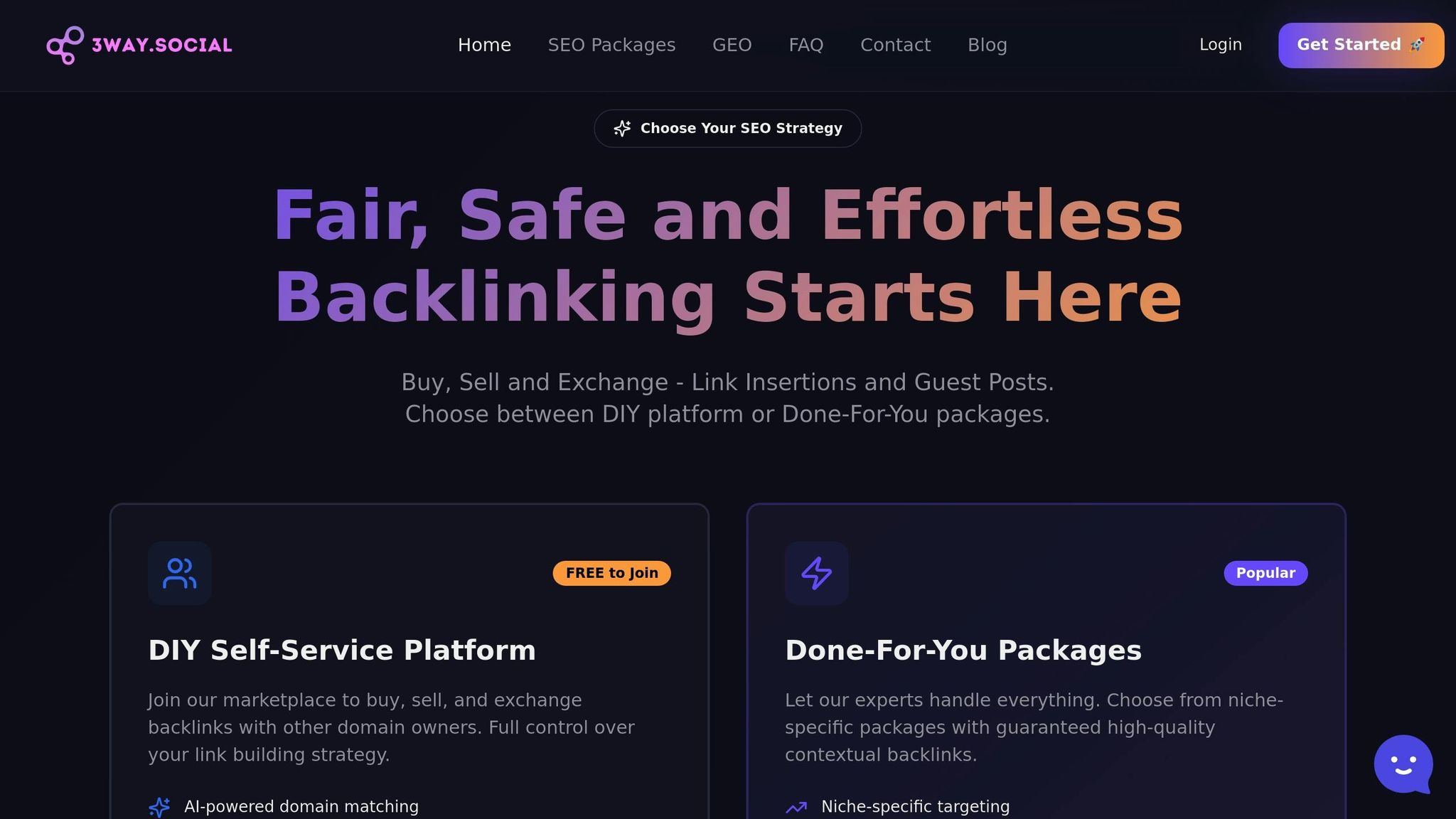
3Way.Social offers a solution that blends AI’s speed with the precision of manual link building. Its AI-driven domain matching ensures connections are based on topical relevance and entity overlap, not just raw authority scores. This approach addresses one of the biggest challenges of automated systems: maintaining editorial relevance and accuracy.
The platform uses an ABC link exchange model, involving three parties to create diverse link patterns that avoid detection by Google’s algorithms. Each exchange includes permanent do-follow links, carefully vetted to eliminate toxic domains and spam signals. By working exclusively with verified SEO professionals, the platform reduces the risk of low-quality placements that could harm your site’s reputation.
For those managing multiple domains, 3Way.Social’s dashboard simplifies the process. It offers tools for link diversification and flexible exchange options, while handling the heavy lifting of prospecting and partner evaluation. AI identifies relevant partners, scores domain compatibility, and manages credit-based exchanges, leaving you in control of approvals. This hybrid approach combines AI’s efficiency with the human judgment needed for sustainable link building.
The platform also expands opportunities by comparing link exchange vs guest posting, allowing you to secure contextual backlinks in relevant editorial content. With secure payment integration and a transparent credit system, you can ensure fair value for each exchange – avoiding overpaying for low-quality links or undervaluing your own domain’s contributions.
Choosing Between AI, Manual, or Hybrid Link Building
When Manual Link Building Works Best
Manual link building shines in scenarios where precision and human judgment are key – like targeting high-profile publications or niche industries. If you’re reaching out to industry influencers or expert sources, a personal touch is essential. Automation alone can’t replace the nuanced communication and editorial expertise required to build meaningful relationships.
For niche sectors, manual outreach is especially effective when relevance and E-E-A-T (Experience, Expertise, Authoritativeness, and Trust) are priorities. Take, for instance, a personal injury law firm that adopted a manual link-building strategy over nine months. The result? A 142% increase in qualified case inquiries, along with appearances in AI-generated answer summaries. Similarly, a restoration company with no prior web presence invested $75,000 in a manual campaign and saw over $1 million in revenue within a year.
“You can automate workflow. You cannot automate reputation.” Stellar SEO
This approach also helps protect your brand’s reputation. Industries like legal, medical, and financial services demand a level of trust that automated templates just can’t deliver. While manual methods excel at relationship-building, AI-driven techniques are better suited for scaling operations.
When AI-Powered Link Building Works Best
AI tools are indispensable when scaling up is the goal. If you’re managing multiple websites or running campaigns that involve hundreds of prospects weekly, AI can handle the workload efficiently. It’s worth noting that 73% of marketers using traditional methods secure fewer than 10 links per month. By contrast, AI workflows can reduce costs by 35% per link and significantly boost output.
Tasks like prospecting, broken link detection, competitor backlink analysis, and relevance scoring can eat up 30–40 hours per week when done manually. For example, a Link Builders agency founder transitioned to AI-assisted workflows in 2024 after a decade of manual efforts. The result? A dramatic increase in efficiency.
AI also improves link quality at scale. Companies using AI-assisted methods reported a 29% boost in the average Domain Rating (DR) of acquired links. Additionally, AI identifies risky or toxic domains 2.1 times faster than manual reviews, helping to avoid penalties while maintaining growth. Tools like 3Way.Social leverage AI to match domains based on topical relevance and entity overlap, addressing one of the biggest challenges in automation while maintaining editorial standards.
Combining AI and Manual Methods
A hybrid approach often delivers the best results, blending AI’s efficiency with human oversight. Let AI handle tasks like data collection, prospecting, and filtering potential domains, while your team focuses on fine-tuning, negotiating, and relationship management. As Single Grain aptly puts it:
“The craft is still human; the heavy lifting is automated.” Single Grain
AI tools can scan for authoritative sites, identify 404 errors, and predict which prospects are likely to respond. Meanwhile, your team can personalize outreach and add editorial touches. This method maintains manual outreach response rates of 15–20%, far outperforming the 2% rate typical of fully automated campaigns.
For example, a 60-day hybrid plan could look like this:
- Days 1–10: Conduct an audit.
- Days 11–20: Use AI for competitor backlink analysis.
- Days 21–30: Build a library of personalized outreach templates.
- Days 31–45: Launch pilot campaigns.
- Days 46–60: Scale using AI-driven reply-intent classifiers.
This phased approach allows you to test and refine your strategy, ensuring a balance between efficiency and authenticity.
Platforms like 3Way.Social embody this hybrid model. They use AI to identify potential partners, score domain compatibility, and manage credit-based exchanges, while leaving final approvals to human judgment. By combining AI’s speed with a human touch, this method ensures sustainable, penalty-free link building.
SEO + AI + Link Building: What Still Matters and What’s Changing
Conclusion
AI and manual link building each bring their own advantages to the table. Manual link building fosters genuine relationships and ensures editorial quality, while AI-driven tools reduce costs by 35% per link and speed up outreach efforts significantly.
The best results often come from a hybrid approach. As Single Grain aptly puts it:
“The craft is still human; the heavy lifting is automated”.
This approach leverages AI for tasks like prospecting, broken link detection, and relevance scoring, while leaving personalization, negotiation, and relationship management to your team. Adopting this model has been shown to boost Domain Rating by 29% and improve outreach success rates. It’s a clear example of how combining technology with human expertise can lead to better outcomes.
Backlinks have evolved beyond being mere ranking signals; they now serve as identity markers that help search engines validate your brand’s expertise and trustworthiness in the real world. In a digital landscape increasingly filled with synthetic content, quality backlinks are crucial, playing a role in 57% of AI Overviews.
Platforms like 3Way.Social illustrate this hybrid strategy in action. They use AI to match domains based on topical relevance and entity overlap, while still relying on human oversight for final decisions. This ensures efficiency without compromising on quality or ethical link-building practices, helping you scale operations while avoiding search engine penalties.
Ultimately, the strategy you choose should align with your goals, budget, and risk tolerance. While automation can handle repetitive tasks, human judgment remains irreplaceable. It’s this balance of AI efficiency and manual precision that will protect your reputation and deliver lasting results.
AI vs Manual Link Building – FAQs
How do I decide between AI, manual, or hybrid link building?
When deciding on AI, manual, or hybrid link building, your choice will depend on what you aim to achieve and the resources you have available.
- Manual link building focuses on creating personalized, high-quality backlinks. While this method often delivers better authenticity and relevance, it can take a lot of time and effort.
- AI tools, on the other hand, are all about speed and scalability. They can streamline the process significantly, but the links they generate might not always feel as genuine or tailored.
- A hybrid approach offers the best of both worlds. By using AI for automation and manual outreach for quality control, you can save time while still building meaningful relationships and meeting today’s SEO standards.
Each method has its strengths, so the right choice depends on your priorities.
How can I use AI without risking Google penalties?
To stay on Google’s good side, use AI for link building in a way that prioritizes ethical, white-hat strategies. Focus on crafting high-quality, relevant content that naturally attracts links and building authentic relationships with others in your industry. Steer clear of black-hat tactics like automated link spamming or acquiring irrelevant backlinks, as these can hurt your site’s SEO and lead to penalties.
What should humans review when AI automates outreach?
When using AI for outreach in link building, it’s crucial for humans to step in and review certain elements to maintain quality. Start by verifying that the target websites are both relevant to your niche and reputable. This helps you steer clear of spammy or low-quality links that could harm your efforts.
Next, examine the tone and level of personalization in the outreach messages. Generic or overly robotic communication can turn off potential partners, so ensure the messages sound natural and tailored.
Finally, keep an eye on response rates and engagement metrics. This helps you identify when follow-ups are necessary or when adjustments to your approach might be needed. Regular human oversight ensures the links you build are genuine, follow SEO guidelines, and uphold ethical standards, all while complementing the automation process.