Last Updated on March 11, 2026 by Becky Halls
Anchor text plays a critical role in SEO by helping search engines understand the context of linked pages. Two common types – exact match and partial match anchor text – offer distinct benefits and risks.
- Exact Match: The clickable text matches the exact target keyword (e.g., “SEO tools”). It provides strong keyword relevance but carries a high risk of penalties if overused. Recommended usage: 1–5% of your backlink profile.
- Partial Match: Combines the target keyword with additional words (e.g., “best SEO tools for agencies”). It’s safer and integrates naturally into content. Recommended usage: 5–15%, or up to 30–40% for specific pages.
Key Differences
- Exact Match: High SEO impact but higher risk.
- Partial Match: Balances relevance and natural flow.
Quick Comparison
| Feature | Exact Match Anchor Text | Partial Match Anchor Text |
|---|---|---|
| Definition | Matches keyword exactly | Includes keyword with modifiers |
| SEO Risk | High | Medium to Low |
| Recommended Ratio | 1–5% | 5–15% (up to 30–40%) |
| Naturalness | Low | High |
| Best Use | Internal links, specific cases | External links, blog content |
Understanding how internal links impact SERP rankings is essential when deciding where to apply exact match anchors.
Takeaway: Use exact match anchors sparingly to avoid penalties and rely on partial matches for safer, more natural linking strategies.
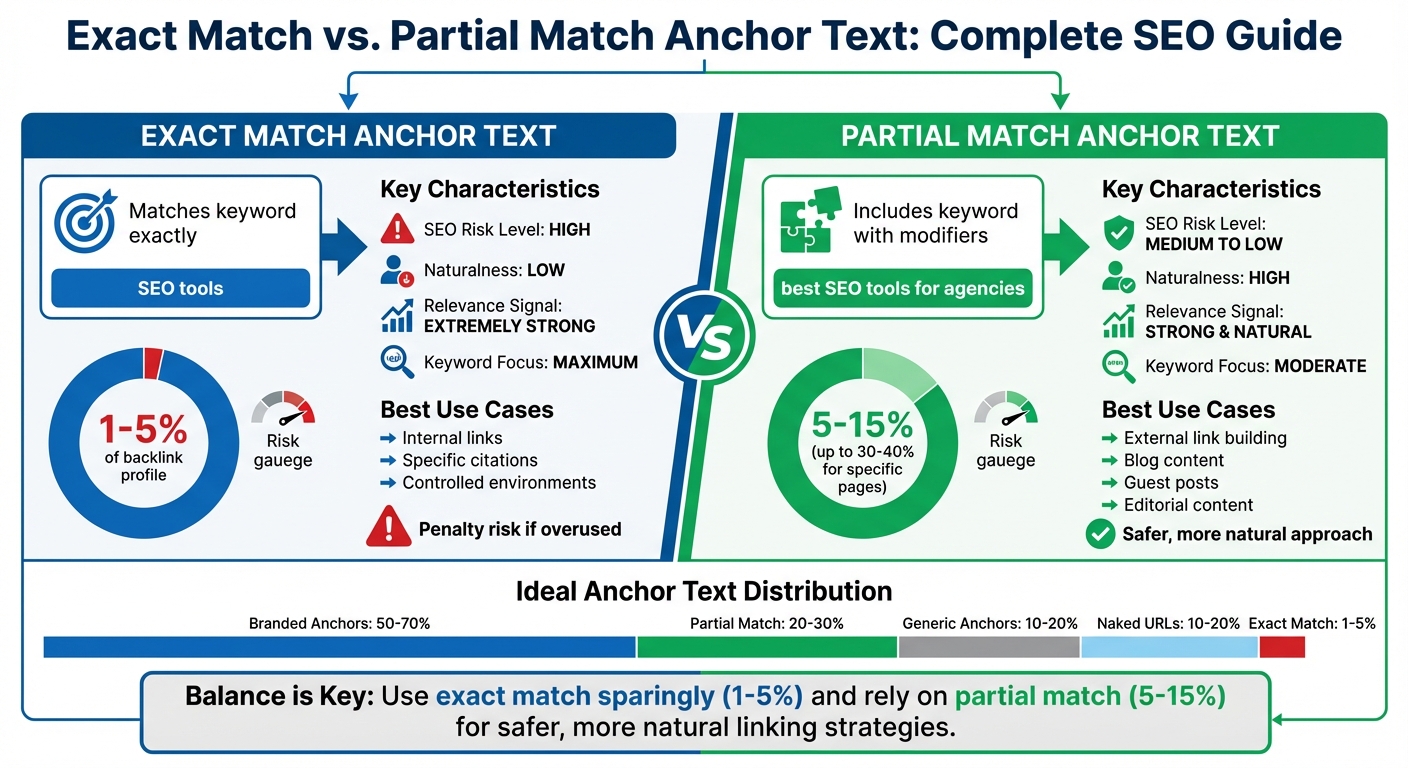
Exact Match vs Partial Match Anchor Text: SEO Comparison Guide
Detailed Anchor Text Strategy that Nobody Talks About
sbb-itb-88880ed
What is Exact Match Anchor Text?
Exact match anchor text refers to hyperlinks where the clickable text is identical to the keyword or phrase that the destination page is targeting. For instance, if your page is optimized for “SEO services”, an exact match anchor would use the phrase “SEO services” as the clickable text. This creates a direct connection between the keyword and the linked page, signaling its relevance to that term.
SEO professionals often consider exact match anchor text a powerful ranking factor. Nizam Ud Deen, SEO Lead Consultant at ORM Digital Solutions, highlights its importance:
“Exact Match Anchor Text is one of the most misunderstood yet influential link-based relevance signals in modern SEO.”
When used for internal linking, these anchors contribute to a well-structured site by reinforcing content relationships and strengthening topic clusters. For external links, however, search engines closely monitor their usage to ensure authenticity.
“We’ve seen exact-match anchors work in small doses, but they become a liability fast when repeated across multiple domains. The pattern is the risk.” Ian Naylor, Founder of 3Way Social
Benefits of Exact Match Anchor Text
When applied thoughtfully, exact match anchor text can boost a page’s authority for specific keywords and help distribute link equity effectively. It also enhances user experience by clearly indicating where the link leads. Jeremy Moser, CEO of uSERP, explains:
“Rather than using phrases like ‘click here’ or ‘learn more,’ Google actually prefers more exact match and closely related variations to the content users click on.”
For internal links, John Mueller, Senior Search Analyst at Google, adds:
“With regards to internal links you’re giving us a signal of context. So basically you’re saying, in this part of my website you’ll find information about this topic.”
Risks of Overusing Exact Match
While exact match anchor text has clear advantages, overusing it can backfire. Excessive reliance on this tactic may result in penalties, reduced link value, or stagnant rankings, as demonstrated by the 2012 Google Penguin update. Experts recommend keeping exact match anchors to less than 5–10% of a site’s backlink profile, ensuring a natural and diverse anchor text strategy. Research shows that a varied anchor text profile often correlates with better search performance.
Modern search engines consider not just the anchor text but also factors like the surrounding content, link acquisition speed, and overall context. A Google representative explained in 2023:
“In general, yes, we don’t trust links from sites we know are spam. This helps us maintain the quality of our anchor signals.”
Balancing the use of exact match anchors with other types, such as partial match anchors, can help maintain a healthy and effective link profile. Up next, we’ll explore how partial match anchor text complements this approach.
What is Partial Match Anchor Text?
Partial match anchor text weaves your target keyword into a broader, more natural-sounding phrase. For instance, instead of just using “SEO tools”, you could go with “best SEO tools for agencies” to give the link a more conversational tone. This approach not only includes the keyword but also adds surrounding context, helping search engines better understand the topic of the linked page.
Chima Mmeje, an SEO Specialist at Moz, explains it this way:
“This linking strategy involves using a variation of the target keyword and additional contextual words, creating a more natural and descriptive link.”
Compared to exact match anchors, which can carry higher risks, partial match anchors strike a balance between effectiveness and safety in SEO.
Benefits of Partial Match Anchor Text
One of the biggest perks of partial match anchor text is how it blends SEO value with a natural writing style. By using keyword variations or longer phrases, these anchors appear less forced, which search engines tend to favor.
Neil Patel, Co-Founder of NP Digital, shares his perspective:
“Partial match anchor texts include your keyword along with other words. I like to use this type of anchor text the most… It’s a useful method because I can still include my keyword without coming across as spammy.”
Another advantage lies in the semantic depth added by related terms. Search engines now analyze not just the anchor text but also the surrounding content. This extra layer of context helps them connect the dots between the source and destination pages.
Research backs this up: a study of 23 million internal links revealed that URLs with varied anchor text – rather than repetitive exact matches – tend to perform better in Google search rankings. Experts suggest that partial match anchors should make up around 30–40% of your backlink profile, a much higher proportion than the 5–10% typically recommended for exact match anchors.
“In our experience, partial-match and branded anchors tend to deliver steadier results over time. They look more natural and still send clear topical signals.” Ian Naylor, Founder of 3Way Social
Examples of Partial Match Usage
Partial match anchors can be created by adding descriptive words to your target keyword. For example, if your keyword is “backlinks”, you might use “high-quality backlinks” or “building backlinks” instead.
Latent Semantic Indexing (LSI) keywords can also enhance your anchors by aligning them with related terms. For instance, instead of repeating “SEO”, you could use alternatives like “search engine optimization” or “website optimization”. Grammatical tweaks, such as turning “optimize” into “optimization” or “optimized”, further diversify your anchor text.
Here’s how partial match anchors are typically used across different types of content:
- Blog posts and product pages: Aim for 20–30% of your anchors to be partial matches.
- Service pages: Keep it at 15–25% to clearly signal what users can expect.
- Product pages: Combine brand names with keywords, like “Ahrefs SEO tool”, to achieve both brand visibility and keyword relevance.
- Guest articles: Use naturally integrated phrases like “using effective link building strategies” to maintain a smooth flow.
These examples highlight how partial match anchors can be seamlessly integrated into content, setting the stage for a comparison with exact match anchors in the next section.
“We’ve noticed anchor text works best when it matches the sentence, not the spreadsheet. If it reads awkwardly, it usually performs awkwardly too.” Becky Halls, Strategist at 3Way Social
Exact Match vs. Partial Match: Side-by-Side Comparison
When comparing exact match and partial match anchor texts, the differences in their strengths and limitations become clear. Knowing these distinctions can help you choose the right approach for your link-building strategy.
The biggest contrast lies in the balance between risk and reward. Exact match anchors send a strong signal of keyword relevance to search engines, which can boost rankings significantly. However, this approach comes with risks, as it may lead to penalties from algorithm updates if overused. On the other hand, partial match anchors strike a middle ground – they maintain solid keyword relevance while appearing more natural to both search engines and readers, reducing the risk of penalties.
Another important factor is how natural the anchors feel in context. Exact match anchors can sometimes seem out of place or forced within content. Partial match anchors, however, integrate more smoothly into sentences, enhancing readability. Danielle Birriel, Founder of D&D SEO Services, highlights this issue:
“Too many exact-match anchors look manipulative. This is one of the fastest ways to get algorithmically suppressed or manually penalized by Google.”
The recommended usage ratios also differ. Experts advise limiting exact match anchors to around 1–5% of your backlink profile. Partial match anchors, being more flexible and natural, can account for 5–15% – or even as much as 30–40% in certain cases, depending on the page type. This aligns with the broader preference for natural, contextually appropriate link-building practices.
Here’s a quick comparison to summarize these key points:
Comparison Table
| Feature | Exact Match Anchor Text | Partial Match Anchor Text |
|---|---|---|
| Definition | Matches the target keyword exactly (e.g., “SEO tools”) | Includes the keyword plus modifiers (e.g., “best SEO tools for 2026”) |
| SEO Risk Level | High (penalty/spam filter risk) | Medium to Low |
| Naturalness | Low (often feels forced) | High (fits editorial context) |
| Relevance Signal | Extremely strong | Strong and natural |
| Keyword Focus | Maximum (directly targets one term) | Moderate (targets keyword plus semantic context) |
| Recommended Ratio | 1–5% | 5–15% (up to 30–40% for specific pages) |
| Primary Use Case | Internal links and specific citations | External link building and blog content |
| User Experience | Immediate clarity on destination | Better flow within editorial content |
When to Use Exact Match Anchor Text
Using exact match anchor text effectively is all about timing and context, especially when it comes to SEO. These anchors work best in controlled settings, like internal links. Jeffrey Bayram, Senior SEO Specialist at JumpFly, highlights this advantage:
“Internal links are where you have the most control, making them the best place to focus anchor text optimization. Strategic internal anchor text helps search engines crawl your site more effectively.”
In internal linking, exact match anchors strengthen topical connections. For instance, linking a blog post to a pillar page using the exact keyword helps search engines clearly understand the relevance of the destination page. This tactic avoids the over-optimization risks that often come with external backlinks.
When it comes to external backlinks, the rules are stricter. Keeping exact match usage to a minimum – around 1–2% of your backlink profile – is a safer approach, as seen in the practices of top-ranking pages. David McSweeney, SEO Researcher and Author, advises:
“I would suggest exact match at around 1.5% and phrase match at around 33% will keep you on the right side of Google.”
This highlights the importance of maintaining a diverse anchor text profile to improve rankings and avoid penalties.
Save exact match anchors for natural scenarios, such as citing a resource by its title. Before adding one, review your backlink profile carefully – if rankings dip, consider removing it immediately. The goal is to apply relevance strategically, not excessively. A single, well-placed exact match anchor can give a page the boost it needs, but only when it’s part of a varied and natural-looking link profile. This balanced approach ties seamlessly into the broader strategy of maintaining a healthy backlink profile.
When to Use Partial Match Anchor Text
Partial match anchor text strikes a balance between keyword relevance and maintaining a natural linking profile. It’s especially useful for external link-building efforts, like guest posts and editorial content. Neil Patel, Co-Founder of NP Digital, puts it this way:
“I like to use this type of anchor text the most. It’s an especially useful method because I can still include my keyword without coming across as spammy.”
This subtle approach makes partial match anchors a great fit for a variety of content types.
Experts recommend keeping partial match anchors at a 30–40% ratio within your overall link profile. This range helps reduce the risk associated with exact match anchors while offering more relevance than generic ones. They work particularly well on resource pages, how-to guides, or blog articles – places where descriptive phrases naturally fit. In competitive niches, where search engines carefully analyze link profiles, partial match anchors can be a lifesaver. If an audit reveals that exact match anchors make up more than 5–10% of your links, partial matches can help dilute that risk.
For best results, keep partial match anchors concise – two to five words is ideal. Before hitting publish, read the sentence aloud. If the clickable text feels awkward or forced, tweak it to ensure it flows naturally for both readers and search engines.
Best Practices for Anchor Text Optimization
Recommended Anchor Text Ratios
Creating a balanced anchor text profile involves using a mix of anchor types in specific proportions. This balance is crucial for signaling to search engines that your site is trustworthy and not engaging in manipulative practices. Most SEO professionals suggest that branded anchor text should dominate, making up about 50–70% of your links. This category includes your company name, naked URLs (like www.yoursite.com), and natural phrases. These types of anchors are considered low-risk and help establish your site’s authority.
Partial match anchors – those that include variations of your target keywords – should make up 20–30% of your profile. They strike a good balance between keyword relevance and a conversational tone. Generic anchors like “click here” or “read more” should account for 10–20%, adding to the organic feel of your profile. Finally, exact match anchors, which use the exact target keyword, should stay below 5–10%. Karen Gardner from BASE Search Marketing emphasizes:
“Best practice these days is to keep exact match links down to less than 5–10%.”
Here’s a quick overview of these ratios:
| Anchor Type | Recommended Range | Risk Level |
|---|---|---|
| Branded | 50–70% | Low |
| Partial Match | 20–30% | Medium |
| Naked URL | 10–20% | Low |
| Generic | 10–20% | Low |
| Exact Match | 1–5% | High |
These percentages provide a solid foundation, but the real key lies in ensuring your anchors integrate seamlessly into your content.
Why Contextual Relevance Matters
Anchor text ratios are important, but the context of your links is what truly amplifies their SEO value. Search engines analyze not just the anchor text itself but also the surrounding content to understand the relationship between backlinks and SEO. When the context around a link aligns with the anchor text and the linked page, it strengthens the connection and boosts its effectiveness. On the other hand, if the surrounding content feels disconnected, even a high-authority link can lose some of its potential impact.
Google highlights this in its guidelines:
“The better your anchor text, the easier it is for people to navigate your site and for Google to understand what the page you’re linking to is about.”
Misleading anchors – where the text promises one thing but the linked page delivers another – can lead to higher bounce rates, which search engines take as a negative signal. If your anchor text feels awkward or unnatural when spoken aloud, it’s time for a rewrite.
Using 3Way.Social for Secure Link Building

Building a natural anchor text profile requires quality backlinks that avoid over-optimization. This is where 3Way.Social plays a crucial role, helping balance exact match and partial match anchors effectively. With its features, the platform lays the groundwork for a well-rounded backlink strategy.
Key Features of 3Way.Social
One standout feature is its AI-powered domain matching, which connects your site with partners that are contextually relevant. By placing your anchors on pages naturally related to your content, it strengthens the SEO signals sent to Google. For example, a partial match anchor on a page discussing similar topics is far more effective than a keyword-stuffed link from an unrelated site.
The platform also prioritizes link diversification. Instead of manually tracking percentages like a 1–5% exact match threshold or a 5–15% partial match range, 3Way.Social helps you maintain these healthy ratios seamlessly across your backlink profile. It emphasizes permanent do-follow links, which are key to passing link equity through optimized anchor text. To ensure quality, all partners are strictly vetted, so your backlinks come from authoritative sources – not spammy sites that could harm your SEO efforts.
How 3Way.Social Supports Anchor Text Optimization
These features translate directly into smarter anchor text management. As SEO expert Cyrus Shepard notes:
“Diverse anchor text performs better than exact-match optimization”
3Way.Social uses equitable ABC link exchanges to create a varied anchor profile. This includes branded, partial, and occasional exact match anchors, all while maintaining contextual relevance. This balanced approach aligns with best practices and keeps your backlink profile strong and natural.
The platform also offers guest posting opportunities within its vetted network. This gives you editorial control over anchor placement, letting you craft partial match anchors that flow naturally within the content. This solves a common problem: if your anchor text feels awkward when spoken aloud, it could be flagged as manipulative. On top of that, the platform’s intuitive dashboard allows you to monitor your anchor text distribution, making it easier to spot and fix over-optimization issues before they affect your rankings.
Conclusion
We’ve taken a deep dive into how carefully chosen anchor text can shape SEO outcomes. The key takeaway? Context is everything. Use exact match anchors sparingly to maintain strong relevance, while partial matches help ensure a more natural flow.
Data backs this up: exact match anchors should make up only 1–5% of your backlink profile, with partial matches accounting for 5–15%. The majority – around 60–80% – should consist of branded anchors and naked URLs. This balanced distribution reflects the kind of natural linking behavior search engines value.
SEO Backlinks Grid underscores this point:
“Anchor text optimization in 2026 is about achieving natural distribution, not maximizing keyword anchors”
Gone are the days of keyword-stuffed linking strategies. A study of 23 million internal links shows that URLs with greater anchor text variation consistently attract more Google search traffic. This shift toward diversity and context is what sets lasting SEO strategies apart from fleeting tricks.
As your site grows, your anchor text strategy should evolve too. Early on, focus on branded and generic links. Over time, introduce partial match anchors in relevant contexts, and reserve exact matches for moments where they fit naturally. Regular audits – say, quarterly – can help you avoid over-optimization penalties.
FAQs
How can I tell if my exact match anchors are overused?
Keeping an eye on the percentage of exact match anchor texts in your backlink profile is crucial. If more than 20% of your backlinks rely on exact match anchors, it could raise a red flag for over-optimization, potentially leading to penalties. To keep things looking natural, aim for less than 20% exact match anchors. Instead, prioritize a mix of branded, generic, and partial match anchor texts. Make it a habit to regularly review and tweak your anchor text ratios to stay on the safe side.
Do internal links need the same anchor text ratios as backlinks?
Internal links operate a bit differently from backlinks when it comes to anchor text. While variety in anchor text is essential for both, internal links place a greater emphasis on relevance and descriptive language rather than sticking to specific ratios. Prioritize anchor text that includes keywords and fits naturally within the context – it helps users navigate your site and assists search engines in grasping your content’s structure.
That said, don’t go overboard. Over-optimization can make your links feel forced and unnatural. Keep your anchor text varied and meaningful to create a seamless and effective internal linking strategy.
What’s the easiest way to diversify anchor text safely at scale?
The simplest way to safely diversify anchor text on a larger scale is by using partial match anchors. These include variations, synonyms, or longer phrases connected to your keywords. This approach feels more natural compared to exact match anchors and lowers the risk of triggering penalties from Google.
By mixing in keyword variations – like singular and plural forms or closely related terms – you can build a more diverse and contextually relevant link profile. This not only strengthens natural linking signals but also boosts your SEO efforts.