Last Updated on June 15, 2026 by Ian Naylor
If I want more local search traffic, I need local backlinks. They help show Google that my business belongs in a city or service area, which can support both map pack visibility and local organic rankings.
Here’s the short version:
- 46% of Google searches have local intent
- Businesses in the local 3-pack get 126% more traffic and 93% more actions
- Backlinks make up about 31% of local organic ranking influence
- In the local pack, backlinks account for about 19% of influence, versus 7% for citation signals
What I’d take from this article is simple:
- I should focus on local links first, not generic link volume
- The best targets are chambers, local news sites, directories, sponsorship pages, partner sites, and community organizations
- I should judge each link by local fit, topic fit, placement, traffic, and ease of getting it
- I should track rankings, referral traffic, and Google Business Profile actions after links go live
- A small group of clean local links can do more than a large batch of random ones
This article explains why that works, where to find those links, how to get them, and how to tell which ones are helping.
Local SEO Backlinks How To Get More Backlinks
sbb-itb-88880ed
How to Find the Right Local Backlink Opportunities
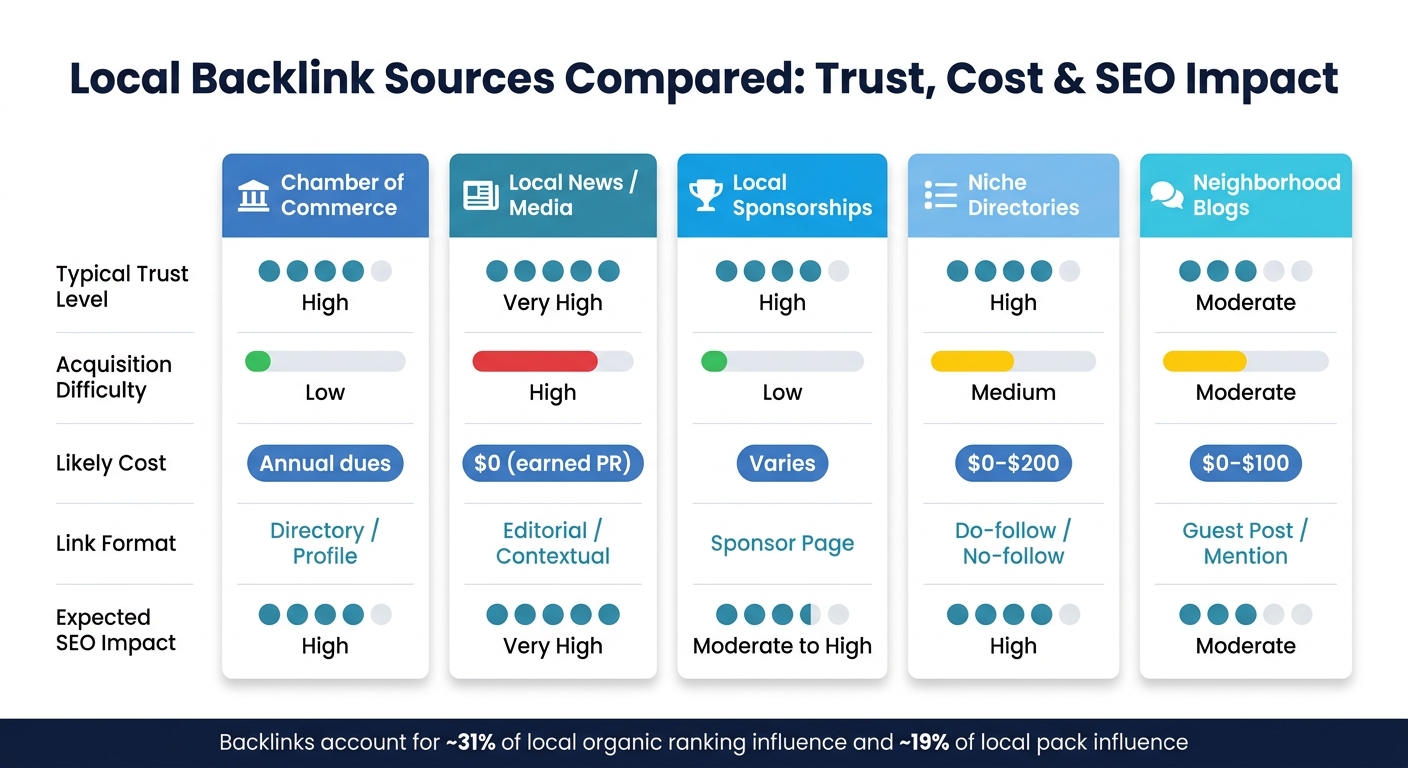
Local Backlink Sources Compared: Trust, Cost & SEO Impact
Don’t chase raw volume. Build a short list of local sources you can actually get and that make sense for your market.
Start with sources that are local, trusted, and easy to confirm.
Best Local Sources to Target First
Go after places that publicly tie your business to a city or service area. A smart place to begin is with local link building tactics like chambers, BBB listings, city and county directories, and niche industry directories.
Then branch out to local media, neighborhood publications, and community groups like nonprofits, schools, churches, youth sports leagues, and event pages. These sources can lead to citations, mentions, and contextual links from the local web.
How to Research Prospects by City and Service Area
Google search operators can help you build a prospect list fast. Try searches like "become a sponsor" AND "[city name]", "local sponsor" AND "[city name]", or "[industry] directory" AND "[city name]" to surface relevant local pages fast. It also helps to check city, county, and metro-area variations so you don’t miss useful local domains.
Competitor backlink audits are just as useful. Pick two or three local competitors that rank well in your market, then look at where they’ve earned links. You’ll often spot local media mentions, neighborhood directories, or association pages you hadn’t thought about yet.
If a site links to a competitor but not to you, that’s a strong prospect for your list.
Once your list starts to take shape, compare each source by trust, cost, and link type.
Comparing Local Link Source Types Before Outreach
Compare sources before outreach.
| Source Type | Typical Trust Level | Acquisition Difficulty | Likely Cost | Link Format | Expected Impact |
|---|---|---|---|---|---|
| Chamber of Commerce | High | Low | Annual dues | Directory/Profile | High |
| Local News/Media | Very High | High | $0 (earned PR) | Editorial/Contextual | Very High |
| Local Sponsorships | High | Low | Varies | Sponsor Page | Moderate to High |
| Niche Directories | High | Medium | $0–$200 | Do-follow/No-follow | High |
| Neighborhood Blogs | Moderate | Moderate | $0–$100 | Guest Post/Mention | Moderate |
"The type of backlinks you build matters just as much as the number. And if your business serves a specific city, county, or metro area, local backlinks are the ones that will actually move the needle." – Ethan Priest, Cofounder, Foxtown Marketing
Use the table to rank prospects by trust, effort, and fit.
Next, sort those prospects by quality so your outreach starts with the best odds.
How to Evaluate and Prioritize Local Links That Can Move Rankings
Once you have a prospect list, score each site before outreach. Not every local site deserves your time. A fast review helps you spend effort on links that are more likely to improve regional visibility.
Quality Checks for Local Backlink Prospects
For local rankings, geographic fit and topical fit matter more than generic authority metrics. A site with lower authority can still beat a much stronger domain if its link profile is tightly focused on your service area.
When you review a prospect, look for a few simple signals:
- The city or neighborhood appears in the H1 tag or URL
- The page is indexed
- The link sits in the main content, not in a footer or buried in a directory
- The site gets traffic from the same city or region as your business
One of the best local signals is a citation-style link. That means your business name, address, and phone number appear next to the link. That setup strengthens physical location signals and local relevance.
Skip sites with spam signals. The link should feel natural for a real person reading the page, not just for a crawler. That simple filter keeps your focus on links that support local prominence, not just domain strength.
How to Build a Simple Priority System for Outreach
After the quality check, score each prospect across four factors: local fit, business relevance, traffic potential, and ease of acquisition. Start with sites that clear the local-fit and relevance checks first.
A neighborhood sponsorship can be a smart way to earn a trusted local mention and backlink. Sometimes that kind of link does more for local search than a bigger site with no tie to your area.
Using 3Way.Social to Scale Vetted Backlink Outreach
If your team needs to scale vetted outreach, 3Way.Social can cut down the manual work. Its AI-powered domain matching surfaces relevant local and topical partners without requiring manual search, the network is pre-screened so you spend less time checking sites, and links placed through the platform are permanent do-follow links with ABC exchanges that help diversify your link profile.
Use your highest-scoring prospects in the outreach steps that follow.
Step-by-Step Process to Earn Local Backlinks
Step 1: Set Up Your Local SEO Foundation
Before you start outreach, get your local SEO basics in order. That means optimizing your Google Business Profile and checking your current backlink profile for local fit.
Here’s the simple idea: if most of your links come from generic sites with no tie to your city, that weakens local relevance. Use your target city list to keep your NAP and outreach consistent. That helps reinforce the geographic relevance and prominence signals local backlinks are supposed to support.
Once that base is in place, go after the easiest wins first: directories, partners, and local media.
Step 2: Earn Links Through Directories, Partnerships, and Local Coverage
Start with the most accessible local links: chambers, trade groups, partners, and local media.
Then look at the relationships you already have offline. Vendors and community organizations you work with are natural backlink targets. Reach out with one useful story angle for each local outlet. And check for unlinked mentions too. If your business shows up in a local event recap or news story without a link, ask for one. It’s a simple way to turn existing visibility into authority.
After you’ve locked in those baseline links, move into sponsorships and event-based placements.
Step 3: Use Events, Sponsorships, and 3Way.Social to Expand Reach
Use the next set of tactics to grow reach without drifting away from local relevance.
Sponsorships work well for local link building. They can help you earn links from trusted local organizations, often on .org or .edu domains.
If your team needs more local links at scale, 3Way.Social surfaces vetted, geographically aligned opportunities through AI-powered domain matching.
How to Measure Results and Refine Your Local Link Strategy
Track Rankings, Traffic, and Local Business Profile Actions
Once your local backlinks are live, give them time to work. Then watch what happens over the next few months. The goal isn’t just to count links. It’s to see which ones are helping your regional rankings.
Focus on four signals:
- local pack visibility
- city-specific keyword rankings
- referral traffic
- Google Business Profile actions like calls, direction requests, and website clicks
Map-rank tools can show how your visibility shifts across ZIP codes and neighborhoods. That matters because local search performance can change block by block, not just city by city.
For organic search, use Google Search Console and filter by your local landing pages. This helps you see whether impressions and clicks are going up for city-specific queries.
Review Backlink Quality and Repeat What Works
Not every local link pulls its weight. Some send traffic. Some help rankings. Some do both.
A simple way to sort this out is to tag each link by source type, such as sponsorship, local news, chamber, or partner. That makes it easier to spot which groups are driving rankings and engaged referral traffic. From there, you can separate high-impact local links from placements that look nice on paper but don’t do much.
Review new links every month. Check rankings and leads every quarter. As LSEO puts it:
"Local link building rarely behaves like paid media; its benefits compound over time." – LSEO
If a source sends referral traffic but no conversions, look at the page people land on. Does it have a clear local call to action? If impressions are high but clicks are low in Search Console, your meta titles may not match local intent. And if one source type keeps falling flat, put more effort into the link types that are driving the strongest results in your target metro areas.
Conclusion: Local Relevance and Consistent Outreach Drive Better Rankings
Local backlinks show that your business matters in a given market. And that can help regional visibility in a big way. In many cases, a small set of clean, well-placed local links beats a much larger pile of generic ones.
The numbers back that up. Link signals account for about 31% of local organic ranking influence. In the local pack, backlinks account for about 19% of influence, compared with 7% for citation signals.
The businesses that keep seeing results tend to follow the same pattern: get the base local links in place first, track what changes rankings and leads, and keep adjusting based on what the data says. That’s what turns a one-off push into a system that keeps working.
FAQs
How many local backlinks do I need?
It depends on your industry and how tough the local search results are. In lower-competition areas, 5–10 strong local backlinks can move the needle.
In more competitive markets, you may need 50 or more locally relevant referring domains to see a similar effect.
How long do local backlinks take to improve rankings?
Most businesses start seeing ranking movement within 2–6 weeks after a strong local backlink gets indexed.
That timeline tends to be shorter in less competitive markets. In dense urban areas, where long-established competitors already have a strong presence, changes often take longer to show up.
Can local backlinks improve Google Business Profile actions?
Yes. Local backlinks can help improve Google Business Profile actions like calls and direction requests because they add stronger local relevance and search signals.
That tends to matter even more when those links come from relevant, nearby, and trusted sources, and when they support a Google Business Profile that’s complete and accurate.