How Automated Link Exchange Tools Work
How platforms automate link exchanges: site profiling, direct or ABC matching, human approval, placement tracking, and quality checks.

Last Updated on June 25, 2026 by Ian Naylor
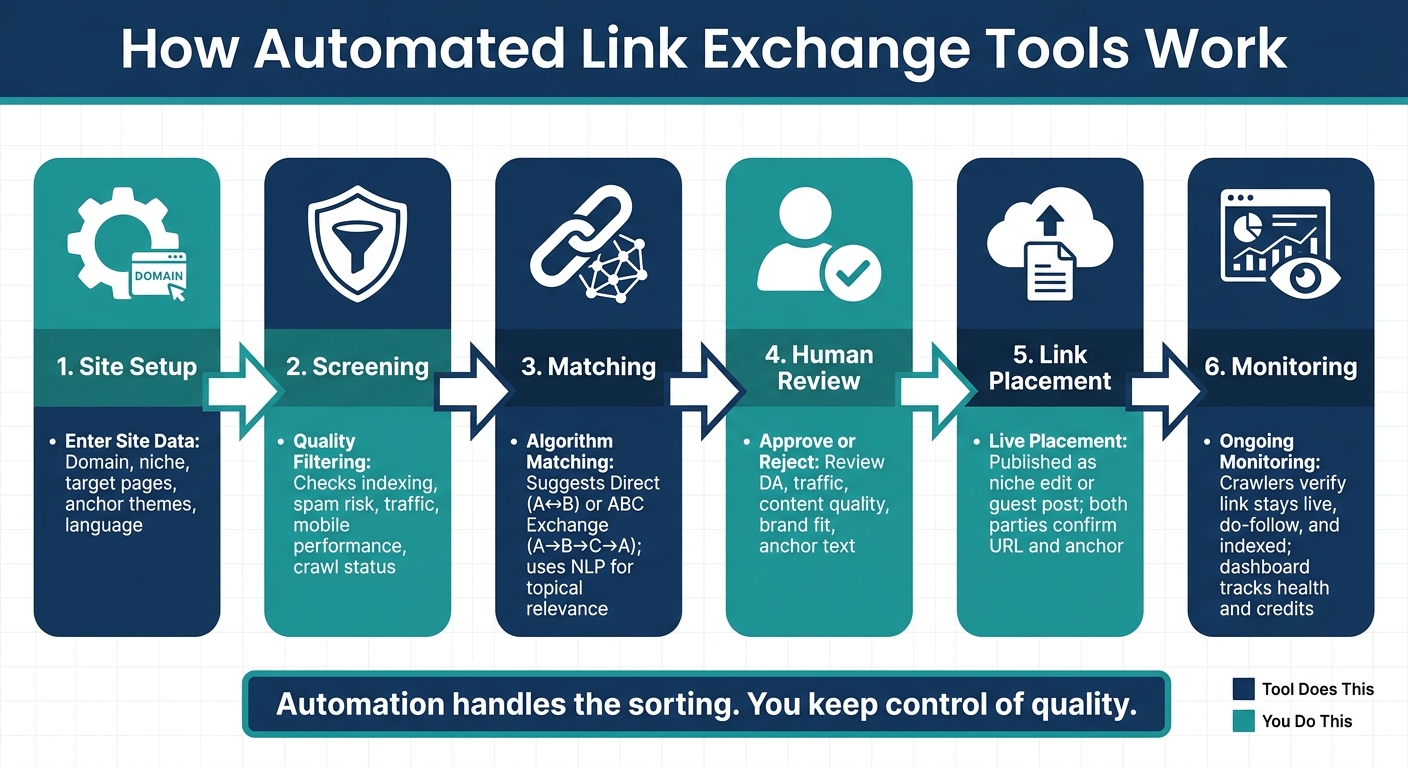
Automated link exchange tools cut most of the manual work out of link building. I’d sum it up like this: the software reads your site data, filters out weak sites, suggests matches, routes direct or 3-site exchanges, and then checks whether each live link stays active.
If you want the short version, here it is:
- I add my domain, target pages, anchor themes, language, and niche
- The tool checks site health, traffic signals, spam risk, and crawl status
- It suggests either direct swaps or ABC exchanges
- I approve or reject each match by looking at relevance, traffic, and content quality
- The system tracks whether links stay live, do-follow, and indexed
- Credits often control supply and demand, where I host links to earn credits and use them to get placements
A lot of the value comes from filtering. If a platform screens for indexing, mobile performance, spam patterns, and traffic before showing me a partner, I waste less time on bad fits. And with ABC exchanges, the tool can coordinate a 3-site loop that would take a lot more back-and-forth by hand.
Here’s the core idea in one glance:
| Part | What the tool does | What I still need to do |
|---|---|---|
| Site setup | Reads domain, niche, keywords, pages, language | Enter accurate data |
| Screening | Checks health, spam signals, and traffic | Review edge cases |
| Matching | Suggests direct or ABC partner paths | Decide if the fit is right |
| Placement | Routes requests and tracks status | Confirm page quality and anchor choice |
| Monitoring | Checks live status, do-follow state, indexing | Fix or replace weak placements |
Bottom line: the software can sort, score, route, and monitor. I still make the call on brand fit, page quality, and anchor text. That matters, because even a strong system can make poor suggestions if the source data is weak or the review step is too loose.
One more point worth keeping in mind: human review is still the safety check. Even if a tool shows solid metrics, I’d still look at the site itself before approving anything.
That’s how I’d frame the article in plain English: automation handles the heavy admin work, while I keep control over quality.
How Automated Link Exchange Tools Work: Step-by-Step
How to Automate Backlinks with Hermes Agent!

sbb-itb-88880ed
1. Site Data the System Uses to Find Matches
Before matching begins, the platform builds a site profile from the details you provide. That profile powers the matching engine.
Domain details, topic relevance, and link preferences
The system looks at your URL, niche, target keywords, link-exchange preferences, link placement types, target pages, anchor themes, and location or language settings. In plain English, it’s trying to figure out what your site is about, what kind of links you want, and which partners make sense.
Use varied anchor text to avoid over-optimization. If every link says the same thing, that can look forced. Location and language matter too, because they shape match quality and help the system line up sites that fit your audience.
Quality signals and eligibility filters
Once your profile is in place, the platform runs eligibility checks before it suggests any matches. It checks indexing status, organic visibility, page speed, mobile optimization, and crawl access. If a site has major technical problems, it may be flagged or left out until those issues are fixed.
The platform also reviews your current backlink profile for spam patterns. Then it looks at domain age, referring domain diversity, and historical link growth to decide if a site can qualify as a partner. When it ranks partners, it weighs domain authority, traffic, and spam score.
After the system filters the pool, it can score the remaining sites for direct or ABC link exchanges.
2. How Matching Algorithms Build Link Exchange Opportunities
Once the platform narrows the pool, the matching engine starts pairing sites and deciding which exchange setup makes sense. Then it ranks the partners that look like the best fit.
Direct reciprocal matches vs. ABC exchange logic
The most basic setup is a direct reciprocal exchange: Site A links to Site B, and Site B links back to Site A. It’s simple and easy to arrange. But if you lean on it too much, search engines may treat the pattern like spam.
ABC exchange logic works a bit differently. It uses a three-site chain: Site A links to Site B, Site B links to Site C, and Site C links back to Site A. That makes the pattern less obvious than a straight two-way swap. Platforms like 3Way.Social use AI-powered domain matching to coordinate ABC exchanges that are both balanced and well-tracked.
Doing an ABC exchange by hand is a headache. You need three sites that all agree, move on the same schedule, and follow through. Automation takes care of that behind the scenes.
How the system scores relevance, balance, and fit
After the platform picks the exchange type, it ranks matches based on relevance and link value. The first filter is topical relevance. The system uses Natural Language Processing (NLP) to spot semantic relationships that go beyond exact-match keywords, so it can match sites with similar topics and overlapping audiences.
From there, the algorithm ranks each option by overall fit. It also balances value by adjusting the number and quality of placements. On top of that, it applies diversification rules and tracks your current anchor profile to avoid over-optimized patterns.
3. Review, Approval, and Link Placement Workflow
The platform sends each match to a human review step before any link goes live. Once the matching engine finds a candidate, the next move is yours.
Approving or rejecting suggested matches
You review each candidate site with filters such as Domain Authority (DA), traffic volume, and topical category. That gives you a simple first pass. It helps you cut sites that don’t fit your link profile before you spend extra time checking them by hand.
Then comes the part software can’t fully handle: your judgment. Does the site’s content line up with your brand? Is the quality steady from post to post? Automation covers the data side, but you still need to confirm editorial quality yourself. It’s also smart to look at the partner’s recent activity before you send a request.
When you decide to move ahead, use the platform’s Request option to set the destination URL and anchor text. You can accept the page the system suggests, or you can propose a specific placement page on the partner’s site. If both sides agree, the platform converts the request into a live placement.
Publishing links and verifying they stay live
After approval, the link is published as a niche edit or guest post. From there, the platform checks that the link stays live, do-follow, and properly indexed. Crawlers revisit each placement and flag broken links.
You can track all of this from one dashboard, including:
- Link health
- Credit balance
- Domain metrics
- Approved/Declined status
4. Quality Controls, Risk Checks, and Key Takeaways
After matches are generated, the platform runs quality checks to stop weak or risky exchanges before they go live.
Filters that reduce spam and poor-fit exchanges
Serious platforms don’t stop at matching. They run checks afterward to screen for topical relevance, authority, real traffic, content quality, and link placement quality.
On 3Way.Social, each potential partner is evaluated for spam risk before a match is suggested. And those checks aren’t meant to work in isolation. They work together, like layers of defense.
| Quality Check | What It Protects Against |
|---|---|
| Spam-risk screening | Partners flagged by Google or showing toxic link patterns |
| Traffic verification | Sites with strong metrics but little or no real organic traffic patterns |
| Editorial quality review | Thin, copied, or low-quality content |
What to keep in mind before using a platform
Once a platform suggests a match, the next step is deciding whether that match should be approved at all. Automated tools can handle site data collection, matching logic, exchange routing, and live placement checks. But the output is only as good as the input data and the rules used to approve each match.
That’s the part people sometimes miss.
The platform’s controls should help you review faster, not do all the thinking for you. The best results usually come from relevant partners, permanent do-follow links when they make sense for the placement, and a careful review before anything goes live.
Automation can take care of the heavy lifting. But calls about editorial quality, brand fit, and anchor text strategy still sit with you.
The goal is simple: automate the sorting, keep the standards strict.
FAQs
Are automated link exchanges safe for SEO?
Automated link exchanges can be safe for SEO when they automate the workflow, not the actual creation or placement of links.
That difference matters. Google prohibits automated link placement as a spam tactic. But using tools for research, outreach sequencing, and performance monitoring is standard practice.
Platforms like 3Way.Social support secure ABC exchanges by putting the focus on quality checks, topical relevance, and link patterns that look natural.
What makes an ABC exchange better than a direct swap?
An ABC link exchange works better than a direct swap because it uses a triangular setup: Site A links to Site B, Site B links to Site C, and Site C links back to Site A.
That matters because it avoids the plain two-way pattern that search engines can flag as unnatural.
Instead of looking like a simple “you link to me, I’ll link to you” deal, this setup makes the backlink profile look more varied and natural. It also spreads link equity across three domains, not just between two sites in a basic trade.
How much manual review is still needed?
AI-powered platforms like 3Way.Social can take care of domain matching, vetting, and performance tracking. That saves time on the repetitive work and gives you a cleaner starting point.
But the strongest results usually come from using automation with human review.
Let AI handle the screening and analysis first. Then do a quick manual sanity check to make sure each partnership lines up with your broader marketing plan. And when niche relevance is hard to pin down, review the links yourself instead of relying on the tool alone.