Last Updated on June 16, 2026 by Ian Naylor
SEO plans fail when teams don’t work together. In one case from the article, a SaaS company lost 60% of its traffic after a site move that left SEO out, and it took months to win much of it back.
If I were judging an SEO partner, I’d look for six things first:
- Active listening to find the business problem before talking tactics
- Clear communication for execs, writers, and developers
- Calm response to change when priorities shift or Google Core Algorithm Updates hit
- Cross-team thinking that connects SEO with content, dev, PR, and analytics
- Strong follow-through so tasks, owners, and deadlines don’t get lost
- Open reporting that shows results, blockers, and next steps
This comes down to one simple idea: SEO only works when other people can act on it. Soft skills now carry more weight too, with 81% of SEO pros saying they matter more by 2026, and firms that put more weight on them seeing 67% higher client retention.
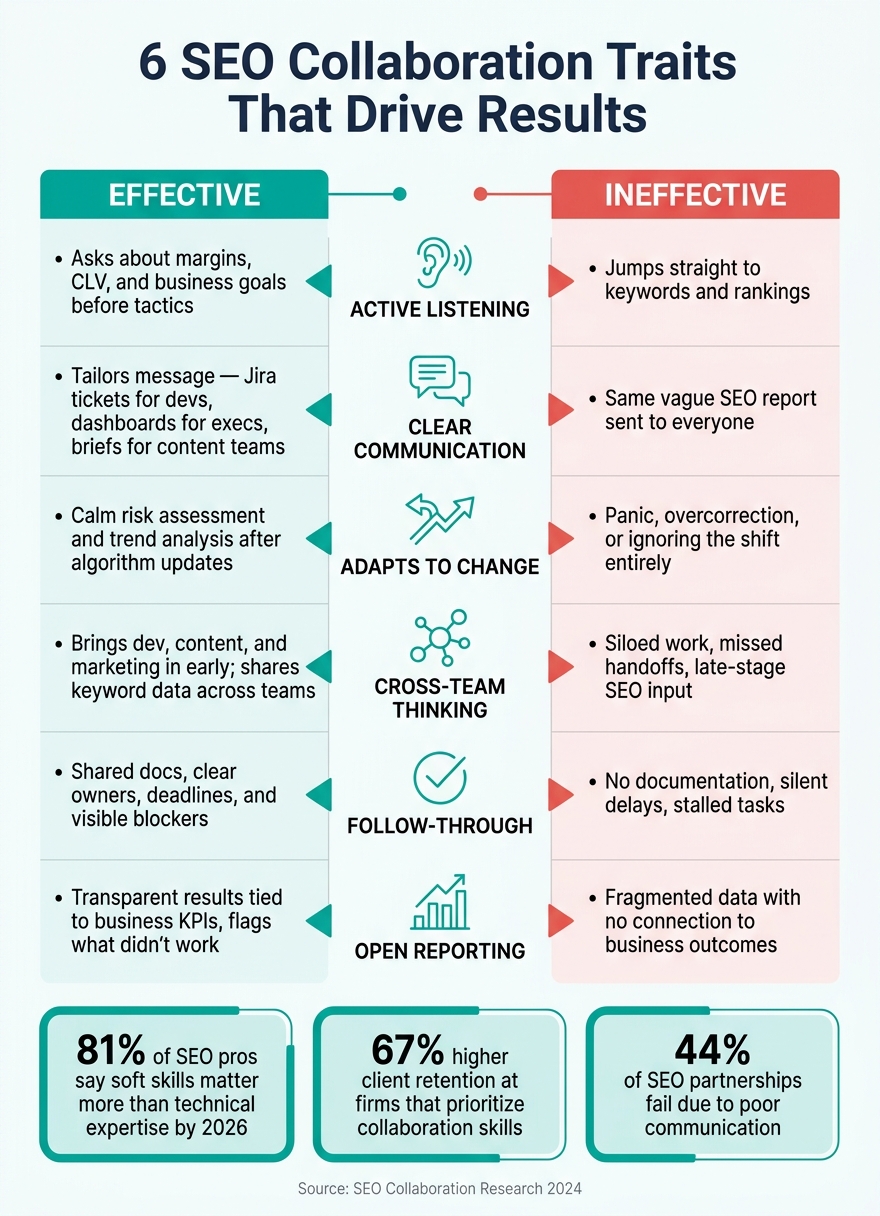
6 SEO Collaboration Traits: Effective vs. Ineffective Behaviors
How Can Cross-Functional Collaboration Make Us Better SEOs? | SEOs Getting Coffee EP.21
sbb-itb-88880ed
Quick comparison
| Trait | What I’d look for | What it helps prevent |
|---|---|---|
| Active listening | Good questions, clear recaps, business context | Work aimed at the wrong problem |
| Clear communication | Tickets, briefs, and updates matched to each team | Confusion and rework |
| Response to change | Steady updates and fact-based decisions | Panic or random course changes |
| Cross-team thinking | Early input from dev, content, and marketing | Siloed work and missed handoffs |
| Follow-through | Shared docs, owners, deadlines, status checks | Stalled tasks and silent delays |
| Open reporting | Plain-English results and visible blockers | Mistrust and bad decisions |
Bottom line: I’d pick the SEO who can get work shipped across teams, not just the one who gives smart advice.
Why Collaboration Traits Matter In SEO Partnerships
Technical SEO only works when people act on it. That’s the line between advice and implementation.
When teams don’t work well together, things get messy fast: rework piles up, timelines slip, and link value gets wasted. The usual trouble spots look like this:
| Collaboration Failure | Business Impact |
|---|---|
| Siloed content | Wasted budget on articles that miss SEO requirements |
| Vague technical requests | SEO tasks stall in the development backlog |
| Redesign without SEO input | Broken redirects and lost rankings |
| Misaligned KPIs | Internal friction and fragmented data |
This is exactly why active listening and requirements discovery need to come first.
1. Active Listening And Requirements Discovery
The first trait shows up before strategy: listening well enough to define the real problem.
Strong SEO collaboration starts with the business problem, not the tactic. If you skip that step, even smart recommendations can miss the mark.
Observable Collaboration Behaviors
You can spot active listening in the way someone asks questions and plays back what they heard. Strong SEO collaborators don’t jump straight into rankings, keywords, or fixes. They slow down and ask what the business is trying to do in the first place.
They dig into the business model, margins, customer journey, and customer lifetime value before talking about tactics. They also summarize key points and send short recap emails so details don’t slip through the cracks.
"SEO discussions that consider the knowledge and input from various cross-functional teams lead to the best output."
Impact on Implementation Speed
When SEO requirements are clear from the start, work moves faster. Technical recommendations are easier to ship and less likely to get stuck in the backlog. Content teams also avoid having to rewrite articles later because SEO was brought in too late.
A simple move helps here: bring engineers into the project early to save time later.
Stakeholder Alignment Value
Listening matters most when it changes how teams make decisions. A strong SEO collaborator can turn technical findings into actions that executives can approve without a long decoding session.
That matters more than ever. 81% of SEO professionals expect soft skills to matter more than technical expertise by 2026, and companies that put more weight on those skills report 67% higher client retention rates.
Trust and Accountability Signals
Clear scope builds trust. So does explaining why the strategy is changing. And when someone restates a complicated request in plain English, it often surfaces hidden blockers before they turn into delays.
| What to Ask | Observable Behavior | Why It Matters |
|---|---|---|
| Business Context | Asks about margins and customer lifetime value | Strategy aligns with revenue, not just traffic |
| Technical Constraints | Consults with devs before proposing fixes | Faster implementation and fewer blockers |
| User Intent | Analyzes search journey and intent | Content satisfies actual user needs |
| Stakeholder Needs | Identifies hidden blockers | Higher trust and long-term buy-in |
Once requirements are clear, the next test is whether the SEO can explain them clearly enough for others to act.
2. Clear And Contextual Communication
Clear communication means shaping the message for the people who need to act on it.
In plain English: the same SEO recommendation should not look the same for every team. A good SEO professional can turn one insight into a developer ticket, an executive summary, and a content brief without losing the point.
Observable Collaboration Behaviors
Strong SEO collaborators turn findings into directions that each team can use right away. For developers, that usually means specific Jira tickets with acceptance criteria and technical user stories. For example, "As a user, I need a unique canonical URL to avoid content duplication" works far better than a vague spreadsheet with a few notes.
For executives, the approach changes. They don’t need a wall of SEO terms. They need the short version, plus the business effect.
The framing should shift with the audience:
- Sales teams need to hear about leads and revenue
- Content teams need detailed briefs tied to search intent and brand voice
- Developers need clear implementation details they can build from
Impact on Implementation Speed
Vague SEO requests slow teams down. When requirements are unclear, engineers have to guess what’s missing, and that often leads to rework.
Clear tickets, shared content briefs, and getting involved early in the design phase help cut that down. Teams that use regular briefings and debriefings can reduce errors by up to 30% within the first 90 days.
Stakeholder Alignment Value
The right framing depends on who’s in the room. Recommendations linked to revenue, risk reduction, or customer experience tend to move up the product roadmap faster.
| Stakeholder | Observable Behavior |
|---|---|
| Executives | Brief dashboards and short audit summaries |
| Developers | Tickets with clear acceptance criteria and technical user stories |
| Content Teams | Detailed content briefs aligned to SEO and brand voice |
| Sales/Marketing | Data connecting SEO performance to leads and revenue |
Trust and Accountability Signals
Trust grows when communication stays steady and honest, especially when something goes off track. People notice when issues are flagged early, mistakes are admitted plainly, and decisions are written down in shared tools.
That way, developers, content teams, and executives can all work from the same plan instead of chasing different versions. It also makes sudden priority shifts a lot less messy.
3. Adapting To Changing Priorities And Algorithm Updates
Priorities can change fast, and algorithm updates show how well an SEO works with other teams when the pressure is on. A major update rarely hits just one area. It can affect content, development, and leadership all at once. That means responsiveness matters just as much as technical skill.
Observable Collaboration Behaviors
This kind of flexibility often looks like steadiness. Strong SEO professionals don’t panic when rankings move or when a new update changes the SERP. They look at the actual impact, adjust the plan based on patterns instead of noise, and stay open to new tools and ways of working.
One international agency reported 25% higher productivity and 30% faster response to major algorithm changes after adding psychological safety workshops and collaborative crawl tools.
Impact on Implementation Speed
Strong SEO collaborators don’t sit around waiting for perfect data. They move with informed judgment. More than that, they help the team stay on the same page by spelling out what changed, what isn’t known yet, and what happens next.
Stakeholder Alignment Value
When an algorithm update lands, non-technical stakeholders don’t need a giant dump of ranking data. They need a plain-English explanation. Strong SEO collaborators turn messy search changes into clear business stories, which helps the company stay aligned on why the work matters.
Trust and Accountability Signals
One of the clearest signs of trust is ownership when results lag. Technical explanations that dodge responsibility can damage confidence fast. Strong collaborators keep people aligned by explaining what changed, what is still uncertain, and what comes next.
Here’s what that looks like in practice:
| Adaptation Signal | Weak Behavior | Strong Behavior |
|---|---|---|
| Algorithm Update | Panic, instant overcorrection, or ignoring the shift | Calm risk assessment, trend analysis, and a refined direction |
| Data Uncertainty | Waiting for perfect clarity or guessing | Making informed decisions based on patterns and context |
| Priority Shift | Chasing every new hype cycle or metric swing | Keeping focus on the work that moves the needle |
| Communication | Hiding behind jargon when results are weak | Translating shifts into business-impact narratives |
4. Cross-Functional Collaboration Mindset
Once priorities change, the next hurdle is simple: can SEO help move the work across teams?
SEO never sits in one corner by itself. It affects content, development, PR, analytics, and even sales. Someone with a cross-functional mindset gets involved early and shows up ready to help, not just to hand over a list of fixes.
Observable Collaboration Behaviors
You can spot this mindset in the way a person talks and works with other teams. A strong SEO partner turns technical SEO needs into developer-ready user stories with clear acceptance criteria, like heading hierarchy or canonical URL rules, so developers can move fast.
They also use keyword research as customer-intent data, then share it with content and paid media teams. And they pull in input from customer-facing teams to sharpen buyer personas and bring pain points into the open.
"SEO discussions that consider the knowledge and input from various cross-functional teams lead to the best output."
Impact on Implementation Speed
That shared language helps work get done faster. When SEO is part of the brief from the start, teams avoid a lot of back-and-forth later. Content can be shaped with search in mind during planning, not after the draft is done.
The same goes for technical work. Recommendations are less likely to sit in a dev backlog for weeks when everyone is working from the same plan.
Stakeholder Alignment Value
SEO gets a lot easier to support when it’s tied to business results instead of just search numbers. If teams can see how SEO connects to the full customer journey, analytics and marketing can link their work to conversions, not only traffic.
Shared KPIs help too. They turn performance into a team goal instead of making SEO carry the whole load alone.
Trust and Accountability Signals
Trust tends to build fast when SEO fixes a problem another team already wants solved. One win can change the tone of the whole working relationship and make future buy-in much easier.
A few habits help keep that trust in place:
- Shared workspaces
- Written strategies
- Clear handoff maps
These make ownership easier to track and follow-through easier to see.
That kind of coordination only works when projects stay organized and follow-through stays visible.
5. Organization And Project Follow-Through
Organization and follow-through keep SEO work from getting stuck between teams. You can usually spot this fast: the work is written down clearly, ownership is obvious, and the next step isn’t left hanging.
Observable Collaboration Behaviors
Organized SEO pros record decisions, owners, and next steps in one place so handoffs are smoother and people can look back later without digging through Slack threads or old emails. They also track work in shared project spaces, where owners, deadlines, and blockers stay out in the open.
For link building, that often means using a link building planner to log outreach status, placement dates, and follow-up tasks. After each sprint, retrospective meetings help the team note what worked and carry those lessons into the next sprint.
Impact on Implementation Speed
Good documentation is only part of the story. The next thing to watch is whether the work keeps moving.
Strong teams assign follow-up tasks, deadlines, and checkpoints before launch. They also use shared content briefs that spell out the target audience, business impact, and SEO requirements. That gives each department the same starting point, so editorial, IT, and SEO stay lined up around the same goals.
Trust and Accountability Signals
Regular status updates, visible progress, and direct access to source data make accountability much easier. People don’t have to guess what’s happening or chase down answers.
When follow-through is steady, trust tends to grow with it. That kind of discipline also makes SEO decisions easier to judge with data.
6. Data-Driven Decision Making And Transparency
Once the work is organized, the next question is simple: can everyone see what happened, and can they explain why it happened?
Data transparency means sharing results and the thinking behind them. In SEO, that doesn’t just mean showing what changed. It means explaining what the data says and how it should shape the next move. The point isn’t more reports sitting in inboxes. The point is faster, clearer decisions across teams.
Observable Collaboration Behaviors
Strong SEO partners talk about performance changes in business terms, not just traffic charts and ranking swings. They flag issues early, keep decisions visible in shared docs, and don’t go quiet when the numbers aren’t great.
In link building, that looks like sharing:
- outreach status
- live placements
- performance changes
Just as important, they don’t hide weak spots. If a campaign stalls, everyone should know.
Impact on Implementation Speed
Decision checkpoints help teams change course based on results, not templates. That’s a big deal. It keeps people from repeating the same playbook just because it’s familiar.
Teams that run regular briefings and debriefings can increase experiment velocity and reduce errors by up to 30% within the first 90 days.
Stakeholder Alignment Value
Role-based reporting gives each stakeholder the same data in the format they can use. That might mean executive dashboards for C-suite leaders and more detailed, jargon-free technical reports for developers.
When everyone works from the same underlying data, alignment tends to happen faster and with less friction. People may still disagree, sure. But they’re arguing from the same starting point.
"When we all start from the same inputs, we may not draw the same conclusions, but we’re going to have much smaller differences." – Teresa Torres, Product Discovery Coach
Trust and Accountability Signals
A simple way to keep momentum visible: track completed work against planned work. Weekly updates that show planned work, completed work, and blockers cut down on the constant "what’s happening?" back-and-forth.
When rankings drop or algorithm updates hit, strong teams run blameless reviews. They look at the data patterns without turning the meeting into a finger-pointing session. That keeps the focus on learning and helps trust hold steady, even when results take time to build.
Where These Traits Show Up In Day-To-Day SEO Work
You can spot these traits in the handoff points: keyword research to content brief, audit to engineering ticket, launch to post-mortem. That’s where the work stops being theory and starts affecting output.
Content briefs are one of the first places this shows up. Good collaborators build SEO needs into the brief from the start, including audience, business goal, metadata, and internal linking.
Communication becomes easiest to judge when SEO findings have to turn into action. Technical audits make that plain. Developers need Jira tickets with implementation details, priority, acceptance criteria, and impact metrics. Leadership, on the other hand, needs a short summary tied to revenue risk or upside.
Sprint planning and roadmap reviews are where organization and cross-functional thinking show up side by side. SEOs who work well with other teams bring prioritized fixes into sprint planning, so everyone can sort quick wins from dependencies and longer-term work.
The last test is whether the team closes the loop after launch. Post-launch reviews are built for that. Strong teams run retrospectives after major launches or ranking shifts to document what happened, why it happened, and what to test next.
Effective Vs. Ineffective SEO Communication
You can spot good SEO communication fast. It shows up in tickets, meetings, and status updates.
And bad SEO communication? Same places.
The difference usually comes down to how SEO professionals write, explain, and report their work. Things like active listening, clarity, organization, and transparency aren’t abstract soft skills. They show up in day-to-day collaboration. The clearest test is simple: how the same SEO message changes based on the audience and the goal.
Here’s how that plays out across five common collaboration points:
| Behavior | Effective | Ineffective |
|---|---|---|
| Active Listening | Summarizes next steps clearly and acknowledges constraints. | Assumes intent and ignores stakeholder priorities. |
| Ticket Quality | Technical user stories with clear acceptance criteria and impact metrics. | Vague requests like "make site faster" with no context or priority. |
| Jargon Use | Frames technical issues in terms of business value, like revenue, risk, or UX. | Leans on SEO buzzwords that alienate finance, sales, and leadership. |
| Follow-through | Documents decisions and updates progress consistently. | No documentation and silent delays. |
| Stakeholder Updates | Transparent reporting tied to business KPIs – including what didn’t work. | Fragmented data with no connection to business outcomes. |
In day-to-day work, this often means turning SEO language into business language. For example, instead of leading with a term dump, say: "We’re targeting keywords that drive more conversions."
That kind of communication matters even more when SEO work relies on outside partners and shared link-building workflows.
Collaboration In Link-Building Networks
Link building is where teamwork gets tested in the open.
Unlike on-page SEO, this work depends on other people: publishers, guest post editors, and link partners. And those people have their own rules, timelines, and expectations. If communication slips, things go sideways fast. You get missed placements, strained relationships, or a link profile that adds risk you didn’t need in the first place.
That pressure shows up in the data too. Poor communication is the top reason SEO partnerships fail at 44%, followed by misaligned expectations at 38% and failure to tie SEO work to business results at 35%.
The best link-building partners keep things simple and smooth. They handle requirements fast, deliver content that’s ready to publish, set placement terms early, and move approvals along without drama. In a structured network, speed helps. But reliability matters just as much.
Structured exchange networks, where links move across several sites in a planned pattern, can cut reciprocal linking risk while keeping coordination and approvals easier to manage. The goal isn’t volume for the sake of volume. It’s relevance, clear terms, and risk control. Platforms like 3Way.Social are built for this setup, with secure ABC link exchanges, domain-relevant partner matching, and access to vetted SEO professionals for guest posting and link diversification.
When you vet partners, focus on a few things that matter:
- Topical relevance
- Traffic quality
- Clear reporting
A niche-relevant site with real organic traffic is usually a better fit than a high-authority site that barely matches your topic. On the flip side, partners with no organic traffic, high spam scores, or lots of sitewide or footer links should be ruled out. That kind of discipline is what separates a managed link program from random outreach.
Managed Vs. Unmanaged Link-Building Relationships
When link building relies on outside partners, the way those relationships are handled becomes a form of risk control. Managed link building cuts risk. Unmanaged outreach tends to add more of it. In many unmanaged campaigns, teams may send 200+ emails just to land 5–10 placements, and cold email reply rates can drop to 1–5%.
The main issue with unmanaged relationships is simple: there’s no system behind them. Good partner relationships need ethical link building practices, clear rules, and steady follow-through. Managed platforms put those guardrails in place. They use domain matching and vetting to screen for quality, which helps remove weak or risky domains before they cause trouble.
Here’s where the gap usually shows up:
| Factor | Unmanaged Outreach | Managed/Vetted Environment |
|---|---|---|
| Partner Quality Control | High risk of PBNs, thin content, or penalized domains | Rigorous vetting for traffic, indexation, and topical fit |
| Domain Evaluation Transparency | Incomplete or easily gamed metrics | Transparent review of traffic trends, spam scores, and link profiles |
| Accountability for Placements | Stalled approvals and missed placements can slip through without follow-through | Structured follow-through with placement terms agreed in advance |
There’s also a plain relationship advantage. Outreach to known contacts gets a reply rate 8x higher than cold outreach. That gap isn’t random. Managed relationships cut friction for both sides: publishers know the process, and SEO teams don’t have to start from zero each time. That kind of consistency is what makes link building repeatable.
Conclusion
These six traits show who can turn an SEO plan into action when the pressure is on. Put them together, and you start to see the gap between giving SEO advice and actually getting SEO work done.
Teams that put soft skills near the top tend to see higher client retention, and complex SEO programs rely on good collaboration to cut risk and move work faster.
For hiring and vendor review, one of the fastest tests is how people handle behavior-based questions. Use these traits as a filter. Ask questions like, "Tell me about a time you got stakeholders to prioritize SEO work." In multi-team SEO programs, these traits build on each other: they line up strategy, keep execution moving, and turn reporting into something people can act on.
FAQs
How do I assess SEO collaboration skills in an interview?
Look for candidates who can explain technical SEO in plain English, work through disagreements without drama, and tie SEO work to bigger business goals.
Ask for specific examples of cross-functional work. You want to hear how they set roles, manage expectations, stay transparent, listen to feedback, and adjust their approach so teams stay aligned.
Which SEO collaboration trait matters most?
Communication is often seen as the top SEO collaboration trait. It turns complex technical data into clear business takeaways that people can act on. And just as important, it helps win support from stakeholders who may not speak SEO every day.
It also keeps cross-functional teams – like developers and content creators – on the same page about their roles, expectations, and shared SEO goals.
How can teams improve SEO collaboration quickly?
Teams can improve SEO collaboration fast when they work toward the same goals and track the same metrics. Core Web Vitals is a good example. When everyone looks at the same numbers, it’s much easier to spot issues, talk through trade-offs, and move in the same direction.
Shared workspaces help too. They make information easier to find, cut down on back-and-forth, and give people a clearer view of what’s happening across SEO, content, design, and development.
Recurring blameless post-mortems can smooth out the process over time. Instead of pointing fingers, the team looks at what happened, what got in the way, and how to fix it next time. That tends to reduce friction and make collaboration less tense.
It also helps to bring SEO stakeholders into discovery and design early. That small shift can prevent technical bottlenecks before they slow down the project.
Tools like 3Way.Social can help streamline link diversification and backlink coordination, which makes cross-team work easier to manage.