Last Updated on June 25, 2026 by Ian Naylor
Anyone can call themselves an SEO specialist. That does not mean they can help your business.
If I were screening an SEO hire today, I’d check five things first: who they are, what type of SEO they do, whether their certifications can be verified, whether their past results tie to traffic or revenue, and whether references back up the story. That matters because bad SEO can lead to lost rankings, wasted time, and lost revenue.
Here’s the short version:
- Check identity first: legal name, business name, website, LinkedIn, email, and phone number should match.
- Match the SEO type to your need: technical, content, local, eCommerce, link building, or AI search and LLM results.
- Verify certificates at the source: look for a public badge URL or certificate ID, not just an image.
- Ask for proof of results: GSC, GA4, crawl reports, rankings, leads, and revenue data.
- Test hands-on skill: use live questions about indexing, JavaScript, faceted navigation, or crawl waste.
- Call references: ask what shipped in the first 30 days, whether reporting matched internal numbers, and whether they’d hire that person again.
A few facts stand out. In the article, a 2025 survey of 412 marketing directors found that 61% had dropped at least one SEO partner in the prior 24 months. The top reasons were poor communication (44%), misaligned expectations (38%), and failure to tie SEO work to business outcomes (35%). That tells me one thing: titles and certificates are not enough.
If I had to sum up the whole process in one line, it would be this: hire only when identity, skills, proof, and references all line up.
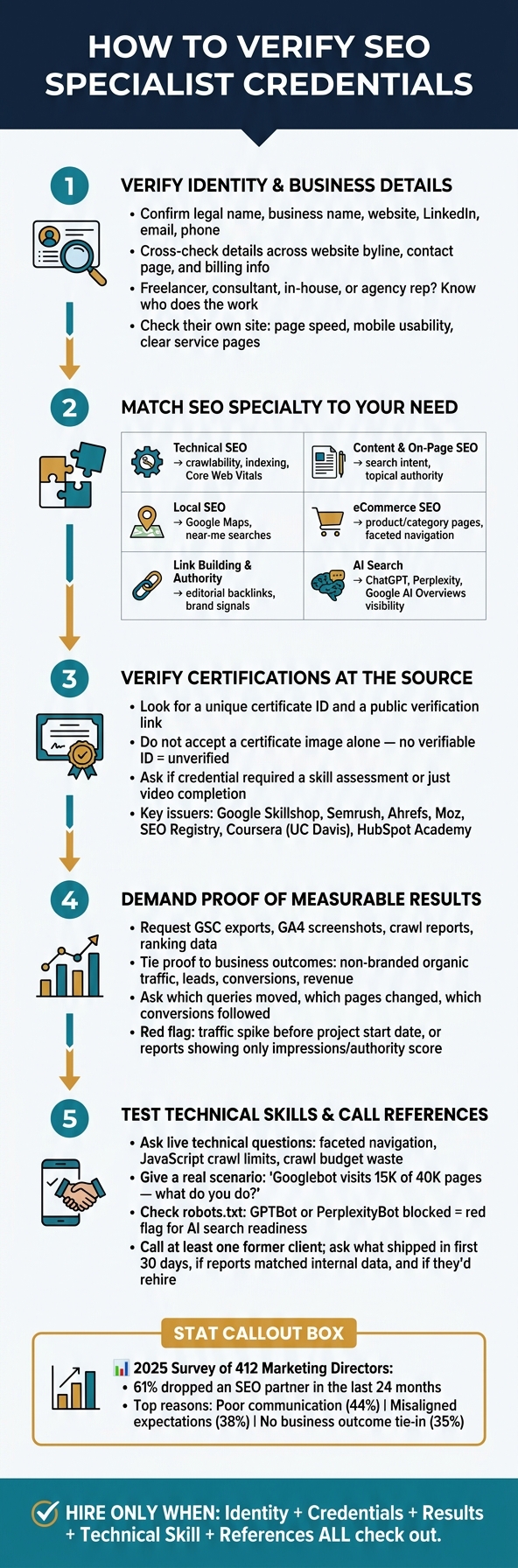
How to Verify SEO Specialist Credentials: 5-Step Checklist
Where to start your screening
Before you dig into certifications, do a few basic checks first. This helps you make sure the person, the business, and the role all match up.
Confirm identity, business details, and role
Check the person behind the claim before you assess the claim itself. Start with their legal name, business name, website, LinkedIn profile, email, and phone number. Then cross-check those details across their website byline, contact page, and billing information. If the details don’t line up, treat that as a red flag.
You’ll also want to confirm how they work. Are they a freelancer, consultant, in-house specialist, or agency representative? That matters because you need to know whether you’re screening the person who will do the work or someone speaking for a team.
Take a look at their own site too. Check page speed, mobile usability, and whether the service pages are clear. If their site feels sloppy, it may indicate a lack of white hat SEO tactics and day-to-day discipline.
Identify the SEO specialty they claim
"SEO specialist" sounds simple, but it covers a lot of ground. Fixing crawl issues is not the same job as building local search visibility or getting editorial backlinks. Before you go further, pin down the specialty they actually claim.
Match the title to the work you need.
| Specialty | Primary Focus | Use when |
|---|---|---|
| Technical SEO | Crawlability, indexing, XML sitemaps, robots.txt, site architecture, Core Web Vitals | Large sites, migrations, indexing issues |
| Content & On-Page SEO | Search intent, topical authority clusters, semantic structure | Improving rankings for informational or commercial queries |
| Local SEO | Google Maps, "near me" searches, mobile search patterns, local citations | Brick-and-mortar businesses and service-area businesses |
| eCommerce SEO | Product and category pages, faceted navigation | Online retailers focused on direct sales |
| Link Building & Authority | High-quality editorial backlinks and brand signals | Competitive niches and low-authority domains |
| AI Search | Visibility in AI engines like ChatGPT, Perplexity, and Google AI Overviews | Brands that want visibility in AI-driven search |
Once the role lines up with your needs, move on to the certifications and the groups that issued them.
sbb-itb-88880ed
How to check certifications and issuing bodies
Once you’ve confirmed the SEO role, the next step is simple: check who issued the credential and how you can verify it. SEO doesn’t have a universal license, so a certificate only matters if you know where it came from and what it actually shows.
Check the issuing body and how to verify it
Most reputable issuing bodies fall into three groups:
- Major platforms like Google and HubSpot
- SEO tool vendors like Semrush, Ahrefs, and Moz
- Independent registries or universities like the SEO Registry or Coursera‘s UC Davis program
Each of these gives you a way to confirm that the credential is real.
When a specialist shares a certificate, look for two things: a unique certificate ID and a public verification link. Then check the credential in the issuer’s public lookup tool. If the certificate only exists as an image and has no verifiable ID, treat it as unverified.
It also helps to ask how the credential was earned. Did the person pass a skill assessment, or did they just finish a set of video lessons? Audit-based credentials involve manual review, so they tend to be a stronger signal than a quiz-only certificate.
What each credential type actually proves
The table below shows the credential types you’ll see most often, what they prove, and where they fall short.
| Credential Type | Issuing Source | How to Verify | What It Proves | What It Does Not Prove |
|---|---|---|---|---|
| Analytics | Google (Skillshop) | Public profile or badge URL | Data literacy, GA4 setup, reporting skills | Real-world ranking or link-building success |
| Tool-Specific | Semrush, Ahrefs, Moz | Certificate ID or public verification link | Fluency in specific SEO software | General SEO strategy or creative execution |
| Audit-Based | SEO Registry | Public registry lookup | Manual auditing skills, technical eye | Successful implementation or developer coordination |
| Academic | Coursera (UC Davis), Simplilearn | Platform verification | Completion of structured, long-form curriculum | Current knowledge of 2026 AI updates |
| Marketing | HubSpot Academy | Public badge URL | Understanding of SEO within a broader marketing funnel | Deep technical SEO or log file analysis |
Some credentials carry more weight than others. A Google Analytics 4 certification is worth putting near the top of the list because it shows the specialist can measure results, not just do tasks. Tool-specific certifications from Semrush or Ahrefs also matter because they confirm hands-on fluency with software SEO practitioners use every day.
Academic programs like Coursera’s UC Davis program usually offer more depth, but there’s a catch: course material can lag behind fast-moving changes like Generative Engine Optimization (GEO), which is a major focus in 2026.
After you’ve verified the credential, the next thing to check is whether the specialist has produced measurable results.
How to review work history and past results
At this stage, look at the track record, not just the title or certification.
Match claims to documented SEO outcomes
A portfolio full of logos doesn’t tell you much on its own. Neither does a long client list. What you want is direct proof: GSC exports, GA4 screenshots, crawl reports, and ranking data. Then tie that proof to a business result.
That means asking whether something that matters actually changed, such as:
- non-branded organic traffic
- lead volume
- conversion rate
- revenue attribution
If someone makes a big claim, go one layer deeper. Ask which queries moved, which pages changed, and which conversions followed. That’s where the story either holds up or falls apart.
Good case studies usually show four things: the baseline, the actions taken, the timeline, and the outcome.
How to separate claims from evidence
Vague wording is often the first sign that a claim doesn’t hold up. Phrases like “improved rankings” or “increased visibility” sound nice, but they don’t mean much without a starting point, a timeframe, and data behind them.
Here’s a simple way to check what’s being claimed against what can be proven.
| Claimed Result | Verifiable Proof to Request | Red Flag |
|---|---|---|
| "Boosted organic traffic" | GSC export filtered for non-branded queries over a 12-month period | Traffic spike occurred before the project start date |
| "Improved technical health" | Before-and-after crawl reports showing resolved 404s, duplicate content, or Core Web Vitals scores | Audit only mentions basic meta tags or alt text |
| "Increased leads or revenue" | GA4 conversion paths, CRM lead-source data, or assisted conversion reports | Report only highlights total impressions or authority score |
| "Built high-quality backlinks" | Actual URLs of earned placements on relevant domains | 100+ links acquired in a single week from unrelated niches |
| "Optimized for AI search" | Evidence of citations in AI Overviews or LLM responses, plus FAQ schema or direct-answer blocks | robots.txt blocks GPTBot, PerplexityBot, or ClaudeBot |
Even strong results need hands-on proof.
One of the best follow-up questions is simple: ask them to walk through one project that underperformed. What went wrong? Why did it happen? What did they change after that?
That kind of answer tells you a lot more than a polished win story.
If the numbers hold up, the next step is to check the hands-on technical skill and the references behind the work.
How to confirm technical skills and check references
Once the paper trail checks out, it’s time for live proof: technical questions, work samples, and reference calls.
Confirm hands-on technical and platform skills
Use live questions to see whether the person can do the work, not just talk about it.
Start with platform-specific questions. Ask how they handle faceted navigation on Shopify, or how they deal with how much JavaScript Googlebot can process on a React-based site. Someone who knows the job will walk you through CMS-specific limits right away. Someone who doesn’t will usually fall back on a vague, one-size-fits-all reply.
Then test how they read crawl data. Put a real case in front of them: "Googlebot is only visiting 15,000 of our 40,000 pages. What do you do?" A strong technical SEO should be able to explain the fix, the tradeoffs, and the likely impact. You can also give them a staging-site audit with noindex tags and broken canonicals, then ask them to sort fixes by business impact.
Modern technical SEO now covers AI search visibility too, so your screening should cover both crawl control and citation readiness. That means checking robots.txt rules and whether the site can show up cleanly in AI results. A simple test works well: append /robots.txt to a domain they managed. If it blocks GPTBot or PerplexityBot, that’s a red flag.
Check references, client proof, and verified professional network
After you test technical ability, verify the person through people who’ve worked with them directly.
References only help if you ask the right questions. Always ask for at least one former client, not just current ones. Former clients usually have less reason to soften the story, and their answer about why the work ended can tell you a lot.
When you speak with references, stay focused on four areas:
- What they shipped in the first 30 days
- How the specialist handled disagreements
- Whether their reports matched internal analytics
- Whether the reference would hire them again for the same scope
That last question tends to cut through polished answers fast.
For outreach-heavy roles, references should confirm both placement quality and transparency. Ask direct questions about tactics. A trustworthy specialist should be able to explain where links were placed, why those placements made sense, and whether the link profile shows steady, explainable growth, not a sudden spike of 50+ links in one week from unrelated niches. If they’re part of a vetted professional network, such as 3Way.Social, that’s a useful signal. Platforms that vet their SEO members and require quality standards add a layer of accountability that a solo reference call can’t fully match.
A 2025 survey of 412 marketing directors found that 61% had churned at least one SEO partner in the previous 24 months. The top reasons were poor communication (44%), misaligned expectations (38%), and failure to connect SEO work to business outcomes (35%). Most of those issues show up during reference calls, if you know what to listen for.
Conclusion: Build a proof-based checklist before you hire
By this stage, you’ve covered the full verification path: identity and business details, certifications and issuing bodies, documented results, technical depth, and past-client feedback.
Only hire when identity, credentials, results, technical skill, and references all hold up.
FAQs
What red flags matter most when vetting an SEO specialist?
The biggest red flag is any promise of specific rankings or overnight success. No agency controls Google’s ever-changing algorithms, so claims like that should make you stop and look closer.
Other warning signs are just as telling: vague metrics, poor transparency, black-hat tactics like excessive link buying or keyword stuffing, generic case studies, unusually low prices, or an obsession with vanity metrics instead of qualified leads, conversions, and revenue.
How can I tell if an SEO certification is valid?
Focus on the issuing platform, not just the certificate itself. Certifications from names like Google, HubSpot, Moz, and Semrush tend to carry more weight because they require exams on ethical search guidelines and core SEO concepts.
That said, certifications are only a starting point. SEO doesn’t have a formal licensing body, so these credentials show foundational knowledge and a willingness to keep learning. They don’t prove results, and they don’t replace hands-on experience.
What proof should I ask for before hiring an SEO specialist?
Ask for verifiable data, not just PDFs or marketing claims. Request raw exports or live access to Google Search Console and GA4 so you can check before-and-after performance for yourself.
It also helps to ask for a redacted technical audit, a sample content brief, a documented SEO roadmap, and client references. Good specialists don’t hide behind vague promises. They walk you through their process, explain what they did and why, and back it up with evidence that points to steady, long-term growth.