Last Updated on March 25, 2026 by Ian Naylor
AI-powered link building simplifies finding and securing backlinks by using algorithms to analyze data and automate outreach. This approach prioritizes quality over quantity, focusing on building credible links that benefit both search engine rankings and references in AI-generated content. Here’s what you need to know:
- What It Is: AI tools streamline tasks like data collection, scoring link authority, and personalizing outreach.
- Why It Matters: Ethical practices are essential to avoid penalties from tools like Google’s SpamBrain, which flags manipulative links.
- Key Benefits: Faster link building, improved scalability, and data-driven risk analysis. Combining AI with human oversight ensures high-quality results.
- Best Practices: Set clear goals, audit your current backlinks, and use AI tools that emphasize relevance and quality. Personalize outreach to improve response rates and comply with regulations.
- Metrics to Track: Monitor link velocity, domain authority, and traffic impact. Ensure links appear in AI-generated answers for added credibility.
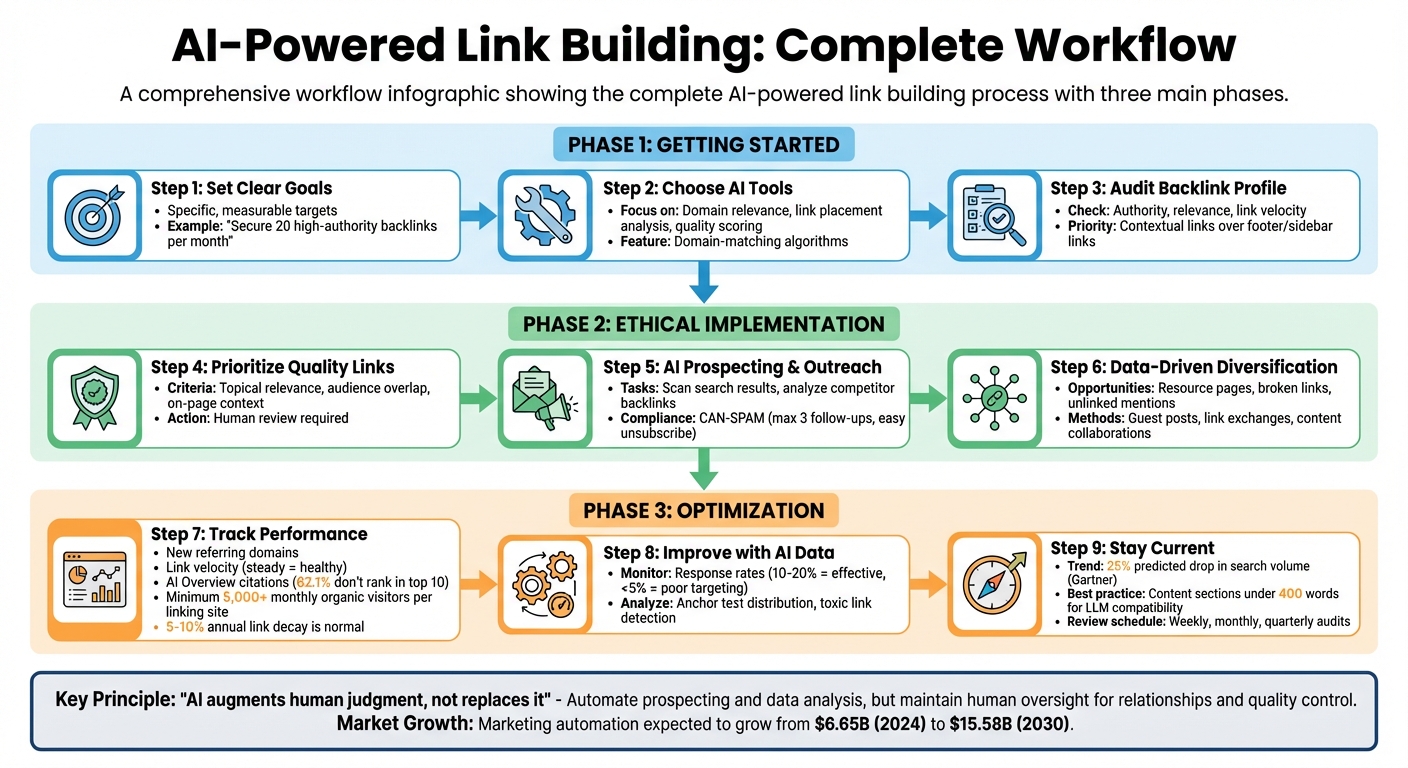
AI-Powered Link Building Best Practices Workflow
Getting Started with AI-Powered Link Building
Set Clear Link-Building Goals
Before diving into AI-powered link building, it’s crucial to define what success looks like for your campaign. Are you aiming to boost your site’s authority or drive more traffic? Align your objectives with the types of links you want to target. Instead of vague goals like "get more backlinks", focus on specific, measurable targets. For instance, aim to secure 20 high-authority backlinks within a month or improve your domain authority by a set percentage. This level of clarity makes it easier for AI tools to filter prospects and prioritize outreach based on your exact needs. Clear goals also help you streamline your process and select the right tools by following an SEO link building checklist.
Choose the Right AI Tools
The tools you choose can make or break your link-building efforts. Look for platforms that emphasize quality over quantity and provide transparent metrics, such as domain relevance, link placement analysis, and scoring for relevance.
One example is 3Way.Social, which uses AI to facilitate link exchanges. It matches you with relevant link partners through domain-matching algorithms and ensures quality through strict filters. This platform simplifies the process with an intuitive dashboard, helping you discover opportunities, manage exchanges, and track link diversification. These features are essential for building strong, reliable partnerships and achieving long-term growth. Once you’ve selected your tools, the next step is to evaluate your existing backlink profile.
Audit Your Current Backlink Profile
To fully harness AI’s potential, start with a deep dive into your existing backlink profile. This means assessing your backlinks’ authority, checking the relevance of referring domains, and monitoring link velocity to identify patterns or potential spam risks. Pay close attention to where your backlinks are placed – contextual links within content often hold more value than those in footers or sidebars. Conducting a thorough audit helps identify weaknesses and opportunities that AI tools can address in a targeted and efficient way.
sbb-itb-88880ed
19 AI Link Building Tactics (Build QUALITY Backlinks with ChatGPT!)
Checklist for Ethical AI-Powered Link Building
When automating link building, it’s crucial to follow ethical practices to maintain credibility and effectiveness.
Prioritize Relevant and High-Quality Links
Start by defining what "quality" means for your site. Train AI scoring models using examples of both successful and poor-performing link placements so the system can pinpoint valuable links. Evaluate potential links based on topical relevance, audience overlap, and on-page context – these factors ensure the links align with your goals. Set clear rules, like thresholds for spam scores, and aim for a balanced mix of nofollow and dofollow links. Diversify anchor text to avoid over-optimization, and focus on links embedded in the main content, as these are more impactful than links in sidebars or footers. Finally, always include a human review step to confirm link quality.
Once you’ve established these criteria, you can move on to efficient prospecting.
Use AI for Prospecting and Outreach
AI tools can simplify the process of finding link opportunities. Use them to scan search results, publisher databases, and competitor backlinks. Enhance these prospects by updating contact details and eliminating duplicate domains. To stand out from generic outreach efforts, analyze each prospect’s recent activity – like their latest posts or challenges – and craft personalized messages.
When launching automated outreach campaigns, take steps to protect your domain’s reputation. Warm up dedicated email inboxes, limit follow-ups to three emails, and always include an easy way to unsubscribe to comply with CAN-SPAM regulations. For added accuracy, verify AI-generated contact details through reliable sources like LinkedIn or official company websites.
With outreach streamlined, use AI to expand and diversify your link sources.
Apply AI for Data-Driven Link Diversification
AI can uncover a wide range of link-building opportunities. Automate tasks like finding resource pages, identifying broken links to recover, or converting unlinked brand mentions into backlinks. A good workflow involves automating the discovery and scoring of opportunities first, then using templates to personalize outreach before scheduling.
For instance, 3Way.Social uses AI to suggest link partners by analyzing topical relevance and site quality. Their system includes quality control filters and tools for diversifying backlink sources through guest posts, link exchanges, and content collaborations – all while maintaining strict relevance standards. Additionally, tracking new backlinks, monitoring link decay, and measuring their impact on organic traffic allows you to fine-tune your AI models over time.
Optimizing Results with AI-Driven Strategies
Track and Measure Backlink Performance
When it comes to modern AI-powered link-building strategies, tracking the right metrics is key. While new referring domains remain a cornerstone metric due to their strong connection with ranking improvements, there’s more to monitor. Keeping an eye on link velocity – how quickly you’re acquiring backlinks – is vital. A steady pace signals healthy growth, while sudden spikes can raise red flags with search engines.
Another critical metric is how often your brand appears in AI Overviews or is cited by large language models (LLMs). These AI systems favor reliable sources when generating answers, so being mentioned here can boost credibility. Interestingly, 62.1% of links cited in AI search results don’t even rank in the top 10 organic results. To avoid wasting resources on ineffective links, set a minimum traffic threshold for linking sites – 5,000+ monthly organic visitors is a solid benchmark. This ensures you’re not linking to "ghost town" websites with no real audience. Additionally, measure the downstream effects of your backlinks, such as organic traffic growth to linked pages and the revenue generated as a result.
These insights are invaluable for fine-tuning your outreach tactics, which we’ll explore further in the next section.
Improve Strategies Based on AI Data
AI can also help you refine your link-building strategies over time. Feeding outreach outcomes into AI models allows for smarter prospecting in the future. For example, AI can analyze your anchor text distribution, ensuring a natural balance of branded, generic, and exact-match anchors. It can also detect toxic links, flagging spammy patterns that may require disavowal.
Monitoring your response rates is another key indicator of campaign success. A response rate below 5% might point to poor targeting or lackluster personalization, while rates between 10% and 20% indicate a more effective approach. Don’t forget to keep an eye on lost links – natural link decay typically results in losing 5–10% of backlinks annually, so this is normal for a healthy profile. Tools like 3Way.Social leverage AI to continuously refine partner recommendations based on topical relevance and quality metrics, helping you maintain a balanced and effective backlink profile.
As you adapt your strategies using AI insights, ethical practices should always remain a priority. The ability to adjust dynamically while staying aligned with industry standards is essential.
Keep Up with AI and SEO Changes
The SEO landscape is shifting rapidly as AI takes on a bigger role. Gartner predicts a 25% drop in search engine volume as AI increasingly provides direct answers. This makes adapting your approach even more critical. Regularly audit AI chatbots by asking how they categorize your brand and which competitors they mention. Structuring your content into sections of under 400 words is also smart – it aligns with LLM token limits (which range from 4,000 to 128,000 tokens) and ensures your links stay intact during AI processing.
It’s also worth noting that AI-driven answer engines, like Perplexity and Google AI Overviews, evaluate backlinks differently than traditional search engines. As LinkBuilder.io explains:
LLMs prioritize contextual relevance and editorial quality in backlinks. Other metrics, like link volume, have a diminished importance in AI search.
To stay ahead, schedule regular reviews – weekly, monthly, and quarterly – to assess the performance of your AI-driven strategies and make adjustments as needed. With the marketing automation market expected to grow from $6.65 billion in 2024 to $15.58 billion by 2030, staying informed about the latest AI advancements will keep your link-building efforts competitive and effective.
Conclusion
Ethical AI practices and smart outreach strategies set the stage, but the real magic happens when you integrate human judgment into the process. AI-powered link building thrives when automation works hand-in-hand with thoughtful oversight. Let AI handle tasks like prospecting, data crunching, and drafting initial content, while you focus on the strategic elements: building relationships, ensuring quality, and refining the approach. As Single Grain aptly explains:
Automated link building promises scalable backlink acquisition without sacrificing quality, but only when AI augments human judgment, not replaces it.
Human involvement remains critical – configure AI tools to emphasize quality and relevance, then review their outputs to ensure outreach feels personal and meaningful. This is especially true when utilizing advanced methods like ABC link exchanges to build sustainable authority. AI can help draft emails and pinpoint prospects, but adding your own insights and personal touches is what makes the difference. Track metrics like domain authority and referral traffic to measure success and tweak your tactics as needed.
The SEO world is evolving fast, with search engines increasingly rewarding contextually relevant content while cracking down on spammy practices. Keep up by staying informed on algorithm updates and ensuring your AI-generated efforts align with current webmaster guidelines. By blending AI’s efficiency with human expertise, you can achieve scalable, ethical link-building that stands the test of time.
FAQs
How can I tell if an AI-generated backlink is safe?
To make sure an AI-generated backlink is safe, check that it aligns with ethical SEO practices. Focus on links that are contextually relevant, come from reliable sources, and are created with transparency. Stay away from manipulative strategies and instead emphasize variety, relevance, and credibility. Reliable backlinks leverage AI to support human decision-making while sticking to white-hat SEO techniques.
What should I automate vs keep manual in link building?
Automation works wonders for tasks like prospecting, outreach, and data processing. AI tools excel at spotting opportunities and taking care of repetitive, time-consuming work. But when it comes to building relationships, securing content placements, and ensuring outreach feels genuine, nothing beats the human touch.
The key? Use automation to handle the repetitive stuff, but keep critical areas like relationship management, content creation, and strategic decision-making firmly in human hands. This balance helps maintain quality and steers clear of potential penalties.
How can I get my links cited in AI answers?
If you want AI systems to reference your links, you need to focus on creating authoritative, citation-ready content. This means producing high-quality, relevant materials that AI can easily recognize as trustworthy sources.
Here’s how to make it happen:
- Build strong assets: Create content that’s well-researched, accurate, and valuable to readers. Include clear provenance signals, like proper sourcing and author credentials, to establish trust.
- Optimize for attribution: Ensure your website is structured in a way that makes it easy for AI to attribute content back to you. This includes proper metadata, clear authorship, and visible publication dates.
- Promote actively: Share your content widely and strategically. Building backlinks from high-authority websites can further enhance your credibility and signal to AI systems that your site is worth referencing.
By following these steps, you improve your chances of having your links cited in AI-generated answers, which can boost both your visibility and authority in search results.