How Permanent Do-Follow Links Boost Domain Authority
Explore how permanent do-follow links enhance domain authority and improve SEO through effective link-building strategies and best practices.

Last Updated on October 9, 2026 by Becky Halls
Permanent do-follow links are a powerful way to improve your website’s domain authority (DA), a metric that predicts how well your site will rank on search engines. These links pass “link juice” or ranking power from one site to another, directly impacting your search visibility and credibility. Here’s the key takeaway:
- What Are Permanent Do-Follow Links? They are hyperlinks that consistently transfer authority to your website over time, unlike temporary or no-follow links.
- Why Do They Matter? Websites with higher DA scores (40+ is strong, 60+ is excellent) rank better on search engines. Permanent do-follow links are essential for building this authority.
- How to Use Them? Focus on links from high-quality, relevant sites, and avoid over-optimization to maintain a natural backlink profile.
Domain Authority (DA), Domain Rating (DR), and Authority Score are third‑party metrics. They estimate comparative domain strength, not signals used directly by Google.
Use them for benchmarking and prospecting, not as targets by themselves. Google ranks pages based on content quality, relevance, and links, not DA or DR.
Expect differences across tools because each vendor maintains its own link index and scoring model. Compare trends within the same tool to avoid false positives from cross‑platform variance.
Short‑term score swings often reflect recrawls or lost links being replaced. Track multi‑week trends alongside actual rankings and traffic for a grounded view.
Studies show that websites with diverse, high-quality backlinks see better rankings and sustained growth. Tools like 3Way.Social can simplify the process by connecting you with trustworthy link partners and ensuring your links remain active.
How to Increase Domain Rating (Website Authority)
Permanent Do-Follow Links in ABC Link Building
When it comes to building a strong SEO foundation, the ABC link-building model stands out by leveraging permanent do-follow links. This strategy ensures steady, long-term SEO benefits while maintaining the natural link patterns that search engines prefer.
What Are Permanent Do-Follow Links?
Permanent do-follow links are hyperlinks that transfer link equity (or ranking power) to the page they connect to. Unlike links with attributes like “nofollow”, “UGC”, or “sponsored”, these links signal to search engines that the destination page is both relevant and valuable.
Here’s the difference: no-follow links include rel="nofollow" in their HTML, which stops search engines from passing authority to the linked page. On the other hand, do-follow links allow search engines to crawl the link, transferring authority from one site to another. This makes them a cornerstone of any effective SEO strategy.
Google treats rel="nofollow", rel="sponsored", and rel="ugc" as hints for ranking (2019), and as hints for crawling and indexing (2020). These attributes guide, but do not block, Google’s evaluation of links.
Use rel="sponsored" for paid or affiliate links, and rel="ugc" for user‑generated links. Keep rel="nofollow" for untrusted or unspecified relationships.
“Dofollow backlinks and nofollow backlinks are like the yin and yang of SEO.” – Neil Patel, Co-Founder of NP Digital & Owner of Ubersuggest
Here’s how the two link types compare in terms of SEO impact:
| Category | Do-Follow Links | No-Follow Links |
|---|---|---|
| Link Juice | Pass authority and boost rankings | Do not pass authority or link juice |
| Crawlability | Search engines follow and crawl the link | Search engines do not follow the link |
| Indexing | Linked page is typically indexed | Linked page may or may not be indexed |
| Anchor Text | Contributes to anchor text relevance | Limited impact on anchor text relevance |
While no-follow links don’t directly pass ranking power, they’re still important for creating a balanced backlink profile. In fact, 89.1% of SEO experts believe that no-follow links can influence rankings indirectly, and 54% agree that a mix of both link types is essential.
This balance is the foundation for the ABC link-building model, which focuses on structured and natural-looking link exchanges.
ABC Link Building Model Explained
The ABC link exchange (or three-way link exchange) is a clever way to create backlinks without the risks associated with direct link swapping. It involves three websites linking to one another in a triangular pattern, avoiding any direct link exchange between two sites. This setup makes the arrangement appear more organic to search engines, reducing the chance of penalties.
For example:
- Site A links to Site B.
- Site B links to Site C.
- Site C links back to Site A.
According to research, 43.7% of top-ranking sites intentionally build reciprocal links. Additionally, Ahrefs reports that 43% of all links on the web are technically reciprocal. The ABC model offers a safer alternative by making the link exchange less obvious to search engine algorithms. Guest posting is often recommended as the most effective way to implement this model, as it adds natural context and value to the links.
Google Link Spam Policies for Exchanges and Guest Posts
Google Search Essentials warns against excessive link exchanges or patterns intended to manipulate ranking. Large‑scale guest posts with keyword‑heavy anchors and buying or selling links that pass PageRank violate policy.
For any compensated placement, add rel="sponsored" or rel="nofollow" and disclose the relationship. Keep editorial links earned through merit, and separate them from sponsored links.
Google’s automated systems, including SpamBrain, can detect and neutralize unnatural link patterns. Manual actions may also apply for link schemes, so assume manipulative links will be ignored or flagged rather than counted.
Keep outreach focused on editorial merit and audience fit. If compensation or placement control exists, label it and avoid keyword‑stuffed anchors.
To make ABC link exchanges successful, experts suggest:
- Partnering with sites that have high domain authority and low spam scores.
- Ensuring all participants benefit from the backlinks.
- Diversifying anchor texts to maintain a natural profile.
- Regularly monitoring the links to ensure they remain active and useful.
- Avoid sitewide or boilerplate exchange links, prioritize in‑content, contextual placements.
- Use
rel="sponsored"orrel="nofollow"for any compensated placements or affiliate links. - Limit direct reciprocity over time, and diversify partners to avoid obvious patterns.
- Prefer natural, readable anchor text over keyword‑stuffed anchors.
- Verify indexability, HTTPS, and a clean outbound link profile before partnering.
These practices make the ABC model a reliable way to build lasting authority through permanent links.
Why Permanent Links Matter for SEO
Permanent do-follow links provide a steady stream of SEO benefits over time. By passing “link juice”, they consistently boost a site’s authority and rankings.
“Permanent dofollow links are backlinks that are permanently active and pass SEO value from one website to another, helping improve search engine rankings and website authority.” – Semalt Q&A
Unlike temporary links, which can expire or lose relevance, permanent backlinks stay active indefinitely. This longevity ensures that search engines continue to see your site as a reliable and authoritative source.
The numbers speak for themselves: pages in the top spot on Google have 3.8 times more backlinks than those in positions 2–10. High-quality permanent backlinks also signal credibility and trustworthiness to search engines, strengthening your site’s overall performance.
Research Findings: Permanent Do-Follow Links and Domain Authority
Recent studies highlight how permanent do-follow links significantly influence domain authority and search rankings. These links provide long-lasting SEO benefits.
Research on Link Permanence and Link Equity
Evidence shows that permanent do-follow links contribute to domain authority by maintaining consistent link equity. This link equity plays a key role in improving PageRank and boosting search rankings.
The permanence of these links offers a competitive edge, transforming theoretical link equity into measurable traffic growth. For example, a JEMSU client experienced a 25% increase in organic search traffic within six months after implementing a link-building strategy focused on do-follow links from authoritative niche sites.
Another important finding is that the placement and context of links matter. Links embedded within content deliver more value than those in less prominent areas like sidebars or footers. This underscores why carefully chosen, permanent placements outperform temporary or low-quality link farms.
Contextual links placed in the main body usually carry more value than footer or sidebar links. Links in widgets, templates, or boilerplate areas are weaker signals.
Mark affiliate and sponsored URLs with rel="sponsored", or rel="nofollow" if sponsored is not available. For comments and forums, use rel="ugc" to identify user‑added links.
Additionally, research shows that properly maintained permanent links retain nearly all their SEO value. Even when a page with backlinks is moved or deleted, using a 301 redirect preserves 90-99% of the original link equity.
Redirects and canonicals for preserving link equity
Google has stated that 3xx redirects, including 301, 302, and 307, can pass PageRank signals. No public percentage is confirmed, so focus on clean migrations rather than estimated loss.
Use 301 for permanent moves, update internal links to the final URL, and keep redirects in place long term. Avoid chains and loops, and apply rel="canonical" only when it reflects the preferred page.
Update XML sitemaps and any hreflang references to point at the final URLs. Use Google Search Console’s URL Inspection to test a moved page and request indexing after deployment.
Keep 301s live long term, and avoid redirect chains by pointing all old URLs directly to the final destination. Validate with server logs and a crawler to catch stray 404s.
While permanence is crucial, link diversity and the quality of linking sources further enhance SEO performance.
Link Diversity and Source Quality Impact
Studies confirm that domain diversity is a top-ranking factor in Google’s algorithm. A diverse range of linking domains amplifies the effectiveness of permanent do-follow links far more than relying on a single source. For instance, a site with 10 backlinks from 10 different domains is more authoritative than one with 100 backlinks from the same domain. This shift in approach has led 93.8% of link builders to prioritize link quality over quantity.
The quality of the linking source is equally important. Links from trusted, high-authority websites are far more impactful than those from newer or less reputable sites. SEO campaigns consistently illustrate this principle.
“We prioritize links from industry leaders, respected publications, and sites with high traffic and engagement metrics. In essence, a single link from a top-tier domain can often have more impact than multiple links from lower-authority sites.”
– Max Shak, Founder & CEO of Nerdigital
Placement within high-quality content also plays a role. For example, Sheraz Ahmed, Founder of HARO Links Builder, shared that links placed in the first two paragraphs of guest posts on technology sites with a Domain Rating (DR) between 60 and 85 generated 312% more referral traffic than links placed at the bottom.
Moreover, link diversity creates a natural pattern that search engines reward. Sites with a broad range of linking domains consistently achieve higher rankings on search engine results pages (SERPs). This variety strengthens an SEO profile and enhances domain authority growth.
The combination of link relevance, source authority, and diversity is essential for maintaining strong search engine rankings. High-quality backlinks remain one of the most influential ranking factors. When paired with permanence and diversity, do-follow links become invaluable tools for achieving long-term domain authority and staying competitive, regardless of algorithm updates or market changes.
How to measure the impact of permanent do‑follow links
Track outcomes over weeks to months because crawling and recrawling take time. Use multiple sources to verify placements and watch performance signals for linked pages.
- Monitor referring domains and links in Moz, Ahrefs, and Semrush.
- Review Google Search Console Performance for impressions, clicks, and average position.
- Check Indexing and Crawl Stats for discovery and fetch patterns.
- Attribute referral traffic in GA4 and review engaged sessions from linking pages.
- Annotate acquisition dates to align changes with link placement.
Evaluate trends over time, not single‑day spikes. Focus on page‑level changes tied to the link target.
Use the Links report in Google Search Console to see “Top linking sites” and “Top linked pages.” Filter Performance by page to review query shifts and anchor‑related terms for the linked URL.
In GA4, compare page‑level engagement and conversions before and after placement with identical date windows. Add annotations on link live dates so movement lines up with known events.
sbb-itb-88880ed
Benefits and Drawbacks of Permanent Do-Follow Links
Permanent do-follow links can be a powerful tool in your SEO strategy, but they come with both advantages and risks. While they can significantly boost domain authority and search rankings, they require careful planning and management to avoid potential pitfalls.
Benefits of Permanent Do-Follow Links
Sustained Link Equity Transfer: One of the biggest advantages of permanent do-follow links is their ability to transfer link equity indefinitely. Unlike temporary links that expire, these links continuously pass SEO value, helping to improve rankings and domain authority over time.
Trust and Credibility: Do-follow links act as endorsements, signaling to search engines that your content is valuable. When these links come from authoritative sources, they enhance your website’s reputation and establish it as a credible brand.
Improved Search Visibility: Backlinks play a crucial role in search rankings. Studies show that 91% of web pages receive no organic traffic from Google, often because they lack backlinks. Permanent do-follow links can directly address this issue by improving your search visibility.
Better Content Indexing: These links also help search engines discover and index deeper pages on your site. By passing link equity to internal pages, they ensure important content doesn’t go unnoticed.
Long-term SEO Benefits: Think of permanent do-follow links as an ongoing investment. They continuously signal to search engines that your content is valuable, which can lead to sustained improvements in rankings. Google’s ranking algorithm still heavily relies on the quality and quantity of backlinks.
While the benefits are clear, it’s essential to recognize and manage the risks associated with these links.
Use internal linking to amplify acquired authority
Route incoming authority to key resources with planned internal links. Build topic hubs, link from high‑traffic pages, and fix orphan content.
Use descriptive anchors that match intent rather than exact‑match stuffing. Keep your XML sitemap current so crawlers find new and updated pages faster.
Avoid using rel="nofollow" on internal links to sculpt PageRank, Google does not conserve signals that way. Build breadcrumbs and contextual cross‑links so important pages get multiple descriptive entry points.
When publishing new posts, add links back to pillar pages and update those hubs to link forward. This keeps equity flowing both ways and improves discovery.
Potential Risks and Drawbacks
Over-optimization Penalties: Overusing or mismanaging do-follow links can backfire. Search engines, particularly Google, view excessive link-building as manipulative and may penalize your site as a result.
Unnatural Link Profiles: A backlink profile that consists only of do-follow links can appear suspicious to search engines. A natural profile should include a mix of do-follow and no-follow links to avoid raising red flags.
“Spread the gain, spread the risk!”
– Bibi Raven, Link Builder at BibiBuzz
Association Risks: Linking to low-quality or spammy websites can harm your site’s reputation. It’s crucial to ensure that the sources of your backlinks are reputable and trustworthy.
Google’s Disavow tool is intended for sites with a manual action or a history of link schemes you control. Most sites can ignore routine spam links and focus on earning better citations or adding rel attributes where you have access.
Comparison: Permanent Do-Follow Links vs Other Link Types
The table below compares permanent do-follow links with temporary and no-follow links, emphasizing the importance of a balanced link-building approach.
| Aspect | Permanent Do-Follow Links | Temporary Do-Follow Links | No-Follow Links |
|---|---|---|---|
| SEO Value | Passes full link equity indefinitely | Passes link equity temporarily | No direct SEO value transfer |
| Ranking Impact | Long-term ranking boost | Short-term ranking benefits | Supports brand visibility only |
| Trust Signals | Strong, ongoing trust signals | Limited-time trust signals | Not viewed as direct trust signals |
| Risk Level | Higher if over-optimized | Moderate risk | Lower SEO risk |
| Traffic Benefits | Long-term referral traffic | Temporary referral traffic | Referral traffic and brand awareness |
| Link Equity | Continuous equity transfer | Temporary equity transfer | No equity transfer |
| Strategic Value | High for authority building | Moderate for quick wins | High for profile diversity |
This comparison highlights why link building remains one of the most challenging aspects of SEO, with over 41% of marketers identifying it as a top difficulty.
Striking the Right Balance
Maintaining a balanced backlink profile is key to long-term SEO success. Experts recommend a mix of roughly 60% do-follow links and 40% no-follow links to create a natural-looking profile.
“I don’t think there is a perfect ratio of nofollow/follow backlinks. Ultimately, your link profile should look natural, and having a good mix of both is a big part of that.”
– Alex Wright, SEO & Performance Marketing Director at Clicky Media
Google has not published an ideal follow to nofollow ratio. Aim for a link profile that reflects real citations across varied sources and contexts.
Focusing on quality over quantity is essential. Aim to earn backlinks from authoritative sources to boost your SEO performance while keeping your link profile natural and sustainable.
How 3Way.Social Makes ABC Link Building Easier
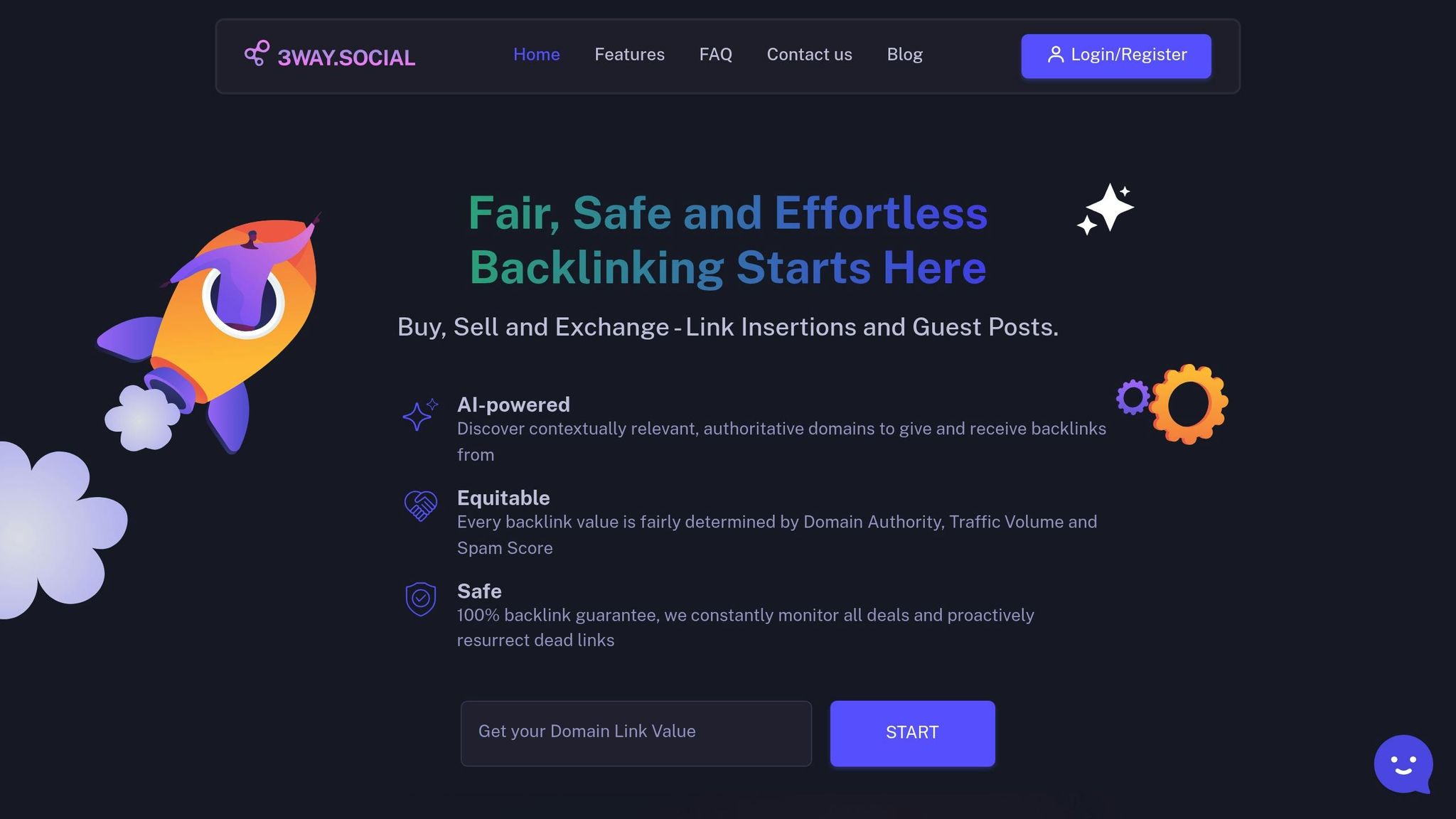
3Way.Social simplifies ABC link building by using AI to match domains and applying strict quality filters. It tackles common challenges SEO professionals face when creating secure and fair link exchanges that help improve domain authority.
3Way.Social Features for Link Building
By sticking to the ABC model, 3Way.Social offers tools that make the entire link-building process smoother and more efficient:
- AI-Powered Domain Matching
The platform’s smart system pairs your domain with relevant link partners. It evaluates domain authority, traffic, and spam scores to ensure meaningful connections. - Guaranteed Permanent Do-Follow Links
Links are verified as do-follow and are continuously monitored. If a link becomes inactive, the system restores it to maintain its value. - Advanced Link Diversification
Build a well-rounded backlink profile with options like ABC exchanges, niche edits, and guest posts – all managed within a trusted network of SEO experts. - Quality Control Filters
Filter potential link partners by domain authority, relevance, and other SEO metrics to ensure each exchange contributes to your rankings. - User-Friendly Dashboard
Easily manage partnerships, monitor link health, and discover new opportunities – all from a single, intuitive interface.
These features work together to streamline your SEO efforts, directly influencing domain authority growth.
How 3Way.Social Helps Build Domain Authority
The platform has delivered impressive results, including a 30% increase in domain authority, a 20% traffic boost, and rankings that improve three times faster – backed by over 10,000 successful link exchanges.
“3Way.Social revolutionized our SEO approach. Our site’s rankings have significantly improved thanks to its innovative ABC link exchange system. The platform’s high-quality partner network is unmatched.”
– Sophia Martinez, SEO Manager
The system ensures fairness in link exchanges by calculating values based on a unified SEO score, which factors in domain authority, traffic, and spam levels. Secure payment options like PayPal and Stripe add extra confidence, while regular health checks keep your backlinks active and effective.
“This platform has been a lifesaver for my link-building campaigns. The user-friendly dashboard and smart exchange options save me countless hours, and the precise partner selection based on SEO metrics is a major plus.”
– Alex Chen, Freelance SEO Consultant
3Way.Social offers free access to its core features, making it accessible for businesses of all sizes. You can test its capabilities before scaling your efforts. By combining AI automation, strict quality standards, and ongoing monitoring, the platform takes care of the technical side of link building, letting you focus on the bigger picture.
With these tools and benefits, 3Way.Social becomes an essential resource for building long-term domain authority.
Building Domain Authority with Permanent Do-Follow Links
Permanent do-follow links play a key role in building and maintaining strong domain authority. According to research, 42% of marketers directly associate backlink quality with domain authority, and achieving top rankings often requires around 23,000–25,000 referring domains. These links pass link equity consistently over time, signaling search engines that a website delivers lasting value.
Take Netlify, for example. Back in 2015, the company boosted its domain authority from 25 to 71 with just 201 referring domains – 88% of which were do-follow links. Similarly, companies like Digital Ocean and Linode have kept their domain authority high by maintaining a majority of do-follow links, at 73% and 77%, respectively. These examples highlight how focusing on high-quality do-follow links can make a significant difference.
As Dmitriy Tsytrosh explains:
“Dofollow links are part of SEO as search engines use them to determine the relevance and authority of a website. Having dofollow links from external websites gives you an extra boost in terms of rankings and visibility in search engine result pages (SERPs). The more dofollow links pointing to your website, the higher you will rank in SERPs.”
Data suggests that maintaining a 75% do-follow to 25% no-follow link ratio is an effective strategy. For businesses looking to scale this approach, platforms like 3Way.Social offer AI-driven domain matching and strict quality controls. These tools ensure that each link contributes to long-term SEO success through continuous monitoring and high standards.
Building domain authority isn’t a quick fix – it requires a long-term outlook. By creating content that naturally attracts authoritative backlinks and utilizing strategic link-building platforms, businesses can steadily improve search rankings and organic visibility over time.
FAQs
How can I make sure my permanent do-follow links come from high-quality, relevant websites?
When building permanent do-follow links, it’s crucial to target high-quality, relevant websites. Start by assessing the site’s domain authority – a score of 50 or higher is a good benchmark. Make sure the website aligns with your industry or niche to maintain relevance. Next, review the site’s spam score; aim for one that’s below 20% to avoid risky links. Also, check for consistent organic traffic and active user engagement, as these indicate a healthy, credible site. Focus on acquiring links that are naturally placed within well-crafted, authoritative content. By sticking to these guidelines, you’ll strengthen your backlink profile and gradually improve your domain authority.
How can I build a natural backlink profile while using permanent do-follow links?
To build a natural backlink profile with permanent do-follow links, aim for steady growth over time. Focus on creating valuable, relevant content that naturally encourages others to link to your site. Diversify your backlinks by connecting with a range of credible sources.
Avoid flooding your site with links from the same domain or using questionable tactics that might seem artificial. Instead, opt for genuine strategies like guest posting on reputable sites. Prioritize links that truly enhance your content and provide value to your audience. The secret? Stay consistent and keep it real to maintain a healthy, organic backlink profile.
Why is it essential to have both do-follow and no-follow links in your backlink profile, and how does it affect SEO?
Having a mix of do-follow and no-follow links is key to maintaining a healthy backlink profile and achieving long-term SEO success. Do-follow links pass authority to your site, which can directly improve your search engine rankings. On the other hand, no-follow links may not transfer authority, but they contribute to a natural link profile, bring in referral traffic, and enhance brand exposure.
Search engines appreciate a diverse backlink profile. Relying too heavily on just one type of link can raise suspicion and potentially hurt your rankings. By balancing both types, you minimize the risk of penalties while building a stronger, more trustworthy online presence.