Last Updated on January 9, 2026 by Becky Halls
Your backlink profile is one of the most important factors for improving your search engine rankings so optimizing backlink profiles should be common sense. High-quality backlinks signal authority and trust to Google, while harmful or spammy links can hurt your performance. To maintain a strong profile, focus on these five steps:
- Audit your backlinks: Use tools like Google Search Console, Ahrefs, or Semrush to identify toxic links, analyze anchor text, and assess your link ratios.
- Disavow harmful links: Remove or disavow spammy backlinks carefully to avoid penalties.
- Analyze competitors: Study your competitors’ backlink strategies to find opportunities for your site.
- Build high-quality links: Focus on guest posting, creating link-worthy content, and using tools like 3Way.Social for safe link exchanges.
- Monitor and maintain: Regularly track changes, reclaim lost links, and audit your profile to ensure long-term success.
Backlinks require consistent attention, but the payoff is worth it. A clean, balanced backlink profile improves rankings, drives organic traffic, and strengthens your site’s authority.
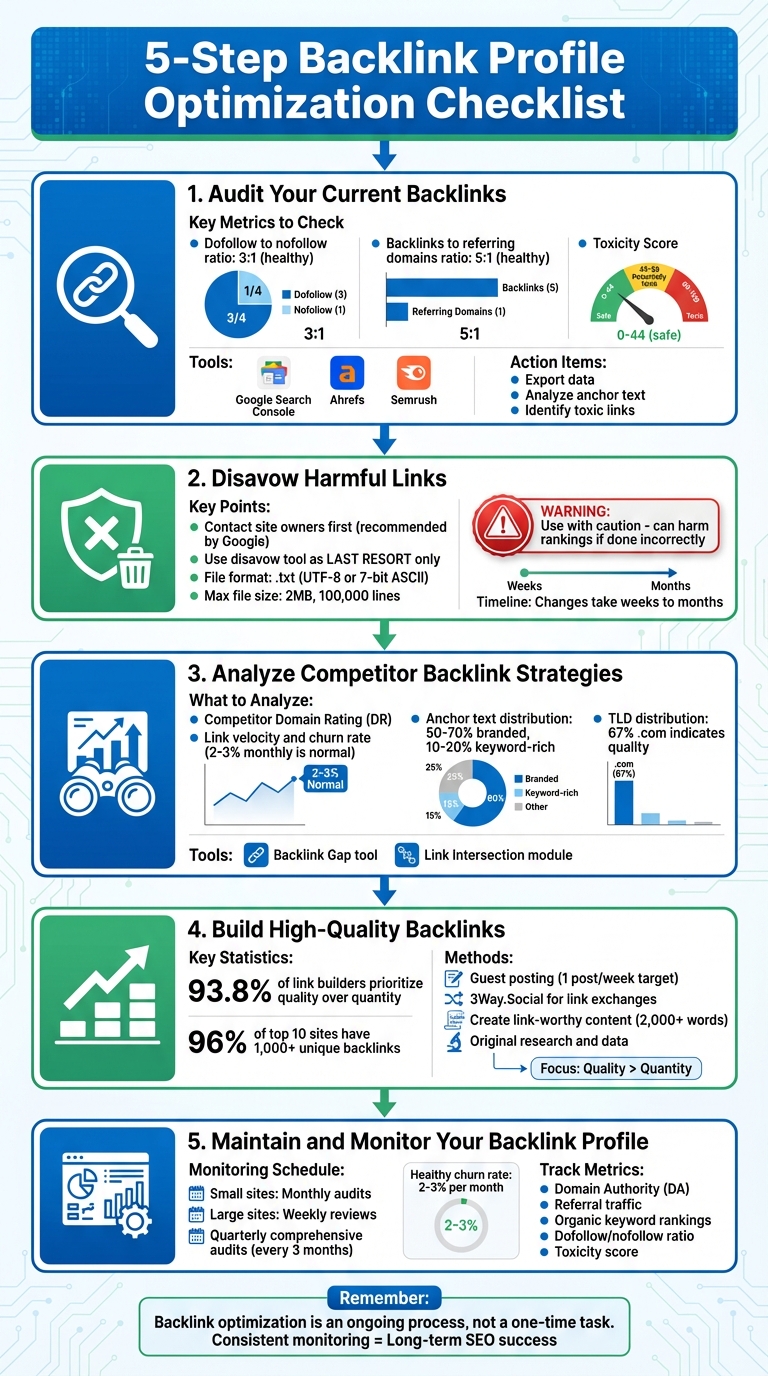
5-Step Backlink Profile Optimization Checklist for SEO Success
Backlink Analysis: Reverse Engineering Link Profiles To Rank
sbb-itb-88880ed
Step 1: Audit Your Current Backlinks
Start by thoroughly examining your backlink profile to understand its strengths and weaknesses. This foundational step is essential for identifying harmful links you may need to disavow and for building stronger, high-quality connections later.
Export and Analyze Your Backlink Data
Begin by gathering your backlink data. Google Search Console is a free and reliable option; head to the “Links” section to export your data in CSV or Excel format. This gives you a snapshot of your top linking sites. For a more detailed analysis, consider tools like Ahrefs or Semrush. Ahrefs provides updated backlink data, while Semrush’s Backlink Audit tool allows you to configure a campaign and export insights such as Domain Rating, Authority Score, and toxicity levels.
Once you’ve exported your data, start organizing it based on key metrics. Sorting by Domain Rating and TLD distribution can quickly reveal lower-quality links. A healthy backlink profile often features a dofollow-to-nofollow ratio of about 3:1 and a backlinks-to-referring-domains ratio around 5:1.
With your data sorted, move on to analyzing your anchor text distribution for additional insights.
Review Your Anchor Text Distribution
Anchor text plays a critical role in helping search engines understand your content. However, overusing certain phrases can lead to penalties. A natural anchor text profile includes a mix of branded anchors (e.g., your company name), generic phrases like “click here”, exact-match keywords, partial-match keywords, and long-tail phrases.
“If you use the same anchor text over and over again, Google’s algorithm is going to catch it – and you could end up with a penalty as a result.” – Timothy Carter, Chief Revenue Officer, SEO.co
Strive for balance across these anchor types. Use tools like Ahrefs or Semrush to identify any overly dominant keywords. Watch for unnatural patterns, such as repetitive commercial phrases, which may signal spam or negative SEO. Comparing your anchor text ratios with those of top-ranking competitors in your niche can help you determine what looks natural for your industry.
After reviewing your anchor text, it’s time to identify any links that could be damaging your site’s reputation.
Identify Toxic or Low-Quality Links
Not all backlinks are helpful – some may hurt your rankings. Tools like Semrush assign a Toxicity Score (ranging from 0 to 100), labeling links with scores between 60–100 as “toxic” and 45–59 as “potentially toxic”. While these scores are useful, they aren’t foolproof. Cross-check with Google Search Console and Analytics to confirm which links drive traffic and to avoid false positives.
Manual review is just as important. Visit linking domains to spot red flags like thin content, excessive ads, missing contact details, or irrelevant topics – a funeral parlor linking to a marketing blog, for example, should raise suspicion. Also, keep an eye out for unusual spikes in backlinks. Links from sources like private blog networks (PBNs), excessive reciprocal link exchanges, or low-quality directories should be flagged.
“Most backlinks, even in a worst-case scenario, will not cause negative SEO, but rather will just be ignored by Google.” – Greg Heilers and Morgan Taylor, SEO experts
If you find a significant number of spammy links or receive a manual penalty, consider disavowing the problematic links. However, Google advises using the disavow tool only as a last resort, as improper use can harm your rankings. This audit will guide your next steps in cleaning up and strengthening your backlink profile.
Step 2: Disavow Harmful Links
As mentioned earlier, auditing your backlinks is the foundation for this step. Once you’ve identified harmful links, the next move is to use the disavow tool – but proceed with care. This tool allows you to tell Google to disregard certain links when assessing your site. However, Google itself advises using this feature sparingly:
“This is an advanced feature and should only be used with caution. If used incorrectly, this feature can potentially harm your site’s performance in Google Search results.”
Before jumping to the disavow tool, try reaching out to the site owners and requesting link removal. Google recommends this as the first course of action. Only resort to disavowing links if you’re dealing with a large volume of spammy backlinks that could trigger – or have already triggered – a manual penalty. Once you’re ready, the next step is to prepare your disavow list.
Compile and Verify Toxic Links
Take a close look at the links flagged during your audit. Scrutinize each domain for red flags like excessive ads, thin content, or signs of being part of a link farm (e.g., unrelated topics like gambling or questionable health products). Check for shared IP addresses, which might indicate a Private Blog Network (PBN).
Pay attention to anchor text in SEO. If you see an overuse of exact-match “money” keywords, it could indicate manipulative practices. Tools like Semrush’s Toxicity Score (ranging from 0 for clean to 100 for highly suspicious) can provide helpful guidance. Cross-check these scores with data from Google Analytics – if a flagged link is actually bringing legitimate traffic, it might not be as harmful as it seems.
When you’re ready, create a plain text file (.txt) encoded in UTF-8 or 7-bit ASCII. Use the syntax domain:spammysite.com to disavow an entire domain or specify a single page with a full URL (e.g., https://spammysite.com/toxic-page.html). Disavowing at the domain level is generally more efficient, as it blocks all current and future spam from that source. You can also include comments for your records using a # (e.g., # Contacted owner on 1/6/2026, no response). Keep the file under 2MB and no more than 100,000 lines.
Submit a Disavow File
To upload your disavow file, go to Google Search Console and select the appropriate URL-prefix property (note that the disavow tool doesn’t work with Domain properties). Navigate to the disavow tool and upload your file. Keep in mind, Google only allows one disavow file per property, so uploading a new file will overwrite the previous one. If you’ve disavowed links before, make sure to include those alongside any new additions.
Once submitted, Google won’t send a confirmation that your file has been processed. It may take several weeks – or even months – for Google to recrawl and apply the changes. After submission, shift your attention to monitoring the impact on your site’s traffic and rankings.
Monitor Results After Disavowing
Keep an eye on the “Security & Manual Actions” section in Google Search Console to confirm there are no manual penalties affecting your site. Track your organic traffic using Google Analytics and review keyword rankings that were previously impacted. Tools like Semrush can also help you reassess your site’s Toxicity Score after disavowing harmful links.
It’s important to note that disavowed links will still appear in your backlink reports. The disavow tool simply instructs Google to ignore them when calculating rankings. If you need to reverse any disavowals, you can remove the relevant lines from your file and re-upload it.
“In some cases, disavowing or cleaning up bad links to your site may help Google’s algorithm trust other links to your site.” – John Mueller, Search Advocate, Google
Improvement in rankings isn’t immediate – it could take weeks or months for the changes to take effect. To stay ahead, schedule regular audits. For smaller sites, monthly checks are usually sufficient, while larger sites may need weekly reviews to catch new spam links early.
With harmful links addressed, you’re ready to focus on analyzing competitor strategies to strengthen your backlink profile further. Conducting a thorough competitor backlink analysis can reveal high-authority opportunities you might have missed.
Step 3: Analyze Competitor Backlink Strategies
After cleaning up harmful links, the next step is to analyze your competitors’ backlink strategies. This helps pinpoint gaps in your own backlink profile and uncovers potential linking domains and ABC link exchange opportunities within your niche.
Identify Your Key Competitors
Start by searching Google for your target keywords and noting which websites consistently rank in the top 10. These are your main SEO competitors. To dig deeper, use tools like Ahrefs or Semrush to examine their backlink profiles. Focus on competitors with a Domain Rating (DR) or Authority Score that’s close to or slightly above yours – these are profiles you can realistically aim to replicate.
Keep an eye on their link velocity using these tools. A sudden surge in backlinks – like hundreds gained in a short period – might indicate a successful content campaign or even a negative SEO attack. This insight ties back to your findings from Step 1, helping refine your strategy. According to Respona, a backlink churn rate of 2–3% is typical, so if you notice competitors losing links at a higher rate, it could signal quality issues.
Evaluate Competitor Link Quality
Now, take a closer look at the quality of your competitors’ backlinks. Pay attention to metrics like the number of unique referring domains, anchor text patterns, and the types of sites linking to them. A well-rounded profile usually has 50–70% branded anchor text (like the company name) and only 10–20% keyword-rich anchors. If a competitor relies heavily on exact-match keywords, they could be at risk for search engine penalties.
“One strong link from a high-authority source could potentially be more valuable than dozens of links from low-quality sources.” – Timothy Carter, Chief Revenue Officer, SEO.co
Also, analyze the top-level domain (TLD) distribution. For example, if 67% of a competitor’s referring domains end in .com, it likely indicates a high-quality, non-spammy profile. Use tools like Ahrefs’ “Best by links” report to see which content types – like guides, tools, or data-driven posts – are earning the most backlinks. This can provide ideas for your own content strategy.
By assessing their link quality, you’ll naturally identify high-value backlink opportunities you can pursue for your site.
Find Link Building Opportunities
Use tools like Semrush’s Backlink Gap tool or SEO SpyGlass‘s Link Intersection module to uncover domains that link to two or more of your competitors but not to your site. Export this data and filter for domains with a DR of 35+ and at least 1,000 monthly organic visitors.
“Looking into the intersection in your competitors’ backlink profiles can give you insight into their link strategy – and help spot some valuable link building opportunities for your own site.” – SEO SpyGlass
Additionally, keep track of when competitors lose backlinks. These “lost” links can be valuable opportunities – reach out to the publishers and suggest your content as a replacement. This approach can help you secure high-quality backlinks, strengthening your site’s authority and visibility. With a clear roadmap of opportunities, you’re well-prepared to enhance your backlink profile.
Step 4: Build High-Quality Backlinks
Now that you’ve completed your audit and competitor analysis, it’s time to focus on building high-quality backlinks. Why does this matter? Because backlinks play a critical role in establishing your site’s authority. But here’s the catch: quality beats quantity every time. Research shows that 93.8% of link builders prioritize link quality over sheer numbers. Plus, 96% of websites ranked in Google’s top 10 positions boast over 1,000 unique backlinks. The key is to stick to ethical practices while building a robust link profile.
Use Guest Posting Opportunities
Guest posting remains a powerful way to earn backlinks – if done right. The trick is to target authoritative websites with high Domain Authority (DA) or Domain Rating (DR) that are relevant to your niche[30, 32]. Links embedded within the main body of an article carry far more weight than those tucked away in sidebars or footers[32, 4]. Make it a goal to pitch at least one guest post each week. But before you send that pitch, take the time to build genuine relationships. Engage with site owners on social media or mention their work in your own content[30, 31]. When you’re ready to pitch, offer content ideas that provide real value to their audience – don’t just ask for a backlink.
“To determine Domain Authority, we employ machine learning against Google’s algorithm to best model how search engine results are generated. Over 40 signals are included in this calculation.” – Moz
Be cautious about over-optimizing anchor text with exact-match keywords, as this could lead to penalties. Once your guest post is live, use Google Search Console to ensure your backlinks are functional and correctly tagged as follow or nofollow[30, 32]. Also, aim to diversify your link sources to create a more natural and balanced link profile.
If guest posting isn’t enough, there are other tools to help expand your link-building efforts.
Use 3Way.Social for Link Diversification
Platforms like 3Way.Social can help you diversify your backlinks in a way that feels organic. This AI-powered tool facilitates three-way link exchanges, which are a safer alternative to direct reciprocal linking. Why? Because search engines are less likely to flag three-way exchanges as manipulative. 3Way.Social connects you with a vetted network of SEO professionals, ensuring that your backlinks come from reputable, high-quality sites. The platform specializes in securing permanent do-follow links, which are essential for passing link equity and improving search rankings.
Its AI-powered matching system pairs you with sites that share similar authority levels and niches, while built-in quality filters weed out spammy or low-quality domains. This ensures that your link-building efforts align with modern best practices.
“Context beats the <href> tag.” – Brian Dean, Backlinko
Another handy feature? The platform’s dashboard lets you monitor your link acquisition rate. This helps you maintain a natural growth pattern since sudden spikes in backlinks can raise red flags and lead to penalties[36, 8].
Create Link-Worthy Content
One of the best ways to earn backlinks is by creating content that people want to link to. Original research and data are particularly effective because they act as “citation magnets.” Fresh statistics and structured facts are highly sought after[29, 39]. Consider publishing resources like free calculators, templates, or datasets on dedicated URLs – these make it easier for others to link back to your site and for search engines to index your content.
Infographics are another excellent option. They’re easy to understand, highly shareable, and especially effective when packed with valuable insights or data. Long-form educational content (think 2,000 words or more) also tends to attract natural backlinks and improve your rankings. Want to take it a step further? Develop your own unique framework or method, and give it a catchy name (e.g., “The Skyscraper Technique”). This makes it more likely that others will reference and link to your work.
“In 2025, the value of a link is determined by relevance, editorial integrity, and the brand signals that accompany it.” – IndexJump
Other smart strategies include becoming a source for journalists through platforms like HARO (Help a Reporter Out), which can lead to mentions in high-authority publications. You can also offer testimonials for products or services you use – these often include backlinks to your site. Lastly, track down mentions of your brand that don’t include a link, and reach out to request one.
Step 5: Maintain and Monitor Your Backlink Profile
Building backlinks is only the first step. The real challenge lies in keeping your backlink profile healthy over time. Links can decay due to “link rot”, and without regular attention, you might lose valuable connections without even realizing it. By adopting consistent maintenance habits and leveraging the right tools, you can safeguard your SEO gains and ensure your efforts continue to pay off. This includes managing strategic partnerships like ABC link exchanges to maintain a natural profile.
Track Backlink Changes
Start by keeping an eye on link velocity and churn. A healthy churn rate typically falls around 2–3% per month. Tools like Ahrefs, SEMrush, and Google Search Console can help you track changes in real time. Set up automated alerts to notify you of new, broken, or lost backlinks. Additionally, be on the lookout for unusual spikes in referrals – this could be a red flag for a potential negative SEO attack.
“Link reclamation is less about retrieval and more about nurturing relationships and maximizing your link profile for SEO.” – Julie Joyce, Link-Building Authority
Don’t forget to check for 404 errors regularly. Redirecting broken but high-quality backlinks to live pages helps retain their value and preserve link equity. These practices set the stage for effective routine audits.
Schedule Routine Audits
Make it a habit to audit your backlink profile every three months. During each audit, identify toxic links, review your anchor text distribution (aim for 50–70% branded and 10–20% keyword-focused), and ensure your link diversity remains balanced. To calculate your churn rate, use this formula: Lost Domains ÷ (Starting Domains + New Domains). Regular audits also help you stay ahead of negative SEO tactics, such as competitors directing spammy links to your site to trigger penalties. Always check the “Manual Actions” report in Google Search Console during these audits for any issues.
Measure Performance Metrics
To confirm that your maintenance efforts are working, monitor key performance metrics like Domain Authority (DA), referral traffic, and organic keyword rankings. Keep an eye on the ratio of dofollow to nofollow links and your toxicity score to spot harmful links early. Google Analytics can show you how much traffic your backlinks are driving, helping you identify the most valuable ones. If you’re running a local or national business, ensure that at least 50% of your traffic and backlinks are from your target country to maintain relevance.
Conclusion
Improving your backlink profile isn’t a one-and-done task – it’s an ongoing process that requires consistent attention. This checklist lays out the key steps: auditing your links, disavowing harmful backlinks, analyzing competitors’ strategies, building meaningful connections, and tracking your progress. Together, these steps create a well-rounded strategy to strengthen your site’s authority. As Timothy Carter, Chief Revenue Officer at SEO.co, aptly states:
“Link building is a double-edged sword. Some backlinks help… Unfortunately, some backlinks hurt. The worst backlinks can be very detrimental.”
The numbers don’t lie – balanced, high-quality backlinks are essential for driving steady organic traffic. Focus on quality over quantity, and aim for a naturally balanced profile. Keep in mind that some link turnover is normal; a healthy backlink churn rate is about 2–3% per month. Reclaiming lost links and continually building new ones is all part of the process.
Ethical link-building practices are non-negotiable. Search engines today prioritize links that are contextually relevant and diverse. This means having a mix of dofollow and nofollow links, securing connections from a variety of domains within your niche, and ensuring steady, organic growth without sudden spikes in activity.
For a more streamlined approach to building diverse and high-quality backlinks, platforms like 3Way.Social offer AI-powered domain matching and permanent dofollow links. These tools can save you the headache of endless manual outreach while helping you avoid low-authority partnerships. Using these resources can reinforce the ongoing process of maintaining a strong backlink profile.
Start your next backlink audit today: check anchor texts, remove harmful links, and set up backlink alerts. The time and effort you put into keeping your profile clean and diverse will reward you with better organic traffic and stronger domain authority over time.
Optimizing Backlink Profiles – FAQs
What’s the best way to identify and remove harmful backlinks?
To spot harmful backlinks, start by reviewing all the links directing traffic to your site. Tools like Google Search Console or other SEO platforms can help you export and analyze your backlink data. Pay close attention to warning signs such as links from low-quality domains, connections to irrelevant or spam-heavy sites, excessive use of exact-match anchor text, or sudden, unusual spikes in referring domains. Keep a detailed record of these problematic links, including their sources and context.
After identifying suspicious backlinks, it’s time to address them. Start by reaching out to the site owners with a courteous request to either remove or update the link. If this approach doesn’t yield results, turn to Google’s Disavow Tool to ensure these links are disregarded when evaluating your site’s authority. To safeguard against future problems, consider using platforms like 3Way.Social, which can help you cultivate high-quality, secure backlinks that boost your SEO without the risk of harmful connections.
How can I effectively build high-quality backlinks for my website?
Building strong backlinks isn’t about quantity – it’s about quality. Focus on earning links from relevant, reputable websites in your industry. How? Start by creating content that people genuinely want to link to, like detailed guides, original research, or compelling case studies. These types of resources naturally attract attention from industry blogs and websites.
Guest posting is another effective way to secure backlinks. By contributing valuable content to respected sites in your niche, you can gain contextual links that boost your credibility.
Other tried-and-true methods include digital PR – pitching stories or expert insights for inclusion in round-up posts – and broken-link building, where you identify dead links on relevant sites and suggest replacing them with your content. Don’t forget to keep your anchor text varied, maintain a healthy mix of do-follow and no-follow links, and regularly audit your backlink profile to weed out harmful links and uncover new opportunities.
For a more efficient approach, tools like 3Way.Social can make a big difference. This AI-powered platform connects you with vetted, high-authority sites for secure, permanent do-follow link exchanges. It also helps diversify your backlink portfolio and tracks performance, ensuring you reap long-term SEO rewards like better rankings, increased traffic, and higher domain authority.
Why should I regularly be reviewing and optimizing backlink profiles?
Regular check-ups on your backlink profile are a must for keeping your SEO strategy on track. Why? Because it lets you spot and address harmful or low-quality links that could drag down your rankings or even trigger penalties from search engines. Plus, by keeping an eye on your backlinks, you can ensure your link profile stays varied and aligned with best practices – helping your site stay strong against algorithm updates and competitive in search rankings.