Last Updated on January 23, 2026 by Becky Halls
Backlinks are crucial for SEO in 2026, yet 94% of blog posts fail to earn even one. Why? Maybe you need to ask the question ‘what are the content types that earn the most links?’ Most content lacks the qualities that attract links. To succeed, focus on creating linkable assets – content so valuable that others naturally reference it. The top-performing formats for backlinks include:
- Infographics: Visual data presentations that are easy to share and embed.
- In-Depth Guides: Comprehensive resources that answer all questions on a topic.
- Data-Driven Studies: Original research offering exclusive, citable insights.
- Case Studies: Real-world examples showcasing results or strategies.
- Videos/Tutorials: Engaging, instructional content with high shareability.
Each format has its strengths but requires effort in production and promotion. For example, infographics demand professional design, while data studies need unique research. Tools like 3Way.Social can simplify link-building efforts.
Key takeaway: Focus on content that provides unique insights, solves problems, or is highly shareable. Proper promotion ensures these formats deliver lasting SEO benefits.
“We’ve seen the biggest link spikes come from ‘reference’ content – stats pages, benchmarks, and simple explainers people can cite without thinking twice.” Becky Halls, Strategist at 3Way Social
Creating Content that Earns Backlinks
1. Infographics
Infographics transform intricate data into visually engaging formats that make complicated information easier to digest. This makes sense when you consider that the human brain processes images 60,000 times faster than text. It’s no wonder infographics are shared on social media up to three times more than other content types. Journalists and bloggers also love them for their ease of use – they can seamlessly embed infographics into their articles.
Link Earning Potential
Infographics are a favorite among SEO experts, with 61% recommending them for earning backlinks. A prime example is a 2017 “guestographics” campaign that secured nearly 1,000 backlinks from over 300 unique domains. However, not all infographics hit the mark – about half fail to earn external links when the data quality falls short. While infographics were a dominant force in link building during 2013–2014, they now face tough competition from original surveys and in-depth research.
Production Effort
Creating a successful infographic takes more than just creativity – it requires a solid investment in accurate data, professional design, and mobile-friendly formatting. For instance, Digital Hothouse created an infographic comparing taxi fares across major global cities using original research. The result? Coverage and backlinks from major outlets like The Guardian, Stuff, The Herald, and The Sydney Morning Herald. While tools like Canva can work for smaller budgets, hiring a skilled graphic designer usually delivers superior results. The key to success lies in using reliable, up-to-date data from trusted sources like surveys, government records, or proprietary research. Once the infographic is ready, an equally well-thought-out promotion strategy becomes essential.
Promotion Needs
Infographics don’t promote themselves – they need active outreach. A proven strategy, known as “guestographics”, involves pitching your infographic to relevant websites along with a tailored description, often in exchange for a backlink. Including an embed code makes it even easier for others to share your work while linking back to your site. Personalized outreach is critical for success, as demonstrated by numerous successful campaigns. To maximize an infographic’s impact, both its creation and promotion must be handled with care and precision.
Long-Term SEO Impact
Infographics deliver lasting SEO benefits by positioning your brand as a trusted authority in your field. They’re also versatile – easily repurposed into videos, white papers, or social media snippets. For example, HubSpot’s “The State of Content Marketing 2020” infographic earned 202 backlinks from high-authority sites like Search Engine Journal and LinkedIn. Optimizing infographics with alt tags and descriptive text can further boost their visibility in both organic and image search results. To keep them relevant, updating the data and design annually is crucial. When done right, infographics can be a cornerstone of your long-term SEO strategy.
“In our experience, templates and checklists earn links quietly for months. They don’t always go viral, but they become the page people keep bookmarking and referencing.” Ian Naylor, FOunder at 3Way Social
2. In-Depth Guides
Thorough guides act as go-to resources for tackling complex topics. When someone needs a reliable reference, they’re more likely to link to one well-rounded guide than cobble together insights from multiple sources. This makes in-depth guides powerful tools for attracting backlinks. In fact, content that exceeds 3,000 words earns 77.2% more referring domain links than shorter pieces under 1,000 words.
Link Earning Potential
The numbers don’t lie. Take Moz’s “Beginner’s Guide to SEO”, for example – it’s attracted over 10,800 referring domains by serving as the industry’s definitive beginner resource. Similarly, HubSpot’s “How to Create Detailed Buyer Personas for Your Business” has gained 6,512 backlinks, thanks to its step-by-step instructions and a valuable free template. High-authority sites like Buffer and Social Media Examiner have linked to it. Another example is Search Engine Journal’s “The Complete List of Google Penalties & How to Recover”, which consolidates scattered information into one resource, earning 1,033 backlinks. These examples highlight how well-crafted guides can become backlink magnets.
Production Effort
Creating a guide that draws thousands of backlinks isn’t a quick or easy process. It often requires professional writers, extensive research, and a clear focus. Instead of tackling a broad topic like “Guide to Marketing”, a more focused subject, such as “Beginner’s Guide to Facebook Marketing”, allows for a detailed and manageable approach. Building such resources demands expertise, thorough research, and the ability to address every question a reader might have about the topic.
It’s no surprise that 60% of advanced SEOs consider white papers and in-depth guides ideal for earning links, making the investment worthwhile. However, the work doesn’t end with creating the guide – strategic promotion is essential to ensure it gains traction and continues to attract backlinks.
Promotion Needs
High-quality guides generate a strong return on investment when it comes to link building.
“Linkable assets have a much higher ROI on your promotion efforts because they’re created with attracting backlinks in mind.” – Joshua Hardwick, Head of Content, Ahrefs
To maximize the reach of your guide, proactive promotion is key. This includes leveraging email campaigns, running paid social ads (typically costing $200–$300 per update), and reaching out directly to relevant websites and journalists. Regular updates with fresh data can also reignite interest, encouraging additional backlinks over time. These efforts not only boost the initial visibility of your guide but also help it maintain momentum, allowing it to earn natural links as it’s discovered by others searching for authoritative sources.
Long-Term SEO Impact
The staying power of in-depth guides is undeniable. Take Moz’s “Beginner’s Guide to SEO” as an example. By February 2017, it had already garnered over 1,700 referring domains and became the most-visited page on Moz’s website, even surpassing their homepage. Fast-forward to January 2025, and that same guide had grown to over 10,800 referring domains.
Another case is Content Marketing Institute’s “What is Content Marketing?” page, which earned 12,462 backlinks from 1,100 root domains by defining a key industry term before it gained mainstream attention. These guides remain relevant for years, continuing to attract organic backlinks – something Google values far more than paid or exchanged links – long after their initial promotion.
3. Data-Driven Studies
Original research and data-driven studies are a powerhouse for link building. While list posts might dominate social media, they often fall short in earning backlinks. On the other hand, data studies provide highly-citable information that content creators rely on to support their arguments. The stats back this up: 70% of SEO experts rank original data and research as the most effective content for building a strong link profile.
Link Earning Potential
The ability of data-driven content to attract backlinks is hard to ignore. Take HubSpot’s 2020 report, The Ultimate List of Marketing Statistics for 2020, for example. By organizing the report into focused categories like video marketing and content marketing, HubSpot earned a staggering 42,469 backlinks from respected domains such as Forbes, Entrepreneur, and the Neil Patel blog. Another standout example is Fractl’s campaign, The Truth About Hotel Hygiene. This study, which used lab tests to measure germ levels in hotels, secured over 700 placements and backlinks from reputable sources due to its eye-opening results.
Why do these studies perform so well? They offer fresh insights that demand attention. Research-backed content shows a clear link between social shares and referring domain links – something many other formats fail to achieve. However, producing this type of content isn’t without its challenges.
Production Effort
Creating data-driven studies isn’t a quick or easy task. Only 54% of SEO experts have ventured into publishing original research because it requires extensive time, planning, and analysis. To stand out, you need to collect unique data that isn’t readily available. This could involve conducting surveys, running experiments, or analyzing massive public datasets. Many teams now leverage AI tools to streamline data analysis and create visually engaging presentations.
“The best type of content is researched content. This means gathering data no one else has and creating new/better content unique to your niche.” – Tonya Davis, ThoughtLab
Even though 94% of blog posts fail to earn external links, original research consistently breaks through this barrier.
Promotion Needs
Once your study is complete, promoting it effectively is essential to maximize its impact. Original data is a goldmine for PR outreach because it offers publishers something exclusive. A perfect example is Fractl’s campaign for an online pharmacy client, The Surprising Reason Why Most Men Cheat. Based on survey data, this campaign resulted in 175 media placements, including features on Fox News, The New York Post, and Cosmopolitan, plus nearly 40,000 social shares.
To amplify your outreach, target specific journalists and consider adding a geographic angle – what Fractl refers to as “geo-bait” – to appeal to regional and global publishers. Pairing your data with infographics can also boost its shareability, as visual content is among the top formats for acquiring backlinks.
Long-Term SEO Impact
Data-driven studies don’t just make an immediate splash; they have lasting value. These studies often become evergreen resources, continuing to attract backlinks long after their initial release. For instance, Buffer’s 2023 State of Social report generated over 2,800 backlinks from 1,220 unique domains, with mentions in high-authority outlets like Entrepreneur, HubSpot, and Search Engine Journal.
The benefits extend beyond the study itself. As these backlinks build your site’s domain authority, they also improve rankings for your other pages. Titles that include words like “data”, “study”, or “research” tend to have greater long-term appeal, ensuring a steady flow of links and shares well after the promotion phase ends.
“Once these rank in the top three for a term, they’ll generate links for you forever.” – Jakub Rudnik, Shortlister
sbb-itb-88880ed
4. Case Studies
Case studies stand out as powerful tools for generating high-quality, relevant backlinks, especially from authoritative industry sources. While formats like infographics and how-to posts might attract more overall links, case studies excel in securing links that carry significant value and relevance .
Link Earning Potential
A well-crafted case study often becomes a go-to resource, passively earning quality backlinks by serving as a trusted research source. Round-up case studies, which compile several real-world examples on a single topic, can be particularly effective – especially if they’re the first comprehensive resource available online.
Take, for example, Tomislav Horvat’s “buyer persona case studies” round-up post, published in April 2024 on tomislavhorvat.com. This post attracted high-profile backlinks from sites like neilpatel.com (Domain Rating 91). What made it stand out? At the time, it was the only article featuring multiple buyer persona case studies compiled on one page. Similarly, between 2013 and 2017, Fractl produced a data-driven case study titled “The Rise of the Freelance Worker” for an HR client. By analyzing 400,000 resumes, this study earned 269 placements, including links from Forbes, Entrepreneur, and Fox News, and was shared over 20,000 times on social media.
Production Effort
Creating a high-quality case study requires significant effort, as it often involves gathering original data and presenting unique insights. These pieces are typically data-heavy and rely on first-party findings, making them valuable resources for others to cite. Additionally, long-form content – generally exceeding 1,000 words – tends to attract more backlinks overall.
“One of the best ways to get links is to publish original research. That’s not that hard to do. Find out a question that people have in your industry and then do something to answer that question with data.” – Marie Haynes, President, Marie Haynes Consulting Inc.
This meticulous approach to production ensures that the case study becomes a strong candidate for promotion and link-building opportunities.
Promotion Needs
To maximize the impact of a case study, focus on targeted outreach to authoritative sites. Once recognized as a credible resource, the case study can continue to earn links naturally through syndication and discovery. Addressing “missing stats” or challenging unverified industry assumptions with real-world data can further enhance the appeal of your content.
“If your content can serve as a citation, you can be in a good position to earn a lot of passive links.” – Kerry Jones, Associate Marketing Director, Fractl
Long-Term SEO Impact
Case studies deliver lasting SEO benefits, much like infographics and in-depth guides. For instance, between 2020 and 2024, Tomislav Horvat published three original case studies and two round-up posts. Without any active link-building efforts, these posts helped his site achieve a Domain Rating of 40 and secured 308 backlinks from 215 domains. Over time, the value of these backlinks increases as referring domains grow in authority.
Interestingly, link-building campaigns often see about 50% of total link volume within the first 30 days, with additional links accumulating over the next two years or more. A great example of this long-term effect is Fractl’s campaign on germs found on water bottles. Launched between 2015 and 2016, the campaign saw a significant secondary spike in links a year later after syndication across the iHeartRadio network.
5. Videos and Tutorials
Videos and tutorials hold a distinct place in link-building strategies. While they might not generate as many backlinks as “Why” or “What” posts – averaging 25.8% fewer referring domain links – they shine in other areas. For instance, videos drive significantly more social shares, with an average of 8,572 shares, compared to just 1,782 for how-to posts. It’s no surprise that 59% of SEO experts use video content for link building, and 66.7% of them find it to be an effective approach.
Link Earning Potential
The real strength of video tutorials lies in their ability to serve as go-to resources. Bloggers and journalists often prefer linking to one comprehensive guide rather than piecing together information from different sources. A standout example is W3Schools‘ HTML Tutorial, which has amassed over 1 million links from 4,400 referring domains, establishing itself as an essential resource for web development.
“Bloggers and journalists would much rather link out to one definitive guide or tutorial than a bunch of different resources.” – Joshua Hardwick, Head of Content, Ahrefs
Production Effort
Producing high-quality video content demands a significant investment of time, money, and expertise, making it more resource-intensive than standard blog posts. However, this also creates an opportunity. Few brands commit to creating detailed instructional videos, which allows those that do to stand out. The key is to focus on educational content that solves specific customer challenges rather than simply promoting products.
“Most brands shy away from creating such high-quality content [long instructional videos]… If you do, you’re more likely to produce content others see as a resource, leading to more backlinks.” – Michael O’Neill, Content Manager, Brafton
Promotion Needs
To maximize the link-earning potential of videos, proper optimization is crucial. This includes uploading transcripts, using custom thumbnails, adding end screens, and incorporating clear calls-to-action. A particularly effective strategy is to host your top-performing videos on your own landing pages rather than relying solely on platforms like YouTube. Once your content gains traction, use link-tracking tools to identify websites linking to your YouTube version and request they update their links to your website instead. When promoted effectively, videos can significantly boost your SEO performance over time.
Long-Term SEO Impact
Videos excel at keeping visitors engaged, which signals user satisfaction to search engines. They also appear in Google Discover, video-specific search results, and even AI-generated summaries, enhancing their reach beyond traditional search listings. Notably, the correlation between total social shares and referring domain links for video content is 0.091, much higher than the general content average of 0.021. This means videos that perform well on social platforms are more likely to convert that momentum into valuable backlinks over time.
Comparison: Strengths and Weaknesses
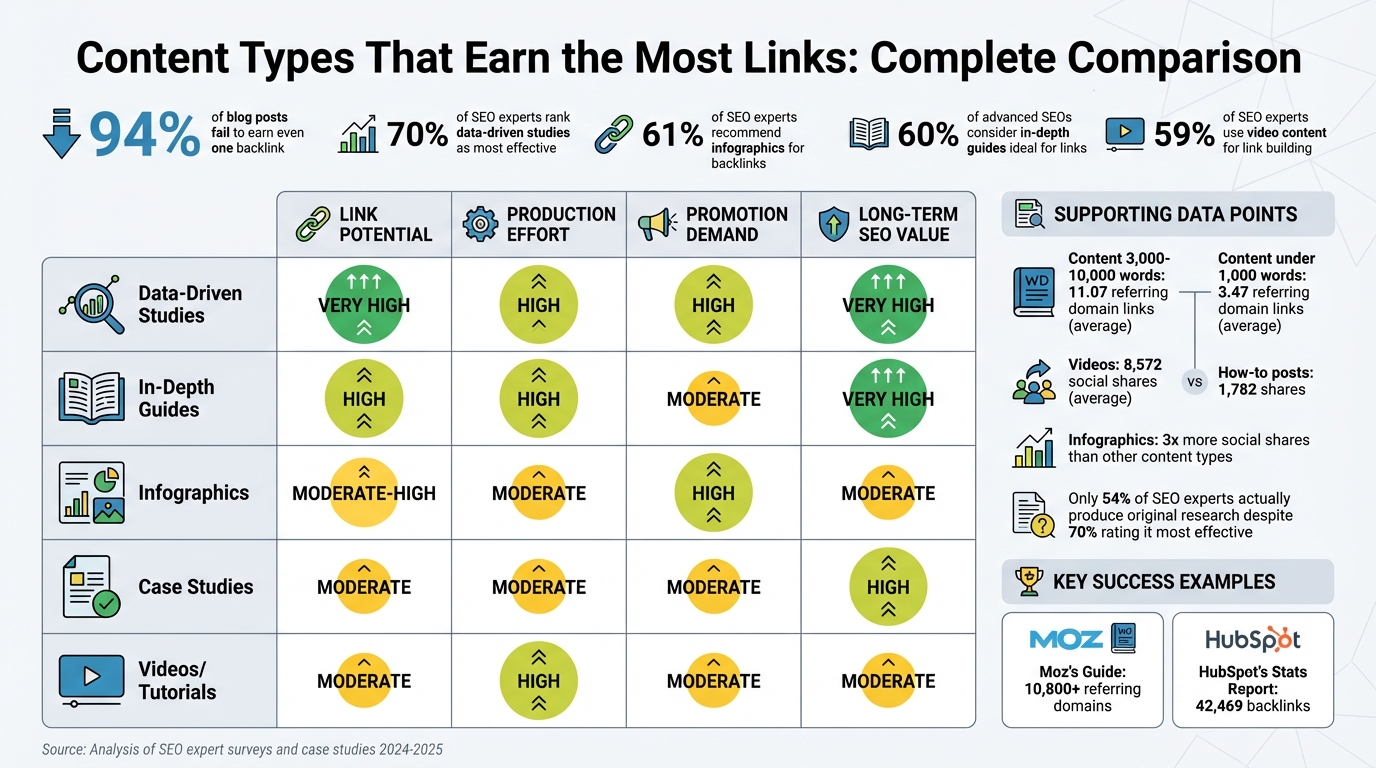
Content Types for Link Building: Comparison of Effectiveness and Effort
Every content format brings its own set of advantages and challenges when it comes to link building. Below, we break down the link-building potential, production effort, promotion requirements, and long-term SEO value of different formats based on the insights shared earlier.
Data-driven studies are at the top of the list, with 70% of SEO experts considering them the most effective for earning links. However, only 54% actually produce them, largely due to the significant effort required to gather and analyze data. The payoff, though, is substantial – these studies often serve as evergreen resources, frequently cited by writers to back up their arguments.
In-depth guides shine when it comes to sustained value. These comprehensive resources consistently attract links over time. For instance, long-form content between 3,000 and 10,000 words garners an average of 11.07 referring domain links, compared to just 3.47 links for posts under 1,000 words. Their detailed nature makes them a go-to reference for creators.
Infographics strike a middle ground. While they require a solid investment in design and active promotion, they can yield impressive results. For example, NeoMam’s interactive infographic, “13 reasons your brain craves infographics”, secured 21,700 links from 1,300 referring domains. This highlights their potential when executed thoughtfully.
Case studies and videos perform moderately well in terms of link-building but excel in engagement. Videos, for instance, average 4.13 referring domains, which is lower than 5.66 for “Why” posts and 6.19 for list posts. However, they dominate in social sharing, with an average of 8,572 shares, compared to 1,782 for how-to posts. The correlation between social shares and referring domain links for videos is 0.091, significantly higher than the general content average of 0.021.
“We’ve noticed ‘best of’ and comparison posts attract links when they’re genuinely opinionated and updated. The stale, generic roundups rarely earn anything.” Ian Naylor, Founder at 3Way Social
| Content Type | Link Potential | Production Effort | Promotion Demand | Long-Term SEO Value |
|---|---|---|---|---|
| Data-Driven Studies | Very High | High | High | Very High |
| In-Depth Guides | High | High | Moderate | Very High |
| Infographics | Moderate-High | Moderate | High | Moderate |
| Case Studies | Moderate | Moderate | Moderate | High |
| Videos/Tutorials | Moderate | High | Moderate | Moderate |
This breakdown highlights how each format brings distinct strengths and challenges, shaping its overall contribution to long-term SEO success.
Conclusion
Original research and data-driven studies are at the forefront of effective backlink building, with 70% of SEO experts highlighting them as the most effective content type for strengthening a link profile. Content like data-driven studies, long-form guides (those between 3,000 and 10,000 words earn an average of 11.07 referring domain links compared to just 3.47 for shorter posts), and well-crafted infographics or videos offer clear advantages when it comes to attracting backlinks.
The key lies in creating assets that are both valuable and targeted. Marie Haynes, President of Marie Haynes Consulting Inc., puts it best:
“One of the best ways to get links is to publish original research. That’s not that hard to do. Find out a question that people have in your industry and then do something to answer that question with data”.
To put this into action, start by conducting an original survey or refreshing outdated studies to provide updated insights. You could also develop interactive tools or calculators that solve specific problems your audience faces. Once these assets are ready, focus on targeted outreach to maximize their impact.
Tools like 3Way.Social can streamline this process. By leveraging AI-powered domain matching, the platform connects you with vetted, high-quality sites for equitable link exchanges. With features like quality control filters and permanent do-follow links, it supports your efforts to build a diverse and effective backlink profile, ensuring the content you’ve worked hard to create gets the attention it deserves.
It’s worth noting that 94% of blog posts fail to earn any external links. By focusing on the right content types and adopting a systematic approach to link building, you can position yourself among the few who succeed in boosting search rankings and domain authority.
FAQs
What’s the best way to promote infographics to earn backlinks?
To promote infographics effectively and earn quality backlinks, focus on crafting visually appealing, data-rich content and sharing it strategically. Begin by selecting a topic that aligns with your niche and supports it with trustworthy data or fresh insights. Design an infographic that is clean, mobile-friendly, and includes your branding along with an embed code to make sharing effortless.
Once your infographic is ready, reach out to relevant websites, blogs, and industry influencers. Send personalized emails that highlight how your content adds value to their audience. Share the infographic across your own platforms, such as your website, social media channels, and email newsletters, to encourage organic engagement. You can also submit your infographic to well-known directories to boost its visibility.
For an added boost, try using 3Way.Social, an AI-driven platform that connects you with secure, high-authority link-building opportunities. This tool ensures your infographic reaches the right audience while enhancing your backlink profile.
Why are data-driven studies so effective for earning backlinks?
Data-driven studies are a powerful tool for earning backlinks because they offer exclusive insights that other publishers can rely on as trusted sources. When your content features unique survey results, experiments, or curated datasets, it becomes highly appealing and “link-worthy.” Editors and writers often prefer referencing information that’s credible and difficult to replicate, making your work a go-to resource.
The rarity and originality of data-driven content also help it shine in crowded niches, prompting high-authority websites to link back to your study. This approach aligns seamlessly with link-building strategies, as it naturally attracts editorial backlinks. To amplify your reach, platforms like 3Way.Social can connect your content with SEO experts and sites actively searching for high-quality, data-rich material, increasing your chances of securing lasting do-follow links.
Why do detailed guides have a long-lasting impact on SEO?
Detailed guides offer thorough, timeless information that stays useful well into the future. Because they dive deep into a topic, they become go-to resources for readers, often earning links from other websites looking for reliable references.
These types of guides tend to bring in high-value backlinks organically. Even years after being published, they continue to attract links. This steady flow of backlinks can enhance search rankings, increase traffic, and strengthen domain authority over time.