How to Find Niche-Relevant Link Opportunities
Target and secure niche-relevant backlinks using competitor analysis, search operators, directories, and personalized outreach.

Last Updated on October 9, 2026 by Ian Naylor
Want better SEO rankings? Focus on getting links from sites that share your niche. These "niche-relevant backlinks" are more impactful than sheer quantity or high domain authority. Here’s why they matter and how to get them:
- Why they work: Google prioritizes topical relevance over link volume. Links from related sites signal authority and drive engaged traffic.
- How to find them: Use competitor analysis, Google search operators, and industry directories to identify opportunities.
- Key steps: Define your niche, perform a competitor backlink analysis, evaluate link quality, and prioritize relevance over domain rating.
- Outreach tips: Personalize emails, focus on value for the recipient, and follow up strategically.
- Tools to help: Platforms like Ahrefs, Semrush, and 3Way.Social streamline the process.
This guide covers everything from goal setting to tracking results, helping you secure links that boost rankings and drive traffic.
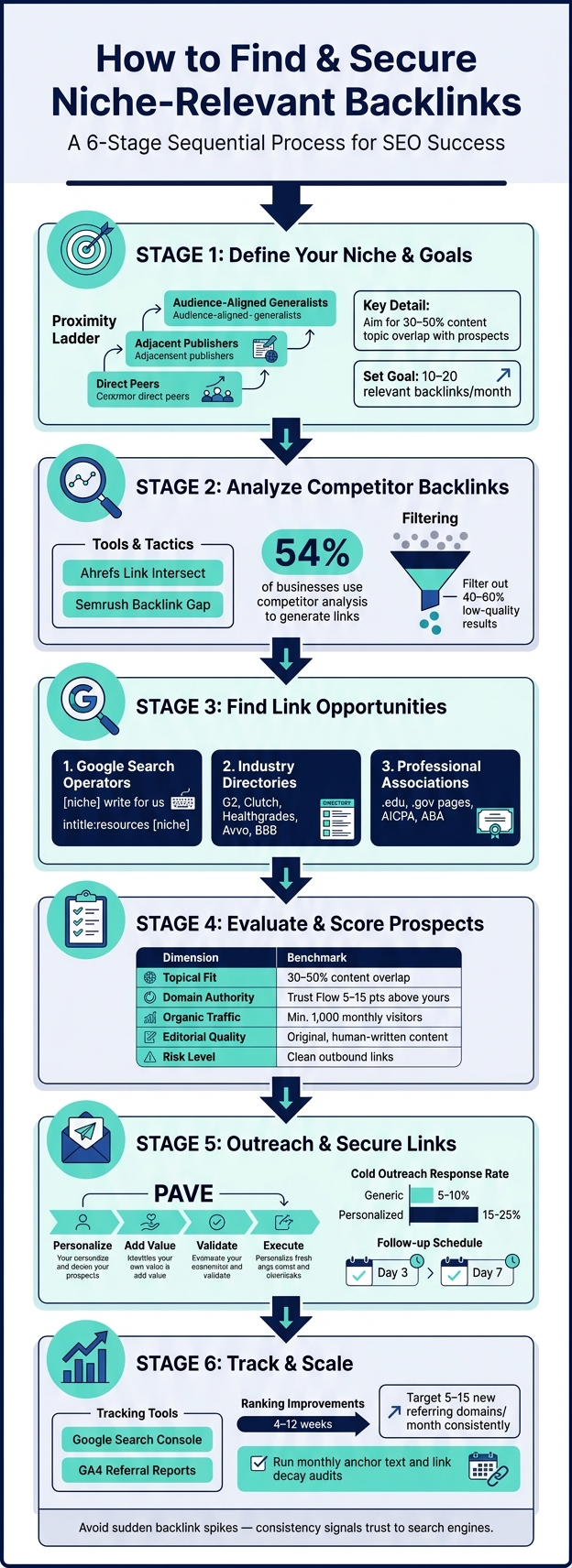
How to Find & Secure Niche-Relevant Backlinks: Step-by-Step Process
Defining Your Niche and Link-Building Goals
Mapping Your Industry and Sub-Niches
To define your niche, focus on two key elements: the specific problem you solve and the audience you serve. Your niche goes beyond just your industry – it’s about how you address a particular need for a targeted group of people. When pursuing link-building opportunities, ensure that the prospect’s audience will genuinely benefit from your content. If there’s no clear value, the link isn’t worth your time.
A helpful framework to organize your approach is the Proximity Ladder, which categorizes potential link sources into three tiers:
| Rung | Prospect Type | Example | Link Impact |
|---|---|---|---|
| 1 | Direct Peers | Cybersecurity blog → cybersecurity blog | Highest relevance; hardest to acquire |
| 2 | Adjacent Publishers | Tax software blog → accounting education site | Best balance of relevance and acceptance |
| 3 | Audience-Aligned Generalists | Small business news site → any B2B SaaS tool | Good for volume and brand awareness |
To broaden your reach, consider "shoulder niches" – non-competing businesses that share an audience with you. For example, a wedding photographer and a wedding planner target the same audience but don’t compete directly. A strong topical fit usually means there’s at least a 30–50% overlap in recent content topics between your site and a prospect’s.
Once your niche is clearly defined, the next step is to develop a target link profile, using competitor insights to guide your strategy.
Building a Target Link Profile
With your niche tiers in mind, work on crafting an ideal link profile for your industry. One of the most effective ways to do this is through competitor analysis. Tools like Ahrefs’ Link Intersect or Semrush’s Backlink Gap can help you find competitor backlinks from domains that link to multiple rivals but not to your site. This approach is widely used – 54% of businesses in a 2026 survey reported generating links this way.
When analyzing competitor backlinks, pay attention to what type of content earned the link. Was it a statistic, a free tool, or a guest post? This will help you understand what publishers are looking for. Before reaching out to potential link sources, identify 3–5 high-value pages on your site that publishers would want to link to. These could be original research, free tools, or detailed guides.
"Your ideal link target is a page that already ranks in positions 4–20 for keywords you care about – you inherit its authority signal, not just its domain rating." – Martial Notarangelo, Founder, Authority Specialist
Once you’ve identified your ideal link sources, the next step is setting clear and actionable goals for your outreach efforts.
Setting Clear Link-Building Goals
Avoid vague objectives like "getting more backlinks." Instead, focus on quality, diversity, and relevance. The relevance of your links matters more than sheer numbers. For competitive niches, aim to acquire 10–20 relevant backlinks per month at a steady pace. Be cautious of sudden spikes in link acquisition, as these can trigger spam filters.
"Backlink quantity is a vanity metric – link relevance, placement context, and referring page traffic are the signals that correlate with ranking gains." – Martial Notarangelo, Founder, Authority Specialist
Concentrate your efforts on "money pages" – the pages that drive conversions or traffic – and high-value linkable assets. Diversify your link types, such as editorial mentions, niche blog features, or resource page inclusions. Additionally, vary your anchor text to maintain a natural link profile, using branded, partial-match, and URL-based text.
Looking ahead to 2026, consider adding a citation gap analysis to your strategy. This involves identifying which sources AI tools like ChatGPT or Perplexity cite when answering questions in your industry, and ensuring your brand is featured in those publications.
sbb-itb-88880ed
7 Best Practices to Build Niche-Relevant Backlinks [2024]
How to Find Niche-Relevant Link Opportunities
Once your link profile is set, the next step is figuring out where to find those quality niche backlinks that can elevate your SEO game.
Analyzing Competitor Backlinks
Start by identifying your link competitors, which aren’t necessarily the same as your business competitors. As Fabian van Til, SEO Lead at EcomSEO, explains:
"Your link competitors are not always the same as your business competitors. A large retailer may dominate in revenue, but a smaller niche blog may actually hold the backlink profile you need to study."
This strategy builds on the link profile you’ve already defined. Tools like Ahrefs’ Link Intersect or Semrush’s Backlink Gap can highlight potential backlink sources that are linking to competitors but not to you. After filtering out low-quality options (about 40–60% of the results), you’ll have a refined list of viable opportunities.
Dive deeper by alternating between domain-level and page-level analyses:
- Domain-level reports: Great for spotting general industry blogs or directories.
- Page-level reports: Pinpoint specific articles where competitors earned links. These are gold when pitching for link insertions.
Also, keep an eye out for broken links on competitor sites, like 404 errors or outdated redirects. These are perfect chances to pitch your content as a better alternative. This is just one of many ethical link-building strategies you can use to grow your authority.
For even more opportunities, Google search operators can uncover link sources that tools might miss.
Using Google Search Operators
Many niche blogs and resource pages don’t show up in standard backlink tool exports. That’s where Google search operators come in handy – they help you dig up these hidden gems.
Here’s a quick guide to the most effective operator combinations:
| Opportunity Type | Search Operator Examples |
|---|---|
| Guest Posting | "[niche]" "write for us", inurl:guest-post "[niche]" |
| Resource Pages | "[niche]" "resources", intitle:resources "[niche]" |
| Listicles | "best [niche] tools", "top [niche] software" |
| Unlinked Mentions | "Brand Name" -site:yourdomain.com |
| Competitor Gaps | "competitor name" "alternatives", "sites like [competitor]" |
For example, instead of searching for broad terms like "accounting", try specific subtopics like "invoice automation" "small business". This approach uncovers pages that are more relevant and less competitive. Also, double-check guest post submission pages – if they haven’t published anything new in six months, they’re likely inactive.
Finding Industry Directories and Associations
Beyond competitor analysis and search operators, industry directories and associations are reliable sources for backlinks. These trusted platforms can complement your other strategies and round out your link-building efforts. Focus on Tier 1 directories – free, industry-specific sites that typically offer dofollow links and where you already qualify for a listing.
Here are some examples based on industries:
- SaaS and B2B: Claim profiles on G2 and Clutch.
- Healthcare: List on Healthgrades, Vitals, and Zocdoc.
- Legal: Use Avvo, Justia, and Martindale-Hubbell.
- Home Services: Start with BBB and Angi.
Professional associations, like the AICPA for accountants or the American Bar Association for lawyers, are also excellent options. These links signal expertise to search engines. Don’t forget about .edu and .gov resource pages, such as university libraries or local government sites, which carry high levels of trust.
Before you dive into creating new listings, check if your business is already auto-listed on relevant directories. Claiming and updating an existing profile is faster and ensures the backlink is live and pointing to the correct page.
How to Evaluate and Prioritize Link Prospects
Once you’ve compiled a list of potential link sources, the next step is figuring out which ones are genuinely worth your time. Not every site that looks promising at first glance will actually help improve your SEO.
Checking Topical Relevance and Domain Authority
Start by asking yourself: does this site align with your niche? Ideally, there should be a 30–50% overlap in content focus – their recent articles should cover topics closely related to yours.
To dig deeper into both topical relevance and editorial quality, tools like Ahrefs (costing roughly $99–$399/month) or Semrush (priced around $119–$449/month) can be invaluable. These platforms let you analyze the keywords a site ranks for. For example, if a site that calls itself a "marketing blog" primarily drives traffic from keywords like "essay writing" or "crypto trading", it’s probably not a good match, no matter how high its Domain Rating is.
But don’t stop at the domain level – apply the page-level rule. The specific page where your link would appear should feel natural and relevant. As Ana Clara, Author, explains:
"If a human editor would struggle to explain why the link belongs there, skip the exchange."
Also, give preference to sites with stable or growing organic traffic over the last 6–12 months. Sometimes, a site with a modest Domain Rating but consistent, relevant traffic can deliver better SEO results than one with a higher rating but declining visibility.
Once you’ve confirmed relevance and authority, it’s time to weed out low-quality link sources.
Spotting and Avoiding Low-Quality Link Sources
Even if a site looks relevant and authoritative, it’s crucial to assess its quality and potential risks. One major red flag? Unusual outbound link behavior. Review the last 10 posts on the site. If each page contains 25 or more commercial links pointing to unrelated industries – like payday loans, online casinos, or supplement brands – it’s likely a link farm.
Another warning sign is a history of erratic traffic spikes followed by sharp declines. Such patterns may indicate past penalties or manipulative SEO practices. To check if the site’s content is being indexed properly, use the site:domain.com operator in Google. If articles published two weeks ago aren’t showing up, the site could be dealing with crawl or quality issues.
Content quality matters too. Look out for thin or templated articles, especially those with no clear author or "About" page. Real editorial sites adhere to high publishing standards, both in their own content and in their outbound linking practices.
Building a Prospect Scoring System
To streamline your outreach, use a link building planner to create a simple scoring system that consolidates all these factors. A 1–5 scoring matrix can help you rank prospects before reaching out, ensuring you focus on the most promising opportunities.
| Dimension | What to Evaluate |
|---|---|
| Topical Fit | 30–50% content overlap |
| Domain Authority | Trust Flow 5–15 points above yours |
| Organic Traffic | Minimum 1,000 monthly visitors |
| Editorial Quality | Original, human-written content |
| Risk Level | Clean and relevant outbound links |
Once you’ve scored your prospects, prioritize the top-tier ones for personalized outreach. This method ensures you avoid falling into the "DR trap" – chasing high Domain Ratings while ignoring the relevance and quality signals that truly impact rankings.
Outreach and Securing Niche-Relevant Links
Once your prospect list is ready, it’s time to start reaching out – and doing it in a way that gets results.
Writing Personalized Outreach Emails
In link building, the average cold outreach response rate hovers around 5–10%. However, personalized campaigns targeting niche sites can achieve response rates as high as 15–25%. The key difference? Specificity.
A compelling outreach email clearly explains how your resource improves their content. Your pitch should highlight exactly how your resource enhances their specific page for their specific audience. For example, reference a particular section of their article, point out something missing or outdated, and present your resource as the solution. Avoid generic statements like "I love your blog" – editors see these as red flags.
To craft an effective email pitch, use the PAVE structure:
- Personalize: Show you’ve read their work and understand their content.
- Add Value: Explain what their readers gain by including your resource.
- Validate: Mention a credential or another site that has cited your content.
- Execute: End with a simple, low-pressure ask, such as, "Would it make sense to include this?"
Keep the call to action easy to say yes to.
Follow up twice – once on day 3 and again on day 7. Each follow-up should offer something fresh, like a new statistic or a different angle on why the link is a good fit. Avoid simply "bumping" the thread, as this rarely works.
"A niche-relevant link sends a stronger credibility signal than a generic broad-topic mention." – Srikar Srinivasula, Founder of OutreachZ
A great example of this approach comes from October 2025, when The Links Guy helped a client in the modular home industry secure links from real estate websites. They pitched a "Content Bridge" article titled "Home Improvements That Increase Your Property Value." This piece naturally referenced the client’s modular homes while addressing what real estate editors needed for their audience. It’s a perfect example of focusing on reader benefit over link benefit.
For managing multiple campaigns efficiently, consider using AI tools to streamline the process.
Using AI Tools for Link Diversification
Manual outreach has its limits, especially when juggling multiple niche campaigns. This is where AI-powered platforms come in, automating time-consuming tasks like matching and vetting prospects.
One standout tool is 3Way.Social. Its AI doesn’t just look at domain authority – it analyzes topical proximity to connect your site with others in the same semantic space. A contextually aligned link from a mid-tier niche site often outperforms a generic link from a high-domain authority site with no topical relevance.
The platform also supports ABC link exchanges, where:
- Site A links to Site B.
- Site B links to Site C.
- Site C links back to Site A.
This reduces the risk of direct reciprocal links, which search engines may flag as manipulative if overused. Additionally, all links through 3Way.Social are permanent do-follow links, and the network is carefully vetted to avoid link farms. For teams looking to diversify further, the platform also offers guest posting opportunities, providing two distinct paths to building links from one dashboard.
While AI tools can improve scalability, building strong relationships with publishers remains essential for long-term success.
Building Long-Term Publisher Relationships
One-off link placements can have a short lifespan. Publishers often refresh content, restructure pages, or remove sections, which can result in your link disappearing. Building lasting relationships with editors in your niche is the most reliable way to maintain and grow your link profile over time.
Use your prospect list to nurture these connections. Before pitching, "warm up" the relationship. Leave thoughtful comments on their articles, share their work on social media, and reference these interactions when you reach out. This approach shows you’re genuinely engaged in the niche – not just chasing links – and increases your chances of success.
After securing a placement, continue to provide value. Share their latest content, offer unique data they can cite, or introduce them to other expert sources. As Martial Notarangelo, Founder of Authority Specialist, explains:
"The most efficient link building programme is not a campaign – it is a relationship portfolio."
When publishers see you as a trusted expert, they’ll return to you for quotes, data, and contributions. This transforms a single link into an ongoing source of niche-relevant authority.
Tracking and Improving Your Link-Building Strategy
Tracking New Backlinks and Their Impact
Once your links are live, it’s time to measure their impact. Start by using Google Search Console’s (GSC) "Links" report. This report confirms whether Google has crawled and recognized your backlinks.
"If a link appears in Search Console, it means Google has crawled it, understood it and considers it part of your authority." – LinkClerk
For deeper insights, pair GSC with GA4’s referral traffic report. By filtering for "Referral" under Traffic Acquisition, you can pinpoint which links are driving engaged traffic. Look for signals like multiple page views or completed sign-ups to assess link quality. Keep in mind, ranking improvements from new backlinks often take 4–12 weeks to show up. Instead of obsessing over daily changes, use a rolling 3-month window to evaluate the overall impact. This approach ensures you’re tracking meaningful trends rather than short-term fluctuations.
Reviewing Your Link Profile Regularly
A quick, weekly 30-minute review of GSC and GA4 can help you stay on top of new referral sources and detect any sudden drops in linking domains. On a monthly basis, dig a little deeper into your link profile. Check anchor text distribution, link placement, and topical relevance. A natural mix of branded, partial-match, and conversational anchors keeps your profile looking organic. Over-optimizing with exact-match keywords, however, could flag your site for a manual review.
Another key area to monitor is link decay – the loss of links due to site redesigns or content updates. If a high-value link disappears, act fast. Reach out to the webmaster within 7–14 days, offering an updated resource or a solution for a broken link.
"The biggest mistake is thinking a link is ‘permanent’ once it’s live. It’s not. Links disappear all the time." – Aryan Jalan, BacklinkCRM
Scaling Your Link-Building Efforts
Once your link profile is under control, you can focus on scaling up. Aiming for 5–15 high-quality referring domains per month sets a steady pace for growth. Avoid sudden spikes in backlinks, as these can appear unnatural to search engines. Consistency is your best bet.
To uncover new opportunities, try the Link Intersect feature in tools like Ahrefs or Moz. This tool identifies sites linking to your competitors but not to you – prime targets for outreach. For an even more efficient approach, 3Way.Social offers an AI-driven system to match your site with relevant partners. It uses an ABC link exchange structure to diversify your profile and includes guest posting options to help scale when manual outreach can’t keep up with your goals.
FAQs
How do I know if a backlink is truly niche-relevant?
To assess whether a backlink is relevant to your niche, consider these three layers:
- Domain-level relevance: Does the website focus on your industry or field?
- Page-level relevance: Is the specific page that links to you discussing a topic related to your content?
- Contextual fit: Does the surrounding text naturally connect to your content in a meaningful way?
A strong backlink isn’t just about being broadly related – it should align closely and organically with your content. Look for links from sites that have real traffic, maintain high editorial standards, and genuinely fit within your niche. Tools like 3Way.Social can help you find and secure these quality, niche-specific backlinks.
Which pages on my site should I build links to first?
If you want to attract links, focus on creating pages that offer something valuable to other websites. These types of pages are more likely to gain attention and earn backlinks naturally. Here are some ideas to prioritize:
- Original research, reports, and data studies: People love linking to unique insights or hard-to-find statistics.
- In-depth guides, tools, and templates: Resources that are practical and actionable often become go-to references.
- Visual assets like diagrams or glossaries: Visuals and concise explanations make complex topics easier to understand, increasing their shareability.
Once your content is ready, don’t forget to define your target audience and craft an outreach strategy tailored to each page. Platforms like 3Way.Social can help streamline this process by connecting you with the right domains and diversifying your link sources, which can significantly boost your page authority.
How can I scale link building without triggering Google spam filters?
To grow your link-building efforts responsibly, concentrate on topical relevance and editorial quality. Aim for backlinks from industry-related websites that attract similar audiences and maintain consistent organic traffic. Focus on placing links within well-written, contextually relevant articles, steering clear of link farms, sidebars, or directories. Tools like 3Way.Social can assist with safe, vetted link exchanges, helping you secure diverse, do-follow backlinks that fit naturally into the content. This approach minimizes risks of leaving detectable patterns at both the domain and page levels.