Last Updated on August 17, 2026 by Becky Halls
You open Search Console on a Tuesday, and your stomach drops. Impressions down, a couple of money keywords sliding, Discover traffic doing something weird. So you do what everyone does: you go looking for the announcement. And… nothing. No Google August 2026 ranking update confirmed. No spam update. Just a lot of other people on X asking the same anxious question you are.
Welcome to the most disorienting situation in SEO: the unconfirmed update. As of mid-August 2026, that’s exactly where a lot of site owners find themselves – and how you respond in the next 48 hours matters more than the wobble itself.
What’s actually happening right now
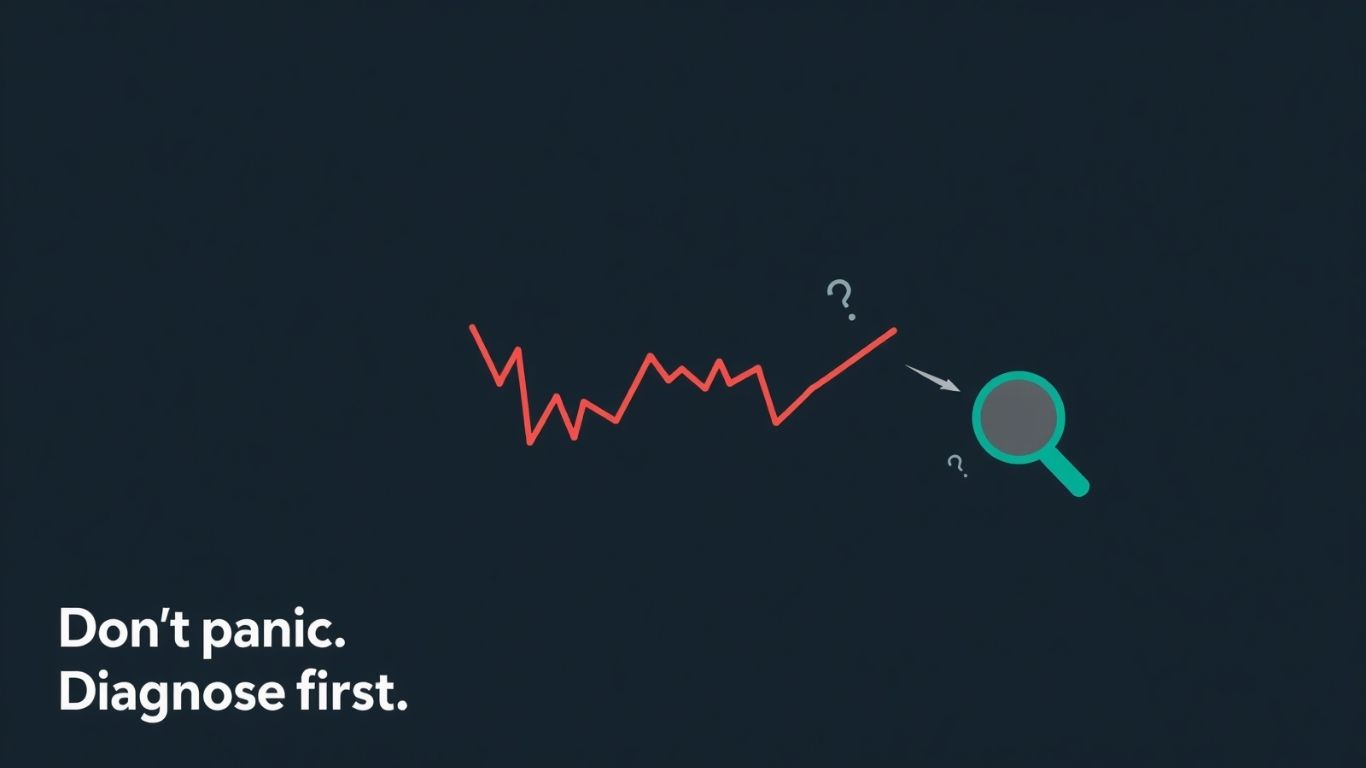
Let’s ground this in facts. Google has not officially confirmed a broad core or spam update so far this month, yet third-party tracking tools and SEO communities have logged several distinct waves of volatility since the month began — clusters of movement around August 1–3, August 5–6, and again near August 12–13. Rankings have genuinely been unstable, and plenty of people are seeing it in their own data.
For context, the last confirmed ranking events were the June 2026 spam update (June 24–26) and the May 2026 core update (May 21–June 2). So this current turbulence is happening in the gaps between announced updates – which is precisely what makes it so maddening.
Here’s the thing worth tattooing on your monitor, courtesy of Google’s John Mueller, who responded to recent volatility questions with characteristic zen: “The web & search is a very dynamic place, it’s expected that things change over time.” Not the answer anyone wants when traffic’s down 20%, but an important reframe. Search moves constantly. Not every dip is a punishment, and not every dip needs a dramatic response.
Step one: prove it’s real before you react
The single most expensive mistake during unconfirmed volatility is gutting your site based on bad data. Before you touch anything, confirm the drop is genuine and understand its shape.
“Nine times out of ten, when someone panics about a ranking drop, the first thing I check isn’t the algorithm – it’s their tracking. GA4 double-counting, a Search Console property split, a broken tag after a deploy. Rule out the boring technical explanations before you convince yourself Google has it in for you. Measure twice, refactor once.” Peter Fox, Head of Dev at 3Way.Social
Concretely, do this in order:
Isolate the data. In Search Console, compare positions, impressions and clicks separately – a click drop with stable impressions is a very different problem from an impressions collapse. Then segment out Discover and Google News traffic, because those behave differently and can distort the whole picture.
Cross-check GA4. Verify your analytics against a second source before trusting a single dashboard. Tracking bugs cause more “algorithm panics” than actual algorithms do.
Rule out technical faults. A botched deploy, a rogue noindex, a robots.txt change, a slow-loading template, an expired certificate – any of these can look exactly like an algorithmic hit. Check crawl stats, coverage reports, and recent site changes first.
Step two: read the shape of the change
Once you’ve confirmed it’s real, diagnose the pattern. Did specific page types drop while others held? Did you lose visibility on one topic cluster but not others? Is it a slow bleed or an overnight cliff? These patterns tell you far more than the raw traffic number.
A sitewide, gentle slide often points to a broad relevance recalibration. A sharp drop confined to certain pages might indicate a targeted quality or intent issue. And if a competitor suddenly leapfrogged you everywhere, the change may be about them improving rather than you declining.
Step three: what to do (and what not to)
This is where discipline pays off.
Do keep a change log. Note the dates, what moved, and what you observed. When Google eventually does confirm something, or the dust settles, this record is gold for spotting the real pattern.
Do double down on fundamentals. Genuinely helpful content, clear structure, strong internal linking, fast pages, and demonstrable expertise (E-E-A-T) are the things that survive every update, confirmed or not. Volatility is a good prompt to fix the boring stuff you’ve been putting off.
Don’t make sweeping changes mid-fluctuation. If rankings are still bouncing, you can’t measure the effect of anything you do — you’ll just add noise and confuse your own diagnosis.
Don’t delete or rewrite content in a panic. Removing pages that dipped is how people turn a temporary wobble into a permanent loss. Wait for stability first.
Barry Schwartz, who tracks this stuff obsessively over at Search Engine Roundtable, has watched countless of these episodes play out, and the recurring lesson is always the same: the people who react calmly and methodically recover far more often than the ones who tear their site apart chasing a ghost.
“We tell clients to treat unconfirmed volatility like weather, not climate. You don’t rebuild your house because it rained on Tuesday. Log what you see, protect the fundamentals, and give it two to three weeks. If the drop holds after things stabilise, then we investigate properly and act. Most of the time, it settles.” Becky Halls, Strategist at 3way.social
The mindset that wins
Unconfirmed updates are a test of temperament as much as technical skill. The web is, as Mueller reminds us, a genuinely dynamic place. Some movement is signal, plenty is noise, and your job is to tell them apart before you spend a fortnight of engineering time reacting to something that would have corrected itself.
Stay calm. Diagnose properly. Fix the fundamentals you can control. And keep that change log – future you will be grateful.
Google August 2026 Ranking – FAQ
How do I know if there’s an unconfirmed Google update happening?
Watch third-party volatility trackers and reputable SEO news sources, and compare against your own Search Console data. If multiple independent trackers spike and communities light up while Google stays quiet, you’re likely in an unconfirmed update.
Should I wait or act when my rankings drop suddenly?
First confirm the drop is real and not a tracking or technical issue. If it’s genuine and rankings are still fluctuating, wait for stability — typically two to three weeks — before making significant changes, so you can actually measure any effect.
Can technical problems look like an algorithm hit?
Absolutely, and they frequently do. Broken tags, indexing errors, botched deploys, and analytics misconfigurations all mimic algorithmic drops. Always rule these out before assuming Google changed something.
Why doesn’t Google confirm every update?
Google rolls out many smaller, ongoing changes that it doesn’t announce, reserving formal confirmations for broad core and spam updates. As Mueller notes, constant change is normal for search, so not every fluctuation gets a headline.
What’s the safest thing to do during volatility?
Keep a detailed change log, strengthen your content and technical fundamentals, and avoid drastic edits until rankings stabilise. Fundamentals-first is the approach that survives every update.
How long should I wait before concluding I was really hit?
Give it two to three weeks of relative stability. If your drop persists once the broader turbulence has calmed, that’s your cue to investigate the specific affected pages and act deliberately.
Written by the team at 3way.social – we watch the SERPs wobble so you don’t have to lose sleep over every dip.