Last Updated on February 3, 2026 by Becky Halls
Let’s talk about an interesting subject of how AI predicts backlink quality. AI has made backlink analysis faster, more precise, and context-aware. Instead of manually evaluating links, modern tools use machine learning and natural language processing to assess quality, relevance, and risks. Here’s how AI transforms backlink evaluation:
- Key Metrics Analyzed: Domain authority, relevance, anchor text variety, link placement, and organic traffic.
- Risk Detection: Identifies harmful links, over-optimized anchor texts, and spammy patterns.
- Prediction Models: AI forecasts SEO impact by analyzing historical data and simulating ranking changes.
- Automation: Tasks like competitor analysis, link scoring, and risk detection are completed in minutes.
AI-powered platforms like 3Way.Social simplify link building by automating partner matching, ensuring quality, and reducing manual effort. This approach helps you focus on building links that genuinely improve rankings and drive traffic.
How to Build Backlinks With AI (High Quality Links)
How AI Evaluates Backlink Quality
AI approaches backlink analysis with precision, examining a wide array of quality signals and ranking factors. For instance, Google’s SpamBrain AI can spot and invalidate links within a link network, effectively neutralizing their impact.
By combining machine learning and natural language processing (NLP), AI doesn’t just look at the surface. It dives deeper, using models like BERT to assess both the content and the context of a link. This enables AI to differentiate between a link in a positive review, a citation in a research report, or a random listing. This shift – from merely counting links to understanding their context – represents a major evolution in how search engines evaluate authority. Instead of viewing links as simple URL connections, AI interprets them as relationships between entities like brands, people, and concepts within a Knowledge Graph. Below are the critical factors AI uses in its evaluation.
Main Factors AI Analyzes
AI examines backlinks through several lenses, each contributing to its overall assessment:
- Domain and Page Authority: Metrics like Domain Rating or Domain Authority help AI gauge the credibility of both the site and the specific page hosting the link.
- Topical and Contextual Relevance: AI goes beyond keywords, analyzing surrounding content to ensure the link fits naturally within its context.
- Anchor Text Variety: A mix of anchor texts is crucial. Overuse of exact-match keywords signals manipulative practices, which AI can flag.
- Link Placement and Prominence: Links embedded in the main content carry more weight than those buried in footers, sidebars, or comments.
- Traffic and Engagement: AI considers the linking page’s organic traffic and user engagement to validate its quality.
- Trust and Risk Assessment: Tools like SpamBrain identify “bad neighborhoods” by evaluating over 25 risk factors, flagging links from spammy or questionable sites.
- Link Velocity and Freshness: AI tracks how quickly links are acquired. Natural, steady growth is preferred over sudden spikes that might indicate manipulation.
“We’ve seen ‘good DR’ links do nothing when the site’s traffic is basically flatlined. In practice, AI tools seem to trust a site’s real audience signals more than a vanity score.” Ian Naylor, 3Way Social
AI vs. Manual Backlink Assessment
AI’s ability to process these factors highlights its advantage over manual evaluations. What used to take SEO professionals weeks can now be done by AI in minutes, with greater precision.
| Feature | Manual | AI |
|---|---|---|
| Speed | Slow; can take days or weeks for large profiles | Rapid; processes thousands of links in minutes |
| Relevance | Subjective; relies on human intuition | Objective; uses BERT and semantic analysis for deeper insights |
| Pattern Recognition | Limited to obvious patterns | Detects hidden link networks and private blog networks (PBNs) |
| Risk Detection | Often overlooks subtle toxic signals | Evaluates over 25 risk factors for comprehensive analysis |
| Accuracy | Prone to human error and bias | High; correlates signals with ranking impact |
Manual evaluations depend heavily on visible metrics and personal judgment, making them more prone to manipulation. On the other hand, AI uncovers hidden patterns – like links between seemingly unrelated sites owned by the same entity – that human analysts might miss.
“The efficiency gain from AI audits is remarkable. What once took weeks can now be completed in hours, with greater accuracy and more actionable insights”.
The AI Prediction Process
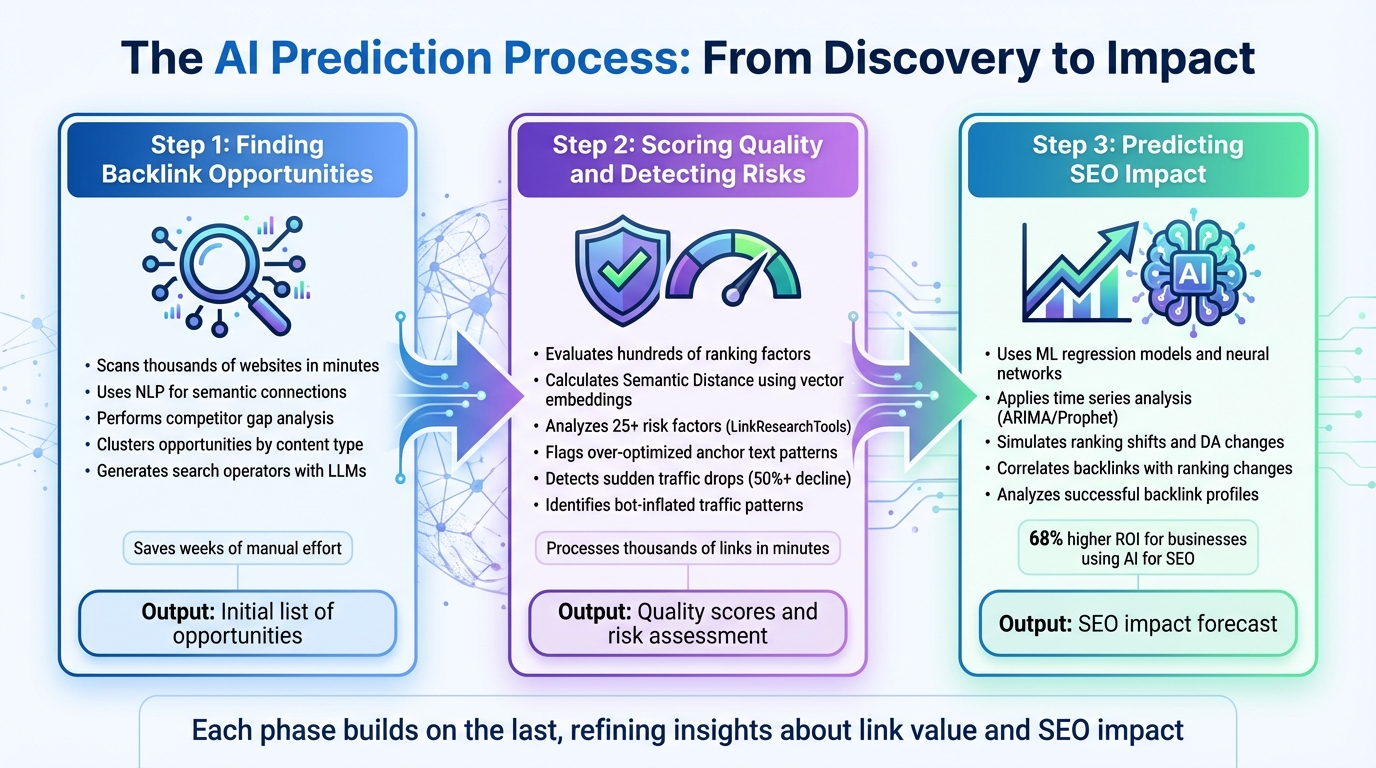
AI Backlink Quality Prediction Process: 3-Step Framework
AI transforms raw data into actionable predictions through a structured three-step process. Each phase builds on the last, refining insights about link value and SEO impact.
Step 1: Finding Backlink Opportunities
AI kicks off by scanning thousands of websites in minutes, saving weeks of manual effort. Using Natural Language Processing (NLP), it identifies semantic connections between your content and potential linking sites, ensuring relevance – both direct and contextual.
Competitor gap analysis plays a key role here, uncovering sites that link to your competitors but not to you. These become high-priority outreach targets. AI clusters these opportunities by content type – such as resource pages, original research, guides, or news articles – helping you tailor your strategy.
Advanced Large Language Models also come into play, generating search operators to find hidden opportunities, like contributor guidelines or resource lists. By creating a topical map of core entities and subtopics, AI guides the scoring of prospects. URLs are then evaluated using an AI rubric, which considers recency, outbound link standards, and topic alignment before outreach efforts begin.
This initial list of opportunities is then refined further in the next stage.
Step 2: Scoring Quality and Detecting Risks
The second phase focuses on quality scoring and risk detection. AI evaluates each opportunity using hundreds of ranking factors, relying on metrics that assess source credibility. For example, “Semantic Distance” is calculated using vector embeddings – ensuring that a link from a plumbing supplier to a plumber scores well, while one from an unrelated tech site might raise red flags.
Tools like LinkResearchTools analyze over 25 risk factors to spot harmful or toxic links. AI also differentiates between high-value links in main content and low-value or spammy links found in sidebars, footers, or comment sections. It flags over-optimized anchor text patterns, identifying profiles with repetitive exact-match keywords instead of a natural mix of branded, naked URL, and long-tail variations.
“We’ve noticed AI models don’t just look at the anchor – they look at whether the surrounding paragraph explains the relationship. When the context reads naturally, the link tends to score better.” Becky Halls, 3Way Social
Other red flags include sudden traffic drops (e.g., a 50%+ decline overnight), which may signal algorithmic penalties. Sites with predominantly non-US traffic, despite targeting US audiences, are also flagged as they often indicate bot-inflated metrics.
Step 3: Predicting SEO Impact
After evaluating quality and risks, the final step is forecasting SEO impact. AI leverages machine learning regression models and neural networks to predict outcomes like ranking improvements. By using time series analysis with algorithms like ARIMA or Prophet, it examines years of historical data to forecast future trends and seasonal fluctuations.
Advanced systems simulate ranking shifts and domain authority changes, helping prioritize targets with the highest potential impact. AI correlates backlink acquisitions with ranking changes, creating a feedback loop that sharpens predictions over time. By analyzing successful backlink profiles, it identifies subtle but critical factors – like contextual placement, anchor text distribution, and topical clustering – that influence link value.
Businesses using AI for SEO have reported a 68% higher return on investment. To maximize results, implement AI-driven recommendations incrementally and test them through A/B experiments rather than making sweeping changes. It’s crucial to ensure that the data feeding into AI models – like crawl data and backlink inventories – is accurate and up-to-date, as flawed input leads to unreliable predictions.
sbb-itb-88880ed
Using 3Way.Social for Backlink Quality Predictions
3Way.Social takes backlink quality predictions to the next level by automating high-quality link exchanges. Building on the AI evaluation process, this platform simplifies the way you connect with link partners. By using AI to assess backlink quality, it eliminates the need for manual outreach and ensures you’re matched with domains that align with your SEO goals.
AI-Powered Domain Matching and Link Exchanges
The platform’s AI works behind the scenes to evaluate potential links. It checks for quality, flags repetitive anchor text, and detects toxic links – all before any exchange takes place. This process ensures that only compliant and effective links are recommended, offering precise suggestions for potential partners.
Features That Ensure Quality Links
3Way.Social is packed with tools to help you secure reliable backlinks:
- Permanent do-follow links: These links stay active long-term, providing lasting benefits.
- Quality control filters: Toxic backlinks and repetitive anchor text are automatically screened out.
- Link diversification: Options are available to maintain a natural distribution of anchor text.
- Guest posting opportunities: Expand your reach by placing content on relevant, high-quality sites.
These features work seamlessly with the platform’s AI detection and scoring methods, creating a consistent and efficient approach to your SEO strategy.
Pricing and Plans
3Way.Social offers flexible plans to cater to different needs, from beginners to large-scale SEO operations.
| Plan | Price | Key Features | Best For |
|---|---|---|---|
| Free Plan | $0 | Add domain, discover link partners, earn/spend credits | Testing the platform and small-scale link exchanges |
| Premium Plan | Custom | Advanced filters, guest posting, priority support | SEO professionals managing multiple sites |
| Enterprise Plan | Custom | Custom integrations, dedicated account management | Large-scale SEO operations requiring tailored solutions |
The Free Plan is a great starting point, letting you build backlinks right away without any cost. For those managing more complex SEO needs, the Premium and Enterprise plans provide advanced features like enhanced filtering and dedicated support. Pricing for these tiers is customized, ensuring flexibility based on your specific requirements.
Measuring the Impact of AI-Powered Backlink Predictions
After building backlinks using AI-driven predictions, it’s crucial to evaluate their impact. Without tracking, you won’t know if your efforts are delivering results. The good news? AI-powered backlink strategies produce measurable outcomes, and by focusing on the right metrics, you can clearly assess their influence on your SEO performance.
Tracking SEO Performance Metrics
To understand how well your backlinks are working, focus on metrics that directly reveal their effectiveness. For instance, unique referring domains act as individual endorsements – one link from 10 high-quality websites holds more weight than 10 links from the same domain. Metrics like Domain Rating (DR) or Domain Authority (DA) are also essential for evaluating your site’s overall strength. In fact, 44% of SEO professionals rely on DR as a key performance indicator.
Other critical metrics include organic traffic and search rankings for the pages targeted by your backlink campaigns. These provide a clear view of how your efforts are impacting visibility. Keep an eye on your anchor text distribution too. For a natural backlink profile, maintain exact-match anchor text below 15%.
Another factor to watch is link velocity, or the pace at which you’re acquiring backlinks. A steady increase looks natural, while sudden spikes can raise red flags. Lastly, evaluate Toxicity Scores to identify harmful links early. Tools like Semrush flag links with scores between 60 and 100 as toxic, helping you avoid penalties. Remember, backlinks are vital – 92% of top-ranking pages have at least one, and off-page SEO contributes to about 50% of your ranking potential.
Tools for Monitoring Backlink Performance
Once you’ve identified the key metrics, leverage monitoring tools to keep track of your backlinks. Combining data from different tools offers a more complete picture. For example, Google Search Console provides raw link data, while platforms like Ahrefs and Semrush offer insights into toxicity and authority. Ahrefs, which maintains an index of 35.0 trillion external backlinks, is trusted by 64% of SEO professionals.
AI-powered audits can dramatically speed up the process, saving an average of 20 minutes per backlink audit. What used to take weeks can now be completed in hours. Set up alerts for link changes to address issues as they arise. It’s also important to confirm that referring domains generate real human traffic, as bot traffic won’t help your SEO efforts. Finally, tie everything together by calculating ROI. Link traffic gains from improved rankings to your conversion data and the overall value of your traffic.
Conclusion
AI has completely changed the way backlinks are evaluated and built. Instead of just counting links, we now focus on predicting their quality and impact, making it easier to prioritize links that genuinely boost rankings. Modern AI tools analyze factors like semantic relevance, user engagement, and contextual placement. They even predict how a link will affect rankings before it’s acquired – something that used to take weeks of manual effort.
“In our experience, the easiest way to lift ‘relevance scoring’ is boring: tighten your categories, clean up internal linking, and stop publishing off-topic posts just to hit a content calendar.” Ian Naylor, 3Way Social
Backlinks account for about 60% of the variance in rankings within generative AI search results. Additionally, referring domain diversity has a +0.62 correlation with higher rankings in search engines powered by large language models. These numbers highlight how crucial a high-quality, diverse backlink profile is for improving visibility – not just in traditional search engines but also on AI-driven platforms like ChatGPT and Gemini.
This shift has also inspired the creation of practical tools like 3Way.Social, which harnesses AI to simplify link building. By offering intelligent domain matching and automated quality scoring, the platform streamlines the process of finding relevant link partners. Its emphasis on permanent do-follow links and broad link diversification ensures that connections are both authentic and contextually relevant, aligning with the standards of today’s search algorithms.
The future of link building isn’t about putting in more effort – it’s about using AI strategically. Predictive analytics, automated quality checks, and real-time risk detection help you stay ahead of algorithm updates while building a backlink profile that thrives in an AI-driven search environment. AI-powered link building is rewriting the rules of SEO, combining precision, efficiency, and strategic foresight.
FAQs
How does AI evaluate the quality and relevance of a backlink?
AI evaluates the quality and relevance of a backlink by looking at several important aspects. It considers the topic and context of the website providing the link, ensuring it matches the target site’s niche and audience. It also reviews the surrounding content, the anchor text used, and the overall purpose of the link to determine how relevant it is.
By analyzing these factors, AI pinpoints backlinks that can boost a site’s authority, improve its search engine rankings, and solidify its position within its online space.
What backlink risks can AI identify?
AI can play a key role in spotting potential dangers in your backlink profile that might hurt your website’s SEO. One of the biggest threats is toxic backlinks. These come from spammy, low-quality, or manipulative sources and violate search engine guidelines. When left unchecked, they can drag down your site’s visibility. AI is particularly good at identifying patterns that signal these harmful links.
Another issue AI can help with is detecting unnatural link schemes. These are manipulative linking practices – like spam networks or other prohibited tactics – that could lead to penalties. By analyzing contextual signals and ranking factors, AI can flag these harmful links. Once identified, you can take steps like removing or disavowing them to safeguard your site’s rankings and reputation.
By leveraging AI for backlink monitoring, you can maintain a cleaner, healthier SEO profile and reduce the chances of penalties from search engines.
How does AI evaluate the quality of a backlink for SEO?
AI assesses backlink quality by looking at several key factors that influence search rankings. These include:
- Relevance: How closely the content of the linking site matches your website’s niche or topic.
- Domain Authority: The credibility and trustworthiness of the site providing the backlink.
- Context: The placement and surrounding content of the link, which help determine its natural fit and purpose.
By analyzing these elements, AI pinpoints backlinks that not only fit your site’s focus but also help boost its authority in the eyes of search engines.
Modern AI tools take things a step further with machine learning. They can detect patterns and subtle details, like the intent behind a link or how well it supports your overall SEO strategy. This means you can concentrate on building links that actually improve your rankings instead of just increasing the number of backlinks you have.