Last Updated on March 11, 2026 by Becky Halls
When building backlinks, choosing the wrong partners can harm your site’s rankings, credibility, and even lead to penalties from Google. Poor-quality backlinks waste time, money, and may exclude your site from future AI-driven traffic sources. Here are some key red flags when choosing link partners to watch for:
- Generic Outreach: Impersonal emails, grammatical errors, or unbranded email addresses signal low-quality partners.
- Unreliable Communication: Slow responses or vague excuses indicate a lack of professionalism.
- Bulk Domain Offers: Offers from Private Blog Networks (PBNs) or sites with unnatural backlink profiles are risky.
- Excessive Follow-Ups: Pushy or spammy follow-ups suggest a focus on quantity over quality.
- Unbalanced Exchanges: Uneven link ratios or partners removing your links after placement can harm your efforts.
To avoid these issues, vet partners carefully using metrics like organic traffic, domain rating, and backlink diversity. AI tools can streamline this process by spotting patterns humans might miss. Always prioritize clear agreements and fair exchanges to protect your SEO strategy.
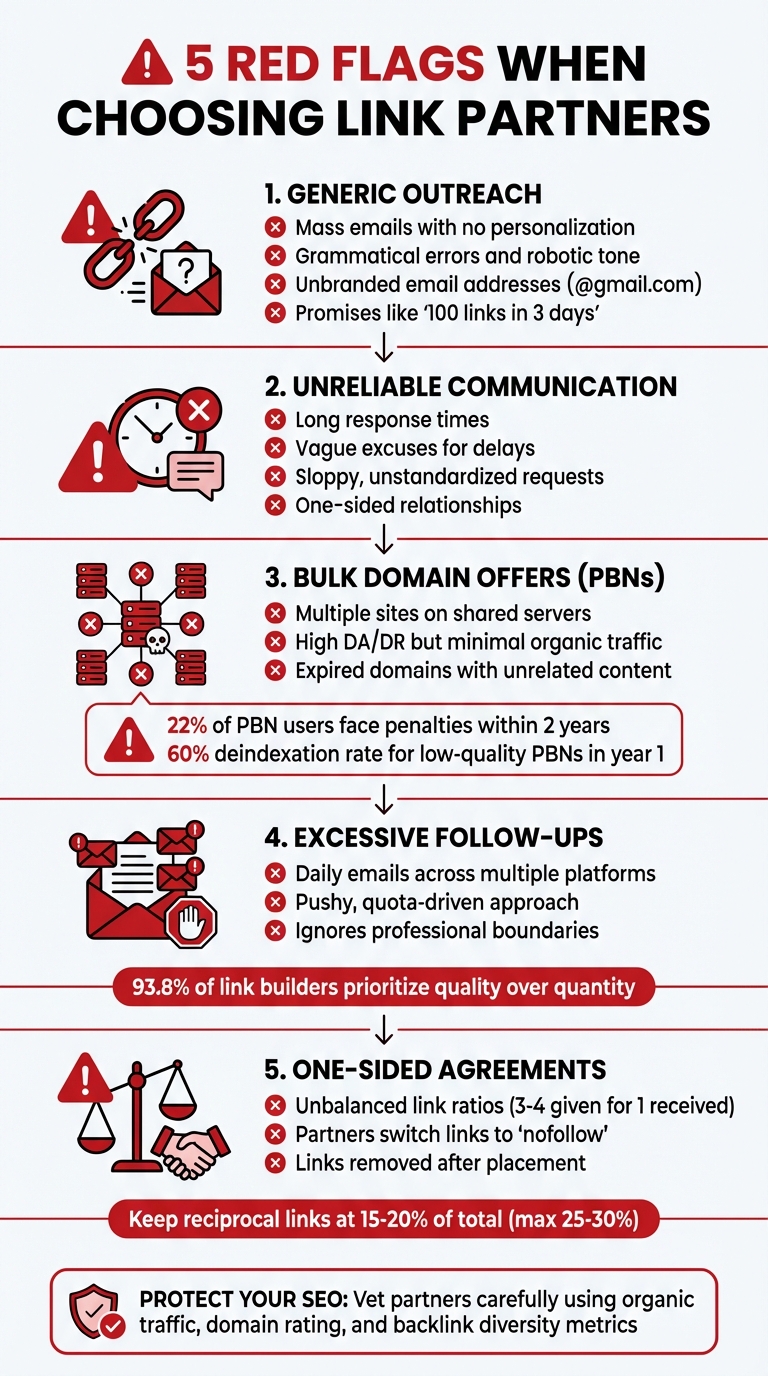
5 Red Flags When Choosing Link Partners for SEO
15 Step Guide to Vetting and Auditing Backlinks (Webinar)
Common Red Flags in Link Partner Selection
Spotting warning signs early can save your site from losing credibility and taking a hit in search rankings. Often, the tone and content of the initial outreach reveal whether you’re dealing with a professional or a low-quality operation.
Generic and Impersonal Outreach
Mass emails are a dead giveaway of a poor-quality link partner. These messages often lack any mention of your website’s unique qualities, niche, or content.
“Nothing kills a good link exchange opportunity faster than an impersonal outreach email.” – Diana Aghumyan, SEO Content Writer, SayNine
Look out for frequent grammatical errors, unusual capitalization, or a tone that feels robotic – these are signs of spam or AI-generated content. Unbranded email addresses (e.g., @gmail.com) and a lack of credentials further diminish trustworthiness. Genuine partners usually provide case studies or examples of reputable brands they’ve worked with. Be cautious if the pitch includes promises like “100 links in 3 days” or bulk domain lists; this signals a focus on volume over quality.
To avoid spam, verify the sender’s identity on LinkedIn and check if their email references a specific part of your site. If it doesn’t, it’s likely not worth your time.
“We’ve seen the biggest red flag is ‘they link to everyone.’ If a site happily links to every niche under the sun, your link is just another transaction.” Ian Naylor, Founder at 3Way Social
Unresponsive or Unreliable Partners
Once you’ve assessed the initial outreach, pay attention to how well the potential partner communicates. Long response times, sloppy link requests sent via multiple Google Docs instead of a standardized format, or vague excuses for delays are all signs of unreliability.
“Poor communication disrupts planning and obscures backlink timelines.” – Diana Aghumyan, SEO Content Writer, SayNine
Successful link-building relies on trust and clear communication, not just transactional exchanges. Regular follow-ups every two to three days can test their responsiveness. If delays and excuses persist, it’s better to cut ties. Tracking the “backlink balance” in a spreadsheet can also highlight one-sided relationships where you’re giving more value than you’re receiving.
Bulk Domain Offers from PBNs
Another major red flag is the nature of the domains being offered. Private Blog Networks (PBNs) aim to manipulate search rankings rather than provide genuine value. Partners offering bulk domain lists are often tied to these networks.
Technical tools can help identify PBNs. Use reverse IP lookup tools to check if multiple sites share the same server, as PBNs often cluster domains on shared hosting. Look for commonalities like shared IP addresses, hosting providers, nameservers, or tracking codes like Google Analytics IDs. RDAP lookups can reveal if seemingly unrelated sites have identical registration details. A high Domain Authority (DA) or Domain Rating (DR) paired with minimal organic traffic is another warning sign – tools like Semrush or Ahrefs can verify these metrics.
Content inconsistencies also provide clues. Watch out for expired domains repurposed with unrelated content, AI-generated text, no social media presence, or missing “About Us” pages. Google actively combats such tactics, neutralizing around 40 billion spam pages daily. A 2025 survey found that 22% of SEOs using PBNs faced penalties or deindexation within two years, with low-quality networks seeing deindexation rates as high as 60% in the first year. Even higher-quality PBNs aren’t immune, with deindexation rates of 5–10% over two years.
Before committing to any partnership, use reverse IP lookup tools to check if the site shares a server with numerous other blogs. The Wayback Machine can also reveal a domain’s history – if a local restaurant site suddenly transforms into a “global tech news” hub, that’s a red flag. Lastly, if a site links to unrelated niches like gambling, crypto, or pharmaceuticals from generic blog posts, it’s likely a link farm.
“In our experience, a clean-looking metric profile can hide a messy reality. One quick skim of their recent posts and outbound links usually tells you what the numbers don’t.” Becky Halls, Strategist at 3Way Social
Avoiding Low-Value Link Exchanges
Not all link exchanges are worth your time. Some can weaken your SEO efforts, while others might harm your site’s credibility.
Excessive Follow-Ups or Pushy Requests
Most professional link builders follow up every two to three days. Anything more frequent can feel spammy and unprofessional. If someone bombards you with daily emails or messages across multiple platforms, it’s a clear sign they’re prioritizing quantity over quality. This approach often reflects a quota-driven mindset that leans on low-quality links. In fact, 93.8% of link builders agree that link quality is far more important than quantity.
To avoid this, set clear deadlines for link placements from the start. If someone repeatedly ignores these boundaries, it’s best to walk away. Respecting professional communication standards is key to maintaining productive partnerships.
One-Sided Link Agreements
Pushy follow-ups aren’t the only red flag. Uneven link exchanges can also undermine your efforts. Keep an eye on your link exchange ratio – if you’re giving three or four links for every one you receive, the partnership isn’t balanced.
“Keep your link ratios balanced: no more than 10 to 15% of inbound links should be from reciprocal sources, this keeps your footprint looking more natural.” – Aaron Whittaker, VP of Demand Generation, Thrive Marketing Agency
A good partnership involves websites with similar authority levels, ideally within 10 points of Domain Rating. If a site with a much lower Domain Rating demands a link without offering equal value, it’s a warning sign. Ideally, reciprocal links should account for 15–20% of your total referring domains. Going beyond 25–30% can raise red flags with search engines.
If a partner switches your links to “nofollow” or removes them after you’ve upheld your end of the agreement, document the issue and end the partnership immediately. Protecting your reputation and SEO strategy should always come first.
“We’ve noticed bad partners leave signatures: thin content, huge sponsor blocks, keyword-stuffed anchors, and lots of unrelated outbound links. If it feels like a link farm, it probably is.” Becky Halls, Strategist at 3Way Social
sbb-itb-88880ed
How to Identify Quality Link Partners
Finding quality link partners takes more than just skimming through a few metrics. It demands a thoughtful, step-by-step process that blends technical analysis with assessing real-world credibility.
Vetting Processes for Secure Partnerships
Start by considering metrics like a Domain Rating (DR) above 50 and monthly organic traffic exceeding 10,000 visitors. But numbers alone aren’t enough – real-world credibility is equally important.
“DA is an outdated metric that you should forget about. What’s really important is obtaining links from sites with strong brand authority in your niche.” – Alexandra Tachalova, Founder, Digital Olympus
Check for genuine branded traffic by looking at searches for the company’s name. Use tools like the Wayback Machine to ensure the domain hasn’t been recently repurposed or acquired from an expired domain, a common red flag for Private Blog Networks (PBNs). Look for trust indicators like a physical address, real team members with verified LinkedIn profiles, and active social media accounts – these are signs of a credible partner.
Don’t stop there. Dive into the partner’s backlink profile to check for diversity. A trustworthy site will have links from a variety of sources and natural anchor text patterns. Steer clear of sites linked to PBNs or those operating in questionable niches. You can also run their content through AI detectors to ensure it’s not low-quality, machine-generated material.
Using AI-Powered Platforms
Manually vetting potential partners can be overwhelming, especially when dealing with large lists. This is where AI-powered platforms come in handy – they can spot patterns and risks that might slip by human review.
Modern AI tools focus on contextual credibility rather than just counting backlinks. They can identify red flags like unnatural anchor text patterns, irregular link placement timing, and whether authoritative sources mention the brand in meaningful ways. These platforms also monitor traffic trends to flag sites that may have been penalized by Google updates.
Take 3Way.Social (https://3way.social) as an example. This AI-driven platform simplifies the process by matching you with quality link partners while ensuring fair exchanges. It automatically checks for key factors like domain authority, traffic patterns, and backlink profile health. Plus, its link diversification features help you maintain a balanced backlink profile by keeping reciprocal links within the safe 15–20% range of total referring domains.
Once you’ve vetted potential partners using these tools, the next step is to establish clear agreements for a successful collaboration.
Setting Clear Communication and Agreements
Even the best partnerships can fail without clear communication. Start by defining expectations for link placement timelines, content quality, and what constitutes a fair exchange.
“One easy mental model for nurturing a good relationship with your link partner is promptness. Respond promptly to their inquiries, especially in a time of conflict/confusion. It builds trust.” – Aquibur Rahman, CEO, Mailmodo
To stay organized, agree on a standardized format for link requests – this could be a shared spreadsheet or a platform dashboard. This avoids the chaos of juggling different formats from multiple partners. Set clear response time expectations, like replying within 48 hours, and define specific deadlines for when links should go live.
Finally, document everything. Include minimum DR requirements, niche relevance, and whether links should be dofollow or include sponsored attributes. Establish a plan for replacing broken or poor-quality links to protect both parties’ SEO strategies over time.
Conclusion: Building Strong and Ethical SEO Partnerships
Picking the right link partners isn’t just about climbing the rankings – it’s about safeguarding your site from penalties that can be catastrophic. Imagine this: in April 2023, an established website watched its organic traffic nosedive from 238,759 to just 23,268 in a single month. The cause? A manual action for unnatural links. Worse still, their top-three keyword rankings dropped from over 1,400 to a mere 113. Years of SEO work, undone in an instant.
Adding to the challenge, modern AI tools like Google’s SpamBrain are now better than ever at spotting manipulative link-building tactics. These systems can detect link spam – both direct and indirect – on a massive scale. This makes risky strategies even more dangerous. Instead, focusing on balanced and meaningful link exchanges is critical. Rather than transactional swaps, aim for partnerships built on shared value and relevant content. These kinds of collaborations are far more resilient under manual reviews.
“If you do link exchange based on content synergy rather than manipulation, then you’ll have all the right signals flying.” – Aaron Whittaker, VP of Demand Generation, Thrive Marketing Agency
Using automated tools can help reinforce these best practices. For example, 3Way.Social simplifies partner vetting, ensures balanced exchanges, and facilitates ABC link-building strategies. Its AI-powered matching connects you with quality partners while keeping you aligned with Google’s guidelines. Regular backlink audits are another must to keep your profile healthy. All of this underscores the importance of selecting partners with transparency, relevance, and a thorough vetting process at the forefront.
Red Flags When Choosing Link Partners – FAQs
How can I quickly tell if a site is a PBN?
To identify a Private Blog Network (PBN), look for clues that suggest shared ownership or coordination. Start by examining WHOIS records for overlapping ownership details. Pay attention to interlinking patterns – PBNs often link excessively between their own sites. Other red flags include the use of expired domains, similar website designs, or poor-quality content. These indicators frequently point to the presence of a PBN.
What’s a safe percentage of reciprocal links for my backlink profile?
When it comes to reciprocal links, keeping the percentage small and natural is key. Many top-ranking websites include some reciprocal links without any problems. However, if more than 50% of your backlinks are reciprocal, it could raise red flags, especially if not handled properly. The best approach? Build a diverse and organic backlink profile to stay on the safe side and steer clear of penalties.
What should I include in a link exchange agreement to avoid problems?
To steer clear of potential problems, it’s essential to include clear terms that outline the partnership’s scope. This might involve specifying approved tactics, such as manual outreach or ethical link placements, and requiring pre-publish link previews for added transparency. Define quality metrics clearly – think relevance and minimum domain authority levels – to set expectations upfront. Additionally, avoid over-optimization by limiting the use of exact-match anchor text and steering clear of unnatural link patterns. A well-detailed, transparent agreement helps ensure compliance with guidelines and minimizes risks tied to link exchanges.