Last Updated on January 29, 2026 by Becky Halls
Social signal integration – likes, shares, comments, and other interactions on platforms like Facebook, Instagram, and LinkedIn – don’t directly affect search engine rankings. However, they play an indirect but impactful role in SEO by increasing visibility, driving traffic, and encouraging backlinks. Viral posts can attract attention from journalists and bloggers, leading to high-quality links that improve rankings. For instance, campaigns like Dove’s Self-Esteem Project gained millions of likes, generating backlinks from major publishers and boosting keyword rankings.
Key takeaways:
- Social signals amplify content reach: They help your content get noticed by influencers and link creators.
- Boost branded searches: Engaged users often search for your brand, signaling relevance to search engines.
- Support Google’s E-E-A-T framework: Social proof enhances your perceived expertise and authority.
To integrate social signals:
- Post platform-specific content (e.g., Instagram Reels, LinkedIn summaries).
- Encourage engagement with questions, videos, and user-generated content.
- Use tools like Google Analytics to track social traffic and branded searches.
Social signals won’t replace core SEO tactics like backlinks but are crucial for maximizing visibility and creating opportunities for growth.
🚀 Social Media SEO: Boost Search Rankings with Social Signals!
What Are Social Signals and How They Affect SEO
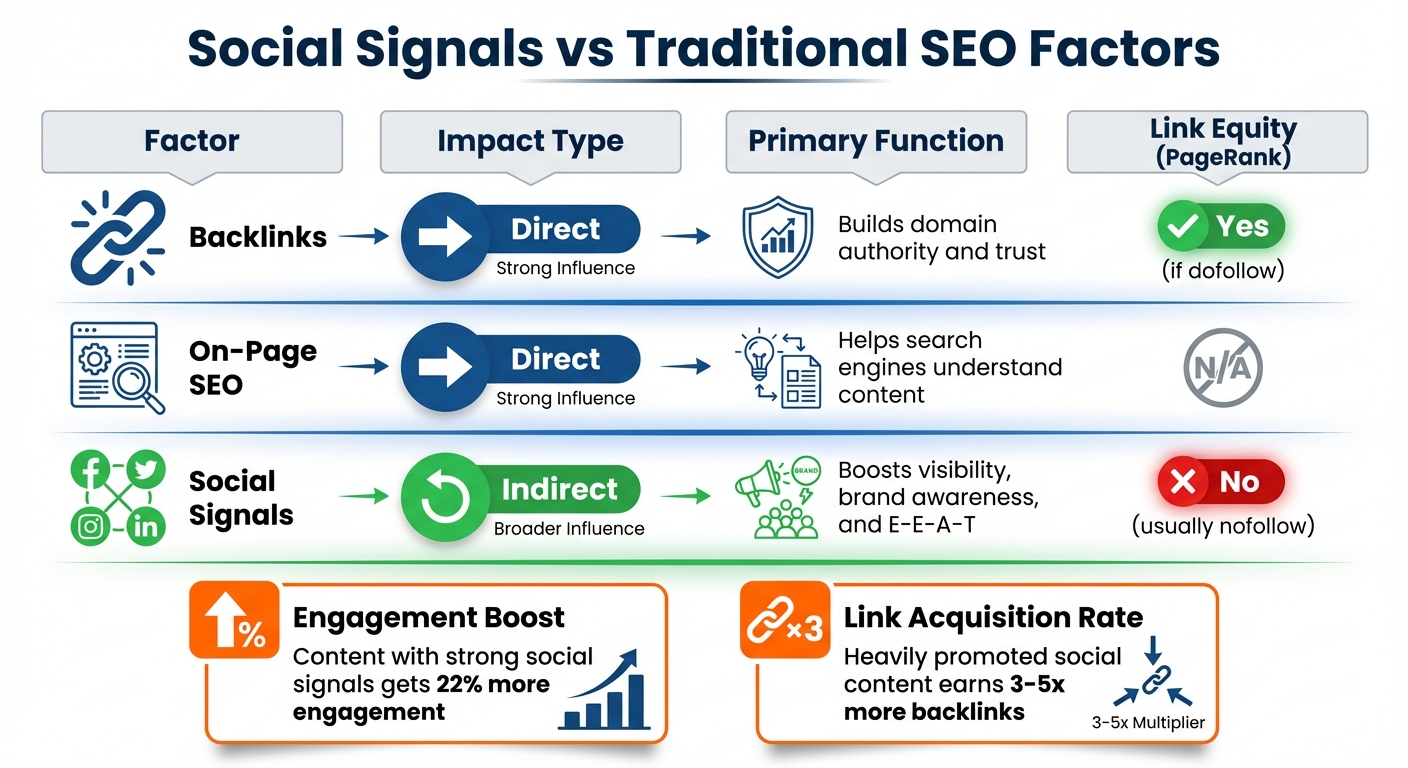
Social Signals vs Traditional SEO Factors: Impact Comparison
What Social Signals Are
Social signals refer to the interactions your content gets on social media platforms – things like likes, shares, comments, retweets, pins, upvotes, and follows. These actions show that people find your content engaging and worth interacting with. For example, when someone retweets your post on X, saves your Instagram reel, or comments on your LinkedIn update, they’re essentially giving your content a public nod of approval. Think of these interactions as a kind of “social proof” for your content.
Now, while backlinks directly influence rankings by passing link equity, most social media links come with a nofollow tag, meaning they don’t offer the same SEO value in a traditional sense. Still, they play an important role by expanding your content’s reach.
Why Social Signals Matter for SEO
Social signals may not directly influence rankings, but they bring indirect SEO benefits. Google has been clear on this point – former Head of Webspam Matt Cutts and Search Advocate John Mueller have both said that social signals aren’t direct ranking factors. Why? Social media data can be messy, with spam, fake accounts, and paid interactions muddying the waters. Even so, the ripple effects of social signals can significantly improve your content’s search visibility.
For starters, high social engagement boosts content discovery. When a post gains traction on social media, it reaches a wider audience, including journalists, bloggers, and other influencers who might link to it from their websites. These editorial backlinks, which do pass link equity, can directly improve your rankings. A great example: In August 2021, the music site Loudwire shared a post about a Nickelback copyright lawsuit on Facebook and Twitter. Within just four days, the post garnered around 600 shares, helping it rank #3 for “nickelback rockstar” and #1 for “nickelback rockstar copyright lawsuit”.
Social signals also tie into Google’s E-E-A-T framework (Experience, Expertise, Authoritativeness, and Trustworthiness). Google looks at social media profiles to assess the credibility of content creators. As Matt Cutts explained:
We do use Facebook and Twitter links in ranking as we always have… but in addition, we’re also trying to figure out a little bit about the reputation of an author or creator on Twitter or Facebook.
SEO expert Marie Haynes echoes this, saying:
If people all over the web are talking about your brand (in a good way), then Google may consider you an authority and want to rank you higher.
Another benefit? Social signals can drive branded searches. When users engage with your content on social media, they’re more likely to search for your brand directly. This sends a strong signal to search engines that your brand is worth noticing. Plus, your social media profiles often rank on the first page for branded searches, giving you more control over how your brand appears in search results.
Next, we’ll see how social signals stack up against traditional SEO factors and how they complement each other.
Social Signals Compared to Other SEO Factors
Traditional SEO focuses on direct ranking factors, while social signals serve as a powerful support system for increasing content visibility. Backlinks and on-page SEO directly influence rankings by building authority and relevance, whereas social signals work indirectly by amplifying your content’s reach.
| Factor | Impact Type | Primary Function | Link Equity (PageRank) |
|---|---|---|---|
| Backlinks | Direct | Builds domain authority and trust | Yes (if dofollow) |
| On-Page SEO | Direct | Helps search engines understand content | N/A |
| Social Signals | Indirect | Boosts visibility, brand awareness, and E-E-A-T | No (usually nofollow) |
The main distinction is that backlinks directly pass PageRank to boost authority, while social signals enhance visibility, creating opportunities for earning quality backlinks. As Wordstream puts it:
The first step to being linked to is being seen. Social media is a great way to be seen by a larger audience, and this is why it can also be a part of your link-building strategy.
Here’s the key: Research shows that content with strong social signals gets 22% more engagement than content without them. Additionally, content that’s heavily promoted on social media typically earns three to five times more backlinks than similar content that isn’t. This snowball effect highlights how social signals can complement and amplify your broader SEO efforts.
How Social Signals Affect Search Rankings
Indirect Benefits of Social Signals
Social signals play an indirect yet impactful role in boosting your search performance. They amplify your content’s visibility, reaching journalists, bloggers, and industry experts who can provide editorial backlinks. Research highlights that content with strong social engagement earns three to five times more backlinks compared to content without social promotion. It also sees about 22% higher overall engagement, creating a ripple effect often referred to as the “flywheel effect”. This cycle not only strengthens your link profile but also enhances your overall SEO performance.
Take the example of the Dove Self-Esteem Project campaign. Its viral social content attracted backlinks from high-authority publishers, helping it dominate search rankings for targeted keywords. Beyond backlinks, social traffic improves key on-site metrics like dwell time, pages per session, and bounce rates. It also drives branded searches as users actively seek out your brand, further boosting your online presence.
Correlation vs. Causation in Social Signal Influence
It’s common to see high-ranking pages with a significant number of social shares. However, it’s important to remember that correlation doesn’t mean causation. As the team at Semrush explains:
Social signals are not a Google ranking factor. But they can increase your brand’s visibility in search results, generate traffic to your website, and build brand awareness.
Tommy Landry, President of Return On Now, adds to this perspective:
Social signals don’t directly influence rankings. However, they DO shape every input that does: traffic, backlinks, awareness, and authority.
The takeaway? Focus on creating content that resonates with your audience. When your content naturally attracts social engagement, it often leads to quality backlinks and other benefits that positively influence your ranking. AI systems are also becoming more sophisticated in evaluating how these signals contribute to search relevance.
How AI Evaluates Social Signals
Modern AI systems have become skilled at interpreting social signals to assess brand credibility and relevance within a specific niche. For instance, tools like ChatGPT analyze social mentions and audience reactions to gauge a brand’s authority. Search engines, in turn, assign different weights to social signals based on the authority of the users engaging with the content. Verified or influential accounts typically carry more influence than newer or less active profiles.
These AI systems also analyze engagement patterns to differentiate genuine interactions from automated activity. Sustained engagement is often prioritized over short-lived viral trends. Social signals also help with entity recognition and topic association, enabling search engines to better understand a site’s relevance to its niche. This process ties directly into the E-E-A-T framework, where social profiles contribute to evaluating the experience, expertise, authority, and trustworthiness of content creators and websites.
To strengthen your brand’s authority across platforms, consider using the sameAs schema property. This allows you to explicitly link your website to your social media profiles, consolidating your brand signals and improving your overall online credibility.
sbb-itb-88880ed
Strategies for Social Signal Integration
Now that you understand how social signals can influence SEO, it’s time to put that knowledge into action with targeted strategies.
Platform-Specific Optimization
Every social platform has its unique algorithm, so your approach needs to align with each one’s preferences. For example:
- Facebook: Content that sparks meaningful conversations performs best. Posts that encourage comments and discussions tend to outperform those that just gather likes. Aim to post between Tuesday and Thursday, from 9:00 AM to 1:00 PM.
- LinkedIn: This platform favors native content that keeps users engaged without leaving the site. A good strategy is to share a summary of your content in the post text and include your website link in the first comment. This avoids penalties for external links and takes advantage of LinkedIn’s referral traffic, which averages 4.1 pages per session and 4.8 minutes of engagement. The optimal posting time is Tuesday through Thursday, between 8:00 and 10:00 AM.
- Instagram: Dynamic formats like Reels, carousels, and videos are key. These formats generate 38% more traffic, and using link stickers in Stories can increase site visits by 23%.
- TikTok: Thanks to its interest-based content surfacing, TikTok allows you to reach new audiences even if you don’t have a large follower base. To make an impact, deliver your core message within the first three seconds. TikTok currently accounts for 15.6% of all social referral traffic.
Once you’ve tailored your strategies for each platform, the next step is creating content that drives engagement.
Creating Content for Social Engagement
Posting at the right time is important, but the content itself must be engaging to generate strong social signals. Shareable content is key. For instance, posts that ask a question drive 21% more engagement, while encouraging likes or shares can increase interaction by up to 400%. Including video content is another effective tactic – pages featuring three or more videos earn 55% more backlinks than those without.
Kyle Risley, Senior SEO Lead at Shopify, highlights the connection between brand-building and social content:
“Google tends to like sites that are associated with brands. And one of the easiest ways to determine a brand’s popularity is by measuring how frequently users search for that brand.”
For local businesses, geotagging physical locations in posts and stories is a smart move. This links your content to specific map coordinates, helping it appear more relevant to local audiences. Adding local keywords to your social media bios – like “Denver’s top-rated artisan bakery” – can also boost visibility. Since 42% of local searchers click on results within the Google Map Pack, this is a powerful way to connect with nearby customers. Additionally, turning 5-star Google reviews into eye-catching social media graphics can build trust and encourage more reviews, which 90% of marketers agree directly impacts search rankings.
Using Tools and Platforms
To make sharing easier, install tools like Mashshare or Shareaholic. These reduce the friction of sharing your content and help search engines index shared pages much faster, sometimes within hours.
Track the effectiveness of your social signals by monitoring branded searches through Google Search Console. You can also use Google Business Profile Insights to measure metrics like “Direction Requests” and “Clicks to Website”, which often align with increased social media activity.
For businesses aiming to combine social signals with link-building, platforms like 3Way.Social offer AI-powered domain matching and quality backlinks to boost rankings and domain authority.
Finally, tools like Google Analytics can help you evaluate the quality of referral traffic from social media. By identifying which platforms bring in the most engaged visitors, you can refine your strategy. Marketers who use social media for link-building outreach generate 22% more links per month, and combining social traction with brand mentions leads to 27% faster keyword growth compared to relying on links alone.
Advanced Techniques for Maximizing Social Signal Impact
Building Social Authority and Credibility
When it comes to social engagement, not all interactions are created equal. Search engines give more weight to likes or shares from recognized industry experts than from less established accounts. This is why building genuine relationships with respected figures in your field is so important. A single authoritative mention can spark a chain reaction, leading to more organic citations and editorial backlinks.
AI tools now go beyond counting clicks – they analyze the sentiment of conversations and assess who’s engaging with your content to determine its usefulness and credibility. As OWDT puts it:
Social signals become part of the ‘experience layer’ that AI assesses to determine whether content is useful, credible, and worthy of ranking.
This shifts the focus away from simply growing follower counts. Instead, the goal becomes creating a trust network – a group of respected voices that vouch for your content. This approach not only enhances credibility but also supports the indirect SEO benefits discussed earlier.
Here are some practical ways to build this trust network:
- Collaborate with micro-influencers in your niche to expand your reach and attract high-quality referral traffic.
- Encourage user-generated content by asking customers to share their experiences. This creates social proof and can even boost branded search volume.
- Turn positive reviews into shareable social graphics to amplify engagement and credibility.
By cultivating these relationships and fostering trust, you’ll also lay the groundwork for more effective backlink strategies.
Combining Social Signals with Backlink Strategies
Social media isn’t just for building awareness – it’s a powerful tool for distributing “linkable assets” like original research, infographics, or detailed guides. When these assets gain traction on social platforms, they’re more likely to catch the attention of bloggers and journalists who can link back to your content. In fact, research shows that content with high social engagement earns 3.5 times more backlinks than content with low engagement.
Take this example: In 2025, Parkdean Resorts launched a digital PR campaign by creating a “mini holiday park for hedgehogs.” They tied the project to a news story about hedgehogs being endangered and promoted it heavily on social media. The result? High-authority editorial backlinks from major sites like Lonely Planet. This campaign shows how a well-timed, newsworthy idea can go viral on social platforms, driving massive traffic and earning mentions from reputable news outlets.
Even during manual link outreach, pointing to content with strong social traction makes your pitch more compelling. Site owners are more likely to see it as credible and worth linking to. For those looking to scale this strategy, tools like 3Way.Social can help. These platforms use AI to match high-performing social content with quality backlink opportunities, streamlining the process and boosting your rankings.
By aligning your social media efforts with your backlink strategy, you can maximize the impact of both.
Tracking and Analyzing Social Signal Performance
To truly understand the impact of your social signals, you need to track both engagement metrics and their influence on SEO. Start by monitoring basic engagement metrics like likes, shares, comments, saves, and reposts. Pay close attention to share velocity – how quickly your content is shared. A high share velocity often leads to natural link acquisition and increased organic traffic.
Evaluate the quality of social referrals by analyzing session duration, pages per session, and UTM parameters. This helps you determine which platforms bring in the most engaged visitors. Also, keep an eye on branded search queries in Google Search Console. High engagement often results in a noticeable uptick in brand searches within 48 hours.
Here’s a quick guide to key metrics by platform:
| Platform | SEO Benefit | Key Metric to Track |
|---|---|---|
| Professional Authority | Share-to-impression ratio | |
| Visual Brand Recognition | Story completion rate | |
| Twitter/X | Real-time Engagement | Retweet velocity |
| Community Building | Comment engagement depth |
Additionally, track both linked and unlinked brand mentions using tools like Google Alerts or Brand24. This helps you monitor how your brand is discussed across platforms. As OWDT explains:
Social signals no longer simply indicate popularity; they shape AI-based content summaries, featured results, and conversational search outputs.
Finally, don’t overlook sentiment analysis. Whether mentions are positive or negative can influence click-through rates from search results. By staying on top of these metrics, you can fine-tune your strategy and maximize the value of your social signals.
Conclusion
While social signals won’t replace core SEO elements like backlinks or on-page optimization, they’re becoming an increasingly important factor in how AI assesses content credibility. Research indicates that high social engagement can lead to more backlinks and improved local search outcomes. As OWDT puts it:
Social signals will not replace backlinks or core SEO practices, but they will increasingly shape how content is interpreted and ranked.
Studies also highlight the strong influence of positive reviews on local search performance.
To leverage these insights, start by optimizing your social profiles as if they were landing pages. Use targeted keywords in your bios, ensure consistent NAP (Name, Address, Phone) information across platforms, and add visible social sharing buttons to your site. When creating content, aim for posts that encourage real interaction – questions, for instance, boost user engagement by 21%, and directly asking for shares can raise sharing rates by a staggering 400%.
Keep an eye on branded search queries in Google Search Console and track the velocity of shares to spot content that’s gaining traction. Metrics like comments, shares, and saves reveal deeper engagement levels than simple likes. This strategy ties together social signals and link-building efforts, creating a more cohesive and effective SEO approach.
Incorporating these methods ensures your social presence aligns with AI-driven search priorities. Social signals now play a role in the “experience layer”, influencing whether your content earns a spot in the rankings. By weaving social signals into your broader SEO strategy, you’ll build the trust, authority, and visibility that modern search engines value.
Social Signal Integration – FAQs
How do social signals affect SEO rankings?
Social signals – like likes, shares, and comments – play an indirect role in SEO by highlighting how popular and engaging your content is. While they don’t directly affect search rankings, these interactions can boost your content’s visibility and bring more traffic to your site. This often leads to more backlinks, which help build your site’s authority over time.
By extending your content’s reach and acting as a form of social proof, these signals make it easier for reputable websites to discover and link to your material. This creates a ripple effect: stronger credibility, higher user engagement, and natural growth – all of which contribute to better SEO results.
What are the most effective ways to boost social media engagement?
To increase engagement on social media, focus on crafting content that grabs attention and encourages sharing. Make sure your posts align with the style and expectations of each platform, and spark interaction by posing questions or initiating conversations. Regularly posting and replying to comments can help nurture a closer connection with your audience.
Take advantage of analytics tools to measure engagement metrics like likes, shares, and comments. These insights reveal which types of content resonate most, allowing you to fine-tune your approach. You can also keep things fresh by creatively repurposing content across different platforms. By concentrating on high-quality posts and staying actively involved with your audience, you’ll not only boost interactions but also build a more robust online presence.
How do I evaluate the impact of social signal integration on my SEO performance?
To evaluate how social signal integration influences your SEO, keep an eye on key engagement metrics such as shares, likes, comments, and traffic from social media platforms. These interactions not only amplify your content’s reach but also add credibility, which can indirectly benefit your SEO performance.
Another important aspect to track is social backlinks – links shared on social platforms that direct users to your website. Even though many of these links are marked as “nofollow”, they still play a role in increasing your site’s visibility and perceived authority. Analytics tools can help you measure both engagement levels and the impact of these backlinks, offering deeper insights into how social signals contribute to your rankings.
By analyzing both engagement metrics and social backlinks, you can gain a clearer understanding of how your social media presence aligns with and supports your SEO objectives.