Ultimate Guide to Competitor Do-Follow Link Replication
Analyze competitor do-follow backlinks, prioritize high-value targets, replicate links ethically via outreach and tools, and track results to boost organic rankings.

Last Updated on December 25, 2025 by Becky Halls
Want higher rankings? Competitors often outrank you because they’ve built stronger do-follow backlinks – links that pass authority and directly impact SEO. The top-ranking page on Google typically has 3.8x more backlinks than lower-ranked pages. By replicating competitor links, you can close this gap effectively.
Here’s what you’ll need to do:
- Understand Do-Follow Links: These links transfer authority to your site, boosting rankings.
- Analyze Competitors: Use tools like Ahrefs or SEMrush to extract their backlink profiles.
- Prioritize High-Value Links: Focus on links from niche-relevant, high-authority sites.
- Outreach with Precision: Personalize emails to secure links ethically, avoiding spammy tactics.
- Track Progress: Monitor acquired links, organic traffic, and rankings to measure success.
Key takeaway: By targeting the same link sources as your competitors and using tools like 3Way.Social for smarter link-building, you can build a stronger backlink profile without resorting to shortcuts. Let’s dive into the details.
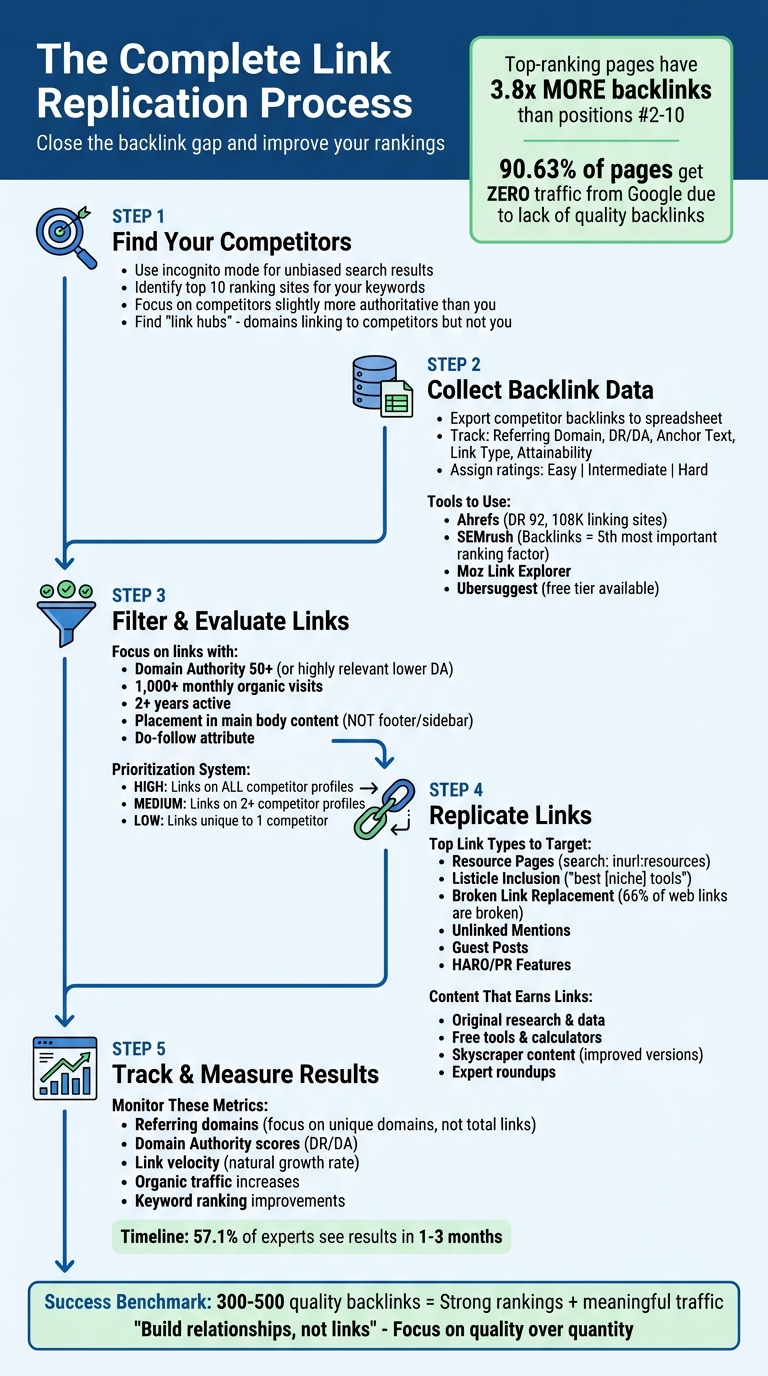
5-Step Competitor Do-Follow Link Replication Process for SEO Success
How to Do Competitor Backlink Analysis Check To Rank On Google
Preparing for Competitor Link Replication
To improve your SEO strategy, it’s essential to identify competitors that are outranking you and analyze the sources of their backlinks. A study examining one billion pages revealed that 90.63% of all pages get zero traffic from Google, often because they lack quality backlinks. This is why pinpointing the right competitors and gathering their backlink data is a critical step.
Finding Competitors to Analyze
Start by focusing on SEO competitors who rank for your target keywords. These are the websites you need to study closely.
To identify them, perform Google searches using incognito mode to see unbiased local search results. Pay attention to the top 10 results for your most important keywords – these are your keyword-based competitors.
Next, expand your scope to entire site competitors – websites that compete with you across a range of keywords and content topics. SEO tools can help you uncover sites with the most shared keywords. It’s best to focus on competitors that are slightly more authoritative than your site. Avoid industry giants like Wikipedia or Amazon, as replicating their resources is unrealistic.
Another effective approach is identifying link hubs – domains that link to multiple competitors but not to you. These hubs are prime opportunities because they already link to businesses in your niche, making them more likely to link to you as well.
Once you’ve identified your competitors, the next step is gathering their backlink data for deeper analysis.
Collecting and Organizing Backlink Data
Use SEO tools to extract the backlink profiles of your competitors. Export this data into a CSV file or Google Sheets so you can organize and analyze it effectively.
Create columns for the following details:
- Referring Domain
- Domain Rating (DR) or Domain Authority (DA)
- Anchor Text
- Link Type (e.g., guest post, directory, forum)
- Target Page
- Attainability (how feasible it is to replicate)
- Action Item (your next steps)
Focus on filtering high-authority do-follow links. Pay close attention to anchor text distribution – if a competitor uses overly aggressive keyword-rich anchors, it could indicate risky, unnatural link-building practices. Additionally, examine the top-level domain (TLD) distribution. For instance, if a local competitor has many foreign TLDs like .ru or .es, it might signal a link profile that’s unnatural or hard to replicate.
“We’ve noticed the links that actually move rankings are usually boring: relevant sites, contextual placement, and a page that clearly deserves the link.” 3Way Social Team
To streamline your efforts, assign an attainability rating to each link. For example:
- “Easy” for directories
- “Intermediate” for mid-tier opportunities
- “Hard” for high-tier editorial mentions
This system helps you prioritize which links to pursue first. Once your data is organized, you’re ready to evaluate link value using professional SEO tools.
Tools for Backlink Research
Professional tools are indispensable for finding and assessing competitor backlinks. Here are some of the best options:
- Ahrefs: Features like Link Intersect and Site Explorer make it ideal for in-depth backlink analysis and discovery.
- SEMrush: Offers Backlink Analytics and competitor traffic insights. SEMrush also highlights backlinks as the fifth most-important SEO ranking factor. As of November 2025, SEMrush boasts a Domain Rating of 92 and is linked by 108,000 websites.
- Moz Link Explorer: Useful for evaluating Domain Authority (DA) and Spam Score, helping you gauge link quality.
- Ubersuggest: A beginner-friendly tool offering basic backlink data, with a free tier for small-budget projects.
- MozBar: A free browser extension for quick domain authority checks.
For identifying shared referring domains, try the Backlink Gap Tool in SEMrush. This feature compares three to five competitors to find common domains linking to them. Additionally, set up alerts for competitor domains to monitor new link-building opportunities in real time. Staying proactive ensures you don’t miss valuable prospects.
| Tool | Key Features | Best For |
|---|---|---|
| Ahrefs | Link Intersect, Site Explorer, Broken Link Data | Comprehensive backlink analysis and discovery |
| SEMrush | Backlink Analytics, Competitor Traffic Insights | Broad SEO insights and campaign tracking |
| Moz Link Explorer | Domain Authority (DA), Spam Score | Evaluating link quality and site reputation |
| Ubersuggest | Basic backlink data | Beginners and small-budget projects |
With these tools and your organized data, you can identify high-value link opportunities and prioritize them for replication in the next steps. This structured approach lays the groundwork for a successful link-building strategy.
Analyzing Competitor Do-Follow Links
When building a strategy to replicate links, focusing on competitor do-follow links is key to identifying quality opportunities. Do-follow links are the ones that transfer authority and can directly influence your rankings. This makes filtering and evaluating these links a crucial step in crafting an effective plan.
Filtering and Evaluating Do-Follow Links
SEO tools like Ahrefs and SEMrush offer filters – such as “Best Links” or “Link Attribute” tags – that help you zero in on do-follow links. These tools allow you to narrow your focus to links that truly matter.
Once you’ve filtered the links, evaluate them based on factors like authority, relevance, placement, and replicability. Aim for sites with a Domain Rating (DR) or Domain Authority (DA) of 50 or higher. However, don’t dismiss lower-authority sites if they’re highly relevant to your niche. For instance, a DA 35 site that’s deeply aligned with your industry might outperform a generic mention on a DA 70 site.
Link placement is critical. Links embedded within the main body of content are far more valuable for SEO than those tucked into footers, sidebars, or sitewide placements. When analyzing competitor links, prioritize those that appear naturally within editorial content.
Also, consider the traffic and longevity of the linking sites. Look for sites with at least 1,000 monthly organic visits and a history of being active for two or more years. This helps you avoid targeting link farms or inactive websites.
“Search engines judge quality not on its own, but by the quantity and quality of links that point to a page.” – Rand Fishkin
Use the “1 Link Per Domain” rule to avoid wasting time on repetitive or low-value links. Remove spammy links – those from pages with more than 100 outgoing links – as they rarely pass any meaningful authority.
With a refined list of links, you can focus on identifying the opportunities with the highest potential impact.
Finding High-Value Link Opportunities
The most valuable links come from authoritative, relevant sites with organic traffic and realistic chances of replication. Focus on link types that are both impactful and attainable, such as guest posts, resource page mentions, and link insertions.
Categorize link opportunities into three tiers:
- High Priority: Links found on all your competitors’ profiles.
- Medium Priority: Links appearing on two or more competitors’ profiles.
- Low Priority: Links unique to a single competitor.
High-priority links often indicate sites that are open to linking with businesses in your niche.
Investigate how your competitors earned their links. Was it through guest posts, paid placements, or organic outreach? Guest posts are typically the easiest to replicate. If your competitor has published on a site, you can pitch your own content there.
Look at your competitors’ top-linked pages to discover what kind of “linkable assets” work in your industry. These might include original research, free tools, or detailed guides. If a competitor’s study or tool attracts a lot of links, creating something similar could yield comparable results.
Evaluate linking sites for E-E-A-T signals (Experience, Expertise, Authoritativeness, and Trustworthiness). Links from respected industry publications carry much more weight than those from generic blogs.
| Metric | High SEO Value Link | Low SEO Value Link |
|---|---|---|
| Link Type | Dofollow | Nofollow |
| Domain Authority | High (DR/DA 50+) | Low (DR/DA <20) |
| Relevance | Niche-specific | Generic/Unrelated |
| Placement | Main body content | Footer or Sidebar |
| Traffic | High organic traffic | Zero or bot traffic |
Creating a Prioritized Replication List
Once you’ve identified valuable links, rank them based on authority, relevance, and ease of replication. This ensures your outreach efforts focus on the most impactful targets.
Assign each link an attainability score:
- Easy: Requires minimal outreach.
- Intermediate: Needs moderate effort.
- Hard: Demands significant work.
Combine this score with the link’s authority and relevance to create a comprehensive ranking system. Organize your findings in a spreadsheet with columns like Referring Domain, DR/DA, Link Type, Attainability, and Priority. Update it regularly to track progress and refine your strategy.
Set realistic benchmarks based on competitor activity. For example, if your competitors secure 15 to 30 guest posts per month, aim for a similar range.
Cold outreach often has low response rates, which is why replicating competitor links can save time and effort. By targeting sites that have already linked to businesses like yours, you significantly increase your chances of success.
sbb-itb-88880ed
Replicating Competitor Do-Follow Links
To replicate competitor links effectively, you need to identify valuable opportunities and tailor your outreach to each link type. By building on competitor insights, you can create a strategy that aligns with your goals.
How to Replicate Different Link Types
Resource Pages are collections of tools, guides, or websites relevant to a specific niche. To find these, look for URLs containing “resources” or “links” using search operators like inurl:resources. When reaching out, craft a personalized pitch that highlights how your content adds value to their audience.
Listicle Inclusion involves getting your brand featured in “best of” or “top” lists. Search for lists that include competitors using queries like "competitor X" "competitor Y" - "your brand". Reach out to the curator and explain how your offering enhances the list or fills an existing gap.
Broken Link Replacement is a highly effective tactic. Use tools like Ahrefs to filter for pages with a 404 status code and high authority. Suggest your content as a replacement for the broken link. With research showing that 66% of web links are broken, this method has enormous potential.
Unlinked Mentions are an easy win. Track instances where your brand is mentioned without a hyperlink and politely ask the author to include a do-follow link for better reader context.
HARO (Help A Reporter Out) and similar platforms let you provide expert commentary to journalists. If your competitors are getting links through media features, monitor those outlets and pitch your expertise.
| Link Type | Replication Method | Search Operator / Tool Feature |
|---|---|---|
| Resource Pages | Value-add Pitching | inurl:resources or inurl:links |
| Listicles | Inclusion Request | "best [niche] tools" or "top [niche] services" |
| Broken Links | Replacement Pitching | Ahrefs “Best by links” + 404 Filter |
| HARO/PR | Expert Commentary | Search competitor quotes in media outlets |
Creating Content That Earns Links
While outreach is important, creating standout content is essential for earning sustainable backlinks. Citation magnets like original data, statistics roundups, free tools, templates, and calculators encourage other sites to reference your work.
The Skyscraper Technique is another proven strategy. Identify your competitor’s most-linked content, improve upon it with updated information, better design, or more data, and reach out to those linking to the original. For example, UnderFit used this approach to earn a high-quality backlink and over 150 sales in a year.
“People are drawn to the best things. And what you’re doing here is selecting the tallest ‘skyscraper’ in your area and adding 20 floors to the top of it.”
- Brian Dean, Founder, Backlinko
Branded strategies can also boost your content’s appeal. By giving a unique name to a technique or framework, like “The Moving Man Method”, you make it easier for others to reference your work.
Additionally, creating standalone assets – such as tools, calculators, or data sets – on dedicated URLs makes them easier to link to. Data shows that 99.2% of top-ranking websites have at least one external link, and the top-ranking page on Google typically has 3.8 times more backlinks than those ranked #2 through #10.
Collaborative content like expert roundups or interviews can also generate backlinks by combining influencer insights. Infographics simplify complex data and are often embedded by other bloggers. When pitching your content, focus on solving audience problems rather than just acquiring links.
“In today’s search landscape – especially with large language models (LLMs) like ChatGPT and AI Mode – context beats the <href> tag.”
- Brian Dean, Backlinko
While replicating competitor backlinks is effective, only 21.8% of SEO professionals rely on this tactic alone, emphasizing the need for superior content.
Using 3Way.Social for Link Building
3Way.Social provides a strategic edge in replicating competitor link profiles. Unlike traditional reciprocal linking, which search engines may penalize, its ABC link exchanges involve three parties, creating natural-looking link patterns.
The platform’s AI-powered domain matching helps identify relevant partners within your niche, ensuring that exchanged links remain contextually aligned. Its quality control features automatically filter out low-authority or spammy sites, maintaining the integrity of your link profile.
Another standout feature is the platform’s permanent do-follow links, which ensure that acquired links remain active over time. Considering that websites with 30 to 35 backlinks can generate over 10,500 monthly visits through referral traffic, maintaining link permanence is vital for long-term SEO success.
3Way.Social also offers guest posting opportunities through its vetted network, providing another avenue for replicating competitor strategies. Its equitable link value determination ensures fair exchanges based on metrics like domain authority, traffic, and relevance.
The platform’s advanced link diversification tools help create a varied link profile. Websites with high anchor text diversity average an SEO ranking of 1.3, compared to 3.5 for those with low diversity. The 3Way.Social dashboard allows users to monitor link diversity, ensuring natural growth patterns.
“We’ve noticed anchor text is where people get reckless. Copying a competitor’s exact anchors across multiple placements is a great way to build a pattern you don’t want.” 3Way Social Team
Secure payment and credit systems make scaling your link-building efforts seamless.
“Build relationships, not links.”
- Scott Wyden Kivowitz
3Way.Social connects you with a trusted network of SEO professionals, making it easier to track link performance and assess their impact on your rankings – all from one user-friendly dashboard.
For businesses aiming to replicate competitor do-follow links, combining traditional outreach with 3Way.Social’s solutions offers a well-rounded strategy. By pursuing high-value guest posts and resource page mentions while leveraging strategic exchanges, you can build a diverse link profile that mirrors or exceeds your competitors’ – all while aligning with search engine preferences for natural link patterns.
Monitoring and Measuring Results
Keeping an eye on your progress is the final and crucial step in a successful competitor link replication strategy. Once you’ve started replicating competitor do-follow links, tracking your efforts is non-negotiable. Without a proper system in place, you won’t know which tactics are effective. A simple spreadsheet can work wonders – log key details like target domains, domain authority, content specifics, and outreach status to stay organized.
Tracking Acquired Links
When tracking your links, focus on referring domains over total backlinks. Why? Because getting multiple links from the same site tends to have diminishing returns. Tools like Nightwatch can automate backlink tracking and monitor keyword progress, saving you time and effort. Linkody is another great option, offering features like lost link notifications and anchor text profile analysis to help you keep tabs on link retention and the health of your backlink profile.
Set up Google Alerts to stay informed about new mentions or links your competitors receive. This allows you to act quickly and replicate those links. Also, make it a habit to check that your replicated links remain active and are still do-follow. Considering that 90.63% of all web pages don’t get any organic traffic from Google due to a lack of quality backlinks, maintaining your links is absolutely essential.
| Tool | Key Tracking Features | Best Use Case |
|---|---|---|
| Nightwatch | Automated backlink tracking, keyword monitoring | Tracking progress against keyword competitors |
| Linkody | Lost link alerts, anchor text analysis | Monitoring link retention and profile health |
Once your links are tracked, the next step is measuring their impact.
Measuring Link Replication Success
To gauge the success of your efforts, track key metrics. Look at domain authority scores like Domain Rating (DR), Domain Authority (DA), or Authority Score, which indicate the “link juice” being passed to your site. Among SEO professionals, 64.1% rely on Ahrefs’ DR and UR metrics, while 15.4% prefer Semrush’s Authority Score.
Pay attention to link velocity, which is the rate at which you’re acquiring new links. This is important because search engines favor natural growth patterns. Beyond that, monitor changes in organic traffic and keyword rankings for the pages benefiting from your replicated links.
Be patient with results. According to 57.1% of SEO experts, link-building efforts typically yield measurable outcomes within 1–3 months. To identify gaps, compare your referring domains to those of your top 10 competitors. Keep in mind that the top-ranking page on Google typically has 3.8 times more backlinks than the pages ranked #2 to #10.
Once you’ve assessed your progress, it’s time to address potential risks and refine your approach.
Managing Risks and Following Best Practices
To avoid penalties, stay vigilant. Search engines are adept at identifying sites that sell links, and backlinks from these sources not only hold little value but also come with a high risk of penalties. Regularly check Google Search Console’s “Manual Actions” report to ensure your replicated links haven’t triggered any red flags.
“Search engines can tell which sites are selling links, and those sites are not rated highly.”
- Nightwatch
When analyzing potential link sources, be on the lookout for warning signs. For instance, 89.0% of experts consider spammy outbound links a major red flag, while 86.3% point to low-quality content, and 72.2% caution against poor domain authority. A quick way to assess the health of a linking site is by checking its organic traffic trends – declining traffic often signals a low-quality or penalized domain.
For maximum value, prioritize link placement within the main body of content rather than in sidebars or footers. And when reaching out for backlinks, ditch the generic email templates. Personalized outreach not only has higher success rates but also reduces the chance of being flagged as spam. If you’re considering purchasing backlinks, the average acceptable cost for a high-quality link is $508.95.
Competitor Do-Follow Link Replication Conclusion
This guide has walked you through a straightforward, step-by-step process to outshine your competitors. Replicating competitor do-follow links isn’t about copying – it’s about refining proven strategies to achieve better results. By following the three-phase approach of identifying competitors, analyzing their backlink profiles for high-value opportunities, and executing strategic outreach, you have a clear plan to strengthen your backlink game.
Do-follow links are crucial because they pass “link juice”, signaling to search engines that your content is credible and authoritative. Interestingly, only 21.8% of SEO professionals currently view replicating competitor backlinks as an effective tactic. And here’s the good news: you don’t need thousands of backlinks to make an impact. With 300–500 quality backlinks, you can achieve strong rankings and drive meaningful organic traffic.
Focus on ethical, relationship-based tactics to secure recurring, high-value backlinks. Tools like 3Way.Social can simplify this process with features like AI-powered domain matching, permanent do-follow links, and advanced link diversification. These tools help you create a natural-looking backlink profile while emphasizing quality over quantity.
Start small, stay consistent, and track your progress. Set up alerts to monitor competitors’ new backlinks, personalize your outreach efforts, and always prioritize relevance and authority over shortcuts. By applying these ethical, data-driven strategies, you’ll steadily close the gap and build a robust backlink profile that enhances your site’s authority.
Competitor Do-Follow Link Replication FAQs
How can I determine which competitor backlinks are worth replicating?
To find competitor backlinks worth pursuing, focus on links that are both relevant and high-quality. Start by identifying competitors ranking well for your target keywords. Use tools like 3Way.Social to analyze their backlink profiles and spot links from reputable sites with strong traffic and domain authority. Make sure these sites align with your niche or audience for maximum impact.
Give priority to do-follow links embedded in the main content rather than those buried in sidebars or comment sections. Steer clear of links from spammy directories or unrelated websites, as they can harm your SEO efforts. You might also explore opportunities like fixing broken links or turning unlinked mentions into backlinks on high-authority sites. By focusing on the most valuable links, you can strengthen your SEO strategy effectively.
What are the top tools for analyzing competitor backlinks?
When it comes to digging into your competitors’ backlink strategies, a few tools stand out for their ability to deliver valuable insights. Ahrefs, SEMrush, and Moz are among the top choices for uncovering link-building opportunities and improving your SEO game.
- Ahrefs: Known for its massive link database, Ahrefs provides detailed metrics such as referring domains, anchor text distribution, and the breakdown of do-follow vs. no-follow links. It’s a go-to for deep backlink analysis.
- SEMrush: With features like Backlink Analytics and the Backlink Gap tool, SEMrush makes it easy to spot the differences between your backlink profile and that of your competitors. It helps you identify areas where you can close the gap.
- Moz’s Link Explorer: If you’re after simplicity and clarity, Moz delivers with its user-friendly interface. It offers insights into domain authority and link quality, making it a solid choice for understanding the strength of your competitors’ backlinks.
These tools simplify the process of researching and analyzing backlink profiles, giving you actionable data to replicate high-quality links and climb the search rankings.
How can I build high-quality backlinks while following SEO best practices?
To secure high-quality backlinks while sticking to SEO best practices, focus on links from reputable, niche-specific websites that genuinely benefit readers. Steer clear of low-quality directories, paid link farms, or overusing exact-match anchor text – these tactics can hurt your rankings. Google values websites with strong E-A-T (expertise, authoritativeness, trustworthiness) and a natural, diverse link profile.
Start by analyzing competitors who rank well for your target keywords. Tools like Ahrefs or SEMrush can help you dig into their backlink profiles and identify high-authority domains that align with your content. When reaching out, make your efforts personal and offer value, such as guest posts or collaborative projects. Keep your anchor text varied, and routinely audit your backlinks to spot and address broken or harmful links.
For a more efficient strategy, platforms like 3Way.Social can be a game-changer. They connect you with verified SEO experts and trusted domains, ensuring your backlinks are permanent, do-follow, and follow Google’s rules. Combining ethical outreach with specialized tools can enhance your site’s domain authority and improve your search engine rankings.