How AI Scores Domain Relevance for Backlinks
How AI evaluates backlinks by analyzing semantic context, topical alignment, authority, placement, and spam signals to score domain relevance.

Last Updated on October 9, 2026 by Becky Halls
AI has transformed how backlinks are evaluated by focusing on context, relevance, and quality rather than just quantity. Modern algorithms like Google’s BERT analyze the semantic meaning of links, prioritizing those that align topically with the linked content. This ensures backlinks are more meaningful and impactful for SEO.
Key insights:
- Domain Relevance: AI evaluates how well the linking website’s theme matches the destination site. Links from related niches carry more weight.
- Semantic Context: Tools like BERT assess the text around links to ensure they fit naturally and contribute value.
- Authority and Trust: AI considers factors like backlink quality, traffic, and spam signals to determine domain credibility.
- Placement Matters: Links in the main content body are more valuable than those in footers or sidebars.
“In our experience, the fastest way to ‘look relevant’ is consistent topic coverage across your site – not a clever anchor text. AI seems to reward the overall theme, not a single keyword.” 3Way Social Team
To build a strong backlink profile, focus on earning editorial links from high-relevance domains, diversify anchor text, and regularly audit your backlinks for quality. Platforms like 3Way.Social simplify this by using AI to identify and secure impactful link partnerships.
How to Find Quality Backlink Opportunities Using Agent.ai & Perplexity | SEO Tutorial
How AI Scores Domain Relevance for Backlinks
AI has evolved far beyond simply tallying backlinks – it now analyzes the content and context of each link. Modern systems dive into multiple layers of data to assess how relevant a backlink is. This involves looking at the topics both websites cover, the credibility of the linking domain, and the context in which the link is embedded.
The process unfolds in stages. AI starts by comparing the overall themes of the two websites. Then, it narrows its focus to specific pages and finally examines the exact placement of the link and the surrounding text. Each step sharpens the precision of the relevance score.
Topical and Semantic Relevance
AI relies on Natural Language Processing (NLP) to understand the context of a link, moving beyond simple keyword matching. Using models like BERT, it evaluates the “semantic neighborhood” – the sentences and paragraphs around the link – to determine if it fits naturally into the content’s flow.
This analysis happens through a process called “topical funneling”, which operates on three levels:
- Domain-to-domain: Do the central themes of the two websites align?
- Page-to-page: Are the specific pages topically connected?
- Link-to-page: Does the anchor text and surrounding content create a logical connection to the linked page?
Keyword co-occurrence plays a crucial role here. Large Language Models identify patterns where certain terms frequently appear together. For instance, if your brand consistently shows up near relevant industry keywords, AI starts to associate your site with expertise in that field. Interestingly, a link from a moderately authoritative site in your niche often carries more weight than one from a high-authority site in an unrelated area.
“In our experience, AI flags pages that exist purely to place links – thin content, generic intros, lots of outbound links. Even when they’re on-topic, they look transactional.” 3Way Social Team
Domain Authority and Trust Metrics
AI evaluates domain credibility using a combination of factors: the quality and quantity of backlinks, organic traffic levels, and spam indicators that suggest whether a profile appears natural.
Authority scores work on a logarithmic scale from 0 to 100, meaning moving from 70 to 80 is exponentially harder than going from 10 to 20. For example, Ahrefs relies on an index of 35 trillion external backlinks for its calculations, and 64% of SEO professionals report trusting this data.
Trust metrics are flagged by “Natural Profile” signals. AI looks for patterns that might indicate manipulation, such as unnatural link growth, too many links from the same IP, or an excessive ratio of dofollow links (over 90% raises suspicion). A study found that 8.12% of sites with high authority scores (60–80) had fewer than 10,000 monthly organic visitors, suggesting potential manipulation.
Google’s SpamBrain has made significant strides in detecting and neutralizing entire link networks. It works in real time, devaluing unnatural links as they are discovered rather than waiting for periodic updates. This ensures that manipulative tactics don’t skew search results.
Even beyond authority, the placement of a link on the page adds another layer of importance.
Contextual Relevance of Backlinks
Links placed within the main body content are weighted more heavily by AI compared to those in footers, sidebars, or comment sections. Body links are seen as stronger editorial endorsements. AI also examines the distribution of anchor text, favoring a natural mix of branded terms, naked URLs, generic phrases, and partial-match keywords. Over-optimized exact-match anchor text can raise red flags.
User engagement signals further validate a link’s value. For instance, Google’s AI Overviews now appear in 88% of informational search queries. These overviews frequently cite the top 10 organic sources – 85.79% of the time – showing that AI continually assesses which sources users find most helpful.
To refine its understanding, AI also evaluates the “semantic neighborhood” of a link. This means it considers whether the link logically fits within the surrounding text. For example, a link in a glowing product review carries more weight than one casually dropped into unrelated content. This nuanced analysis allows AI to differentiate between meaningful endorsements and irrelevant mentions.
“We’ve seen the best results when the linking page and the target page share the same 5-10 entities (tools, concepts, brands, problems) – it’s like AI is matching topic fingerprints.” 3Way Social Team
Step-by-Step: How AI Calculates Domain Relevance Scores
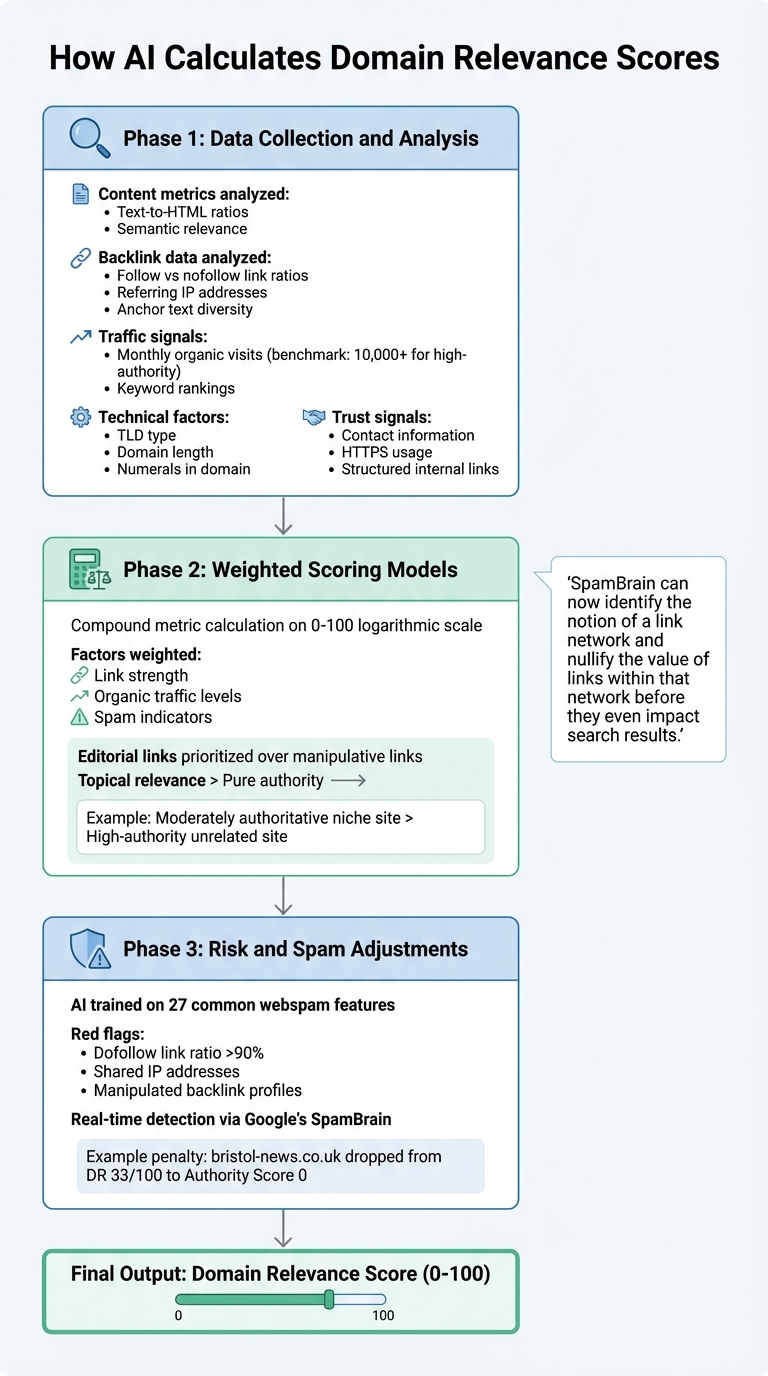
How AI Calculates Domain Relevance Scores for Backlinks in 3 Phases
AI determines domain relevance scores through a structured process that involves three key phases. Each step builds on the last, creating a detailed evaluation of a backlink’s value. Here’s how it works:
Data Collection and Analysis
The process starts with gathering a wide range of data to profile both the linking and target domains. This includes analyzing content metrics like text-to-HTML ratios and semantic relevance, backlink data such as follow versus nofollow link ratios, referring IP addresses, and anchor text diversity. AI also evaluates traffic signals, including monthly organic visits and keyword rankings, alongside technical factors like TLD type, domain length, and whether the domain contains numerals .
Trust signals also come into play. Details like contact information, structured internal links, HTTPS usage, and the absence of risky keywords are scrutinized. For high-authority domains, a benchmark of at least 10,000 monthly organic visitors is often required to validate their relevance. Falling short of this threshold, despite having a large backlink count, raises concerns.
Once all this data is collected, it’s fed into a weighted model for further analysis.
Weighted Scoring Models
Next, AI applies a compound metric to consolidate the data into a single score, typically on a 0–100 logarithmic scale. This score reflects factors like link strength, organic traffic levels, and spam indicators. Editorial links – those placed naturally by human creators who find the content valuable – are given more weight than links that appear manipulative or artificially placed.
The system also considers topical relevance. For example, a link from a moderately authoritative site within your niche might score higher than a link from a highly authoritative site that’s unrelated to your field. This ensures that relevance, not just authority, plays a critical role.
Finally, the model evaluates potential risks before finalizing the score.
Risk and Spam Adjustments
In this phase, AI identifies and penalizes domains with suspicious link patterns. Negative weights are applied to adjust scores for domains exhibiting risky behaviors. AI systems are trained to recognize 27 common webspam features by analyzing extensive datasets of penalized domains. For instance, if a domain has a dofollow link ratio exceeding 90%, it’s flagged as potentially engaging in unethical link-building practices.
A real-world example of this adjustment process comes from Semrush’s January 2023 analysis of bristol-news.co.uk. Although the domain initially earned a Domain Rating of 33/100 on Ahrefs, its Authority Score dropped to 0 after negative weights were applied. Factors like an excessively high follow link share, a manipulated backlink profile, and backlinks sharing IP addresses contributed to the penalty.
“SpamBrain has become so advanced that it can now identify ‘the notion of a link network’ and nullify the value of links within that network before they even impact search results.” – Google (via Webbb.ai)
Google’s SpamBrain system operates in real time, devaluing suspicious links as they’re detected. This proactive approach ensures manipulative tactics are neutralized before they can influence search rankings.
sbb-itb-88880ed
Using Domain Relevance Scores to Build a Strong Backlink Profile
Once you understand how AI calculates domain relevance, you can use these scores to fine-tune your backlink strategy. These insights help you focus on building links that truly matter for your site’s SEO performance.
Prioritizing High-Relevance Domains
Focus on domains that rank high in both authority and topical relevance. AI tools analyze factors like Domain Authority (DA), Page Authority (PA), natural anchor text, and link placement to identify the most impactful sites. Look for domains with a DR of 50+ and at least 1,000 monthly visitors.
AI-driven strategies can improve your success rate by 40% when targeting backlinks from domains with DA 50+. This is largely due to AI’s ability to identify “influencer nodes” – high-impact websites that frequently link to relevant industry content. Another effective approach is link intersect analysis, where AI tools find domains linking to your competitors but not to you, creating a clear roadmap for outreach.
“Predictive SEO is no longer a luxury – it’s a necessity. Leveraging AI-driven insights allows marketers to shift from reactive to proactive optimization.” – Cyrus Shepard, SEO Strategist and Founder, Zyppy
By identifying these high-value opportunities, AI helps you focus your efforts where they’ll yield the best results.
Diversifying Your Backlink Portfolio
A strong backlink profile isn’t just about authority – it’s also about variety. For example, an enterprise SaaS company increased its backlinks by 40% while reducing manual outreach by 62% using AI-powered tools.
AI can even simulate different link-building scenarios, helping you predict which types of domains will offer the most long-term value. If local SEO is your focus, prioritize backlinks from high-authority regional websites; studies show a 0.33 correlation between backlinks and local query rankings. Tools like 3Way.Social make this easier by connecting you to a network of vetted domains for secure ABC link exchanges. This approach helps you build a diverse portfolio of do-follow links without risking penalties from reciprocal linking practices.
Monitoring and Adjusting Strategies
Domain relevance scores aren’t fixed – they fluctuate as domains gain or lose authority, traffic, or trust. To stay ahead, perform quarterly audits of your backlink profile using AI metrics like Authority Score, which updates biweekly.
Be on the lookout for sudden drops in scores. If a referring domain’s score drops, investigate potential causes like traffic declines, an unusually high percentage of do-follow links (over 90%), or spam indicators. Domains with zero organic rankings despite high authority may have underlying technical problems that reduce their link equity.
It’s also important to monitor your backlink velocity – the rate at which you acquire new links – and compare it to your competitors. AI tools can flag toxic links (scoring between 60 and 100) that need immediate attention. Use these scores as benchmarks, not absolutes. If your score drops, compare it to niche competitors to determine if it’s an isolated issue or part of a broader trend.
“The evolution of search hasn’t diminished the importance of backlinks – it has refined their purpose. In an AI-driven landscape, backlinks serve as quality signals that help algorithms distinguish between authoritative and manufactured content.” – Itamar Haim, SEO Specialist, Elementor
The Benefits of 3Way.Social for Backlink Optimization
Building a strong backlink profile requires more than just effort – it demands actionable insights and the right tools to execute them effectively. That’s where 3Way.Social steps in, simplifying the process with its AI-powered matching system and secure link exchange framework. This platform helps you grow your website’s authority while avoiding the pitfalls of traditional reciprocal linking. Let’s explore how 3Way.Social turns AI-driven insights into real SEO wins.
Smarter Domain Matching with AI
3Way.Social leverages advanced AI algorithms to evaluate domain relevance, authority, and topical alignment, ensuring you’re paired with the best link exchange partners. The platform automatically filters potential partners based on niche, traffic, and backlink profiles, taking the guesswork out of the equation.
Quality control is baked into the process. Before approving any exchanges, the platform screens domains for key factors like Domain Authority, organic traffic, and spam signals. This automated vetting not only saves time but also ensures that every link contributes meaningfully to your SEO goals.
Permanent Do-Follow Links That Matter
One standout feature of 3Way.Social is its ability to secure permanent do-follow links. Why is this important? Pages that rank highest on Google tend to have 3.8 times more backlinks, and 75% of pages featured in Google’s AI Overviews rank within the top 12 search results.
Using a clever ABC link exchange model, 3Way.Social creates a triangular linking structure where three parties link to one another. This avoids the penalties tied to direct reciprocal linking while still building a diverse and authoritative backlink profile. With more than half of searches now leading to zero-click results, having a strong backlink portfolio is crucial for standing out in AI-driven search summaries.
Secure, Fair Link Exchanges
Traditional link exchanges often feel one-sided – one party might provide a high-value link but receive a low-quality one in return. 3Way.Social solves this imbalance by using AI to evaluate the value of each link, ensuring all participants benefit equally.
The platform’s vetted network of SEO professionals ensures all exchanges meet strict quality standards, reducing risks. Plus, its integrated dashboard tracks every live exchange and verifies link activity, offering full transparency. In today’s SEO landscape, where AI search models prioritize content from authoritative sites with relevant backlinks, this level of oversight is vital. By maintaining high-quality standards, 3Way.Social helps you build a backlink profile that not only boosts your rankings but also stands the test of time.
Conclusion
AI has transformed how backlinks are evaluated, focusing on their semantic context rather than sheer numbers. A single, well-placed link can now carry far more weight than dozens of generic ones. Tools like Google’s BERT and SpamBrain assess the “semantic neighborhood” of links to determine whether they genuinely contribute value or are simply manipulative attempts to boost rankings.
The data speaks for itself: the top result on Google typically has 3.8 times more backlinks than the pages ranked two through ten, and 92% of top-ranking pages boast at least one backlink . However, it’s clear that quality outshines quantity. AI systems are equipped to spot and neutralize manipulative link schemes in real time, reinforcing the need for ethical link-building practices.
To build a strong backlink profile, focus on earning natural, editorially given links. Use diverse anchor text in an organic way and conduct regular audits to weed out low-quality or harmful links that might trigger spam filters. These audits, combined with adjustments to your strategy, ensure you stay in tune with ever-evolving algorithms. AI-powered tools make this process more efficient by automating tasks like domain matching, monitoring link quality, and identifying gaps in relevance.
Platforms like 3Way.Social take these insights a step further, offering actionable strategies for modern link-building. The platform automates the discovery of contextually relevant domains, secures permanent do-follow links, and facilitates secure link exchanges that mimic natural growth patterns. By combining AI-driven domain matching with transparent quality control, 3Way.Social helps you scale your link-building efforts while maintaining relevance and trust. This approach directly addresses the challenges discussed earlier, turning AI insights into real, measurable SEO improvements.
Domain Relevance FAQs
How does AI evaluate the relevance of backlinks?
AI determines the value of backlinks by examining the content, credibility, and context of the linking domain. Using sophisticated algorithms, it evaluates how well the linking page matches the target site’s topic, the quality of the domain, and the purpose behind placing the link.
Here’s how it works:
- Content analysis: The AI reviews the linking page’s text, meta tags, anchor text, and overall topic to assess how closely it relates to the target site.
- Authority signals: It looks at factors like domain authority, the site’s backlink profile, and its reliability to measure the source’s overall quality.
- Contextual relevance: The AI checks where the link appears on the page and the surrounding content to ensure it fits naturally with the target site.
3Way.Social uses this AI-powered method to help users build a strong backlink profile with relevant, permanent do-follow links, enhancing SEO efforts and increasing domain authority.
What factors determine a domain’s authority and trustworthiness in link building?
When it comes to link building, a domain’s authority and trustworthiness hinge on several important factors. Domain authority scores, like Domain Rating or Authority Score, measure the overall strength of a site’s backlink profile. Generally, older domains with a steady track record of reliability are viewed as more dependable.
Another critical factor is relevance. Search engines evaluate how well the content of the linking site aligns with your niche. Links from content that matches your industry or topic send a stronger signal of endorsement. Beyond that, aspects like anchor text diversity, the natural integration of links within the content, and the publisher’s credibility all contribute to building trust.
By prioritizing these elements, you can create a stronger, more reliable backlink profile that supports your site’s SEO growth.
Why are links within the main content more valuable than those in footers or sidebars?
Links placed within the main content are surrounded by meaningful, relevant text, giving search engines a clearer understanding of their context and purpose. This makes these links carry more weight for SEO, as they pass stronger link equity to the linked pages.
On the other hand, links found in footers or sidebars often lack the same level of contextual relevance. Search engines may view these links as less impactful, treating them as weaker signals, which can diminish their influence on your site’s rankings.