Last Updated on January 9, 2026 by Becky Halls
When it comes to link building, targeting niche domains for link building is one of the most effective ways to boost your SEO. These sites are closely aligned with your industry, making their backlinks more relevant and impactful. Here’s how you can find and secure niche domains:
- Use Google Search Operators: Commands like
intitle:,inurl:, andsite:help you locate industry-specific blogs, resource pages, and guest post opportunities. - Leverage SEO Tools: Platforms like Ahrefs and Semrush allow you to analyze competitors’ backlinks, identify high-authority domains, and discover link gaps.
- Evaluate Domain Quality: Focus on metrics like Domain Rating (DR), organic traffic, and topical relevance to ensure you’re targeting credible sites.
- Automate with AI Tools: Platforms like 3Way.Social streamline domain discovery and outreach, saving you time while ensuring high-quality matches.
How to Build Niche Edits & Guest Posts via Organic Outreach | Link Insertions Tutorial
Step 1: Research Niche Domains Using Google Search Operators
Google search operators are incredibly handy for pinpointing niche domains. These specialized commands help you cut through the clutter and find exactly what you’re looking for. Instead of wading through endless pages of irrelevant results, you can quickly narrow down your search to industry-specific sites. As Nikola Baldikov, Founder of InBound Blogging, explains:
You can quickly enhance your Google search using search operators.
Use Search Operators to Find Relevant Sites
Some must-know operators include intitle:, inurl:, and site:.
- The
intitle:operator helps you locate pages with your keyword in the title tag. It’s perfect for finding listicles like “best fitness blogs” or “top SEO tools.” For example, searchingintitle:"best [your niche] blogs"will uncover curated lists where your site could be featured. - The
inurl:operator focuses on specific URL structures. If you’re after guest posting opportunities, try searches like[your niche] + inurl:write-for-usorfitness + inurl:guest-post-guidelines. These queries will surface pages actively looking for guest contributors. - The
site:operator allows you to search within a specific domain or top-level domain. For instance,site:.edu "marketing resources"will help you find resource pages hosted by educational institutions.
For even sharper results, combine operators. For example, using site:competitor.com intitle:"best" "keyword" will show all listicles on a competitor’s site that mention your target keyword. You can also exclude irrelevant results by adding a minus sign (-) to your query. For example, SEO tips -site:pinterest.com removes Pinterest from the results.
Find Resource Pages and Link Opportunities
Resource pages are treasure troves for link-building because they’re designed to link out to valuable content. You can locate these pages using searches like [your niche] + "useful links", [niche] + inurl:resources, or [niche] + intitle:resources. These curated pages are perfect targets for outreach.
Ivan Vislavskiy, CEO and Co-founder of Comrade Digital Marketing Agency, highlights their importance:
One effective method is keeping an eye on industry directories and resource pages. These often have high authority and relevance in your niche.
Securing a spot on a well-established industry directory can result in a 25% boost in referral traffic. To expand your list of prospects, try the related: operator. For example, searching related:healthline.com will uncover similar sites in the same niche. These techniques lay the groundwork for more detailed competitor analysis using advanced SEO tools.
Step 2: Use SEO Tools for Competitor Analysis
After exploring manual search methods, it’s time to take advantage of advanced SEO tools to simplify the process of identifying relevant domains. Tools like Ahrefs and Semrush are invaluable for automating competitor analysis and uncovering niche-specific opportunities. These platforms let you dive into your competitors’ backlink profiles to find websites already linking to similar content. The logic is simple: if a domain links to multiple competitors, there’s a good chance they’ll link to you, too. As Ahrefs puts it:
“If a site is linking to every one of your competitors, what are the odds that they will link to you, too (once they find out you exist, of course)?”
Once you’ve identified potential domains, use the specialized features offered by these tools to refine your analysis further.
Use the Competing Domains Feature
Start by pinpointing your primary competitors. With Ahrefs’ Site Explorer, head to the “Organic Competitors” report. This report highlights websites that rank for similar keywords and have comparable or higher Domain Ratings (DR). Make sure these sites are relevant to your niche. Once you’ve built your list, analyze their backlink profiles and apply quality filters:
- Set a minimum DR of 50.
- Focus on dofollow links.
- Require at least 1,000 monthly visits.
Switch the report to “referring pages” to zero in on the specific articles or resource pages where your competitors are mentioned. These pages become clear targets for your outreach efforts.
After narrowing down competitor domains, take your analysis a step further with link intersect tools.
Use the Link Intersect Tool
Ahrefs’ Link Intersect feature is a powerful way to uncover untapped opportunities. Enter your domain in the “target doesn’t rank for” field, then add up to 10 competitor URLs in the “Show link opportunities” section. The tool will generate a list of domains linking to your competitors but not to your site. Here’s how to prioritize:
- Domains linking to all competitors: High-value targets.
- Domains linking to at least two competitors: Medium-value targets.
Manually review the top results to ensure they align with your industry, avoiding generic business directories. For a similar approach, Semrush’s Backlink Gap tool works in much the same way, using Authority Score (AS) instead of DR to evaluate potential link opportunities.
Both tools streamline the process, making it easier to identify high-quality domains that can help boost your backlink profile.
Step 3: Evaluate Domain Quality and Relevance
After gathering a list of potential domains, it’s time to dig deeper. Not all backlinks are equal, so evaluating each domain carefully ensures you’re connecting with credible, authoritative sites.
Key Metrics to Evaluate Domains
To gauge a domain’s strength, tools like Ahrefs, Moz, and Semrush provide helpful metrics:
- Domain Rating (DR) from Ahrefs, Domain Authority (DA) from Moz, and Authority Score (AS) from Semrush rank sites on a scale of 1–100 based on their backlink profiles.
- Scores between 20–40 are decent, 40–60 are strong, and anything above 60 is excellent. However, higher scores often mean tougher competition for links.
- Organic traffic is another critical indicator. Aim for domains with at least 1,000 monthly visitors and a traffic value of $1,000 or more. A high DR with minimal traffic might signal manipulated metrics, so tread carefully.
- Referring domains carry more weight than sheer backlink numbers. Ten links from ten different quality sites are far more valuable than ten links from the same domain.
- Topical relevance is just as important. A backlink from a site in your niche or a related industry has far more impact than one from an unrelated domain. Use SEO tools to check which keywords drive traffic to the site – if it ranks for unrelated terms, its value may be overstated.
- Toxicity and spam indicators help identify potential risks. For example:
- Semrush’s Toxicity Score (0–44 is considered safe).
- Moz’s Spam Score (aim for below 7).
Here’s a quick reference table for these metrics:
| Metric | Tool | Good Benchmark |
|---|---|---|
| Domain Rating (DR) | Ahrefs | 40–80 |
| Organic Traffic | Ahrefs/Semrush | 1,000+ visits/month |
| Traffic Value | Ahrefs | $1,000+ |
| Spam Score | Moz | Below 7 |
| Toxicity Score | Semrush | 0–44 (Non-toxic) |
While these numbers provide a solid starting point, always follow up with a manual review to confirm quality.
Avoid Spammy or Low-Quality Domains
Even the best tools can’t catch everything. That’s why manual checks are essential to ensure you’re not dealing with spammy or low-quality sites. As SEO consultant Jenny Abouobaia puts it:
“Many authority metrics can be manipulated, so it is always advisable to check each site to do your best and avoid spam.”
Here’s what to look for:
- Content quality: A site filled with poorly written or irrelevant content is a red flag. Legitimate sites typically have an “About Us” page, clear contact details, and specific author bylines instead of generic labels like “Editorial Team.”
- Traffic trends: A sudden drop in traffic could indicate a Google penalty. Similarly, if a site hasn’t published new content in over six months, it may be inactive and less valuable for backlinks.
- Outbound links: Use an outbound link checker to ensure the site isn’t linking to questionable niches like gambling, pharmacy, or adult content. Also, check for a natural mix of anchor text, including branded and naked URLs, rather than over-optimized “money” keywords like “buy cheap loans.”
- Legitimacy signals: Look for signs of a real, engaged audience. This could include an official employee list on LinkedIn, active social media accounts, regular updates, and engagement metrics like comments, shares, or newsletter subscribers.
Nick Zviadadze, Founder at MintSEO, emphasizes the importance of traffic:
“A website without traffic is, in most cases, not worth your time. High traffic generally indicates legitimacy and the potential to attract more readers to your site through backlinks.”
sbb-itb-88880ed
Step 4: Automate Domain Discovery with 3Way.Social
Manually researching domains can be a serious time sink, pulling you away from creating standout content or fine-tuning your SEO strategy. That’s where 3Way.Social comes in. By automating domain discovery, this tool simplifies your link-building process, helping you connect with niche-specific, high-quality domains that align with your SEO objectives.
AI-Powered Domain Matching
3Way.Social leverages AI to match your website with the most relevant link partners. It evaluates potential matches based on critical metrics like Domain Authority (DA), traffic volume, and spam score. Plus, you can filter these results by topic, DA, or traffic to ensure the best contextual fit for your needs. This level of automation makes link building faster and more reliable.
Features That Simplify Link Building
Once you’ve got your matches, 3Way.Social takes the hassle out of link building. The platform guarantees permanent do-follow links with no “sponsored” tags and even includes proactive monitoring to restore dead links if needed. Instead of juggling spreadsheets or endless email chains, you’ll manage everything from a CRM-style dashboard. This centralized hub tracks your link exchanges, monitors performance, and helps you discover new opportunities. As Sophia Martinez, an SEO Manager, puts it:
3Way.Social revolutionized our SEO approach… The platform offers an unmatched, high-quality partner network.
Strengthen Your Backlink Profile
A diverse backlink profile is essential for strong SEO performance. With 3Way.Social, you tap into a broad network of vetted domains spanning various niches and authority levels. Its automated vetting process ensures every domain meets quality benchmarks, so you can confidently expand your backlinks without worrying about spammy or low-value sites. Alex Chen, a Freelance SEO Consultant, shares:
The user-friendly dashboard and smart exchange options save me countless hours, and the precise partner selection is a major plus.
Step 5: Compare Domain Discovery Methods
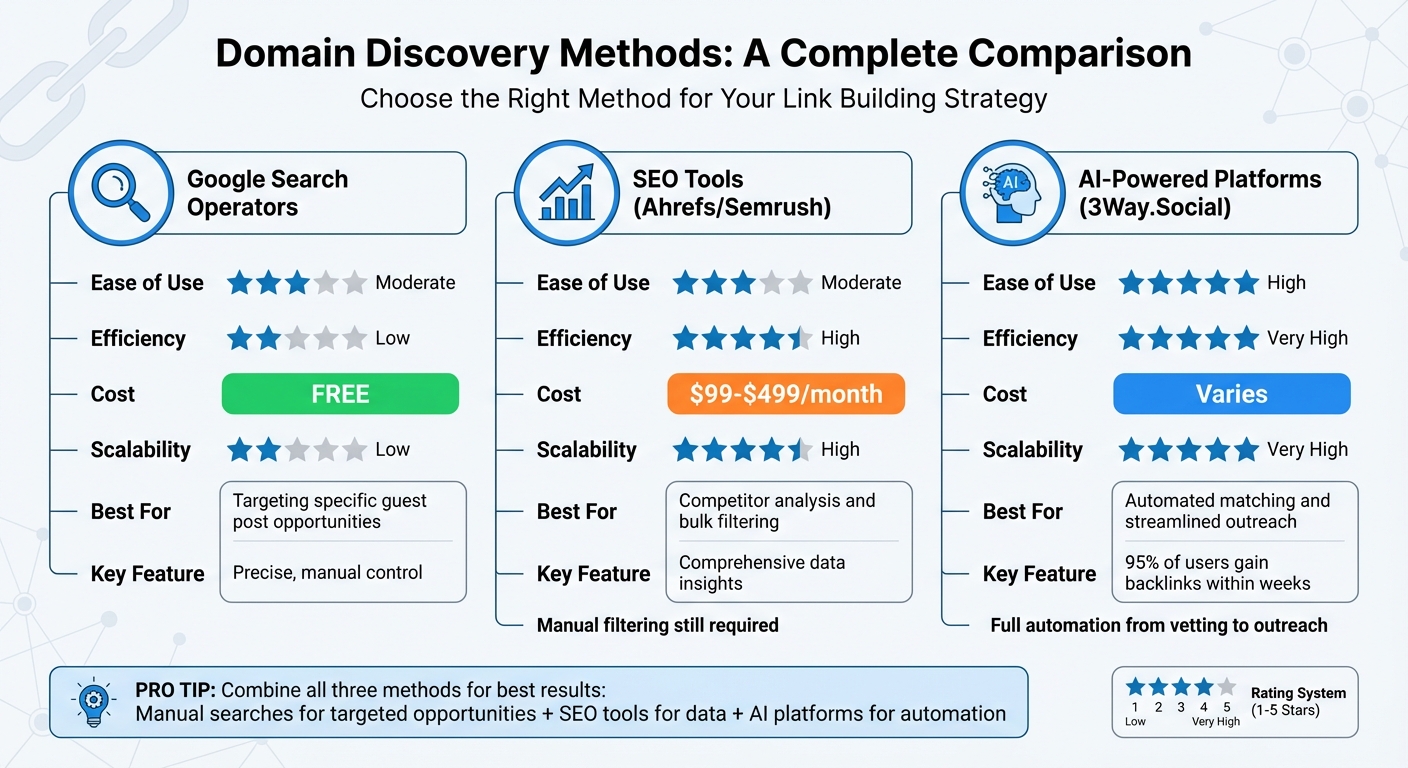
Comparison of Domain Discovery Methods for Link Building
Once you’ve explored the various methods for finding niche domains, it’s time to weigh their efficiency and cost. The right choice depends on your budget, time constraints, and the scale of your campaign. Each method has its own strengths and limitations.
Manual research using Google search operators, as outlined in Step 1, is a precise and cost-free option. It’s great for pinpointing specific guest post or resource opportunities. However, it requires significant time and effort to manually vet each result. This method is best suited for beginners or those targeting a small number of highly specific sites.
SEO tools like Ahrefs and Semrush, covered in Step 2, offer powerful features for bulk discovery, such as Link Intersect and competitor analysis. These tools start at around $100 per month and provide detailed insights into metrics like Domain Rating, traffic, and backlink history. That said, you’ll still need to manually filter results to avoid high-DR sites with little organic traffic. As Ron Evan Del Rosario from Thrive Internet Marketing Agency notes:
I find good niche-based sites to build backlinks through competitor backlink research, a simple yet effective way of putting you ahead.
AI-powered platforms like 3Way.Social take automation to the next level. These tools use AI to match domains based on topical relevance and authority metrics, handling everything from vetting to outreach. Impressively, 95% of users report gaining new backlinks within just a few weeks. This approach significantly reduces the time spent while maintaining high accuracy.
Comparison Table: Methods for Finding Niche Domains
Here’s a quick breakdown of the key features of each method:
| Method | Ease of Use | Efficiency | Cost | Scalability | Best For |
|---|---|---|---|---|---|
| Google Search Operators | Moderate | Low | Free | Low | Targeting specific guest post opportunities |
| SEO Tools (Ahrefs/Semrush) | Moderate | High | $99–$499/month | High | Competitor analysis and bulk filtering |
| AI-Powered Platforms (3Way.Social) | High | Very High | Varies | Very High | Automated matching and streamlined outreach |
For the best results, consider combining these methods. Use manual searches for targeted opportunities, SEO tools for comprehensive data, and AI platforms for efficient automation. Together, they can help you build a well-rounded and effective backlink profile.
Conclusion
Discovering niche domains involves a mix of targeted searches, competitor analysis, and leveraging AI-driven tools. Start with Google search operators, expand your research with SEO tools, and use AI platforms to automate and refine your findings.
With the growing emphasis on contextually relevant links, relevance now outweighs sheer volume. Search engines increasingly favor backlinks from industry-specific sources over generic, high-authority sites. This shift presents a unique chance to build meaningful connections within your sector. Industry experts stress the importance of this approach, as it strengthens your site’s credibility and aligns with search engine guidelines.
When it comes to link building, quality always beats quantity. Elisa Montanari, Head of Organic Growth at Wrike, offers a crucial reminder:
Never ever buy a backlink just to have one, which kills your credibility and user trust while setting your site up for major penalizations from Google and other search engines.
This highlights the importance of a thoughtful, strategic approach to link building.
Key Takeaways
Focus on domain quality and niche relevance by identifying active communities, recent content, and genuine traffic – steering clear of vanity metrics. If your primary industry is too specific, explore related niches; for instance, a hockey school could benefit from links on blogs about youth activities.
AI tools like 3Way.Social can simplify the process by matching you with relevant domains and enabling vetted link exchanges. This ensures high-quality, permanent do-follow links while maintaining relevance. By integrating automation, you can build a natural, diverse backlink profile efficiently – without compromising ethical standards.
FAQs
How can I use Google search operators to find niche domains for link building?
Google search operators are incredibly handy when it comes to narrowing down search results and finding niche-specific websites for link-building opportunities. Operators like intitle:, inurl:, and site:, combined with relevant keywords, can quickly point you to websites that fit your industry and may be open to collaboration. For instance, a query like "digital marketing" intitle:"write for us" will surface sites looking for guest contributors, while "home décor" inurl:resources helps you locate resource pages that could be ideal for backlink outreach.
These tools make it much easier to identify high-quality, relevant domains, cutting down the time and effort required compared to a purely manual search. Tools like 3Way.Social take this concept even further by automating the process. They use similar search techniques to connect you with pre-vetted domains offering permanent do-follow links, streamlining the task of building a strong and authoritative backlink profile.
What factors should I evaluate to determine the quality of a domain for link building?
When evaluating a domain for link-building opportunities, start by ensuring it’s relevant to your niche. This connection is key to creating backlinks that resonate with your target audience. Next, take a look at its organic traffic volume to verify it attracts real visitors. A domain with steady, genuine traffic is usually a good indicator of quality.
You’ll also want to examine the number of unique referring domains and total backlinks it has. A diverse and robust link profile often signals a healthy domain. Don’t forget to review SEO authority metrics such as domain authority or trust score. These provide a snapshot of the domain’s overall credibility and strength.
Lastly, watch out for any spam or toxicity signals. Domains with questionable practices can harm your SEO efforts rather than help. By focusing on these factors, you can secure backlinks that genuinely boost your site’s visibility and performance.
How can AI tools like 3Way.Social simplify and improve link building?
AI-driven tools like 3Way.Social simplify link building by automating tasks that would otherwise consume a lot of time and effort. This platform pinpoints niche-specific domains, assesses their authority, and aligns them with your content – all without the need for tedious manual research. Using advanced machine learning, it ensures your outreach focuses on high-quality sites that can boost your SEO and deliver impactful results.
On top of that, 3Way.Social takes outreach to the next level by creating personalized templates, estimating response rates, and automating the process of securing permanent, do-follow links through carefully vetted guest-post opportunities. This method not only strengthens your backlink profile but also minimizes the risk of spammy links, helping you establish a solid, Google-friendly SEO strategy with greater efficiency.