Ethical Guest Posting vs. Black Hat Tactics
Why ethical guest posting builds lasting authority while black hat link tactics offer short-term gains that risk penalties, deindexing, and reputation damage.

Last Updated on October 9, 2026 by Becky Halls
Guest posting can either boost your SEO sustainably or lead to penalties, depending on your approach. Ethical guest posting focuses on creating valuable, high-quality content for relevant sites, earning trust and long-term results. Black hat tactics, like buying links or using PBNs, aim for quick wins but risk penalties, deindexing, and harming your reputation.
Key Differences:
- Ethical Guest Posting: Builds authority with quality content, follows search engine guidelines, and prioritizes user value.
- Black Hat Tactics: Manipulates rankings with spammy links, violates guidelines, and risks long-term penalties.
Quick Comparison:
| Feature | Ethical Guest Posting | Black Hat Tactics |
|---|---|---|
| Goal | Build trust and authority | Manipulate rankings quickly |
| Link Quality | High-quality, relevant links | Low-quality, spammy links |
| Risk | Low | High |
| Sustainability | Long-term growth | Short-term gains prone to collapse |
| User Focus | Provides value to readers | Ignores user experience |
Ethical guest posting takes time but delivers lasting results, while black hat methods can undo your efforts with one algorithm update. Stick to ethical strategies for steady growth and credibility.
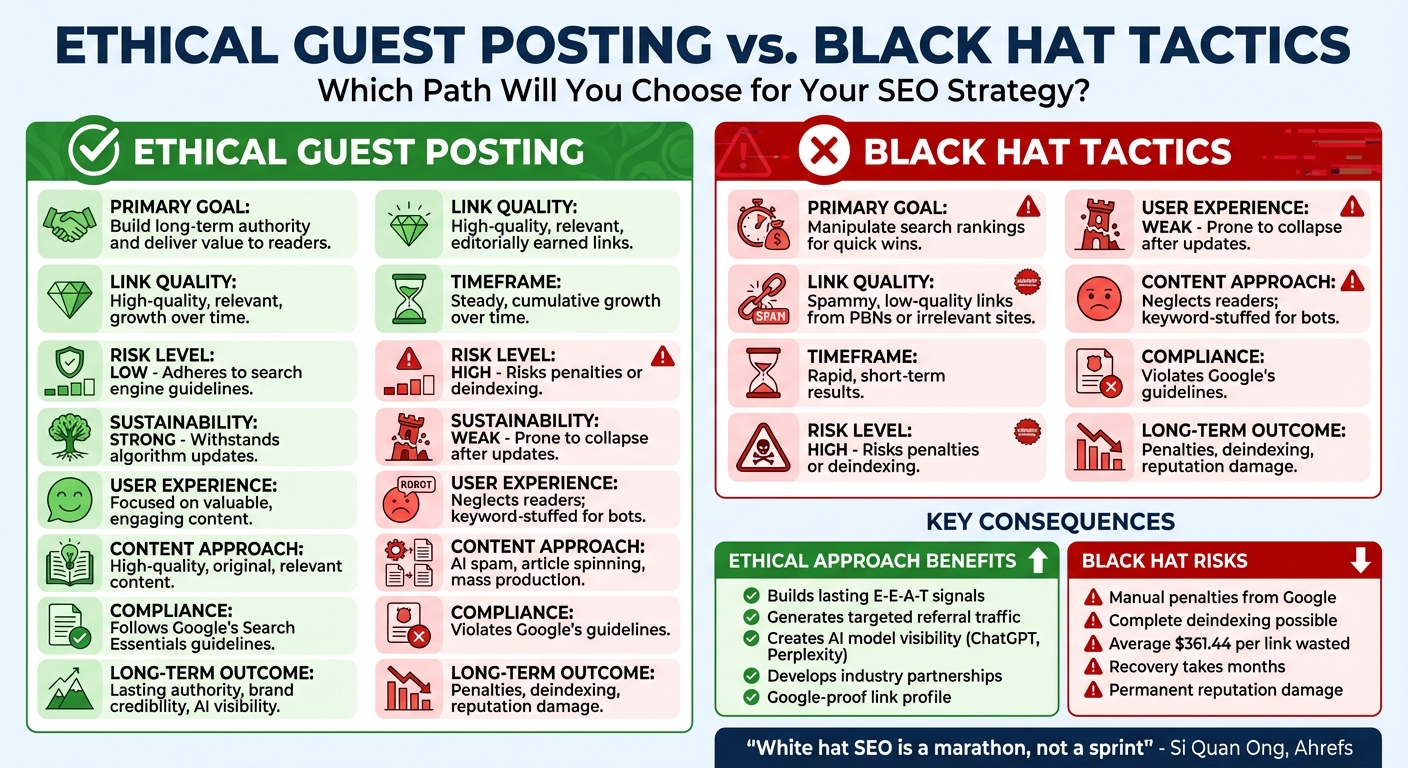
Ethical Guest Posting vs Black Hat Tactics: Complete Comparison
How to Win With Guest Posting in 2025 (With Jasper Morris of Profit Engine)
sbb-itb-88880ed
What Is Ethical Guest Posting?
Ethical guest posting involves crafting high-quality, original, and relevant content for well-regarded third-party websites. The aim? To genuinely benefit the host site’s audience while naturally earning links and building credibility along the way.
This approach aligns with Google’s guidelines because it prioritizes the reader’s experience over any attempts to manipulate search rankings. Instead of trying to game the system, the focus is on creating meaningful, insightful content that stands the test of time. The result? Earned links that stem from offering unique perspectives and firsthand knowledge.
“If you want to crush it with guest blogging today, you’ve got to be an expert first, link builder second.” – Backlinko Editorial Team
Modern guest posting requires more than just surface-level knowledge. It calls for genuine expertise, personal experience, and unique data. Search engines now assess content using E-E-A-T principles – Experience, Expertise, Authoritativeness, and Trust – making it more important than ever to showcase authentic knowledge.
Core Principles of Ethical Guest Posting
To succeed with ethical guest posting, these key principles are essential:
- Content Relevance: Your article should align with the host site’s niche and provide real value to its audience.
- Authenticity: Share insights drawn from personal experience instead of rehashing generic advice.
- Transparency: Clearly attribute authorship and link to verified profiles to build trust and authority.
- Relationship-Building: Foster long-term connections with site owners by promoting your post and engaging with their community.
When guest posting is approached as a partnership rather than a transaction, the links you earn act as genuine endorsements. This ensures placement on platforms with rigorous editorial standards and engaged audiences, steering clear of sites that accept content indiscriminately.
By following these principles, you not only establish trust but also set the stage for tangible outcomes.
Benefits of Ethical Guest Posting
When done right, ethical guest posting delivers results that last. It boosts domain authority by earning links from trusted, reputable sites. For instance, in August 2025, marketer Dana Nicole shared a guest post on Buffer‘s website. Over the next 11 months, her post brought in nearly 400 email subscribers.
But the advantages go beyond SEO. A well-placed guest post can drive targeted referral traffic – readers genuinely interested in your expertise may convert into email subscribers, customers, or even business partners.
There’s also an emerging benefit tied to large language models like ChatGPT and Perplexity. Guest posts and even unlinked brand mentions on authoritative sites can increase the chances of these AI tools referencing your brand when users ask related questions. This shift is also being driven by how AI improves link exchange strategies and content discovery. This makes ethical guest posting a powerful way to build credibility – not just for link-building but for long-term brand recognition.
“Quality and trust signals are increasingly surrounding content and the individuals who write them.” – Matt Cutts, Former Head of Web Spam, Google
What Are Black Hat Tactics in Guest Posting?
Black hat guest posting refers to strategies that violate Google’s Search Essentials guidelines (formerly Webmaster Guidelines) in an attempt to manipulate rankings quickly. Instead of focusing on providing meaningful content for readers, these methods aim to deceive search engines.
Google clearly defines this behavior under its “link scheme” policy. As Marie Haynes, CEO of Marie Haynes Consulting Inc., puts it:
“Any links intended to manipulate PageRank or a site’s ranking in Google search results may be considered part of a link scheme and a violation of Google’s Webmaster Guidelines.”
While these tactics may deliver quick results, they skip the hard work of genuine outreach and come with serious risks, including long-term penalties.
Common Black Hat Tactics
Here are some of the most frequently used black hat techniques in guest posting:
- Private Blog Networks (PBNs): These involve using expired, high-authority domains repurposed to link to target sites. They often share IP addresses, use similar themes, or block crawlers – red flags that search engines can detect.
- Link Farms: Websites specifically created to sell outbound links. These sites are typically filled with low-quality or AI-generated content.
- Buying Links: This includes paying for followed links or offering goods and services (like “free” products) in exchange for reviews containing followed links.
- Article Spinning and AI Spam: Automation tools rewrite a single article into multiple versions, enabling mass production of low-quality guest posts.
- Large-Scale Anchor Text Campaigns: Distributing guest posts across numerous sites with exact-match, keyword-rich anchor texts to manipulate rankings.
- Irrelevant Link Placements: Adding links to sites with no topical connection, like inserting a link for “nursing tops” on a blog about graphic design.
A notable example of black hat tactics involved a 12-year-old fashion and lifestyle blog, “Still Being Molly.” Hackers inserted links into 500 old posts, some of which directed visitors to NSFW sites. The blog owner only discovered the issue while updating older content.
Short-Term Gains vs. Long-Term Risks
These tactics might lead to a temporary surge in rankings, but the consequences often outweigh the benefits. Some sites, especially those with short-term goals – like affiliate sites riding the wave of a trending product – might find these shortcuts tempting.
However, search engines like Google actively combat unnatural link profiles through algorithm updates (such as Penguin) and manual penalties. For instance, in 2022, a travel blog that relied on PBNs to rank for “best tropical vacations” saw a 90% drop in organic traffic after a Google Core Update. It took the site more than eight months to recover.
Using black hat tactics risks algorithmic penalties, deindexing, and permanent damage to a site’s reputation. As Dr. Peter J. Meyers, Marketing Scientist at Moz, wisely states:
“If you play the game purely for SEO, and you lose, you lose everything. If you build something of value that actually attracts visitors and then the rules change, you’ve still built something.”
Ethical Guest Posting vs. Black Hat Tactics: A Comparison
Ethical guest posting and black hat tactics couldn’t be more different in their purpose and execution. Ethical approaches focus on building genuine authority and creating content that benefits real readers. On the other hand, black hat tactics are all about exploiting algorithm weaknesses for short-term gains.
Ethical guest posting involves personalized outreach and original, high-quality content that aligns with search engine guidelines. In contrast, black hat strategies rely on automation, link-buying, and exploiting private blog networks (PBNs) to generate artificial results. The difference is stark: ethical efforts earn links based on merit and relevance, while black hat methods deliberately break the rules with manipulative practices.
These differences show up clearly in outreach strategies, content quality, and the level of risk involved.
Comparison Table
Here’s a side-by-side look at how ethical guest posting stacks up against black hat tactics:
| Feature | Ethical Guest Posting | Black Hat Tactics |
|---|---|---|
| Primary Goal | Build long-term authority and deliver value to readers | Manipulate search rankings for quick wins |
| Link Quality | High-quality, relevant, editorially earned links | Spammy, low-quality links from PBNs or irrelevant sites |
| Timeframe | Steady, cumulative growth over time | Rapid, short-term results |
| Risk Level | Low; adheres to search engine guidelines | High; risks penalties or even deindexing |
| Sustainability | Strong; withstands algorithm updates | Weak; prone to collapse after updates like Penguin |
| User Experience | Focused on valuable, engaging content | Neglects readers; often stuffed with keywords for bots |
One of the most important differences is sustainability. Black hat tactics may deliver quick boosts to Domain Authority, but as Ahrefs puts it, they’re like a “house of cards” that falls apart when search engines update their algorithms. Ethical guest posting, however, builds lasting value over time, creating what experts often describe as a “Google-proof” link profile by focusing on link diversification. While ethical methods may take longer to show results, they offer long-term benefits that far outweigh the risks of shortcuts.
Risks and Penalties of Black Hat Tactics
Engaging in black hat guest posting can undo years of SEO efforts in an instant. Google has a range of responses to such tactics, from manual actions that demote specific pages or entire sites to algorithmic filters like the Penguin update, which can cause unexpected and dramatic ranking drops. These risks aren’t just limited to penalties; they also lead to long-term trust issues with both search engines and users.
One of the harshest consequences is complete deindexing – your website could disappear entirely from Google’s search results. Even if Google doesn’t issue a direct penalty, it may still devalue your links, rendering them useless. This can be a costly blow, especially considering the average investment of around $361.44 per link.
The damage doesn’t stop at search engine penalties. Black hat tactics can significantly harm your site’s credibility. Being associated with spam networks can erode trust with both search algorithms and your audience. As Bastian Grimm, CEO of Peak Ace, explains:
“Google were not necessarily trying to rank sites that had done best SEO, but rather that deliver a decent or at least an experience people were happy with”
Tactics like keyword stuffing or content spinning are often obvious to readers, causing them to leave your site and further damaging your credibility.
Recovering from these penalties is no small feat. Once a manual action is taken, webmasters must identify and remove harmful links or disavow them, then submit a reconsideration request to Google. This process can take months, during which your rankings and traffic remain affected. John Mueller from Google highlights this challenge:
“Sites don’t get permanently removed from Google – there’s always a way to get the site indexed again. Sometimes it takes a long time and a lot of work”
The time and financial resources required for recovery often outweigh any short-term benefits gained from black hat strategies.
Adding to the complexity, Google increasingly nullifies spammy links automatically rather than issuing explicit penalties. Modern AI-driven algorithms dive deeper into assessing site credibility. Websites with manipulative link patterns risk being excluded from valuable features like AI Overviews and featured snippets. In short, shortcuts taken today can lead to setbacks that are difficult, if not impossible, to reverse.
Long-Term Advantages of Ethical Guest Posting
While shortcuts like black hat tactics might offer quick results, they tend to fall apart with the next algorithm update. Ethical guest posting, on the other hand, delivers steady, long-term growth. By sticking to white hat practices that follow search engine guidelines, you create rankings that can weather changes to Google’s core systems and updates.
The benefits of ethical guest posting don’t just stop at consistent traffic. They also position your brand to stay relevant in the age of AI-driven search tools like ChatGPT, Perplexity, and Claude. These tools often reference brands that appear on credible, authoritative websites. By building genuine relationships and earning placements on respected platforms, you’re not only enhancing your backlink profile but also increasing the chances of your brand being featured in AI-generated responses. For example, in 2023 and 2024, UnderFit partnered with luxury suit brand Black Lapel to create a strategic blog post on menswear. This authentic collaboration resulted in over 150 sales in just 12 months and boosted UnderFit’s visibility for product-related keywords in AI-generated summaries.
This strategy builds lasting value, even as SEO rules and algorithms evolve.
Ethical guest posting also strengthens your E-E-A-T signals – Experience, Expertise, Authoritativeness, and Trustworthiness. These factors are critical in adapting to algorithm updates. Links from reputable sources bring in high-intent traffic and open up multiple revenue opportunities beyond just search rankings. Over time, the connections you make through ethical guest posting can lead to recurring collaborations, industry recognition, and access to new networks – laying the groundwork for sustainable, organic growth for years to come.
How 3Way.Social Supports Ethical Guest Posting
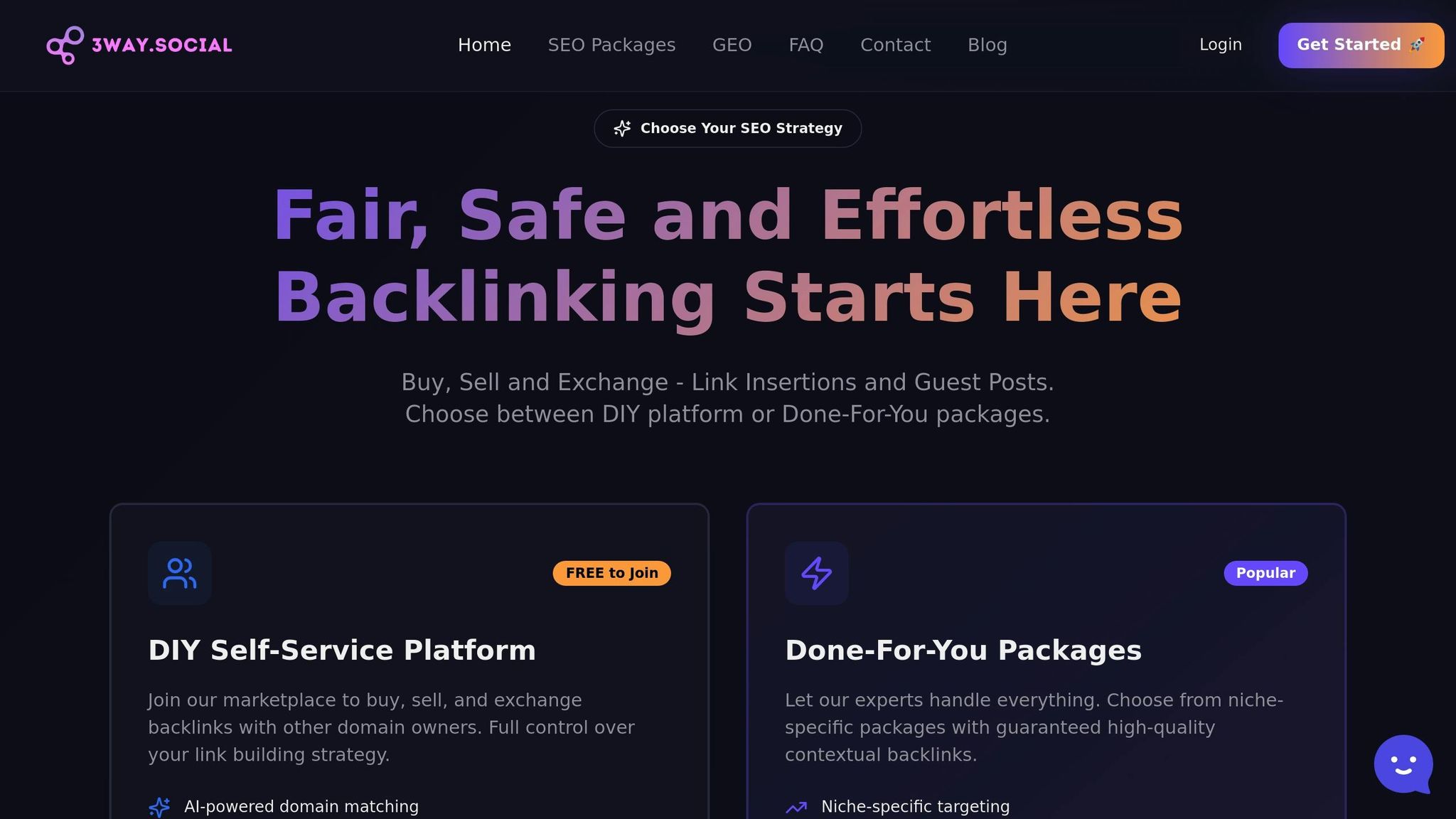
Navigating the world of guest posting without falling into the trap of black hat tactics can be tricky, but platforms like 3Way.Social make it easier to stay on the right path. Building a strong backlink profile doesn’t mean resorting to risky shortcuts that could lead to penalties. Instead, 3Way.Social provides an AI-powered solution that ensures your guest posting efforts align with search engine guidelines while delivering measurable results. By automating the link-building process, the platform connects you with carefully vetted partners.
One of the standout aspects of 3Way.Social is its focus on ethical guest posting. The platform ensures that all link exchanges are contextually relevant and adhere to Google’s guidelines. Its AI-powered domain matching prioritizes topical relevance, steering clear of artificial manipulation. This approach helps create natural link profiles that modern search engines are designed to reward.
To further protect against unethical practices, 3Way.Social employs secure networks and rigorous quality control filters to avoid common pitfalls like link farms and private blog networks (PBNs). As Stephen Spencer from Search Engine Land cautions:
“If just one of the sites in your network [PBN] gets hit with a penalty, it can quickly be passed on to any site you’re linking to. You can torch your entire network with one slip-up.”
By pre-screening partners and implementing quality control measures, 3Way.Social significantly reduces these risks, safeguarding your site from potential penalties. These protections are central to the platform’s ability to support ethical link-building practices and enhance your site’s long-term SEO authority.
Key Features of 3Way.Social
The platform comes equipped with features tailored to support ethical, white-hat SEO strategies. For instance, permanent do-follow links provide lasting value, helping to build authority over time rather than offering fleeting benefits that disappear with the next algorithm update. Additionally, advanced link diversification prevents suspicious patterns – like an unusually high number of links from a small number of root domains – that could raise red flags with search engines. On top of that, the platform’s quality control filters block problematic practices such as content spinning and thin content, which are penalized by updates like Google Panda and Penguin.
The user-friendly dashboard is another highlight, offering complete transparency into your link exchanges. This allows for regular audits to ensure every connection adds real value and supports sustainable growth. Considering that 68% of SEO professionals identify content marketing as the most effective method for building high-quality links, 3Way.Social positions you to achieve consistent results. This comprehensive approach not only strengthens your E-E-A-T signals but also ensures your site remains competitive as search algorithms continue to evolve.
Conclusion
Opting for ethical guest posting instead of black hat tactics lays the groundwork for lasting authority. As Si Quan Ong from Ahrefs aptly says, “White hat SEO is a marathon, not a sprint”. It’s a strategy that prioritizes long-term gains over fleeting shortcuts.
Ethical guest posting aligns perfectly with the direction search engines are heading. With Google’s focus on E-E-A-T (Experience, Expertise, Authoritativeness, and Trustworthiness) and the increasing role of AI models like ChatGPT, building contextual authority has never been more important. Brian Dean from Backlinko highlights this shift, stating, “Context beats the <href> tag”. By producing authentic content and fostering meaningful relationships with publishers, you’re creating links that go beyond SEO – they become trusted signals that even AI-driven search tools value.
On the flip side, black hat tactics carry significant risks, including manual penalties, algorithmic downgrades, or even complete de-indexing, which can undo years of hard work. Ethical strategies, however, offer benefits that snowball over time. They help you build brand credibility, attract referral traffic, and cultivate partnerships that offer value far beyond a single backlink.
Tools like 3Way.Social make sticking to ethical practices more manageable. By connecting you with vetted partners, ensuring topical relevance, and adhering to search engine guidelines, the platform simplifies the process of building a sustainable backlink profile. Its quality control features and transparent dashboard support the creation of links that align with your long-term goals. As search evolves, strategies rooted in value and trust are more critical than ever.
FAQs
What are the long-term advantages of ethical guest posting?
Ethical guest posting focuses on quality over quantity, making it a smarter approach to building backlinks. By contributing well-researched, original content to reputable websites, you gain backlinks that search engines view as credible and trustworthy. These high-quality links are more likely to hold up against algorithm changes, offering long-term SEO value and helping your rankings stay consistent over time.
Beyond boosting search visibility, ethical guest posting strengthens your brand’s authority and reputation. Sharing meaningful, insightful content positions you as a knowledgeable voice in your industry, earning the trust of both readers and peers. Over time, this strategy can lead to valuable partnerships, increased referral traffic, and fresh opportunities for collaboration – creating a ripple effect of growth and influence.
Platforms like 3Way.Social make it easier to keep your guest posting efforts ethical and impactful. They connect you with reliable websites, provide permanent do-follow links, and support your long-term SEO goals.
What are the risks of using black hat SEO tactics?
Using black hat SEO tactics can wreak havoc on your website, leading to penalties from search engines. These penalties – whether issued manually or through algorithms – can result in plummeting rankings, a sharp drop in traffic, or, worse, complete removal from search results.
But the damage doesn’t stop there. Engaging in these unethical practices can tarnish your brand’s reputation, making it an uphill battle to regain trust from both users and search engines. To achieve lasting success and steady growth, it’s crucial to stick with ethical, white hat SEO strategies.
Why is it crucial to follow Google’s E-E-A-T guidelines when guest posting?
Adhering to Google’s E-E-A-T guidelines – Experience, Expertise, Authoritativeness, Trustworthiness – is crucial when it comes to ethical guest posting. These principles help ensure your content aligns with Google’s quality standards, reducing the risk of penalties like ranking drops or de-indexing due to spammy or low-quality posts.
Google prioritizes guest posts that genuinely educate or inform readers, rather than those created purely for link-building purposes. By emphasizing expertise, credibility, and trust, you not only comply with these standards but also gain high-quality, do-follow backlinks that strengthen your website’s SEO and domain authority.
Platforms like 3Way.Social can simplify the process. They connect you with vetted networks, ensure permanent do-follow links, and focus on delivering quality content. This approach helps you meet E-E-A-T standards while driving sustainable SEO growth.