Last Updated on March 11, 2026 by Becky Halls
Learning how to vet SEO professionals and choose the right one is critical to your website’s success and reputation. A wrong choice can waste your budget and harm your domain authority, while ethical SEO experts can drive sustainable growth and conversions. Here’s a quick guide to help you identify trustworthy SEO professionals:
- Verify Certifications: Look for credentials from Google, HubSpot, Moz, or Semrush. Memberships in organizations like SEMPO also indicate adherence to ethical standards.
- Check Testimonials: Review client feedback, case studies, and independent platforms like Clutch or G2. Speak directly with past clients to confirm results and practices.
- Spot Black-Hat Tactics: Avoid promises of quick rankings or vague methods. Ethical SEO focuses on quality content, proper link-building, and technical optimization.
- Assess Communication: Ensure transparency, detailed reporting, and clear updates. Professionals should explain strategies and results in simple terms.
- Research Reputation: Use tools like Ahrefs or Semrush to evaluate an agency’s track record. Look for consistent, positive reviews and avoid agencies with questionable backlinks.
- Use Vetted Platforms: Platforms like 3Way.Social pre-screen SEO experts to ensure ethical practices and quality link-building.
How to Find an SEO Agency You Won’t Regret Hiring
Step 1: Check Certifications and Credentials
The SEO industry doesn’t have strict regulations, which means almost anyone can claim to be an expert after watching a few tutorials online. With over 30,000 SEO firms in the U.S. and less than 10% delivering consistent results, certifications help separate genuine professionals from the rest. These credentials show that an individual has passed independent evaluations and follows best practices instead of resorting to risky shortcuts that could lead to penalties. Certifications and memberships provide a reliable way to gauge an SEO professional’s skills and ethical standards.
Industry-Recognized Certifications
Look for certifications from trusted names like Google, HubSpot, Moz, and Semrush. These credentials require passing exams that test an individual’s understanding of search engine guidelines and ethical SEO methods. For example, nearly 90% of employers prefer candidates with a Digital Marketing Institute certification, and 95% say these certified professionals perform better on the job. Some popular courses include the Coursera/UC Davis Google SEO Fundamentals course, which has a 4.8-star rating from over 3,600 reviews, and CXL, which boasts a 4.8/5 rating on G2.
When evaluating agencies, focus on those with Google Premier Partner status – an honor reserved for the top 3% of agencies – or certifications from HubSpot and Semrush. If you have specific needs, check for specialized credentials like Moz’s Technical or Local SEO certifications, which highlight expertise in niche areas. As Matthew Gibbons, Senior Data & Tech Writer at SEO.com, explains:
“Certifications act as proof of an SEO company’s skills and credibility granted by a third party”.
Professional Organization Memberships
Membership in groups like SEMPO (Search Engine Marketing Professional Organization) or the SEO Association indicates more than just basic knowledge. These organizations require members to follow a Code of Ethics, which prohibits misleading practices. The SEO Association emphasizes:
“The SEO Code of Ethics is considered the best practice guidelines for the SEO industry… SEO Professionals globally expect the SEO industry to respect and adhere to [them] in order to receive endorsement from the Association”.
To confirm membership claims, check official directories on these organizations’ websites. Members who violate ethical standards can be reported for investigation, offering an extra layer of accountability. Since search engine algorithms evolve constantly, professionals involved in ongoing education through these groups are better equipped to adapt, setting them apart from those relying on outdated techniques.
Step 2: Review Client Testimonials and Case Studies
After verifying credentials, the next step is to examine a professional’s track record through client feedback. While certifications show what an SEO expert knows, testimonials and case studies reveal what they can actually deliver. The tricky part is separating genuine success stories from polished marketing material that might conceal questionable practices or unsustainable tactics. This is where a closer look at client testimonials and case studies becomes essential.
“We’ve seen the most ethical SEOs ask uncomfortable questions early – about risk tolerance, past link building, and what ‘success’ actually means for the business.” Ian Naylor, Founder of 3Way Social
Examining Portfolios and Case Studies
The key is to focus on results that are both ethical and long-lasting. Proper SEO takes time – typically 6 to 12 months to build momentum – not instant fixes or dramatic spikes in traffic. If a case study claims overnight success or quick top rankings, it might indicate the use of risky black-hat techniques, which could lead to Google penalties later. As Raymond Yeh, Founder of Wisp CMS, advises:
“Do not hire anyone that doesn’t track and hold themselves accountable to organic conversions”.
When reviewing case studies, look for details about how results were achieved. Did they rely on technical audits, strategic content planning, or ethical link-building practices?. Additionally, check if they mention adapting to major Google updates, such as Core Web Vitals or Helpful Content updates, which suggests their strategies align with search engine guidelines. Metrics that matter most are those tied directly to business outcomes – like qualified leads, conversion rates, or revenue growth – not just vanity metrics like traffic or rankings.
To verify portfolio claims, use SEO tools to assess the health of the websites featured. Look for red flags like broken links, poor metadata, or recent traffic drops, which may indicate that the results didn’t last. If confidentiality prevents the professional from sharing full details, ask for redacted data or alternative references. To further confirm their claims, consider reaching out to past clients directly.
“In our experience, good SEOs don’t hide behind jargon. They explain exactly what they’ll do, why it’s safe, and what they won’t do even if it’s ‘faster’.” Ian Naylor, Founder of 3Way Social
Contacting Client References
Polished testimonials are helpful, but nothing beats speaking directly with 3–5 past or current clients. Trevin S., Vice President of Business Operations at WebFX, stresses this point:
“Past and proven performance is the most important factor, in my mind, when somebody is looking to find an SEO partner”.
As noted earlier, trustworthy professionals are transparent and willing to be held accountable. Pay attention to how they respond to your request for references. Confident practitioners will readily provide contacts, while hesitation might signal a lack of satisfied clients. When speaking with references, ask critical questions: Did the website experience traffic drops or penalties during or after the engagement? Were the strategies explained clearly? Did the professional provide detailed reports that linked SEO metrics to measurable business outcomes? These insights can help you gauge whether their methods were both effective and sustainable.
To complement website testimonials, check independent review platforms like Clutch, G2, or Google Business Profiles. Platforms like Clutch even conduct phone interviews to verify the authenticity of reviews. Given that only 46% of businesses are willing to recommend their current SEO agency, finding consistent positive feedback across multiple sources is a strong indicator of ethical practices and reliable results.
Step 3: Evaluate White-Hat SEO Compliance
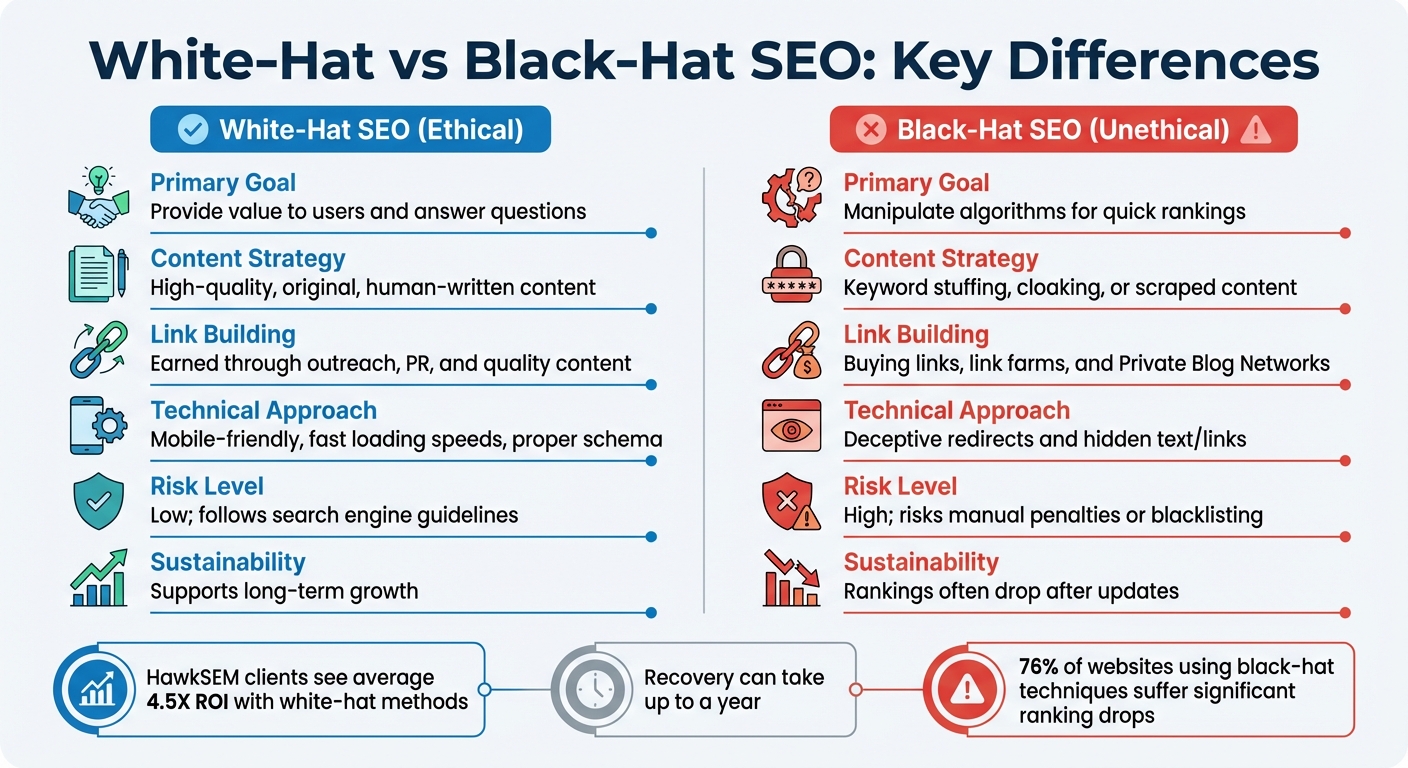
White-Hat vs Black-Hat SEO Practices Comparison Guide
Once you’ve validated a client’s results, the next step is to dig into how those results were achieved. White-hat SEO aligns with search engine guidelines and prioritizes delivering genuine value to users. On the other hand, black-hat tactics rely on deceptive shortcuts to manipulate algorithms. The stakes are high – 76% of websites using black-hat techniques suffer significant ranking drops, with recovery taking up to a year. This evaluation connects the dots between a client’s success and the ethical strategies that made it possible.
Recognizing White-Hat SEO Methods
Ethical SEO practices ensure sustainable growth by sticking to Google’s Search Essentials guidelines. These methods focus on creating original, user-focused content that directly answers search queries. Madison Scherner, Senior Lead Strategist at HawkSEM, emphasizes:
“Google isn’t fighting spam, it’s rewarding quality”.
When it comes to backlinks, white-hat professionals earn them through legitimate outreach and valuable content. They also prioritize technical aspects that enhance user experience, such as mobile optimization, fast loading speeds, secure HTTPS connections, and proper schema markup. HawkSEM clients, for instance, see an average 4.5X ROI by adhering to these practices. Transparency is crucial – ethical SEOs should have no problem explaining their methods, even to a Google representative.
Warning Signs of Black-Hat SEO
Spotting unethical practices often starts during initial discussions. Be wary of anyone promising guaranteed #1 rankings within 30 days or claiming to have a “special relationship” with Google. Similarly, vague or secretive explanations of their strategies could indicate manipulative tactics. Watch out for mentions of Private Blog Networks, link farms, or backlink packages, as these violate search engine policies.
Other red flags include:
- Keyword stuffing, where excessive keywords are crammed into content unnaturally
- Cloaking, a tactic where search engines and users are shown different content
- Misleading “bait-and-switch” headlines that don’t match the actual page content
Additionally, suspiciously low pricing often signals the use of automated, high-risk methods. If an SEO provider doesn’t request access to tools like Google Analytics, Search Console, or your content management system, it’s a sign they might be relying on spammy link-building without optimizing your site.
Comparison Table: White-Hat vs. Black-Hat SEO
Here’s a side-by-side breakdown of ethical and manipulative SEO practices:
| Aspect | White-Hat SEO (Ethical) | Black-Hat SEO (Unethical) |
|---|---|---|
| Primary Goal | Provide value to users and answer questions | Manipulate algorithms for quick rankings |
| Content Strategy | High-quality, original, human-written content | Keyword stuffing, cloaking, or scraped content |
| Link Building | Earned through outreach, PR, and quality content | Buying links, link farms, and Private Blog Networks |
| Technical Approach | Mobile-friendly, fast loading speeds, proper schema | Deceptive redirects and hidden text/links |
| Risk Level | Low; follows search engine guidelines | High; risks manual penalties or blacklisting |
| Sustainability | Supports long-term growth | Rankings often drop after updates |
These differences highlight why it’s essential to carefully evaluate SEO strategies before committing to a provider.
To ensure compliance, use free tools like Google PageSpeed Insights or Search Console to identify technical issues such as crawl errors, indexing problems, or slow load times. Ask direct questions like, “How do you acquire backlinks?” If the response includes buying links or using network sites, that’s a clear sign of black-hat tactics. As an extra precaution, review the provider’s own website for quality standards.
sbb-itb-88880ed
Step 4: Assess Communication and Transparency
Once you’ve ensured white-hat methods are in place, it’s time to evaluate communication. Transparency isn’t just a nice-to-have – it’s critical. The data paints a stark picture: only 30% of clients would recommend their current SEO provider to a colleague, and a mere 8% of brands report being “very satisfied” with their marketing agency partners.
Brian M. Reiser, a Strategic SEO Consultant, sums it up perfectly:
“Communicating with clients transparently and honestly is one of the most important facets of being an ethical SEO consultant”.
True professionals prioritize clear, jargon-free communication. They ensure clients have direct access to tools like Google Analytics and Google Search Console. If an SEO provider refuses to explain their methods, claiming they’re “proprietary”, that’s a major red flag. Similarly, focusing on vanity metrics – like raw traffic numbers over meaningful results such as conversions or revenue – could signal “analytics theater”.
Transparency shows up in two key areas: detailed reporting and consistent updates.
Detailed Reporting and Metrics
Ask to see a sample report before committing. A good report doesn’t just list numbers – it provides insights you can act on. As Ashot Nanayan, CEO and Founder of DWI, cautions:
“If an agency can’t explain its reports or relies too heavily on SEO reporting tools without customizing the data to your objectives, it’s a red flag”.
Ethical SEO professionals focus on metrics that truly impact your business, such as conversions, leads, and revenue, rather than just keyword rankings or overall traffic. They should provide real-time access to dashboards and deliver monthly reports tailored to your goals using tools like Google Analytics (GA4) and Google Search Console. These reports should clearly explain performance changes, outline next steps, and directly connect SEO efforts to your business outcomes.
Frequent Updates and Strategy Disclosure
Regular updates are a hallmark of ethical SEO providers. Set clear expectations for communication, including who your main contact will be, how often you’ll receive updates, and typical response times. Avoid agencies that rely on emailed PDFs – instead, insist on scheduled meetings to review reports and adjust strategies.
Casey Markee, Owner of Media Wyse, puts it bluntly:
“SEO is not a black box. A competent SEO should be able to explain their strategies and approach to the client without hesitation or cajoling”.
During the proposal process, pay attention to how promptly and clearly they respond to your questions. Ask specific questions like, “How do you acquire backlinks?” or “How do you adapt to recent algorithm changes?” Ethical professionals will provide straightforward answers and take the time to educate you. They’ll also be upfront about setbacks, offering revised strategies rather than hiding behind excuses.
Strong communication is the backbone of ethical SEO practices and lays the groundwork for deeper evaluation. It’s not just about keeping you informed – it’s about building trust and accountability.
Step 5: Research Reputation and References
Once you’ve established clear communication with a potential SEO partner, it’s time to dig deeper into their reputation. Did you know that 74% of business owners research an agency’s reputation before hiring? And it makes sense – reputation often reflects ethical practices and reliability.
To get the full picture, don’t just rely on what the agency says about itself. Testimonials on their website are typically handpicked to highlight only the best feedback. Instead, explore reviews on independent platforms like Clutch, G2, Trustpilot, and Google Reviews. These sources often provide more balanced insights into client experiences. For example, WebFX is transparent with over 1,100 client testimonials available online. Similarly, Fractl stands out by ranking in the top 3 of Clutch’s “Leaders Matrix” for Content Marketing, competing against 26,000 global firms. Such third-party endorsements are far more credible than self-reported success stories.
Beyond reviews, use tools like Ahrefs or Semrush to analyze an agency’s portfolio. Look at metrics like traffic growth and backlink quality to ensure their work aligns with ethical SEO practices. Pay attention to traffic sources – suspicious patterns, like a sudden spike in low-quality backlinks, could indicate risky link-building tactics that might lead to Google penalties. Also, take a close look at the agency’s own website. An SEO firm should practice what they preach, showcasing a strong and professional online presence.
Checking Online Reviews
When it comes to online reviews, patterns matter more than isolated complaints. A few negative reviews here and there are normal, but recurring issues – such as poor communication or inconsistent results – should make you think twice. Also, observe how the agency responds to criticism. Ethical companies handle feedback constructively, while defensive or dismissive responses could be a red flag.
Watch out for overly generic reviews that seem too good to be true. Phrases like “great results” without specific details might indicate fake or incentivized feedback. And if the agency has little to no presence on major review sites like Clutch or G2, that’s another warning sign. Be sure to check their Google Business Profile for verified reviews, especially those that mention concrete outcomes like traffic growth or lead generation, rather than vague claims about “ranking improvements.”
Conducting Professional Interviews
Online reviews are a good starting point, but direct conversations reveal much more about an agency’s performance. Ask for a list of 3–5 current or past clients and try to speak with decision-makers who were actively involved in their SEO campaigns.
Make your questions count. Instead of asking general questions like, “Are you happy with the results?” dig deeper. Try something specific like, “How many qualified leads did the campaign generate in six months?” or “What happens when a strategy doesn’t deliver the expected results?”. Also, inquire about the client-to-staff ratio. For example, a ratio of 500 clients to 30 staff members might indicate heavy outsourcing or subpar service. Itemized pricing is another must – this ensures you’re paying for expertise, not just link-building packages.
When speaking directly with the SEO professional, ask about their ethical approach. Adam Heitzman, Managing Partner at HigherVisibility, puts it well:
“Legitimate SEOs will never guarantee a client a top ranking position because they know there are no guarantees with SEO”.
Test their knowledge by asking about recent developments, like the rollout of GA4 or the latest Google algorithm changes. Request specific examples of their work, such as content they’ve created or technical audits they’ve performed, to confirm their expertise.
Finally, prioritize references from clients who’ve worked with the agency for at least a year. This can help you assess whether the results they deliver are sustainable over time. Considering that the average client-agency relationship lasts 2 to 3 years in digital marketing, long-term partnerships are a strong indicator of consistent, ethical practices. Combining these steps – reviews, interviews, and reference checks – will give you a well-rounded view of your potential SEO partner.
Step 6: Use Vetted Networks like 3Way.Social
After verifying an agency’s ethical practices and effectiveness, the next step is to utilize networks that pre-screen SEO professionals. This can save you time and help you avoid working with individuals who might take shortcuts. One such platform is 3Way.Social, which connects website owners with SEO experts who follow ethical practices.
Unlike many traditional link-building services that rely on unclear or questionable methods, 3Way.Social operates transparently. It acts as a matchmaker rather than a direct seller, giving you full control over your backlink strategy. With its AI-powered domain matching, the platform suggests niche-relevant sites, ensuring that every link adds value and aligns with white-hat SEO principles. The focus here is on quality and relevance – not just quantity – helping you avoid penalties from search engines.
Key Features of 3Way.Social
3Way.Social specializes in equitable ABC link exchanges. This involves triangular linking: Site A links to Site B, Site B links to Site C, and Site C links back to Site A. This structure creates a natural and diverse backlink profile, unlike direct reciprocal links, which can appear artificial.
The platform also offers permanent do-follow links, which contribute to long-term SEO gains. Its advanced diversification tools help you build a balanced backlink profile, steering clear of the “more is better” trap. With options like guest posting and flexible exchange setups, you can customize your approach to suit your specific SEO objectives.
How 3Way.Social Upholds Ethical Standards
3Way.Social prioritizes transparency and quality. A user-friendly dashboard lets you monitor link placements and campaign performance in real time. To maintain high standards, the platform employs quality control measures to filter out link farms, private blog networks (PBNs), and other unreliable sources. This ensures you’re connecting with legitimate websites that attract real, organic traffic.
Additionally, the platform includes secure payment options and detailed reporting to uphold transparency and ethical practices. As Irina Nemchenko, SEO Strategist at SEOlogist Inc., puts it:
“Ethical SEO involves establishing a code of principles that govern the conduct of those who engage in specific activities… The goal is to develop something that’s easy to understand and broad enough to apply to most, if not all, aspects of SEO”.
Conclusion on Learning How to Vet SEO Professionals
Evaluating SEO professionals requires a thorough approach. Look for certifications from trusted organizations like Google Analytics or Semrush, analyze case studies that clearly connect SEO efforts to revenue growth, and ensure they follow white-hat practices. As Samuel Edwards, CMO of SEO.co, puts it:
“SEO is not just your money at stake – it’s your reputation. Going with the wrong agency won’t just waste your money; it could potentially harm your domain authority in the long-term”.
With thousands of SEO companies in the U.S. and only a small percentage delivering consistent results, choosing the wrong partner can lead to wasted resources and penalties that might take years to fix. On average, client-agency partnerships last 2–3 years.
Technical expertise is important, but transparent communication is equally critical. SEO professionals who provide detailed reports, explain their strategies in simple terms, and connect their results to business goals – like increased leads and conversions – are far more effective than those who rely on vague methods or promise instant success. Ethical practices and open communication are the foundation for building trust and achieving long-term success.
Platforms like 3Way.Social simplify the process by pre-screening SEO experts and maintaining strict quality controls. By eliminating link farms and unreliable tactics, they help businesses focus on strategies that align with search engine guidelines. Their emphasis on equitable ABC link exchanges and permanent do-follow links supports the creation of a natural backlink profile that search engines reward. Features like an intuitive dashboard and secure payment options further ensure transparency and accountability – key components of ethical SEO.
Taking the time to properly vet SEO agencies protects not just your budget but also your brand and long-term online presence. The right partner does more than improve rankings – they enhance your digital authority, reduce customer acquisition costs, and positively impact your bottom line.
Learning How to Vet SEO Professionals – FAQs
What should I ask to confirm an SEO uses white-hat tactics?
To confirm that an SEO professional sticks to ethical, white-hat tactics, consider asking these key questions:
- Do you adhere to Google’s guidelines?
- What is your approach to link-building?
- How do you track and measure success in SEO?
- Can you provide examples of successful projects you’ve worked on?
- Are you open and honest about your methods?
Be cautious of unclear responses or any hints of black-hat techniques. Take time to review their strategies and past work thoroughly to ensure they align with best practices.
How can I verify an SEO’s results without trusting their case studies?
To evaluate an SEO professional’s performance without depending solely on their case studies, start by examining how their clients currently rank on search engine results pages (SERPs). Ask for clear, detailed reports that include metrics such as website traffic, keyword rankings, and conversion rates. Take time to assess their technical skills, familiarity with your industry, and adherence to ethical SEO practices. It’s also a good idea to reach out to their clients or provided references to confirm that their methods are effective, results-driven, and built for long-term success.
What’s a fair timeline to expect measurable SEO results?
When it comes to seeing measurable SEO results using ethical, white-hat methods, the timeline is usually around 3 to 6 months. Sure, you might notice some quick wins early on – especially if you’re addressing technical issues – but meaningful, lasting growth takes time.
Several factors can affect how fast you see results, including the level of competition in your industry, the current state of your website, and the overall scope of your SEO strategy. Ethical SEO focuses on building long-term success rather than chasing short-term gains, so patience is crucial if you want results that stick.