Last Updated on July 1, 2026 by Becky Halls
For fifteen years, the SEO answer to “how do we rank higher?” had a reliable default: get more links. Good links, relevant links, hard-won links – but links. In 2026, that default is getting a serious wobble, and the data pushing it is hard to argue with.
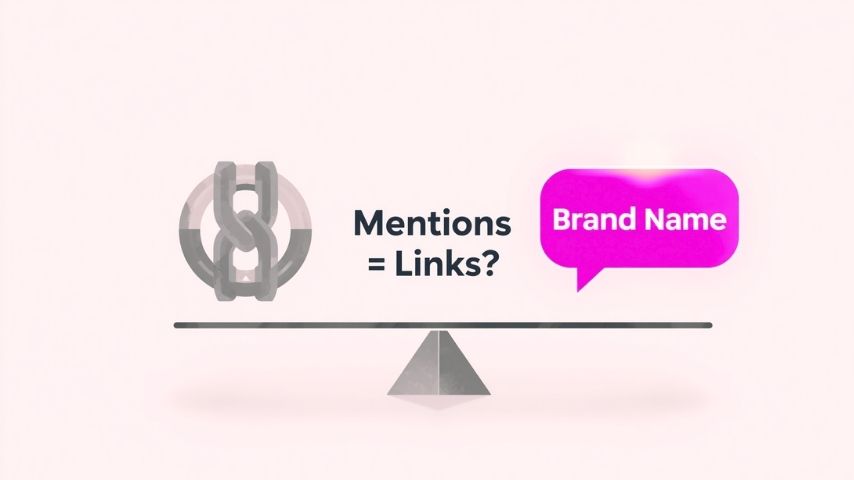
Ahrefs studied 75,000 brands and found that brand web mentions correlate roughly 3x more strongly with AI search visibility (0.664) than backlinks do (0.218). Read that twice. In the world of AI Overviews and answer engines, being talked about is pulling ahead of being linked to.
So are backlinks dead? Absolutely not. But the smart money is rebalancing the portfolio.
Backlinks still work – for the thing they’ve always done
Let’s not throw the baby out with the bathwater. Classic ranking signals remain robustly link-driven. Pages sitting at #1 on Google still have 3.8x more backlinks than those ranking #2 to #10, and pages with at least one backlink are 77% more likely to reach the top 10 than pages with none.
That’s not a footnote – that’s the entire blue-link ecosystem, which still drives the majority of search traffic today. Links remain the single most reliable way to earn Google’s trust for traditional rankings.
Which is exactly why the fundamentals-first crowd keeps winning:
“There is no such thing as GEO or AEO without doing SEO fundamentals.” — John Mueller, Google Search Advocate (via GSQI)
Mueller’s point applies perfectly here. The brands winning brand-mention visibility in AI search are, overwhelmingly, the same ones who did the unglamorous authority-building work for years. Mentions don’t replace links; they compound on top of a solid link foundation.
Why mentions are suddenly the belle of the ball
The mechanism is simple once you see it. When an AI model builds an answer, it’s not counting href attributes — it’s pattern-matching on how often, and how credibly, a brand shows up in association with a topic. An unlinked mention in a respected trade publication still teaches the model “this brand is a thing in this space.” A link in a footer nobody reads teaches it very little.
“For two decades we optimised for a crawler that needed a hyperlink to follow. Now we’re also optimising for a model that reads the whole web like a librarian and remembers who keeps coming up. The winners in 2026 won’t be the ones with the biggest link count – they’ll be the ones whose name is unavoidable in their category.” Ian Naylor, Founder
This is a genuine strategic shift, not a tweak. It means your PR team and your SEO team should probably stop pretending they run separate departments.
How to rebalance without blowing up what works
1. Chase mentions and links together – via digital PR
The good news: the single best tactic for both goals is the same one. Digital PR earns links and unlinked brand mentions from credible outlets in one motion. It’s also just effective full stop – brands using earned media and digital PR report an average ROI of 312%, and 48.6% of professionals now rate digital PR as their single most effective link-building tactic, well ahead of guest posting.
2. Create the content that earns mentions
Not all content pulls equal weight. “What is” and “why is” explainer content earns 25.8% more backlinks than how-to guides or videos and it’s exactly the definitional, authoritative content that AI models love to cite. Original research and proprietary data are the crown jewels here: give journalists and models a statistic they can only get from you, and you become the source everyone points at.
3. Stop measuring links in isolation
If your monthly report is a single number (links acquired) you’re now measuring half the picture. Track branded search volume, share of voice in your category, and unlinked mentions alongside your link metrics.
“The campaigns delivering for our clients right now aren’t ‘link campaigns’ or ‘PR campaigns’ – they’re story campaigns. You build one genuinely newsworthy asset, then earn coverage that brings links and mentions together. When the same effort feeds Google rankings and AI visibility at once, the ROI conversation gets very easy.” Becky Halls, Strategist
4. Don’t fall for the shortcut
Worth flagging: the average “acceptable” price for a single high-quality backlink has crept up to around $509, which tempts people toward cheap and dodgy paid-link platforms full of spam sites. Given Google’s increasingly aggressive spam updates this year, buying links (or buying AI citations) is a worse bet than ever. Choose your link building partners wisely and don’t go chasing irrelevant links.
The bottom line
Backlinks are the foundation; brand mentions are the new upper floors. The 2026 winner isn’t the marketer who abandons link building for a shiny “mentions” strategy, nor the one who ignores the AI shift entirely. It’s the one who runs a single, well-told story that earns links, mentions, and citations all at once – and measures all three.
FAQ
Are backlinks still important in 2026?
Very. #1-ranked pages still have 3.8x more backlinks than pages ranking #2–10. Links remain essential for traditional Google rankings – they’re just no longer the whole story.
What exactly is a brand mention?
Any reference to your brand online, linked or unlinked. In AI search, even an unlinked mention in a credible source contributes to how models associate your brand with a topic.
Should I stop building links and focus on mentions?
No. The most efficient approach earns both at once through digital PR and original content. Treat them as complementary, not competing.
How do I get more brand mentions?
Publish original research and data, pitch expert commentary to trusted publications, and pursue digital PR. Give people (and models) a reason to name you.
Is buying links or citations a safe shortcut?
No. With multiple spam updates rolling out in 2026, now covering AI-citation manipulation too, dodgy paid schemes are a growing liability. Choose a link partner wisely – make sure they are relevant and worthwhile.
Becky Halls is a Strategist at 3way.social, where she’s mildly obsessed with campaigns that do three jobs at once.