Last Updated on January 26, 2026 by Becky Halls
When building links, the text you click on – anchor text – matters for SEO. But in 2026, branded anchor text, like “3Way.Social”, is one of the safest and most effective strategies. It helps search engines trust your site, reduces penalty risks, and strengthens your brand’s authority. Here’s why it works and how to use it effectively:
- Why It Matters: Branded anchors signal trust to Google, avoiding penalties tied to overusing exact-match keywords. A balanced link profile should include 30%-50% branded anchors.
- Benefits: They reduce risk, boost credibility, and align with Google’s guidelines. For example, a SaaS company saw a 35% traffic increase by shifting from exact-match to branded anchors.
- Best Practices: Keep exact-match anchors below 10%, use tools like Ahrefs to monitor your profile, and diversify with partial-match, generic, and naked URL anchors.
“Branded anchor text isn’t just safe – it’s a smart way to build trust and improve rankings. We’ve seen branded anchor text steady rankings when link building ramps up. It keeps your profile looking natural even as you add more links.” Ian Naylor, Founder of 3Way Social
Benefits of Using Branded Anchor Text
Better Link Profile and Lower Penalty Risk
Using branded anchor text helps diversify your link profile and minimizes the risk of penalties. Search engines, when evaluating your links, look for patterns that suggest manipulation. For instance, repeatedly using exact-match keywords like “best project management software” can raise suspicion. On the other hand, branded anchors come across as natural and organic since they mirror how people typically reference sources.
Take a real-world example: in late 2025, an OutreachFrog client in the SaaS industry faced challenges after overusing the exact-match anchor “project management software” in their link-building efforts. Once they shifted to a strategy emphasizing branded mentions and natural variations like “ways to manage remote projects”, their traffic surged by over 35% within eight weeks. This change not only restored their traffic but also created a more resilient link profile capable of handling future algorithm changes.
Data supports this approach. Exact-match keywords should ideally make up less than 10% of your link profile to avoid spam detection. In contrast, branded anchors, which should account for 30% to 50% of your links, provide the flexibility to occasionally use targeted keywords without appearing manipulative. As Bradley Bernake from OutreachFrog explains:
“The safest anchors aren’t engineered for algorithms – they’re written for readers.”
Beyond mitigating risks, branded anchors also contribute to building your brand’s authority.
“In our experience, the biggest branded anchor win is consistency. When your brand name, domain, and product name are used predictably, it’s easier for search engines to understand who you are.” Becky Halls, Strategist at 3Way Social
Stronger Brand Recognition and Authority
Branded anchor text doesn’t just protect your link profile – it amplifies your brand’s credibility. When others link to your site using your brand name, they’re essentially endorsing you as a trusted source. This contributes to what SEO experts call “entity trust”, where your brand is recognized as a legitimate authority rather than just a collection of keywords.
“Google sees branded anchors as trust signals, not manipulation attempts.” – Ilias Ism, Founder & CTO, LinkDR
Research backs this up: reputable sites like Ahrefs have around 50% of their referring domains using branded anchor text. This pattern emerges naturally when a brand builds genuine authority – credible sources cite them by name. Additionally, branded anchors provide clarity for users. For example, when someone clicks a link labeled “3Way.Social”, they know exactly where they’re headed, unlike vague phrases like “click here.” This transparency boosts user confidence, improves click-through rates, and lowers bounce rates.
These advantages align perfectly with Google’s preference for natural, user-focused linking.
Compliance with Google’s Guidelines
Google’s algorithms in 2025 take a deeper look at link context, focusing on the intent behind each link rather than just counting keywords. Branded anchors fit seamlessly into this framework because they prioritize the reader’s experience while naturally supporting SEO. By using plain, helpful language, branded anchors align with Google’s guidelines and avoid any attempts to manipulate rankings.
The risk levels make the case even clearer. Branded anchors are classified as “Very Low” risk for penalties, while exact-match anchors are labeled “Very High” risk. This distinction is critical as Google’s spam detection becomes more advanced. Moreover, Google expects most natural backlinks to use branded anchors, as publishers typically reference authoritative sites by name. By centering your link-building strategy around branded anchors, you not only reduce the risk of penalties but also demonstrate compliance with Google’s quality standards. This approach ensures stable rankings, even as algorithms continue to evolve.
How To Use Branded Anchor Text To Boost Site Health And Push Rankings
Types of Branded Anchor Text
Let’s dive into the different types of branded anchor text and how they can be used effectively.
Exact Brand Name Anchors
Exact brand name anchors include only your company or website name. For example, using “3Way.Social” directly ties the link to your brand and is one of the safest options for anchor text. These are ideal for homepage links, general citations, and establishing baseline brand authority. Since they align with Google’s expectations for natural, trustworthy links, they’re a reliable choice for guest posts, link exchanges, and editorial placements. Plus, they carry minimal risk of penalties while strengthening the trust signals search engines value.
Brand Variations and Combined Forms
Brand variations mix your brand name with descriptive keywords, such as “3Way.Social platform” or “3Way.Social AI tools.” This approach adds context, making it clear what the linked page is about. These anchors are especially useful when linking to product pages or specific features rather than your homepage. They create a stronger connection for users by setting clear expectations about the content they’ll find after clicking. By blending brand recognition with topical relevance, these anchors can rank for specific terms without risking over-optimization penalties.
Branded vs. Partial-Match Anchors
It’s important to understand the difference between branded and partial-match anchors to balance safety with keyword targeting. Partial-match anchors combine your target keyword with other words, making them sound more conversational and natural.
| Feature | Branded Anchor Text | Partial-Match Anchor Text |
|---|---|---|
| Primary Goal | Build brand trust & recognition | Boost keyword relevance & rankings |
| Risk Level | Very Low | Moderate |
| Naturalness | High (meets Google’s expectations) | High (conversational tone) |
| SEO Impact | Strong for Domain Authority | Effective for keyword-specific rankings |
| User Experience | Clearly identifies the source | Provides clear content context |
Branded anchors should make up the majority of your backlink profile – around 30% to 50%. Partial-match anchors, on the other hand, are best kept at 20% to 30%. As LinkDR puts it:
“Partial-match anchors… are your ranking workhorses. They maintain keyword relevance while sounding completely natural”.
Up next, we’ll explore how to optimize these anchor types for your 2025 strategy.
sbb-itb-88880ed
Best Practices for Branded Anchor Text in 2025
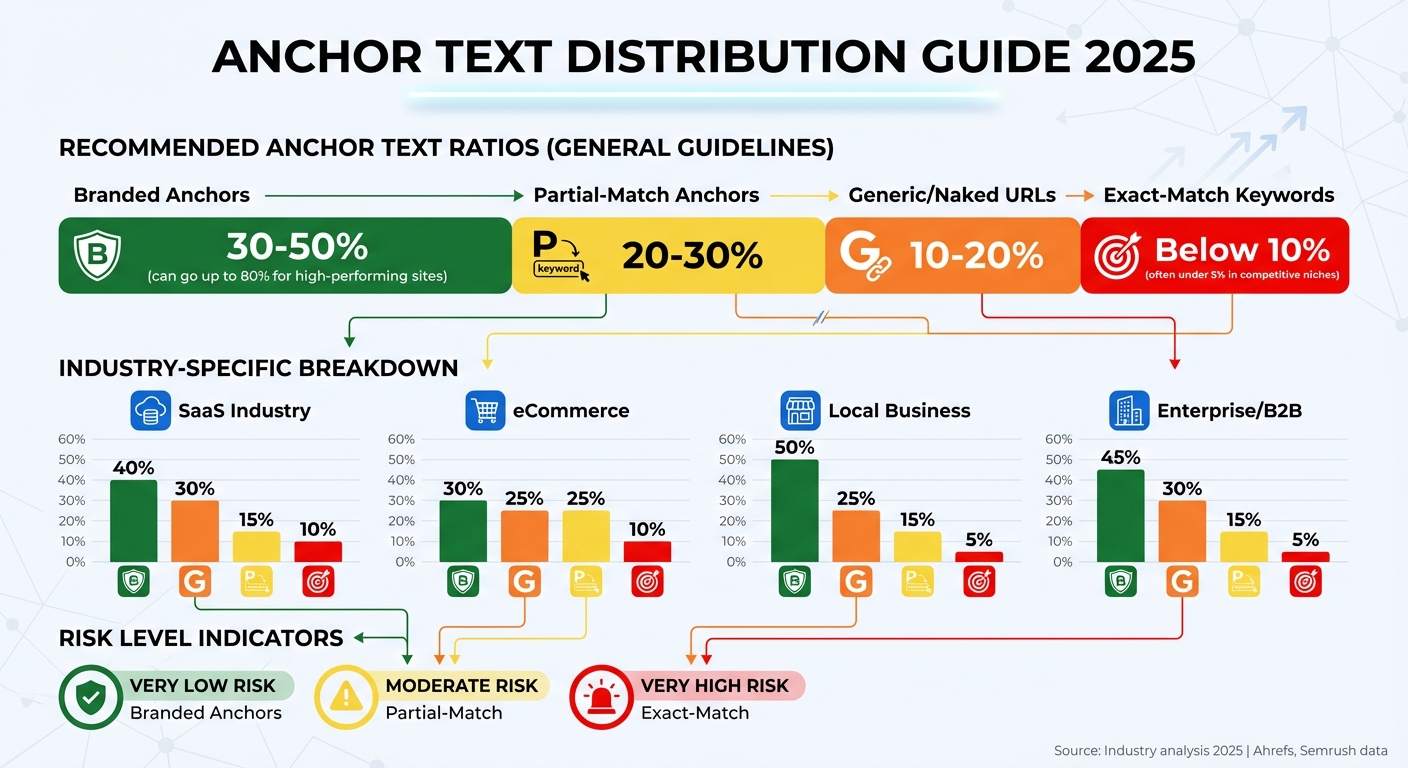
Recommended Anchor Text Distribution Ratios by Industry 2025
Recommended Anchor Text Ratios
To maintain a natural backlink profile, it’s crucial to strike the right balance in your anchor text mix. Branded anchors should typically account for 30% to 50% of your profile, though some high-performing sites manage up to 80% without issues. Partial-match anchors work best at 20% to 30%, while exact-match keywords should stay below 10%, and often under 5% in competitive niches. Meanwhile, generic anchors and naked URLs generally make up 10% to 20% of a well-rounded profile.
Here’s a breakdown of suggested anchor text ratios by industry:
| Industry | Branded | Generic/Naked | Partial Match | Exact Match |
|---|---|---|---|---|
| SaaS | 40% | 30% | 15% | 10% |
| eCommerce | 30% | 25% | 25% | 10% |
| Local Business | 50% | 25% | 15% | 5% |
| Enterprise/B2B | 45% | 30% | 15% | 5% |
These ratios are not set in stone but serve as a helpful guide. Remember, the context of the surrounding content and the relevance of the linked page are just as important as the anchor text itself.
With these benchmarks in mind, focus on creating a diverse anchor text profile that mirrors organic linking habits.
Diversifying Your Anchor Text Profile
Repetition is a red flag. If Google detects the same anchor text repeated across multiple backlinks, it can signal manipulation. To avoid this, aim for variety. Combine branded anchors with partial-match phrases, naked URLs, and descriptive text to maintain a natural and topic-relevant profile.
For example, a SaaS company struggling with stagnant traffic due to repetitive exact-match anchors like “project management software” saw a 35% traffic boost in just eight weeks after shifting to branded mentions and topic-based phrases like “ways to manage remote projects”.
Regular audits are essential to stay on track. Every 4–6 months, use tools like Semrush or Ahrefs to review your anchor text. Export your backlink data into a pivot table to spot patterns and identify any over-optimization issues.
“We’ve noticed over-optimised anchors cause problems long before anyone admits it. Swapping some exact-match anchors for branded or blended anchors often improves stability without hurting performance.” Ian Naylor, Founder of 3Way Social
Using Tools for Safe Link Exchange
Once you’ve nailed down your ratios and diversified your anchors, consider leveraging tools to streamline and safeguard your link-building efforts.
Platforms like 3Way.Social offer an AI-driven solution for acquiring high-quality backlinks. It ensures natural anchor distribution, filters out spammy links, and connects you with vetted, relevant partners. This approach aligns perfectly with the editorial-fit principle, emphasizing links that integrate seamlessly into content.
For ongoing monitoring, pair 3Way.Social with tools like Ahrefs, Semrush, or Moz Link Explorer. Google Search Console is another valuable resource – check your “Top linking text” quarterly to catch any clustering issues early.
And when building links, always prioritize editorial relevance over forcing specific keywords. Keep anchor text concise, ideally between two and five words, for a balance of clarity and usability. Ultimately, the goal is to create links that benefit users first, with search engines as a secondary consideration.
Monitoring and Measuring Performance
Tracking Anchor Text Distribution
Keep a close eye on your backlinks by conducting monthly checks with tools like Ahrefs or Semrush. Group your anchor text into categories such as Branded, Naked URL, Generic, Partial-Match, and Exact-Match. Regular reviews can help you catch potential issues before they escalate.
Google Search Console is an essential resource here. Use its “Top linking text” report every quarter to see what Google’s crawlers have indexed. Export this data into a spreadsheet and create a pivot table to link anchor phrases to their corresponding destination URLs. This step makes it easier to spot if any single page is overloaded with repetitive anchors.
To stay competitive, compare your anchor text distribution to that of top players in your industry. Tools like Ahrefs or Semrush can help you ensure your exact-match anchors remain below 10%.
Finally, assess how your anchor text strategy is affecting your overall SEO performance.
Measuring SEO Impact
To measure the effectiveness of your anchor text distribution, start by analyzing its impact on rankings and traffic. Track keyword rankings for both branded terms and primary target keywords to understand how branded anchors are influencing your domain’s authority. Google Search Console can also help you monitor changes in organic traffic and impressions as you refine your anchor text strategy.
Additionally, keep an eye on your Domain Authority (DA) or Domain Rating (DR) to evaluate backlink strength. It’s worth noting that case studies have shown overusing exact-match anchors can significantly hurt organic traffic.
Here’s a quick breakdown of key metrics and tools to track your anchor text strategy:
| Metric Category | Specific Metric to Monitor | Tool Example |
|---|---|---|
| Profile Health | Anchor Distribution % | Ahrefs, Moz, Semrush |
| Visibility | Brand Keyword Rankings | Google Search Console |
| Authority | Domain Rating (DR) / DA | Ahrefs, Moz |
| Risk | Toxic Link/Anchor Score | Semrush Backlink Audit |
| User Intent | Click-Through Rate (CTR) | Google Search Console |
Adapting to Google Updates
Your performance metrics should guide you in adapting to Google’s ever-evolving algorithms. Google’s systems now focus more on understanding context – taking into account the anchor text, the surrounding content, and the overall theme of the page – rather than simply looking at keyword percentages. This shift means it’s crucial to audit your link profile whenever a major algorithm update occurs.
If you discover signs of over-optimization, like too many exact-match anchors, don’t rush to remove links. Instead, rebalance your profile by building new branded, naked URL, and generic anchors. For added convenience, platforms such as 3Way.Social offer AI-driven solutions to automate domain matching and maintain a natural anchor text distribution.
“Anchor text isn’t static – it’s a living part of your SEO system.” Eric Koellner, SEO Expert, Blue Tree Digital
A well-rounded anchor profile typically includes 40–50% branded anchors, which can help establish trust and provide stability during core algorithm updates.
Conclusion
Branded anchor text is a smart and reliable strategy for SEO success in 2025. With Google’s algorithm now resembling what experts describe as a “context-reading cyborg”, branded anchors have emerged as a key trust signal that distinguishes genuine brands from manipulative SEO tactics. In fact, about 50% of backlinks from authoritative sites use branded anchors, showing that this isn’t just about avoiding penalties – it’s about building trust and authority.
FAQs
What are the SEO benefits of using branded anchor text in 2025?
Branded anchor text plays a key role in improving SEO in 2025 by boosting your website’s credibility and signaling relevance to search engines. It contributes to a natural and varied backlink profile, which is crucial for climbing search rankings and strengthening domain authority.
Incorporating branded anchor text also builds trust by associating links with your brand name. This makes it easier for both users and search engines to identify your content as authentic and worthwhile. As a result, this approach supports steady SEO growth and helps your brand gain visibility in an increasingly competitive online environment.
What is the ideal anchor text distribution for different industries in 2025?
In 2025, the recommended anchor text distribution will depend on the industry, but a good rule of thumb is to aim for 30-50% branded anchors, 20-30% partial-match anchors, and less than 10% exact-match keywords. This balance helps maintain relevance while steering clear of penalties from search engines.
To take it a step further, incorporate a variety of natural, descriptive, and generic anchors into your strategy. This not only makes your backlink profile look more organic but also strengthens your authority, which can give your SEO efforts a boost.
Why are branded anchor texts safer than exact-match anchors in SEO?
Branded anchor texts are a safer bet because they naturally tie in with your brand name or identity, making them less likely to raise red flags for over-optimization. Unlike exact-match anchors, which can come across as manipulative when overused, branded anchors feel more natural and user-friendly.
Search engines tend to prefer branded anchors because they signal authentic linking practices while still boosting your site’s authority and visibility. By prioritizing branded anchors, you can lower the chances of penalties and keep your backlink profile balanced and trustworthy.