Last Updated on January 23, 2026 by Becky Halls
I’m sure we all know backlinks are like votes of confidence for your website, but not all links are helpful. Poor-quality backlinks can harm your rankings or even get your site penalized. Here’s our guide on building trustworthy backlinks for a strong, reliable backlink profile:
- Focus on Relevance: Links should come from sites related to your topic or industry.
- Prioritize Quality Over Quantity: High-authority domains with consistent traffic are more valuable than many low-quality links.
- Follow Google’s Guidelines: Avoid manipulative practices like paid links or link farms.
- Vet Domains: Check metrics like domain authority, organic traffic, and spam scores before acquiring links.
- Diversify Anchor Text: Use a mix of branded, generic, and descriptive text to avoid penalties.
- Monitor Regularly: Audit your backlinks to remove harmful links and ensure they remain live and useful.
Backlinks for SEO: Complete Guide for 2026
What Makes a Backlink Trustworthy
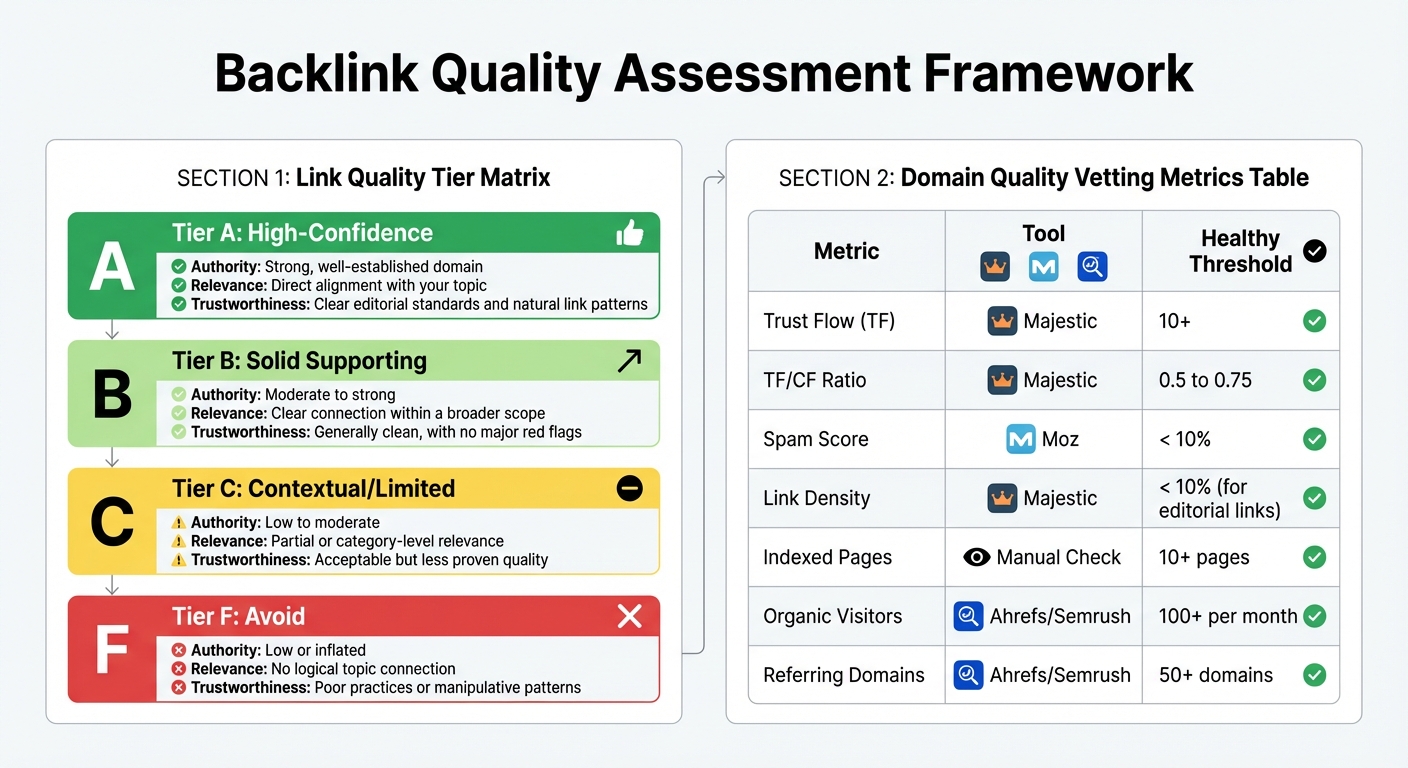
Backlink Quality Assessment Tiers and Vetting Metrics
A trustworthy backlink strengthens your site’s credibility and aligns with search engines’ expectations. Its value depends on factors like relevance, the authority of the linking domain, and adherence to Google’s guidelines.
Relevance and Context
For a backlink to be considered credible, it should come from a site that shares a connection with your topic, audience, or industry. For example, links between websites catering to similar audiences add more weight to your site’s credibility. Search engines evaluate how closely two sites align within a particular subject area. If a site has no history of covering your topic, the link might get flagged as a “semantic outlier”, reducing its impact.
“In our experience, relevance is the quickest trust filter. One solid link from a site that lives in your niche usually beats a handful of random high-metric links that don’t belong.” Becky Halls, Strategist at 3Way Social
Context matters just as much. Links naturally placed within the main body of content carry more authority than those tucked away in headers, footers, or sidebars. It’s also important to use anchor text that feels organic, steering clear of over-optimized exact-match terms. In local SEO, geographic relevance can play a role too. For instance, a local bakery linking to a nearby plumber sends a strong “geographic association” signal.
“Relevance is no longer optional. It determines whether a link contributes authority or disappears into the noise.” – Stellar SEO
To quickly check a link’s relevance, try a search query like site:domain.com [your topic].
Once relevance is established, the next step is evaluating the linking site’s authority.
“We’ve seen ‘trustworthy backlinks’ come from pages that look like they were written for humans first. If a site’s content feels thin, templated, or stuffed with outbound links, the backlink rarely holds value.” – Ian Naylor, Founder at 3Way Social
Domain Authority and Credibility
Metrics like Domain Authority (DA) from Moz and Domain Rating (DR) from Ahrefs rate a site’s ranking potential on a 100-point scale. A backlink from a high-authority site acts as a strong endorsement. However, authority alone isn’t enough – credibility plays a crucial role. Signals like organic traffic, Trust Flow, and adherence to E-E-A-T principles (Experience, Expertise, Authoritativeness, and Trust) also matter.
A healthy link profile often shows a Trust Flow to Citation Flow ratio close to 0.75, indicating that the site attracts high-quality links rather than just a large volume of them. As a general rule, trustworthy domains often meet these minimum benchmarks:
- At least 10 indexed pages
- 100+ organic visitors per month
- 50+ referring domains
Be cautious of sites with high DR but very low traffic (under 500 visits per month); this could signal a penalized link farm.
| Link Quality Tier | Authority | Relevance | Trustworthiness |
|---|---|---|---|
| A: High-Confidence | Strong, well-established domain | Direct alignment with your topic | Clear editorial standards and natural link patterns |
| B: Solid Supporting | Moderate to strong | Clear connection within a broader scope | Generally clean, with no major red flags |
| C: Contextual/Limited | Low to moderate | Partial or category-level relevance | Acceptable but less proven quality |
| F: Avoid | Low or inflated | No logical topic connection | Poor practices or manipulative patterns |
Make sure the linking site has consistent organic traffic and uses HTTPS (SSL encryption). Also, check its outbound links – if it frequently links to shady sites (e.g., gambling or essay mills), it’s better to avoid it.
These attributes lay the groundwork for compliance with Google’s guidelines, which we’ll address next.
Google Guidelines Compliance
Google’s link spam policies aim to prevent manipulation, and violations can lead to manual actions that harm your site’s rankings or even remove it from search results. Practices like paid links, reciprocal exchanges, or private blog networks (PBNs) are devalued and can trigger penalties.
“Links obtained primarily for artificial manipulation of Search rankings are link spam. Our algorithms and manual actions aim to nullify these unnatural links at scale.” – Google
To stay on the right side of Google’s rules, mark paid links or sponsorships with the rel="sponsored" attribute and user-generated content (like forum posts or comments) with rel="ugc". This helps Google understand that these links aren’t editorial endorsements. A natural backlink profile should include a mix of “Dofollow” and “Nofollow” links. If your profile is made up entirely of “Dofollow” links, it could raise red flags.
Be vigilant for warning signs like sudden spikes in domain activity or excessive use of exact-match anchor text. Regularly check Google Search Console for any penalties. Sites that focus on ethical, guideline-compliant strategies – such as digital PR, which 48.6% of SEO professionals identify as the most effective link-building method – tend to maintain steady rankings even during algorithm updates.
“We’ve noticed the easiest way to spot risky links is to scan the company they keep. If a site links out to every industry under the sun, it’s not being selective – and that’s usually a bad sign.” 3Way Team
Pre-Acquisition Vetting Checklist
Before diving into a backlink partnership, guest post opportunity, or link exchange, it’s crucial to have a solid vetting process in place. This helps you steer clear of low-quality or penalized domains that could negatively impact your rankings. The idea is to catch any potential issues before the link goes live.
Domain and Page Quality Assessment
Start by running a WHOIS lookup to check the domain’s age. Domains less than six months old often lack the trust signals that search engines prioritize.
Next, do a Google site search (site:domain.com) to confirm the domain is indexed. If it doesn’t show up, the site might be de-indexed due to penalties.
Use tools like Ahrefs or Semrush to analyze organic traffic trends. A reliable domain will show consistent or growing traffic over time. Watch out for sharp drops or stagnant performance, as these can indicate issues. Domains with poor organic visibility generally pass little authority.
Check Trust Flow (TF) and Citation Flow (CF) scores using Majestic. A good TF/CF ratio falls between 0.5 and 0.75, with a Trust Flow score of at least 10 being acceptable. If the ratio is below 0.5, it could indicate a spammy link profile. Also, confirm the domain uses HTTPS encryption – a lack of SSL certification is a red flag for low-quality sites.
| Metric | Tool | Healthy Threshold |
|---|---|---|
| Trust Flow (TF) | Majestic | 10+ |
| TF / CF Ratio | Majestic | 0.5 to 0.75 |
| Spam Score | Moz | < 10% |
| Link Density | Majestic | < 10% (for editorial links) |
Finally, review the site’s referring domain graph. Gradual and steady backlink growth is ideal. Sudden spikes can be a sign of manipulative link-building tactics.
Once you’ve confirmed domain quality, move on to assess potential spam and risk factors.
Spam and Risk Analysis
Evaluating risk factors is just as important as confirming domain quality. Use Moz’s Spam Score and Semrush’s Toxicity Score to identify risky domains. Moz’s Spam Score highlights the likelihood of penalties based on patterns seen in previously penalized sites – stick to scores below 10%. Semrush’s Toxicity Score analyzes over 45 markers to assign a risk rating from 0 to 100.
Anchor text distribution is another critical area. A natural backlink profile includes branded terms, naked URLs, and generic phrases like “click here.” If a domain’s backlinks are dominated by exact-match commercial anchors (e.g., “best running shoes”), this is a major warning sign of manipulation. Additionally, ensure the domain’s niche aligns with your own – links from unrelated industries (e.g., a tech blog linking to a plumbing site) may carry little value.
“A high-DR link from a bad neighborhood is more dangerous than no link at all.” – Stellar SEO
Look closely at outbound links on the site. Frequent links to gambling sites, essay-writing services, or unregulated supplement vendors can harm your profile. Also, be cautious of geo-mismatches – sites claiming to be U.S.-based but receiving most of their traffic from non-English-speaking regions may rely on bot traffic.
Watch for suspicious domain names that include terms like “DIR”, “directory”, “article”, or “links.” These often indicate low-quality submission sites. It’s also worth checking if multiple domains share the same IP address, as this can signal a Private Blog Network (PBN).
Content and Editorial Standards Review
Technical metrics aside, the quality of a site’s content is equally important. Manually review the site for well-written, original articles that include author bios and are updated regularly. Avoid sites with thin, plagiarized, or spun content. Poor editorial oversight is a major red flag.
Pay attention to the link-to-content ratio. Pages overloaded with outbound links compared to actual content are often link farms. For editorial links, aim for a link density of 10% or less. Links should be naturally placed within the main content, not stuffed into footers, sidebars, or directory lists.
“A quality backlink is one both search engines and users can follow… It is contextual – placed in the content of the web page because the author believed it is a backlink of value for the reader.” – Majestic
Look for transparency signals like a clear “About Us” page, verifiable contact information, and a professional design. Avoid sites missing these elements, especially if they display a PayPal button specifically for link submissions. Lastly, confirm that any paid or sponsored links use the rel="sponsored" or rel="nofollow" attributes to comply with Google’s guidelines.
Backlink Implementation Checklist
Once you’ve vetted a backlink, the next step is implementing it effectively to maximize SEO benefits. Proper implementation is crucial to avoid penalties from search engine algorithms.
Anchor Text and Link Placement
Anchor text plays a key role in signaling the relevance of the destination URL to search engines. However, relying too heavily on keyword-rich anchor text can backfire, as search engines are quick to flag patterns of commercial or exact-match anchors as unnatural.
To maintain a balanced backlink profile, use a mix of anchor text types, such as:
- Brand names (e.g., “3Way.Social”)
- Generic phrases (e.g., “click here”)
- Descriptive keywords
If multiple sources use the exact same descriptive phrase for anchor text, it can raise red flags with search engines.
“Describing the content of the target page with the anchor text helps them understand what the page is about, but the same description over and over from multiple sources starts to look suspicious. Aim for relevance; avoid spam.” – Moz
Placement matters, too. Links embedded within the main body of content carry far more SEO weight than those buried in headers, footers, or sidebars. Place links naturally within the flow of the content for maximum relevance and visibility.
Also, ensure the linking site’s content aligns with the target page. By 2026, search engines will focus more on semantic relationships and entity resolution, evaluating how consistently a site is referenced across the web rather than just matching keywords.
Link Attributes and Crawlability
The technical setup of a backlink determines whether it will pass ranking signals to your site. Dofollow links, which are standard hyperlinks without additional attributes, transfer authority to the destination page and are essential for improving organic rankings.
In some cases, other link attributes are necessary:
rel="sponsored": Use this for paid links or advertisements to avoid penalties for manipulative link-building practices.rel="ugc": Apply this to links in user-generated content, like blog comments or forum posts, to indicate they weren’t editorially placed.
Additionally, ensure the host page is both indexed and crawlable. A backlink from an unindexed page won’t provide any SEO value. Be mindful of the number of outbound links on the page as well – pages with more than 200 external links risk being flagged as link farms, which can dilute the SEO equity of your link.
On-Page Relevance and Brand Alignment
The content surrounding your anchor text plays a significant role in determining the quality and relevance of the backlink. Search engines analyze nearby text to assess the relationship between the linking page and the target page. Make sure the surrounding content is relevant to your site and supports your brand’s message.
Avoid backlinks from sites that cover unrelated topics. These links, often considered “semantic noise”, are increasingly devalued by search engines.
“You should build your links as though Google might disappear tomorrow. In essence, you should focus on acquiring links that will bring qualified traffic to your website.” – Eric Ward, Link Building Thought Leader
A well-placed backlink doesn’t just improve SEO – it also serves as a natural pathway for referral traffic. Position links where readers are most likely to click for additional information, ensuring they provide genuine value to your audience.
sbb-itb-88880ed
Backlink Monitoring and Maintenance
Backlinks don’t stay static; their quality can decline over time due to changes on linking sites. That’s why keeping tabs on your backlinks through regular audits and maintenance is essential. Below, we’ll break down how to audit, remove, and monitor backlinks effectively.
Regular Backlink Audits
To conduct a thorough backlink audit, start by gathering data from tools like Google Search Console (GSC), Ahrefs, Semrush, Moz, and Majestic. This data will help you evaluate link quality, anchor text distribution, and identify issues like duplicates or broken links. For established websites, aim to perform a comprehensive audit annually, while monitoring new and lost links monthly to catch potential SEO problems early.
When auditing, focus on the following:
- Remove duplicates and dead links: Eliminate broken links (404/503 errors) and links that don’t pass equity, such as nofollow links.
- Anchor text balance: Ensure a healthy mix of branded, naked, and generic anchors. An overuse of exact-match commercial keywords in anchor text can raise red flags with search engines, signaling potential manipulation.
Here’s a quick overview of key steps and tools to streamline your audit process:
| Audit Step | Goal | Recommended Tools |
|---|---|---|
| Data Aggregation | Gather all inbound link data | GSC, Ahrefs, Semrush, Majestic |
| Quality Assessment | Spot toxic or irrelevant links | Moz Spam Score, Semrush Toxicity Score |
| Anchor Text Review | Check for natural keyword distribution | Moz Link Explorer, Ahrefs Site Explorer |
| Technical Cleanup | Fix broken internal/external links | Screaming Frog, Semrush Site Audit |
| Competitor Gap Analysis | Identify untapped link opportunities | Ahrefs, Semrush Backlink Gap |
Identifying and Removing Harmful Links
Not all backlinks are beneficial – some can actively harm your site’s performance. Harmful links often come from de-indexed sites, private blog networks (PBNs), link farms, or irrelevant domains. Before removing a link flagged as “toxic” by automated tools, check its performance in Google Analytics. If it’s driving referral traffic or conversions, it might still be worth keeping.
“There is nothing worse than spending time on link removals when in reality your site is suffering by non-link-related issues.”
For links that genuinely need removal, start with manual outreach. Contact the site owner and request either link removal or the addition of a nofollow attribute. Document all your outreach efforts, but keep in mind that manual removal success rates are generally low – between 5% and 15%.
If manual removal fails, the Google Disavow Tool can be a last resort. However, as Google’s John Mueller advises, “The vast majority of sites do not need to use the disavow tool.” Only use it if your site has accumulated a significant number of spammy links or has received a manual penalty in Google Search Console. When creating a disavow file, follow these guidelines:
- Use a UTF-8 encoded
.txtfile. - Add one URL or domain per line.
- Use the
domain:prefix to block entire domains (e.g.,domain:spammysite.com).
“Disavowing links should be your last resort, not your first line of defense. Misusing this tool can have negative consequences, potentially further harming your rankings.”
Tracking Backlink Performance
After addressing harmful links, it’s crucial to keep monitoring your backlink profile. Use Google Analytics to track referral traffic and watch for changes in keyword rankings. Additionally, monitor authority and trust metrics like Domain Authority (DA), Domain Rating (DR), and Trust Flow. A high Citation Flow paired with a low Trust Flow could indicate a site is accumulating low-quality links.
Regularly check the HTTP status of your backlinks. Links returning errors like 404 or 410 provide no SEO value and should be flagged for follow-up. Also, keep an eye on your link velocity – the rate at which you acquire new links. Sudden spikes in link acquisition might signal a negative SEO attack.
One case study demonstrated that disavowing roughly 35% of toxic links helped restore rankings quickly. This highlights the importance of proactive backlink management in maintaining your site’s SEO health.
Using 3Way.Social for Trustworthy Backlinks
Building on the earlier steps of vetting and monitoring, 3Way.Social simplifies the entire process of acquiring backlinks. Manual backlink building can be tedious and risky, but this platform offers an AI-driven solution to automate tasks like vetting, matching, and monitoring – all while staying aligned with Google’s guidelines. It connects you with pre-screened partners within your niche, making the process both efficient and reliable.
AI-Powered Domain Matching
When you register your domain on 3Way.Social, its AI technology gets to work by analyzing your site’s content, niche, and keywords. This ensures you’re matched with partners that are topically aligned, sharing similar authority levels and audience demographics. The system evaluates each potential partner for factors like link quality, domain authority, and toxicity scores, eliminating the need for manual prospecting and cold outreach. This means no wasted time on irrelevant sites or risky partnerships that could harm your SEO. With such precise matching, your links follow natural patterns, reducing the chance of penalties.
ABC Link Exchange Structure
Reciprocal linking often leaves detectable footprints that search engines may flag as manipulative. 3Way.Social takes a smarter approach by enabling circular link exchanges: Site A links to Site B, Site B links to Site C, and Site C links back to Site A. This structure mimics organic linking behavior and significantly lowers the risk of algorithmic penalties. The platform handles the entire process, ensuring your backlink profile appears natural while steering clear of the pitfalls associated with direct reciprocal links.
Backlink Profile Tracking and Diversification
The platform offers real-time monitoring to ensure your backlinks remain live and do-follow, notifying you of any lost or broken links. To maintain a natural backlink profile, 3Way.Social manages anchor text distribution with a balanced ratio: 40% branded, 35% natural, and 25% keyword-focused. It also tracks your link-building pace to avoid suspicious spikes. For newer sites, a steady rate of 2–3 high-quality exchanges per month is typically recommended. Additionally, all links are incorporated into relevant, high-quality content – like blog posts or resource pages – rather than less effective placements like footers or sidebars. This ensures contextual relevance and maximizes SEO benefits.
Conclusion
Earning trustworthy backlinks isn’t about obsessing over metrics – it’s about focusing on relevance, authority, and ethical strategies. Links from niche-specific, high-authority domains (with a domain authority of 40 or higher) act as genuine endorsements, signaling to search engines that your site is worth ranking higher.
The approach to link building has evolved from transactional methods to relationship-driven strategies. As Jolissa Skow, Content Strategist, explains:
“Modern link building is about relationships, not transactions. If you’re building links using the same tactics you were years ago, it’s time to take a fresh look at what actually works today”.
With Google’s SpamBrain 4.0 now detecting manipulative links 58% faster than earlier versions and purchased links leading to a 62% penalty rate, shortcuts like link buying or relying on private blog networks (PBNs) are no longer viable. These risks highlight why prioritizing quality over quantity in link building is essential.
A checklist-based approach ensures you’re covering all the bases: vetting domains for spam signals, using appropriate link context and anchor text, and conducting regular audits to avoid toxic links. This method not only shields your site from penalties but also builds long-term authority. Integrated tools simplify these steps, making the process more efficient.
Platforms like 3Way.Social take this a step further by automating domain matching, vetting, and monitoring while adhering to Google’s guidelines. Its AI-powered matching ensures links are contextually relevant, the ABC link exchange structure mimics natural linking patterns, and real-time tracking helps maintain a diverse backlink profile. White-hat users have reported a 34% boost in organic visibility within six months.
FAQs
How do I make sure a backlink is relevant to my website’s content?
When evaluating the relevance of a backlink, make sure the linking page’s topic closely matches your website’s niche and speaks directly to your target audience. Additionally, the anchor text should fit seamlessly into the content, offering genuine value to readers.
To streamline this process, consider using backlink analysis tools. These tools can help you identify whether a website is both credible and contextually aligned with your content. This not only boosts your SEO efforts but also builds user trust and encourages engagement.
What metrics should I use to evaluate a domain’s authority and trustworthiness?
To evaluate how credible and reliable a domain is, focus on a handful of critical metrics. Start with Domain Authority (DA) and Domain Rating (DR) – these give you an idea of the domain’s overall strength. Next, examine the Trust Flow and how it compares to the Citation Flow; this helps gauge the quality of links directing to the site. Other key indicators include the total number of referring domains, the site’s organic traffic levels, and whether it employs HTTPS security. Lastly, a low spam score is a good sign that the domain is clean and trustworthy.
By analyzing these metrics, you can ensure your backlink strategy targets reliable, high-quality domains that contribute to lasting SEO growth.
How can I avoid penalties from bad backlinks?
To keep your site safe from penalties caused by bad backlinks, make it a habit to audit your backlink profile regularly. This helps you spot and deal with harmful links, like those from spammy domains, over-optimized anchor text, or irrelevant, low-quality websites. If you come across questionable links, try reaching out to the site owner to request their removal. If that doesn’t work, Google’s Disavow Tool is a great option to ensure those links don’t hurt your rankings.
The key to staying on track is building a natural and well-rounded backlink profile. Focus on getting a healthy mix of dofollow and nofollow links, use anchor text that’s varied and relevant, and aim for backlinks from trustworthy, topic-related sites. Stay away from buying links or participating in shady link schemes. Tools like 3Way.Social can make this easier by connecting you with a network of SEO professionals who can help you secure permanent, high-quality backlinks. By pairing regular audits with ethical link-building strategies, you’ll safeguard your site and set yourself up for long-term SEO success.