Last Updated on April 1, 2026 by Ian Naylor
Contextual links – hyperlinks embedded naturally within relevant content – are a key factor in improving search engine rankings. Unlike links in footers or sidebars, search engines see these as authentic endorsements, which transfer authority and improve user engagement. Here’s why they matter:
- Google prioritizes quality links: Contextual links pass more authority and align with Google’s emphasis on relevance and trust.
- Boosts SEO metrics: They improve rankings by signaling topic relevance, passing link equity, and enhancing user behavior metrics like dwell time and bounce rates.
- E-E-A-T compliance: Links from authoritative and trustworthy sources align with Google’s focus on Experience, Expertise, Authoritativeness, and Trustworthiness.
To succeed, focus on:
- Topical alignment: Ensure the link is relevant to the content.
- Descriptive anchor text: Use clear, meaningful text for the hyperlink.
- Quality sources: Prioritize links from authoritative, well-maintained pages.
Platforms like 3Way.Social simplify the process by connecting you with relevant partners, ensuring high-quality placements, and monitoring link health. Contextual links remain one of the most effective strategies for improving SERP rankings in 2026.
Footer Backlinks Vs. Contextual Backlinks (2024 Update)
sbb-itb-88880ed
What Are Contextual Links?
A contextual link is a hyperlink embedded directly within the main body of content, seamlessly connecting to a related topic. These links are surrounded by text that supports and reinforces the subject of the destination page. For example, linking to a resource about email marketing within a discussion about email campaign strategies qualifies as a contextual link. This differs from generic links found in footers or sidebars, which often lack specific relevance to the content on the page.
Here’s why this distinction matters: Google uses the Reasonable Surfer Model to evaluate links. This model gives more weight to links placed prominently within content, as they are more likely to be clicked by users. Contextual links naturally align with this behavior, drawing more clicks and passing greater authority. Search engines interpret these links as genuine editorial endorsements – adding depth and value to the reader’s experience. As LinkBuilder.com explains:
"Contextual backlinks carry more weight than links in footers, sidebars, or unrelated pages. Google views these links as organic recommendations". This is why many SEOs prefer ABC link exchanges to maintain natural footprints.
| Feature | Contextual Links | Sidebar or Footer Links |
|---|---|---|
| Location | Embedded within body paragraphs | Placed in sidebars, footers, or menus |
| Context | High; surrounded by relevant text | Low; weakly tied to the page topic |
| Perception | Seen as an "earned" editorial mention | Viewed as generic or navigational |
| SEO Impact | High; boosts relevance and rankings | Lower; lacks contextual strength |
How Contextual Links Show Relevance to Search Engines
Contextual links do more than just connect pages – they actively signal relevance to search engines. Google evaluates the surrounding text to understand the topic of both the link and the destination page. For instance, linking to a page about local SEO strategies within a paragraph about geographic targeting allows Google to see the connection between the two topics.
This "semantic neighborhood" acts as a trust signal. It shows Google that the link is logical, serves the reader’s intent, and ties together two related pieces of content. The algorithm assesses whether a user reading that specific paragraph would benefit from clicking the link. If the answer is yes, the link passes more authority, helping both pages rank higher for related search queries.
Characteristics of High-Quality Contextual Links
To maximize their impact, high-quality contextual links should meet several key criteria:
- Topical alignment: The link must appear in content closely related to the destination page. For example, a link to a project management software review fits naturally in a discussion about productivity tools but would feel out of place in an article about social media trends.
- Clear, descriptive anchor text: Use anchor text that naturally describes the destination, such as "our guide to email segmentation" or "HubSpot’s marketing automation features." Avoid vague phrases like "click here" or "read more", which add no context and can hurt user experience.
- Editorial value: A good link should improve the content even if search engines didn’t exist. As Incremys puts it:
"A credible editorial link answers a simple question: would this link improve the content even if Google didn’t exist?".
If removing the link makes the paragraph less informative, it’s likely well-placed.
- Authoritative source content: Links from high-quality, well-maintained pages carry more weight. For example, a link from a detailed, regularly updated resource guide is far more impactful than one from outdated or thin content. The quality of the referring page directly affects the authority passed to your site.
How Contextual Links Improve SERP Rankings
Contextual links play a crucial role in modern SEO by transferring authority, improving user engagement metrics, and reinforcing topical relevance. These benefits make them one of the most effective tools for boosting SERP rankings.
Passing Link Equity and Increasing Domain Authority
When a high-authority page links to your content, it passes link equity – a signal to search engines that your page is trustworthy and relevant. This can significantly enhance your chances of ranking on the first page of Google. Considering that only 0.63% of users click on results from the second page, first-page visibility is critical.
Google prioritizes links that are likely to be clicked, particularly those embedded in the main body of the text. For instance, a link placed within a "proof paragraph" or a how-to section carries more weight than one buried in a footer. As Incremys highlights:
"A link that is more likely to be clicked is more likely to be considered useful than a link buried in a footer".
To maximize link equity, use follow and nofollow links correctly, as tags like nofollow, sponsored, or ugc prevent the direct transfer of authority. Additionally, the number of outbound links on a page matters. For example, a page with eight outbound links will distribute roughly 12.5% of its equity to each link.
But the impact of well-placed links goes beyond authority transfer – they can also enhance user engagement metrics.
Improving User Behavior Metrics That Affect Rankings
Google tracks how users interact with your content, and contextual links can positively influence key metrics like bounce rate and dwell time. When users click on a contextual link to explore related content, they often spend more time on your site, signaling to Google that your page meets their needs.
A great example is Beaconstac’s contextual link campaign, which ran from September 2025 to January 2026. By strategically placing links, they moved a key tool to the first page for a competitive keyword, achieving a 36% conversion rate through HARO-sourced placements.
These improved user behavior metrics further reinforce your content’s relevance, which ties directly into the importance of topical connections.
Building Topical Relevance and Content Connections
Contextual links help search engines understand your content by creating clear connections between related topics. For example, linking to a keyword research guide within an SEO strategy article strengthens both pages’ ability to rank for relevant queries.
Google’s John Mueller has stressed the importance of context in linking:
"The context we pick up from internal linking is really important to us… with that kind of anchor text, that text around the links. That’s really important to us".
This contextual clarity allows Google to categorize and rank pages more effectively. It’s no surprise that first-page results capture between 71% and 92% of all search traffic.
To ensure your links are contextual, try the surrounding text test: remove the link and read the paragraph. If the paragraph loses an essential piece of information or clarity, the link is well-placed.
Step-by-Step Guide to Implementing Contextual Links with 3Way.Social

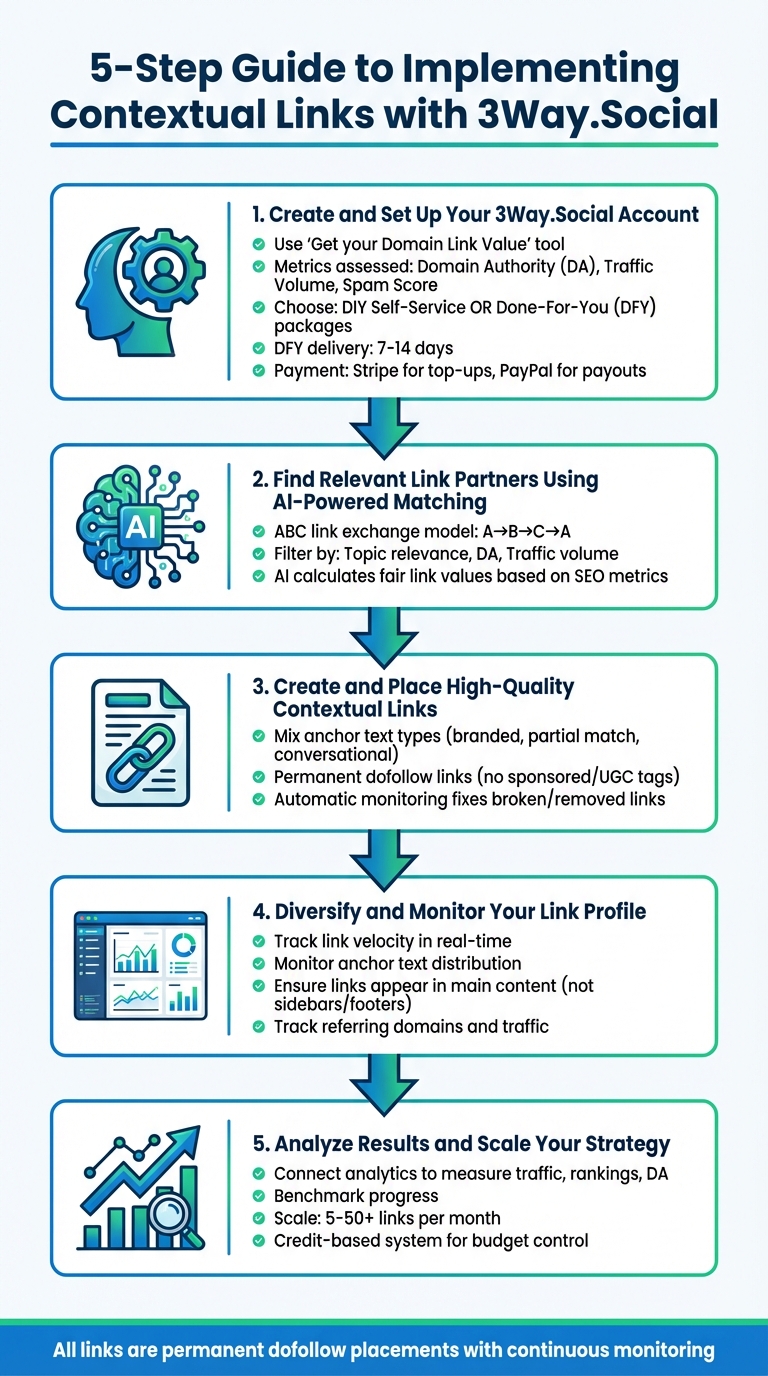
5-Step Guide to Implementing Contextual Links with 3Way.Social
Now that you know how contextual links can improve your rankings, it’s time to apply that knowledge. This guide walks you through the process of using 3Way.Social to implement contextual links effectively. With its AI-powered matching and credit-based system, the platform simplifies link exchanges while ensuring fairness. Let’s break it down step by step.
Step 1: Create and Set Up Your 3Way.Social Account
Getting started with 3Way.Social is straightforward – and free. Begin by exploring potential link partners and evaluating your SEO value using the "Get your Domain Link Value" tool. This tool assesses your site based on Domain Authority (DA), Traffic Volume, and Spam Score, giving you a preview of matched partners.
Once you’re ready, you can choose between two options:
- DIY Self-Service Platform: Offers full control, allowing you to manually manage link exchanges.
- Done-For-You (DFY) Packages: SEO experts handle everything, from niche targeting to delivering results within 7–14 days. This option includes a quality guarantee and money-back protection, making it ideal for those who prefer a hands-off approach.
After setting up your account, add your domain. This unlocks your dashboard, where you can manage your link portfolio, track SEO performance, and oversee campaigns. Payments are simple – Stripe is used for account top-ups, and PayPal handles payouts for selling link placements.
With your account ready, it’s time to find the right link partners.
Step 2: Find Relevant Link Partners Using AI-Powered Matching
The platform’s AI engine pairs your domain with authoritative, relevant sites. Instead of traditional reciprocal exchanges, 3Way.Social uses an ABC link exchange model. Here’s how it works: Site A links to Site B, Site B links to Site C, and Site C links back to Site A. This creates a natural linking structure that search engines favor.
To refine your results, use the platform’s precision filters. These filters let you sort potential partners by topic relevance, DA, and traffic volume. The system also calculates link values based on real SEO metrics, ensuring fair pricing and high-quality connections.
Once you’ve identified suitable partners, it’s time to place your contextual links.
Step 3: Create and Place High-Quality Contextual Links
When crafting guest posts or articles, make sure your links are integrated naturally. Use a mix of anchor text types, including branded terms, partial matches, and conversational phrases, to maintain a natural flow.
All links placed through 3Way.Social are permanent dofollow links, meaning they pass full SEO value. There are no sponsored or UGC tags attached. Plus, the platform continuously monitors your placements, automatically fixing any broken or removed links to safeguard your investment.
With your links in place, focus on maintaining a balanced link profile.
Step 4: Diversify and Monitor Your Link Profile
Your dashboard provides real-time insights into your link velocity, which is the rate at which you acquire backlinks. Keeping this rate steady and natural is crucial – sudden spikes can raise red flags with search engines.
You’ll also want to monitor your anchor text distribution to ensure it remains diverse. Links should always appear within the main content, not buried in sidebars or footers. The platform’s monitoring tools help you spot and resolve any issues before they affect your rankings. You can also track which referring domains are driving traffic, allowing you to fine-tune your strategy as needed.
Step 5: Analyze Results and Scale Your Strategy
Connect your analytics to measure changes in traffic, rankings, and domain authority. Use these insights to benchmark your progress and identify areas for improvement.
As you start seeing positive results, consider scaling your efforts. You can increase the number of monthly link placements or expand into new topics. The credit-based system makes it easy to manage your budget and adjust your pace – whether you’re adding 5 links a month or 50. By continuously analyzing and refining your approach, you can steadily enhance your site’s performance in search engine results.
Benefits of Contextual Link Building
Improved SEO Metrics and Visibility
Contextual links offer a clear advantage for SEO compared to links placed in sidebars or footers. Positioned within the main body of content, these links are seen as earned editorial mentions, passing significantly more link equity. This boosts your site’s domain authority, as each link from a reputable source strengthens your site’s perceived expertise. They also serve as a strong signal to Google about your content’s relevance to specific topics.
Another key benefit? Your link profile becomes more resilient to algorithm updates. As Incremys puts it:
"A credible editorial link answers a simple question: would this link improve the content even if Google didn’t exist?"
On top of that, contextual links help search engines find and index deeper pages on your site, especially when placed on pages that are frequently crawled. These SEO improvements naturally pave the way for enhanced user experiences, which we’ll explore next.
Better User Experience and Engagement
Contextual links improve the way users interact with your content. When a link is embedded within relevant text, readers are much more likely to click it compared to a generic link in a footer. This aligns with the Reasonable Surfer Model, which suggests that search engines favor links users are likely to engage with.
By offering logical next steps through well-placed links, you can increase dwell time and reduce bounce rates. Contextual links also make it easier for users to find related content quickly, cutting down on click depth and improving navigation. Beyond keeping users engaged, these links also enhance your site’s reputation, a point we’ll dive into next.
Credibility Through High-Quality Backlinks
While improved SEO metrics and user engagement lay the groundwork, high-quality contextual backlinks take your site’s credibility to the next level. When an authoritative industry publication includes your link in its content, it signals to search engines – and readers – that your site is a trusted source of information. This kind of endorsement serves as independent validation, something that self-promotion simply can’t achieve.
Securing editorial links from respected platforms consistently reinforces your position as a leader in your niche. In fact, a single link from a top-tier source often outweighs dozens of links from less credible directories. This growing trust not only strengthens your authority with search engines but also builds confidence among your audience. Over time, this credibility attracts even more high-quality link opportunities, creating a positive cycle of growth for your site.
Wrapping It Up
Contextual links are still one of the strongest tools for boosting your SERP rankings in 2026. They pass link equity from high-authority pages, signal semantic relevance to search engines, and improve user engagement metrics like dwell time and bounce rates. But the real secret lies in creating valuable links – the kind that enhance your content even if search engines weren’t part of the equation.
The tricky part is getting it right. It takes effort and strategy to find partners with aligned topics, place links in meaningful "proof paragraphs", maintain a varied anchor text profile, and keep an eye out for link drift. This is where platforms like 3Way.Social come in handy. Their AI-powered domain matching helps you quickly connect with relevant link partners, secure placements in body content, and monitor your link profile’s health over time.
As search engines continue to emphasize quality over quantity – and as structured, evidence-backed content becomes more important in generative search results – your contextual link strategy needs to be sharp and scalable. Whether you’re building internal links to strengthen your site structure or obtaining external backlinks from trusted sources, the focus should always remain on relevance and editorial quality.
Want to take action? Create a free account on 3Way.Social now and start building a contextual link profile that delivers real ranking improvements. With their vetted network, permanent do-follow links, and advanced diversification tools, they make professional-grade link building easier than ever – no manual outreach required.
FAQs
How many contextual backlinks do I need to see ranking gains?
When it comes to improving rankings, there’s no magic number of contextual backlinks you need. What really counts is getting high-quality, relevant links embedded naturally within your content. These types of links carry more weight for SEO. Instead of chasing sheer numbers, prioritize links that are well-placed and relevant – they can make a noticeable difference in your rankings over time.
How can I tell if a contextual link appears natural to Google?
A contextual link feels natural to Google when it’s integrated into relevant content and uses anchor text that blends smoothly with the surrounding text. To make sure it looks authentic:
- Place it within high-quality, related content that aligns with the topic.
- Choose anchor text that fits naturally and reflects the subject matter.
- Use a proper HTML
<a>tag with a valid, crawlable URL to ensure functionality.
What should I track to measure contextual link ROI?
To gauge the return on investment (ROI) of your contextual link strategy, focus on tracking several key metrics. Start with search rankings for your targeted keywords – this will show if your efforts are improving visibility. Next, keep an eye on organic traffic growth, as it reflects how well your links are driving users to your site. Improvements in domain authority or other trust-based metrics can also signal progress.
Don’t stop there. Dive into engagement metrics like bounce rate and time on page. These stats help you assess the quality of the traffic your links are bringing in. When you combine these indicators, you get a clear picture of how contextual links are influencing your SEO performance and ROI.