Last Updated on July 20, 2026 by Becky Halls
There used to be a rhythm to SEO. Google would announce a core update, the industry would collectively hold its breath for two weeks, rankings would shuffle, everyone would write a “what we learned” post, and then things would go quiet until the next one. You could practically set your calendar by the drama.
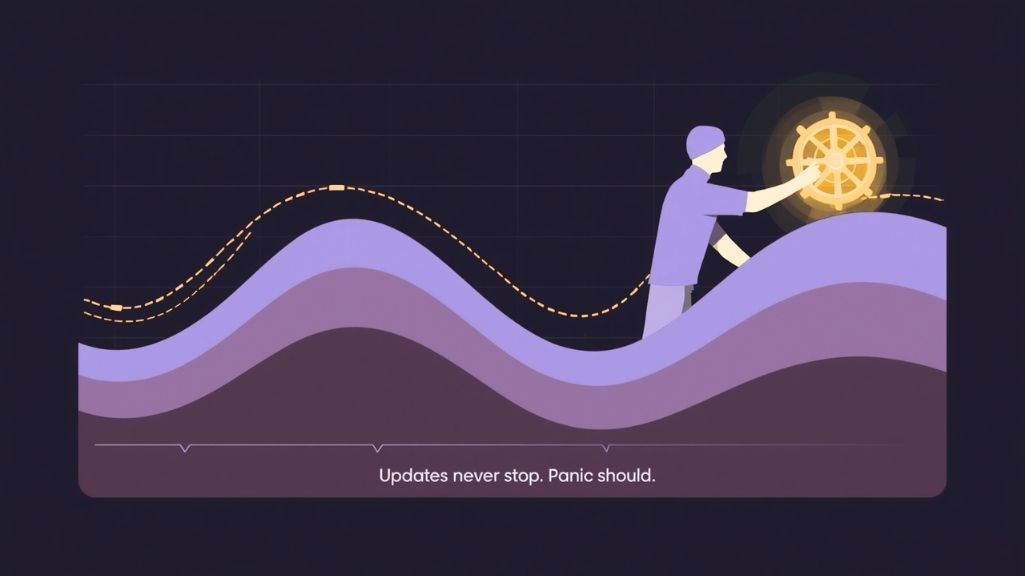
That rhythm is gone – enter Google’s continuous core updates. On 9 July 2026, Google effectively confirmed what a lot of us had already suspected from staring at our analytics: smaller core updates now roll out continuously, without announcements. The big, named core updates still happen. But underneath them, the algorithm is now in a state of permanent, quiet motion. Welcome to the always-on era — where the update never really ends, and neither does your job.
What Google’s “continuous” core updates actually means
Let’s be precise, because the phrase gets misused. Google isn’t running one giant rolling core update forever. What’s changed is that between the marquee, named updates, Google is shipping frequent smaller refinements to its core systems that never get a blog post or a status-dashboard entry. As the search community summarised it this month, Google now makes ongoing improvements almost every day — many of which never get an official announcement.
This matters for a very practical reason: you can no longer blame every ranking dip on “the update,” because there’s almost always an update. The old habit of waiting for a confirmed rollout before investigating a traffic drop is now a great way to lose three weeks.
“The mental model people need to drop is ‘update = event.’ It’s a stream now, not a series of earthquakes. Which is actually good news — it means fewer violent overnight swings and more gradual movement you can diagnose calmly, as long as you’ve got clean logging and you’re watching trends instead of single days.” Peter Fox, 3Way.Social
The July 2026 spam update: separate thing, don’t confuse them
While core systems hum along in the background, Google also ran a spam update in July – the loudest single piece of algorithm news this month, and the second spam update of the year after March’s, which finished in under 24 hours. Spam updates are a different animal from core updates. Core updates broadly reassess how helpful and relevant content is. Spam updates target things that violate Google’s spam policies – refinements to detection systems like SpamBrain.
The useful clarification here comes from Barry Schwartz, who asked Google directly and reported that the recent spam update does not target link spam and does not target Site Reputation Abuse. That’s worth knowing before you panic-audit your backlink profile — this particular update wasn’t gunning for your links.
Why does the distinction matter? Because your response differs entirely. If a core update moves you, the fix is usually about content quality, expertise and helpfulness. If a spam update hits you, something is likely violating a specific policy and needs cleaning up. Misdiagnose which one you’re dealing with and you’ll spend effort in the wrong place.
Why core updates take so long (and why that’s fine)
If you’ve ever wondered why a core update drags on for weeks, John Mueller explained the mechanics this year: these rollouts involve multiple interconnected systems and large-scale re-evaluation across the whole index, which simply takes time to propagate. The practical takeaway is that you should never judge your fate from day three of a rollout. Rankings genuinely bounce mid-update, and the picture on the final day can look very different from the middle.
How to work in an always-on world
Here’s the shift in mindset, and the specific things to do.
Watch trends, not days. A single bad day is noise. A two- or three-week downward slope is signal. Set up weekly and 28-day comparison views in Search Console and your analytics, and train yourself to look there first.
Keep a change log. When rankings move, the first question is always “what did we change?” If you’re logging your own site changes — content edits, technical deployments, redirects — you can rule yourself out fast and stop blaming Google for a redirect you broke.
Separate your diagnostics. Keep a simple two-column mental checklist: core-update symptoms (broad, content-quality-related, gradual) vs spam-update symptoms (sharp, tied to specific pages or tactics, policy-related). Diagnose before you act.
Invest in fundamentals that survive everything. Genuinely helpful content, demonstrable expertise (the E-E-A-T you keep hearing about), clean technical health, and fast pages don’t get punished by any update. Chasing individual algorithm tweaks is whack-a-mole; building a genuinely good site is the only durable strategy.
Don’t neglect the AI surfaces. The same July report noted Search Console gained new tools to control how content appears in AI features, and AI Overviews keeps expanding. Ranking blue links is now only half the visibility game. For context on how big this is getting, the AI SEO software market is projected to hit $22.39 billion in 2026 — this isn’t a fringe concern anymore.
The headline for 2026 is almost reassuring once you sit with it: because updates never stop, no single one is worth losing sleep over. The winners aren’t the people who react fastest to each tremor — they’re the ones who built something steady enough that the tremors barely register.
Google’s Continuous Core Updates – FAQ
Did Google release a core update in July 2026?
Not a broad, named one. The May 2026 core update had already settled. July’s notable news was a spam update, plus Google’s confirmation that smaller core updates now run continuously without announcements.
What’s the difference between a core update and a spam update?
Core updates broadly reassess how relevant and helpful content is across the index. Spam updates specifically target content violating Google’s spam policies via detection systems like SpamBrain. They require different responses.
Did the July 2026 spam update target link spam?
According to Barry Schwartz’s reporting, the recent spam update does not target link spam or Site Reputation Abuse. So a backlink panic-audit isn’t the right first move if you were affected.
Why do Google core updates take weeks to roll out?
Because they involve re-evaluating enormous amounts of content across multiple interconnected systems, which takes time to propagate. Rankings genuinely fluctuate mid-rollout, so don’t judge the outcome until it completes.
If updates never stop, how do I know if I was “hit”?
Look at trends over two to four weeks, not single days, and cross-reference against your own change log. A sustained decline that doesn’t line up with your own site changes is the signal worth investigating.
What’s the safest long-term SEO strategy in an always-on world?
Fundamentals: helpful content, real expertise, clean technical health, fast pages, and growing visibility across AI surfaces too. These don’t get penalised by any update, named or not.
Peter Fox leads the dev team at 3way.social, where he spends his days making sure sites stay healthy, fast, and legible to both search crawlers and AI models.