Last Updated on June 9, 2026 by Becky Halls
Automated link exchanges can boost your SEO, but if done incorrectly, they risk penalties from Google. Follow these key practices to ensure safe and effective link exchanges:
- Understand Risks: Google penalizes excessive or unnatural link patterns, not all link exchanges. Keep reciprocal links under 25–30% of your inbound profile.
- Use Smart Models: ABC link exchanges are safer than direct swaps. Avoid obvious patterns that algorithms can detect.
- Vet Partners: Choose domains with steady traffic, natural anchor profiles, and topical relevance. Avoid spammy sites with over-optimized anchors or unrelated niches.
- Diversify Anchors: Use branded, natural, and partial-match anchor texts. Avoid exact-match commercial phrases.
- Monitor & Audit: Regularly check your link profile for issues. Use tools like Google Search Console or Ahrefs to track performance and detect risks.
ABC “3way” link exchange made safe and simple!
sbb-itb-88880ed
Pre-Exchange Preparation: Compliance and Risk Reduction
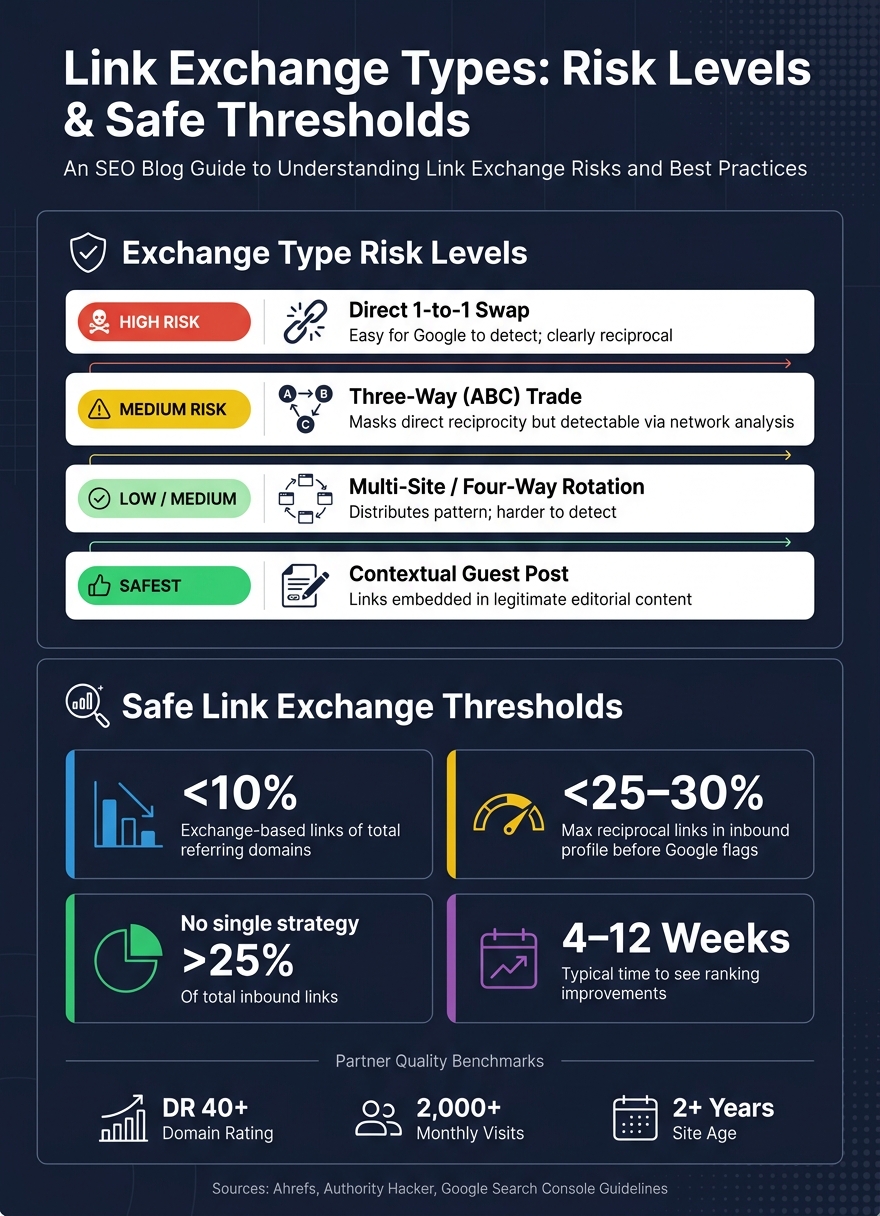
Link Exchange Types: Risk Levels & Safe Thresholds at a Glance
Laying the groundwork for compliance is crucial before launching any automated exchange. This helps you sidestep potential SEO problems right from the start.
Review Google’s Link Guidelines
Google’s spam policies explicitly warn against “excessive link exchanges” and “partner pages created solely for cross-linking”.
“The line is pattern density and intent, not the existence of any single trade.” – Brijesh Vadukiya, Co-Founder, Outreach Desk
To stay compliant, examine each potential link. If you wouldn’t naturally link to a partner without expecting something in return, it’s best to skip that exchange. By sticking to clear compliance rules, you can avoid unnecessary risks.
Define Risk Limits and Exchange Criteria
Your overall backlink profile – not any single link – determines your risk level. Aim to keep exchange-based links under 10% of your total referring domains to maintain a natural profile. If reciprocal links exceed 25–30% of your inbound link profile, Google may flag this as a suspicious pattern.
Before starting exchanges, set strict criteria for potential partners. These should include:
- Non-zero organic traffic
- A stable or growing traffic trend over the past 12 months
- A natural anchor text profile
Additionally, avoid exact-match commercial anchors in exchanges. Instead, use branded or descriptive anchor text. The table below outlines the relative risk levels of different exchange types to help guide your decisions:
| Exchange Type | Risk Level | Why |
|---|---|---|
| Direct 1-to-1 | High | Easy for Google to detect; overly obvious |
| Three-Way (ABC) | Lower | Masks direct reciprocity across three sites |
| Four-Way (Cross-Network) | Lowest | Distributes the pattern, making it harder to detect |
| Contextual Guest Post | Safest | Links are embedded in legitimate, editorial content |
Once you’ve defined your risk tolerance and partner criteria, it’s time to establish a system for monitoring and auditing.
Set Up Monitoring and Auditing Tools
Before launching any exchanges, set up tracking systems. Start by connecting Google Search Console to monitor for manual actions or crawl issues. Complement this with tools like Ahrefs or Moz to ensure exchanged links are dofollow, indexed, and live.
From day one, keep an eye on anchor text distribution. A balanced profile includes branded terms, partial-match phrases, and natural language. Over-optimized anchor text is a red flag for algorithms. If you’re using a platform like 3Way.Social, take advantage of its built-in tracking to monitor link placement and longevity, reducing the need for manual checks.
Make it a habit to review your link profile monthly. This is especially important because partners might add low-quality or spammy content to pages after your link is placed. Regular audits help you catch and address these issues early.
Vetting Partners and Domains for Quality and Relevance
Once you’ve set up monitoring, the next step is choosing your partners wisely. Poor-quality links can damage your SEO efforts, so careful vetting is essential.
How to Identify High-Quality Domains
A domain with a high Domain Rating (DR) might look appealing, but it’s not enough on its own. You also need to check for steady organic traffic and a natural anchor profile. Tools like Ahrefs, Semrush, and Moz can help you evaluate key factors such as organic traffic levels, backlink diversity, and trust indicators. Look for essentials like HTTPS, a legitimate About page, contact details, and active social media accounts.
Here’s an eye-opening stat: an Ahrefs study of over 1 billion pages found that pages with 35+ referring domains get significantly more organic traffic than those with just one or none. This shows how important a domain’s own link profile is when deciding whether to partner with it.
As a rule of thumb for most U.S.-based niches, aim for domains with:
- 1,000–5,000 monthly organic visits
- A DR or Domain Authority (DA) above 20
- Backlinks from well-known and diverse sources
If you want to save time, services like 3Way.Social pre-screen domains using these benchmarks, streamlining the process.
Once you’ve identified potential domains, make sure they align topically with your content.
Why Topical Relevance Matters
Relevance is often more critical than raw authority. According to a 2022 Authority Hacker study, ~53% of SEOs consider the relevance of the linking site the most important factor when evaluating backlinks. Google’s algorithms rely on contextual signals to determine if a link is genuine or artificially placed.
To assess relevance, look at the domain, section, and page levels. For example, a U.S. personal finance blog linking to a budgeting tool is contextually appropriate. However, that same blog linking to an outdoor gear store? Not so much. Google is increasingly adept at identifying these mismatches.
For automated partnerships, set filters to ensure links come from within your industry or closely related fields – for example, health and fitness, or marketing and sales. AI-driven tools like 3Way.Social can help automate this process, ensuring your links stay relevant and natural.
How to Spot Spam Signals
After evaluating quality and relevance, the final step is to weed out domains with spammy characteristics. A quick 3–5 minute review of shortlisted domains can help you spot red flags. Start by opening three to five recent articles and checking the outbound links. If you see posts packed with 10–20 external links to unrelated niches – like gambling, payday loans, or crypto on a cooking blog – that’s a clear sign of link schemes.
Other spam indicators include:
- Over-optimized anchor text (e.g., repeated exact-match commercial keywords)
- Footer or sidebar link blocks labeled “Partners” or “Resources” stuffed with keywords and lacking editorial context
- Guest post author bios that always include followed commercial links
- A traffic history chart showing a steep drop after a Google update, like the December 2022 Link Spam Update, which could signal an unresolved penalty
Here’s a quick reference table to guide your review:
| Signal | What to Check | Red Flag |
|---|---|---|
| Outbound link density | Count links per article | 10+ external links in short posts |
| Anchor text | Scan recent post anchors | Repeated exact-match commercial keywords |
| Niche consistency | Review category pages | Casino, loan, or adult content on unrelated sites |
| Traffic history | Check Ahrefs/Semrush chart | Sharp drop after a Google update |
| Footer/sidebar links | Inspect page templates | Keyword-stuffed “Partners” link blocks |
How to Run Automated Link Exchanges Safely
Once you’ve meticulously vetted your link exchange partners, the next step is configuring exchanges to look natural and maintain editorial credibility. Even with high-quality partners, poorly managed exchanges can harm your SEO if they come across as artificial.
Diversify Link Patterns and Anchor Text
Steer clear of simple one-to-one link swaps. Instead, adopt the ABC (three-way) model, which avoids direct reciprocity by involving a third party. This method makes exchanges less obvious and harder to trace. Tools like 3Way.Social can simplify this process by using AI to facilitate fair three-way link arrangements.
Anchor text diversity is equally important. Alternate between branded, natural, and partial-match anchor texts to create a more organic backlink profile. As a rule of thumb, no single exchange type should make up more than 25% of your total backlinks to prevent algorithmic red flags.
Finally, ensure these links are placed within meaningful content to enhance their credibility.
Place Links in Contextual Content
The placement of a link is just as critical as the link itself. Avoid putting links in footers, sidebars, or on “Partners” pages, as these are commonly flagged by Google’s spam policies as part of link schemes. Instead, embed links within the main body of high-quality, relevant articles. The link should feel like a natural editorial recommendation, passing what’s often referred to as the SCR test: Scrutiny, Context, and Relevance.
“The safest link exchange is the one you are willing to remove later if the page, partner, or context stops making sense.” – Ana Clara, Rankchase
Control Exchange Volume and Pacing
How often and how quickly you exchange links can also raise red flags. Spread out link publications over time – days or even weeks – rather than publishing them all at once. Keep reciprocal links under 25% of your total backlink profile to maintain a natural appearance. Be wary of partners who push for immediate publication, as this is often a sign of volume-driven schemes rather than genuine editorial partnerships.
| Pattern | Risk Level | Why It Triggers Signals |
|---|---|---|
| Direct 1-to-1 Swap | High | Clearly reciprocal and easy to detect through crawl timing |
| 3-Way (ABC) Trade | Medium | Masks direct reciprocity but can still be identified through network analysis |
| Multi-Site Rotation | Low/Medium | Reduces detection risk but requires diverse site ownership |
| “Partners” Pages | Critical | Explicitly flagged in Google’s spam policies as a link scheme |
Monitoring, Auditing, and Adjusting Your Link Exchanges
Keeping a close eye on your link exchanges is what separates a long-term SEO strategy from one that could backfire.
Track Key Performance Metrics
Use tools like Google Search Console, Ahrefs, or Semrush to monitor how your link exchanges are impacting organic impressions and find backlinks Google is indexing, click-through rates (CTR), and keyword rankings. Platforms like 3Way.Social can simplify this process by offering real-time alerts if links disappear or if there’s a noticeable dip in your metrics.
Run Regular Link Audits
Tracking performance is just part of the equation. Regular audits are also essential to ensure the quality of your links remains intact. Check that all links are still live and relevant to your content. Keep an eye on your partners’ profiles – sudden changes, like a shift toward artificial link building, can be a red flag. If you spot any issues during these audits, act quickly to address them and safeguard your strategy.
Handle Risk and Fix Problem Links
When risks arise, it’s crucial to act fast. If a link becomes problematic, reach out to your partner to request its removal or repositioning. If they don’t cooperate, you can turn to Google’s Disavow Tool as a last resort. For links that show signs of over-optimized anchor text or increased spam scores, consider diversifying your approach. Use a mix of branded, generic, and partial-match anchor texts, and explore multi-site exchanges to spread the risk. This keeps your SEO efforts on track while staying compliant with best practices.
Conclusion: Key Takeaways for Safe Automated Link Exchanges
Safe automated link exchanges revolve around three main pillars: compliance, quality, and consistency. These elements help protect your site from triggering Google’s SpamBrain and other algorithmic penalties.
To stay on the safe side, aim to keep link swaps to less than 10% of your total backlinks, maintain reciprocal one-to-one swaps at around 1 in 10 links, and ensure no single strategy accounts for more than 25% of your inbound links. These thresholds create a balanced, natural-looking backlink profile that avoids raising red flags.
“The risk isn’t getting caught on one swap. The risk is the pattern adding up across many.” – Brijesh Vadukiya, Co-Founder, Outreach Desk
This underscores the importance of strict quality standards. Collaborate only with partners who meet specific criteria: a Domain Rating (DR) of 40+, at least 2,000 monthly visits, and a site age of 2+ years. Additionally, focus on topical relevance – a niche-specific link from a moderately authoritative site often delivers better results than a generic link from a high-DR domain that has no connection to your industry.
Regular monitoring is equally important. Meaningful ranking improvements from compliant link exchanges typically take 4 to 12 weeks to materialize. Consistent audits and patience are essential for long-term success. Tools like 3Way.Social can simplify the process by offering domain matching, permanent do-follow links, and a network of pre-screened partners to ensure your exchanges are both effective and compliant.
Automated Link Exchanges – FAQs
How can I estimate what percentage of my backlinks are exchanges?
To get an idea of how many backlinks might be the result of exchanges, it’s important to audit your link profile regularly. Look for patterns where inbound links are being reciprocated. While doing this manually can take a lot of time, tools like 3Way.Social make the process easier by monitoring your profile and highlighting potential concerns. Ideally, you should aim to keep link exchanges under 5% of your total backlinks. This helps ensure your backlink growth looks natural and reduces the risk of penalties from search engines.
What’s the safest way to automate ABC (three-way) link exchanges?
To automate link exchanges safely, prioritize relevance, quality, and organic growth. Leverage AI tools like 3Way.Social to handle the intricacies, ensuring all participating sites share related topics. Steer clear of “link farms” and avoid overloading pages with outbound links.
Place links naturally within the main content, vary your anchor text, and keep link exchanges to less than 5% of your total backlink profile. Regularly check that links remain active, are do-follow, and continue to be indexed by search engines.
When should I remove or disavow an automated link exchange?
It’s important to address links that damage your SEO or violate partnership agreements. If a partner removes your link or changes it to nofollow without informing you, it might be time to reconsider the partnership.
Make it a habit to audit your backlinks regularly. Watch out for:
- Links with a Toxicity Score of 60 or higher
- Links pointing to sites with little to no traffic
- Links blocked by noindex tags
- Links that no longer offer real value to readers
Taking these steps helps maintain the integrity of your SEO and ensures your partnerships remain mutually beneficial.