Last Updated on February 3, 2026 by Becky Halls
Forum backlinks are a powerful tool for boosting your SEO and driving traffic. Competitors use forums to strategically build links that improve their rankings. Here’s how they do it:
- Identify competitor backlinks: Use tools like Ahrefs or Moz to analyze where competitors are getting forum links.
- Focus on relevant forums: Look for forums tied to your niche with high activity and domain authority.
- Filter for quality links: Prioritize forums with user-generated content (UGC), high traffic, and a strong Domain Rating (DR).
- Analyze competitor strategies: Study how links are placed – contextually in posts, via signatures, or in profiles.
- Engage before linking: Competitors often build trust by contributing valuable posts before adding links.
The key is to target active, high-quality forums and follow ethical practices to avoid penalties while improving your link profile.
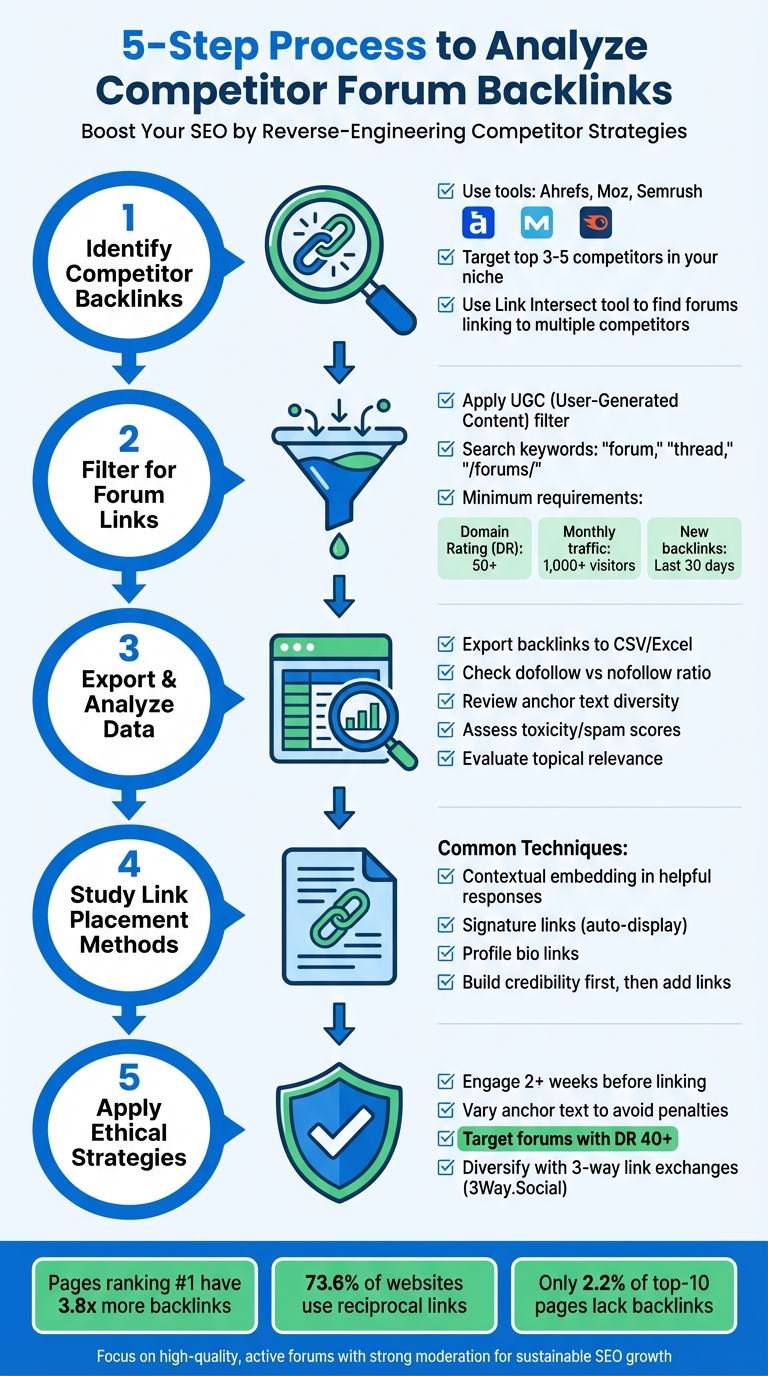
5-Step Process to Analyze Competitor Forum Backlinks for SEO
Finding Competitors Who Use Forum Backlinks
Research Competitors in Your Niche
Start by identifying competitors that rank for your target keywords. Tools like Ahrefs or Moz can help pinpoint the websites performing well in your niche. Once you’ve narrowed it down to your top 3–5 competitors, dive into their backlink profiles to uncover where their links are coming from.
Using the Link Intersect tool can be especially helpful here. This tool highlights domains linking to multiple competitors but not to your site. If three or more competitors have backlinks from the same forum, it’s a strong indicator that the forum is relevant and could be a valuable resource for your industry.
“We’ve seen forum backlinks work best when you stop thinking ‘link’ and start thinking ‘useful answer’. The posts that rank, get upvoted, and stay live are the ones that earn the safest links.” Ian Naylor, 3Way Social
Filter for Forum Referring Domains
Once you’ve accessed a competitor’s backlink profile, the next step is to filter out the forum links from the mix. Many SEO tools now include a User-Generated Content (UGC) filter, which is designed to identify links from content like comments and forum posts. As explained by Ahrefs Academy:
“UGC – Shows that a link is placed in user-generated content (like comments and forum posts)”.
To refine your search further, use keywords like “forum,” “thread,” or specific platform names such as “reddit.com.” Look for recognizable patterns in URLs, such as “topic,” “viewtopic,” or “quora.com.” Searching for URLs containing /forums/ or /community/ often leads to active discussion boards.
To confirm whether competitors are actively creating forum backlinks, adjust the date filter to show new backlinks from the past 30 days. For better results, apply a minimum traffic filter of about 1,000 monthly visitors to ensure the forum is active and worth targeting. Additionally, filtering by a Domain Rating (DR) of 50 or higher will help you focus on forums that carry more SEO weight.
Once you’ve isolated the forum links, export the data using your SEO tools for further analysis.
Backlink Analysis: Find Thousands of Link Building Opportunities
Collecting and Analyzing Competitor Forum Backlink Data
Once you’ve identified forum links, the next step is digging into their quality and impact. This step is essential if you want to replicate what’s working for your competitors.
Export Competitor Backlinks Using SEO Tools
To start, use tools like Ahrefs, Semrush, or Moz to pull backlink reports in CSV or Excel formats.
For Ahrefs, apply the UGC filter to focus specifically on forum posts. You can also use the Platform filter to sort sites by type – like blogs, forums, or wikis. Over on Semrush, the Backlink Gap report is particularly helpful. It lets you compare up to five competitors side-by-side and export a list of domains linking to them but not to you.
Before exporting, narrow the data. Set a minimum Domain Rating (DR) of 30 and require at least 1,000 monthly organic visits. This way, you’re focusing on forums that are both authoritative and active.
With this data in hand, you’re ready to evaluate the quality and patterns of these backlinks.
Assess Link Quality and Patterns
Start by analyzing the dofollow versus nofollow ratio of the forum links. As Ahrefs Academy points out:
“Dofollow links are important because they pass link equity to the destination page, which is one of Google’s most important ranking factors”.
While many forum links are UGC or nofollow, a balanced mix that includes dofollow links from authoritative forums signals a strong backlink profile. Review the “Anchors” report to see how competitors are using anchor text. Are they relying on branded terms, keyword-rich phrases, or generic calls-to-action? A varied anchor text profile tends to look more natural to search engines.
Next, use tools like Semrush’s Toxicity Score (which ranges from 0 to 100) or Moz’s Spam Score to weed out low-quality or potentially harmful links. Also, evaluate topical relevance by checking domain categories or referring page titles. As Chima Mmeje, Senior Content Marketing Manager at Moz, explains:
“Topical links are the key to success – suspecting links that are more topically aligned are given higher priority when assessing their value”.
Finally, examine link velocity. Filter for new and lost backlinks over the last 30 days. A steady stream of new forum links suggests an active strategy, while a high number of lost links might indicate issues like forum post deletions or declining forum quality.
sbb-itb-88880ed
Understanding How Competitors Build Forum Backlinks
With the data in hand, it’s time to dive into how competitors strategically place links within forum content to boost their SEO efforts.
Forum Post Types and Link Placement Methods
Competitors often rely on specific methods to integrate links into forum posts effectively. One popular technique is contextual embedding, where links are seamlessly included within a helpful response to a question. As Jesse Stoler, Advanced Link Building Specialist at Page One Power, puts it:
“The links that are going to be more powerful for you are contextual links in posts… a majority of your posts in the forum should not include a link back to your site”.
Another common method is the use of signature links, which are automatically displayed at the bottom of every post. These provide ongoing brand visibility without the need for manual placement. Additionally, many competitors take advantage of the profile bio or “website” field to direct traffic to their site when users want to learn more about their expertise.
A particularly crafty tactic involves building credibility first. Competitors establish trust by posting valuable, non-promotional content initially. Once they’ve gained credibility within the community, they begin adding links. Some even adopt a delayed editing approach – posting helpful content first and then returning a day later to insert a link after moderators have already reviewed the post.
Mastering these techniques is only half the battle. The next step is identifying the right forums to target.
Find High-Traffic Forums
Once you’ve learned how to place links effectively, the focus shifts to finding the forums that deliver the most SEO value. Competitors prioritize forums with high community engagement – specifically, those with at least five threads showing new posts daily. To evaluate activity, check the “last post” column on the forum’s main page; forums lacking frequent updates are unlikely to drive meaningful traffic.
Domain authority is another critical factor. Competitors generally target forums with a Domain Rating (DR) above 40 and at least 1,000 monthly organic visitors. These benchmarks align with the broader standards for identifying quality backlinks. To discover potential forums, you can use advanced Google search strings like keyword + "discussion board" or keyword inurl:/forums and then cross-check these results with SEO tools to identify forums that frequently link to competitor sites.
Strict moderation is also a green flag. As Ty Hammock from SEOptimer explains:
“Forums often represent the heartbeat of your industry”.
Well-moderated forums help maintain quality by filtering out spam, which protects both the forum’s reputation and the value of any backlinks placed there. Even forums that use nofollow links, such as Reddit and Quora, are valuable. Why? They drive qualified referral traffic and often dominate Google’s results for “best [service]” searches.
Applying Competitor Forum Backlink Strategies
Transform your competitor insights into actionable strategies with these practical approaches.
Choose Relevant, High-Authority Forums
Start by identifying forums that link to your competitors but not to your site. Tools like Link Intersect or Backlink Gap can help pinpoint these opportunities. Once you have a list, evaluate each forum’s quality using metrics like Domain Authority (DA) or Domain Rating (DR). Focus on forums that are active, niche-specific, and have a strong, engaged community. Use backlink analysis tools to weed out forums with spammy outbound links. As uSERP puts it:
“Think of forums like neighborhood bulletin boards. The link is your flyer – but if you spam the board, the community will notice”.
Well-moderated forums not only protect your site’s reputation but also maintain the integrity of your backlinks.
Follow Ethical Link-Building Practices
Building links ethically means adding genuine value to the community. Spend at least two weeks engaging with forum discussions before sharing any links. This shows you’re a legitimate participant, not a spammer. When you do share links, make sure they naturally enhance your contributions.
Be mindful of anchor text diversity. Repeatedly using the same anchor text can activate spam filters. In fact, research shows that over-reliance on identical anchor text has led to an average ranking drop of 15 positions as of 2026. To avoid this, vary your anchor text by mixing branded terms, plain URLs, and descriptive phrases. As Dmytro Tsybuliak, Co-founder of Editorial.Link, explains:
“Ethical link-building, also known as white hat link-building, involves acquiring links in a fair, non-manipulative manner that aligns with Google’s guidelines and best practices”.
Additionally, keep an eye on the “Manual Actions” page in Google Search Console to ensure your forum activities don’t result in penalties.
To strengthen your strategy further, balance forum backlinks with other types of links.
“In our experience, competitors that ‘scale’ forum backlinks without getting burned do three boring things well: pick tight niche threads, use branded or URL anchors, and only link when it genuinely helps the reader.” Ian Naylor, 3Way Social
Use 3Way.Social for Link Diversification
While forum backlinks are valuable, relying on them alone isn’t enough for long-term SEO success. Data shows that pages ranking first on Google have 3.8 times more backlinks on average, and only 2.2% of top-10 pages lack backlinks entirely.
To avoid the pitfalls of direct reciprocal linking – which can be flagged as a link scheme – try 3-way (ABC) link exchanges. Platforms like 3Way.Social (https://3way.social) use AI to match domains and ensure equitable link value, helping you create a more natural backlink profile. According to a 2026 State of Link-Building Survey, 9.3% of SEO experts view link exchange as an effective tactic, and Ahrefs research reveals that 73.6% of analyzed websites include reciprocal links.
Conclusion
Analyzing competitor forum backlinks can give your SEO strategy a real edge. By identifying forums that link to your competitors’ well-ranking pages, you uncover opportunities that search engines value. As Tom Capper, Senior Search Scientist at Moz, explains:
“Quality, quantity, and relevance are all key factors when analyzing a site’s backlink profile”.
The key is to focus on high-quality, active forums – these are the places where you’ll find the most valuable prospects. Sites already linking to your competitors have shown an interest in your niche, making them prime targets for your outreach. This approach doesn’t just reveal opportunities; it lays the groundwork for meaningful improvements in your backlink strategy.
But finding these links is only the beginning. To truly succeed, you need to turn insights into action. Carlos Silva, Content Marketer at Semrush, sums it up perfectly:
“Finding competitor backlinks is step one of better link building. You then need to turn what you learned into action by finding the best link targets, creating content worth linking to, and building real connections”.
Incorporating tools like 3Way.Social can further strengthen your strategy. Platforms like this allow for secure ABC link exchanges, complementing your forum-based efforts. By diversifying your backlink profile, you create a natural and credible link structure that search engines are more likely to reward with better rankings and increased organic traffic.
Ultimately, success comes from combining the right tools with ethical practices. Study your competitors’ forums, assess link quality, and focus on providing value that surpasses theirs. Stay consistent and patient – this approach can lead to sustainable and long-term SEO growth.
FAQs
How do I find the best forums for building backlinks?
To discover the best forums for building backlinks, start by zeroing in on those that align closely with your niche and attract an active, engaged audience. A good starting point is using search engine queries with specific industry-related keywords to pinpoint forums where your target audience is likely to hang out.
Another smart move? Check out your competitors’ backlink profiles. By analyzing where they’re active, you can uncover forums they’re leveraging and identify opportunities to follow suit. When evaluating forums, look for ones with strong moderation, a good reputation, and the ability to include do-follow links – these can make a real difference for your SEO.
Lastly, focus on forums with lively, ongoing discussions and participants who are relevant to your niche. Active communities not only boost your backlink game but can also bring valuable referral traffic to your site. Remember, aiming for quality over quantity is the key to seeing meaningful results.
What are the best ethical practices for building backlinks through forums?
When creating backlinks through forums, the key is to stick to honest and meaningful approaches. Begin by becoming an active participant in forums that align with your niche. Share useful advice, answer questions thoughtfully, and engage in discussions that matter. Whenever you include links, make sure they genuinely contribute to the topic and provide real value.
Focus on forums with active moderation and engaged members. Steer clear of spammy behaviors like excessive self-promotion or irrelevant link dropping. Instead, build trust by consistently offering helpful, well-thought-out input. Incorporating a mix of dofollow and nofollow links can also keep your backlink profile balanced and natural.
By staying transparent, genuine, and focused on helping the community, you’ll not only build quality backlinks but also earn a solid reputation in your field.
How can I evaluate the quality of forum backlinks used by competitors?
To assess the quality of competitor forum backlinks, start by examining the authority and relevance of the forums linking to their site. Prioritize forums with strong domain authority and substantial traffic, as these are more likely to boost SEO performance. Tools like Ahrefs or Semrush can provide detailed insights into these metrics.
Next, evaluate the diversity and naturalness of the backlinks. A balanced mix of dofollow and nofollow links is key, as it signals a natural link profile. Ensure the links align with the forum discussions and don’t appear forced or out of place. Context matters – links embedded in meaningful, high-quality conversations carry more weight.
Lastly, inspect the forum’s link profile for any indications of spam or unnatural linking patterns. Forums riddled with low-quality content or excessive spam links can harm SEO rather than help it. By regularly analyzing these factors, you can pinpoint valuable backlink opportunities while steering clear of risky or poorly managed forums.