Last Updated on February 20, 2026 by Becky Halls
Hiring the right SEO professional is crucial for your business. The right expert can boost your website’s visibility and revenue, while the wrong one can cause setbacks or penalties. This guide covers a 7-step process to evaluate SEO candidates effectively:
- Portfolio & Results: Verify their past work with live dashboards and client feedback. Look for real business outcomes like conversions and ROI.
- Current Knowledge: Ensure they understand recent SEO updates, ranking factors, and modern strategies like mobile-first optimization and AI-driven search.
- Technical Skills: Test their ability to conduct audits, fix crawlability issues, and implement structured data.
- Content Strategy: Assess their approach to keyword research, content planning, and building authority with content hubs.
- Credentials: Check certifications from reputable platforms and their commitment to staying updated.
- Communication: Review their reporting style and ability to explain strategies clearly.
- Tools & Network: Evaluate their use of SEO tools and connections within the industry.
Key takeaway: Choose someone who aligns with your goals, demonstrates ethical practices, and can deliver measurable results within realistic timelines.
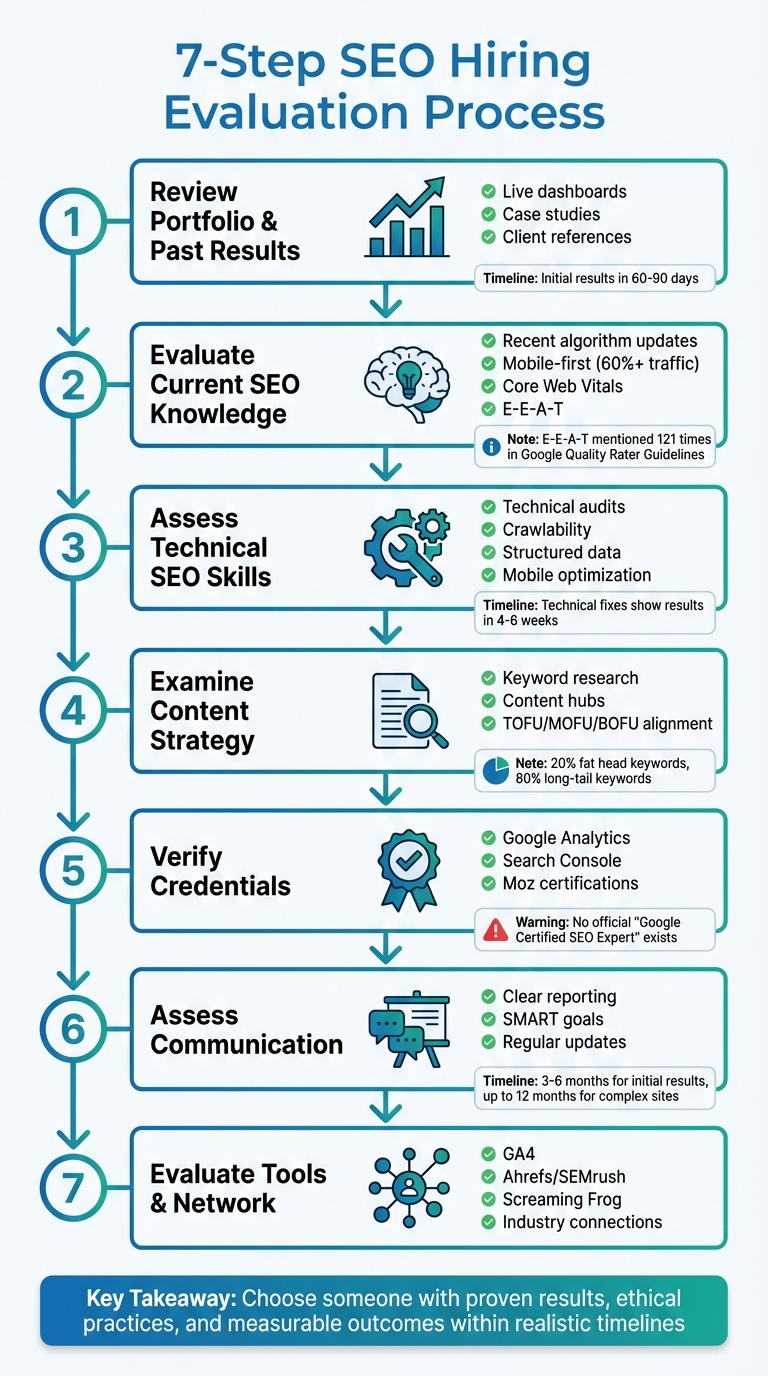
7-Step Process to Evaluate SEO Candidates Before Hiring
How to hire an SEO expert? Interview questions & skills
sbb-itb-88880ed
Step 1: Review Their Portfolio and Past Results
A solid portfolio is a clear indicator of whether an SEO professional can deliver measurable outcomes. As Gordon Ibarra, an SEO Specialist, aptly says:
"If someone can’t show you how they moved the needle, they probably didn’t".
Start by asking for raw data instead of relying on static PDFs or cropped screenshots. Look for live Looker Studio dashboards or exports from GA4 and Google Search Console to verify their claims .
Analyze Case Studies and Success Metrics
Dive deep into their case studies to confirm the results and focus on metrics that show real business impact – like organic conversions, ROI, and customer lifetime value (CLV) . Florian Fuehren, Senior Writer at Brafton, puts it this way:
"SEO ROI is the superstar of KPIs. It proves your digital marketing efforts are making the company money, which keeps the C-suite grinning".
Additionally, evaluate keyword rankings in the top 10 positions, search impressions, and domain authority trends . Make sure traffic increases align with the professional’s involvement, rather than a pre-existing trend or a Google algorithm update.
Pay close attention to whether their successes involve competitive, high-intent keywords that drive actual business value – not just obscure, low-volume long-tail terms. Use tools like Ahrefs or SEMrush to independently verify the performance of domains highlighted in their case studies. Typically, you’ll see initial SEO results within 60 to 90 days, while technical fixes like structured data updates can show impact in as little as 4 to 6 weeks.
Once you’ve validated their metrics, it’s time to verify client feedback.
Request Client References
After confirming the numbers, back them up with direct client feedback. Reach out to previous clients to get a firsthand account of their experience working with the SEO professional . Ask targeted questions like:
- Were project deadlines consistently met?
- How well did they explain technical concepts?
- Did you see measurable improvements in organic traffic or conversions?
- How did they handle algorithm updates or sudden traffic drops?
- Would you hire them again?
These conversations will help you determine if the professional is a strategic partner or just someone who executes tasks. As Warren Buffett famously said:
"Past performance is the best predictor of future success".
Be on the lookout for red flags during reference checks, such as promises of guaranteed top rankings, lack of transparency, or pricing that seems unusually low . Ensure their methods were ethical and white-hat, and confirm that the site didn’t face penalties during their tenure .
Step 2: Evaluate Knowledge of Current SEO Practices
SEO is always evolving. Strategies that were effective in 2023 might be irrelevant by 2026. A skilled SEO professional should stay up-to-date with Google’s latest priorities rather than relying on outdated methods. As Gary Illyes, Webmaster Trends Analyst at Google, cautions:
"There are SEO companies who are really really good. But you have to be careful how you choose your SEO team."
When interviewing candidates, ask how recent updates like Helpful Content, SpamBrain, or SGE have shaped their strategies. Gordon Ibarra, an SEO Specialist, puts it bluntly:
"Ranked a keyword one time in 2022 is not a portfolio. It’s a memory."
Gauge their understanding of modern ranking factors by asking how they approach AI-driven search results, ensure mobile-first readiness, and rank higher on Google by optimizing for Answer Engine Optimization (AEO) – a method of tailoring content to be cited by AI search agents. With mobile devices accounting for over 60% of website traffic in 2026, mobile-first optimization is no longer optional – it’s essential. This insight sets the stage for deeper discussions about their technical SEO strategies.
Focus on Core Web Vitals and E-E-A-T
Core Web Vitals (CWV) are critical ranking factors that measure a site’s loading speed, interactivity, and visual stability. Ask candidates how they address specific metrics such as LCP (Largest Contentful Paint), FID/INP (First Input Delay/Interaction to Next Paint), and CLS (Cumulative Layout Shift). If their answers are limited to basic tactics like "alt text" or "meta tags", it could signal outdated knowledge.
Request a technical audit that includes Core Web Vitals and Lighthouse scores. Note that implementing technical fixes often takes 4–6 weeks to show measurable results. Be wary of candidates who can’t explain how they optimize HTML or JavaScript files to improve page load speed and responsiveness.
E-E-A-T – Experience, Expertise, Authoritativeness, and Trustworthiness – plays a huge role in Google’s Quality Rater Guidelines, which reference it 121 times. The "Experience" component, added in late 2022, emphasizes firsthand expertise. Candidates should demonstrate this through thought leadership, proprietary data, or expert insights. As Ben Gomes, Google’s Senior Vice President of Education, explains:
"You can view the rater guidelines as where we want the search algorithm to go. They don’t tell you how the algorithm is ranking results, but they fundamentally show what the algorithm should do."
Ask how they incorporate E-E-A-T signals like detailed author bios, mentions in reputable publications, or original research to build content credibility . If your site covers health or finance topics – often referred to as "Your Money or Your Life" (YMYL) content – ensure they have a strategy to meet these stringent standards and avoid penalties. Beyond technical SEO, explore how their approach improves user experience and establishes topical authority.
Understand Their Approach to User Experience and Topical Authority
Once technical SEO is addressed, shift the focus to how their strategies enhance user experience and build content authority. Modern SEO prioritizes quality content and relevance over outdated tactics like keyword stuffing. A strong candidate should explain how they create content clusters – interconnected groups of articles that position your site as a trusted authority on specific topics. Test their knowledge by asking how they tailor content to match different search intents, such as informational, navigational, commercial, or transactional. For example, a query like "best project management software" (commercial intent) calls for comparison content, while "how to create a Gantt chart" (informational intent) requires educational material.
A case study from 2022 highlights this approach: digital PR agency JBH worked with a B2B healthcare software provider to boost E-E-A-T by securing six backlinks from three highly relevant publications. Instead of chasing volume, they focused on relevance, achieving a 219% year-over-year increase in organic traffic and a significant rise in leads.
Finally, discuss their strategy for building a strong internal linking structure. This helps guide users to high-value pages and improves site navigation. Look for candidates who prioritize measurable business outcomes – like leads, sales, or revenue – over vanity metrics like impressions or generic traffic . Keep in mind that nearly 60% of consumers say they withhold trust in a brand until it demonstrates credibility.
Step 3: Assess Technical SEO Skills
Technical SEO is the backbone of any effective search strategy. Without the right site architecture, proper crawlability, and accurate indexing, even the most outstanding content will struggle to rank. A strong SEO professional has hands-on experience pinpointing and fixing issues that prevent search engines from accessing, understanding, and ranking your site. As Russ Jones, former Principal Search Scientist at Moz, puts it:
"Any sufficiently technical action undertaken with the intent to improve search results."
When evaluating candidates, ask them to explain their approach to conducting a technical audit. They should be adept at using best SEO AI tools and platforms like Google Search Console or Screaming Frog to uncover site health issues. Pay attention to whether they can clearly differentiate between a robots.txt "disallow" directive and a "noindex" meta tag. This step builds on earlier assessments by ensuring the candidate has a solid technical foundation in SEO.
Check Their Technical Audit Skills
A comprehensive technical audit goes beyond running automated tools. Candidates should be able to explain how they identify indexing gaps, such as comparing the number of pages found during a site crawl with those indexed in Google Search Console or through a "site:" search query. For larger websites, they should know how to optimize crawl budgets and manage crawling frequency effectively.
Ask them how they handle orphaned pages – those with no internal links that search engines may overlook. Their strategy should involve creating a flat site structure where most pages are accessible within three clicks from the homepage. Request a sample audit that includes metrics from Google Search Console reports, such as "Indexing" or "Pages", to identify issues like 404 errors, blocked resources, or problems with canonical tags.
Evaluate their understanding of HTTP status codes. A capable candidate knows that URLs must return a 200 status to be indexed and can confidently explain when to use a 301 (permanent) redirect versus a 302 (temporary) one. Additionally, confirm that they grasp how Googlebot renders JavaScript, ensuring content is discoverable on sites that rely heavily on JavaScript frameworks. They should also be aware that Google often ignores user-defined meta descriptions, making well-crafted title tags and structured data even more essential. These audit skills lay the groundwork for assessing their expertise in mobile optimization and structured data.
Verify Experience with Mobile-Friendliness and Structured Data
Beyond technical audits, a strong candidate should excel in mobile optimization and structured data implementation. With mobile devices driving the majority of web traffic, mobile-first optimization is a must. Ask candidates to describe their process for auditing mobile usability using tools like the URL Inspection tool and the Mobile-Friendly Test in Google Search Console. They should also explain how they implement viewport meta tags to automatically scale pages for different screen sizes and identify any blocked CSS or JavaScript in robots.txt that could hinder mobile rendering.
Structured data is another critical area. While schema markup doesn’t directly influence rankings, it helps search engines understand content better and enables rich snippets, which can significantly boost click-through rates. A skilled professional should be familiar with JSON-LD, Google’s preferred format, and know how to use the Rich Results Test to identify and resolve schema errors.
Ask for examples of past projects where they successfully implemented structured data to enhance search visibility. If a candidate cannot demonstrate proficiency with tools like Schema.org Validator or explain how canonical tags prevent duplicate content issues, it’s a clear warning sign. These skills are essential for ensuring your website stays competitive in today’s search landscape.
Step 4: Examine Their Content Strategy
A well-thought-out content strategy pinpoints valuable keywords, aligns them with user intent, and creates interconnected content that builds authority. As Moz aptly explains:
"The ‘magic of SEO’ happens because, when you know what people are searching for, you can make the answer appear the exact moment they search for it."
When evaluating candidates, ask them to walk you through their content planning process. They should be able to explain how they balance informational content (TOFU – top of funnel), commercial investigation content (MOFU – middle of funnel), and transactional content (BOFU – bottom of funnel). While 20% of keywords are high-traffic "fat head" terms, the majority are long-tail keywords that often drive more qualified traffic. This distinction is critical in shaping how content is prioritized and created.
Keyword Research and Content Planning
Good keyword research starts with identifying seed keywords tied to your business strengths. From there, candidates should use tools like Google Keyword Planner, Semrush, or Ahrefs to expand their list. But relying solely on tools isn’t enough. Strong candidates validate keywords using Google Autocomplete in a private browser window. If a term doesn’t autocomplete, it likely lacks sufficient search demand to prioritize.
Ask candidates to detail their prioritization process. Effective professionals often use a Keyword Matrix to weigh relevance, search volume, and competition. They should also leverage internal data sources like site search queries, customer reviews, and feedback from sales or support teams to capture the exact language your audience uses. As Greg Gifford, VP of Search at Search Lab, points out:
"The biggest mistake I see people making with keyword research is simply not doing it… We have to understand how potential customers are searching – and specifically, the intent of their search query."
Look for candidates who focus on "money keywords" – MOFU and BOFU terms that drive immediate ROI and business growth. They should also analyze Search Engine Results Pages (SERPs) to understand intent. For example, a shopping carousel indicates transactional intent, while a map suggests local or navigational intent. This level of analysis demonstrates they know how to create content that converts.
Building Content Hubs for Authority
Once keywords are prioritized, the next step is organizing them into content hubs to establish authority. A skilled SEO professional should understand how to create content hubs (or pillar pages) that reinforce topical expertise. A pillar page provides a broad overview of a core topic and links to detailed "spoke" articles covering specific subtopics. This hub-and-spoke model not only improves PageRank flow but also helps search engines recognize your site’s expertise. Omid G from Marketer Milk explains:
"Topical authority is when you cover a specific topic in depth, across multiple pages on your website. When you develop this, everything you write and publish (within that topic) ranks fast and high."
Ask for examples of pillar pages (ideally 2,000+ words) and their related cluster articles. These should include keyword-rich, descriptive anchor text. If a candidate cannot share examples due to NDAs, request an anonymized "dummy dataset" that demonstrates their reporting structure. Jonas Sickler, Senior Brand Marketing Analyst at Terakeet, breaks down the structure:
"A pillar page is a high-level piece of content that broadly overviews a main topic and links out to in-depth articles about specific subtopics. Think of it like a table of contents, and the cluster pages like individual chapters."
Pay close attention to whether they understand how content hubs contribute to E-E-A-T (Expertise, Authoritativeness, and Trustworthiness) signals, which are crucial for ranking in competitive spaces. Candidates who can explain how comprehensive pillar pages attract high-quality backlinks and distribute PageRank to connected cluster pages show a deep understanding of long-term SEO strategy. This approach ties directly into the technical SEO and user experience improvements discussed earlier.
Step 5: Verify Credentials and Certifications
Certifications can showcase expertise in areas like on-page optimization, link building, and reporting. They also reflect a professional’s dedication to staying updated in a field where Google holds over 90% of the market share. However, a certification alone isn’t a guarantee of success. Christine Darby, Founder of Collaborada, puts it plainly:
"A certification badge means someone knows where to click, not how to rank."
This highlights the importance of digging deeper to assess the true value behind certifications.
Recognized SEO Certifications to Consider
Focus on certifications from reputable platforms. For instance, credentials in tools like Google Analytics and Google Search Console are valuable, as they demonstrate the ability to track performance and measure ROI effectively. Be cautious of claims like "Google Certified SEO Expert" – Google doesn’t offer an SEO certification. Instead, look for credentials such as Google Career Certificates, Google Ads, or Google Analytics certifications.
For specialized roles, match certifications to the job’s focus. Moz offers certifications like SEO Essentials, Technical SEO, Keyword Research, Local SEO, and SEO Competitive Analysis. If you’re hiring for content-focused roles, prioritize Keyword Research certifications. For technical roles, Technical SEO certifications are more relevant.
Always verify the authenticity of certifications. Request the unique verification URL issued by the certifying body. If a candidate cites an NDA as a reason for not sharing portfolio details, consider asking for an anonymized technical audit to get a sense of their approach.
Credentials are a starting point, but it’s equally important to assess how candidates stay current in this ever-changing field.
Evaluate Continuous Learning and Adaptability
SEO evolves rapidly, with constant algorithm updates and shifting priorities. While certifications indicate familiarity with specific tools, ongoing education reveals strategic thinking. To gauge this, ask questions like:
- "How do you stay updated on the latest SEO trends?"
- "Can you explain a recent algorithm update in terms a non-technical client would understand?"
Strong candidates will reference credible industry publications, conferences, or independent training programs, such as those offered by the University of California on Coursera.
Abby Russell, Founder of ARD, highlights the importance of these traits:
"SEO is always changing, we search out candidates who are adaptable and inquisitive."
Additionally, ask about their responses to major changes, such as Core Web Vitals or the rise of AI-driven search engines. Candidates who can simplify complex technical concepts for non-technical audiences demonstrate both expertise and excellent communication skills – qualities that are essential for success in SEO.
Step 6: Assess Communication and Reporting Practices
When it comes to SEO, clear communication is just as important as technical expertise. Transparent dialogue ensures that SEO strategies align with your business goals. A skilled SEO partner doesn’t just execute tasks – they collaborate with teams like developers, content creators, and legal departments to bring recommendations to life.
Request Sample Reports
A good SEO report should go beyond raw data to tell a story. When reviewing sample reports, check for connections between SEO metrics – like revenue, Sales Qualified Leads (SQLs), and Marketing Qualified Leads (MQLs) – and your broader business objectives. Reports that only focus on clicks and rankings fall short. Look for transparency, especially when addressing both successes and setbacks. The best reports break down why metrics have changed and provide clear next steps.
For instance, setting SMART goals is key. A goal like "Increase average pages per visit by 10% in one month" is far more actionable than vague promises such as "Get more traffic". Tailored reporting is another must-have. Executives typically need high-level ROI summaries, while marketing teams may require detailed, task-specific insights. Pay attention to any unclear jargon – top-tier professionals focus on explaining the impact of their work in straightforward terms, rather than overwhelming you with technical language.
Clear, well-structured reporting sets the foundation for effective communication, which is explored further in the next section.
Evaluate Communication Style
Strong communication – both written and verbal – is essential for SEO success. During interviews, consider asking candidates to explain how a search engine works in under 60 seconds. This exercise helps gauge their ability to simplify complex ideas. Jessica Bowman, Founder and CEO of SEOinhouse.com, highlights the importance of this skill:
"Many SEOs just haven’t mastered the ability to present well and write with an executive/authoritative tone for a corporate environment… this keeps the SEO team stifled in the organization rather than rising to gain visibility."
Ensure the SEO professional commits to regular updates and provides a dedicated point of contact to avoid any communication gaps. Keep in mind that SEO often takes three to six months to yield initial results, and more intricate websites may require up to 12 months. Be wary of anyone who promises "Page 1 results within 30 days", as such claims are unrealistic.
Finally, ask how they handle unresponsive internal teams when trying to implement recommendations. The best candidates demonstrate a mix of political awareness and empathy, understanding the goals and challenges of their teammates to find solutions that benefit everyone.
Step 7: Evaluate Their Professional Network and Tools
An SEO professional’s network and the tools they use can reveal a lot about their ability to deliver results. Bruce Clay puts it this way:
"An SEO agency should be a think tank of skilled analysts. Their experience and talent, coupled with access to talented peers, tools and data, is an invaluable resource for any business."
Having strong connections and staying updated with the latest tools are key traits of effective SEO professionals.
Assess Industry Partnerships
A well-connected SEO expert can tackle complex challenges by leveraging their network. Dana Tan, Senior Manager of Global SEO at Under Armour, highlights the importance of these connections:
"I built a network of people, including colleagues and co-workers – I still reach out to that group when I am hiring for a new role."
When evaluating an SEO professional, ask how they use their network to address challenges or bring in specialized talent. The most effective professionals often have relationships with content creators, developers, and industry insiders who can help secure authoritative backlinks and boost brand visibility.
Also, consider their ability to navigate internal company dynamics and build relationships across departments. Jessica Bowman, Founder and CEO of SEOinhouse.com, emphasizes this skill:
"One of my clients realized they needed someone who could navigate their organization, build relationships and keep investigating until they found who to work with."
This ability to collaborate and influence across teams is crucial, as SEO recommendations often require buy-in from multiple stakeholders.
Check for Use of Current Tools
In addition to a strong network, expertise with modern SEO tools is essential. Look for professionals who are skilled in using platforms like Google Analytics (GA4) and Google Search Console for tracking traffic. Paid tools such as Ahrefs, SEMrush, or Moz Pro are invaluable for competitive analysis and backlink research. For technical audits, familiarity with tools like Screaming Frog, Sitebulb, or DeepCrawl is a must, especially for evaluating Core Web Vitals and structured data.
Ask for access to live Looker Studio dashboards that link directly to GA4 properties. These dashboards provide real-time insights and are far more useful than static reports. For link building, inquire about their approach to acquiring backlinks ethically. Tools like 3Way.Social use AI to match domains and ensure high-quality, editorial backlinks. Verify that they are also preparing for the rise of AI-driven search by optimizing content for platforms like ChatGPT and Perplexity.
Conclusion: Key Takeaways for Hiring the Right SEO Professional
When it comes to hiring an SEO professional, it’s not just about ticking boxes on a resume – it’s about finding someone who can genuinely elevate your business. The right hire can transform your online visibility and drive meaningful revenue growth, while the wrong one can hinder progress or even harm your search rankings. As George Nguyen, Director of SEO Editorial at Wix, puts it:
"The stakes for hiring an SEO are high. The right person can help put your business on a path toward significant organic visibility and revenue growth. Yet, the wrong person could have little impact – or worse, reverse your existing organic visibility."
So how do you ensure you’re making the right choice? Start by focusing on proven results, not empty promises. Don’t settle for static PDFs or cherry-picked screenshots. Instead, ask for view-only access to live GA4 or Search Console dashboards, where you can see real-time data that showcases performance improvements.
But technical skills alone aren’t enough. The best SEO professionals combine a deep understanding of technical audits and site optimization with the ability to communicate complex ideas clearly. They should be able to explain strategies in a way that resonates with executives and aligns with goals like lead generation and revenue growth. Look for someone who not only shares your business values but also brings fresh perspectives to the table.
Patience is key when it comes to results. While you might start seeing initial improvements in 60–90 days, it typically takes 3–6 months for strategies to stabilize and show their full impact. A thorough hiring process – complete with skills tests, reference checks, and transparent reporting – will help you pinpoint the right candidate who can deliver measurable outcomes tailored to your business needs.
Once you’ve done your due diligence, connect with trusted platforms to find top-tier SEO talent. For businesses ready to enhance their online presence, 3Way.Social offers access to vetted professionals focused on delivering results.
FAQs
What should you look for in an SEO portfolio to evaluate expertise?
A solid SEO portfolio should clearly present measurable results that prove the professional’s ability to achieve meaningful outcomes. Look for before-and-after data that showcases growth in areas like organic traffic, keyword rankings, conversions, or revenue. Case studies that include baseline metrics, detailed strategies (such as technical audits, on-page optimization, or link-building), and concrete results are excellent indicators of expertise.
It’s also important to see client testimonials, relevant certifications, and examples of how the professional adapts to challenges, like handling algorithm updates or incorporating AI tools. Bonus points if they’ve demonstrated success in your specific industry or niche. Tools like 3Way.Social can also add credibility by highlighting vetted backlink projects, proving their skill in building authoritative, high-quality links.
Together, these elements paint a clear picture of the SEO expert’s ability to deliver consistent, results-focused value for your business.
How can I effectively evaluate an SEO candidate’s technical skills?
To gauge an SEO candidate’s technical expertise, start by requesting a recent technical audit they’ve completed. Look closely at the report to ensure it covers key areas such as crawl errors, site speed, schema markup, XML sitemaps, and mobile usability. A well-structured audit that highlights and prioritizes critical issues can give you a clear sense of their technical abilities.
Another effective approach is to provide a hands-on test. Share a sample URL or test site and ask them to identify the top 5–7 technical issues, along with their recommendations for addressing them. This exercise offers insight into their problem-solving skills and how they tackle real-world challenges.
It’s also important to discuss their familiarity with recent algorithm updates and how these influence technical SEO strategies. If they can link updates to actionable steps, it’s a good indicator they stay informed and adapt to changes in the field. Lastly, check their proficiency with tools like Google Analytics or Screaming Frog. You can ask for certifications or even a brief walkthrough of their workflow to confirm their hands-on experience.
Why is it essential for an SEO professional to stay updated with the latest trends?
SEO is always on the move, with search engines frequently updating their algorithms and shifting best practices. Keeping up with these changes is key to staying competitive and maintaining strong rankings in search results.
When SEO professionals stay informed about the latest trends, they can fine-tune strategies to boost your site’s visibility. This often translates into tangible benefits like higher traffic and better ROI. By staying ahead of the curve, businesses can navigate the ever-changing digital world with confidence.