Last Updated on March 11, 2026 by Becky Halls
Traffic metrics are the backbone of effective link-building so learning how traffic metrics impact link building is vital for success. Here’s why: organic traffic signals Google’s trust in a website. If a site gets real visitors from Google, it’s more likely that its backlinks will positively impact your rankings. On the flip side, relying solely on authority scores like DA or DR can be misleading – these metrics can be artificially inflated and don’t guarantee real-world value.
Key takeaways:
- Organic traffic shows Google trusts the site. Links from such sites improve rankings.
- Referral traffic measures direct clicks from backlinks, offering immediate results.
- Traffic value reflects the commercial worth of a site’s traffic, showing its relevance and quality.
Focusing on traffic metrics ensures your backlinks make a measurable difference, driving both SEO growth and business outcomes. Tools like Ahrefs and platforms like 3Way.Social can help you identify high-traffic sites for link placements. Always track traffic trends post-link placement to refine your strategy and maximize results.
Link Building in 2025 – How to Build Proper Links & Avoid Poor Quality Domains
sbb-itb-88880ed
Key Traffic Metrics for Link Building
To succeed in link building, you need to focus on the right traffic metrics. The three most important ones are organic traffic, referral traffic, and traffic value. Each offers a different perspective on how a backlink can boost your SEO efforts.
Organic Traffic Shows Link Value
Organic traffic measures how many visitors a site gets from Google search results. This metric is a strong indicator of Google’s trust in a site. Why? Because while authority scores can be manipulated, organic traffic is much harder to fake.
“If Google likes those websites enough to send them traffic, it’ll like you enough to count the link placement, ensuring Google values the connection.” – Authority Builders Co.
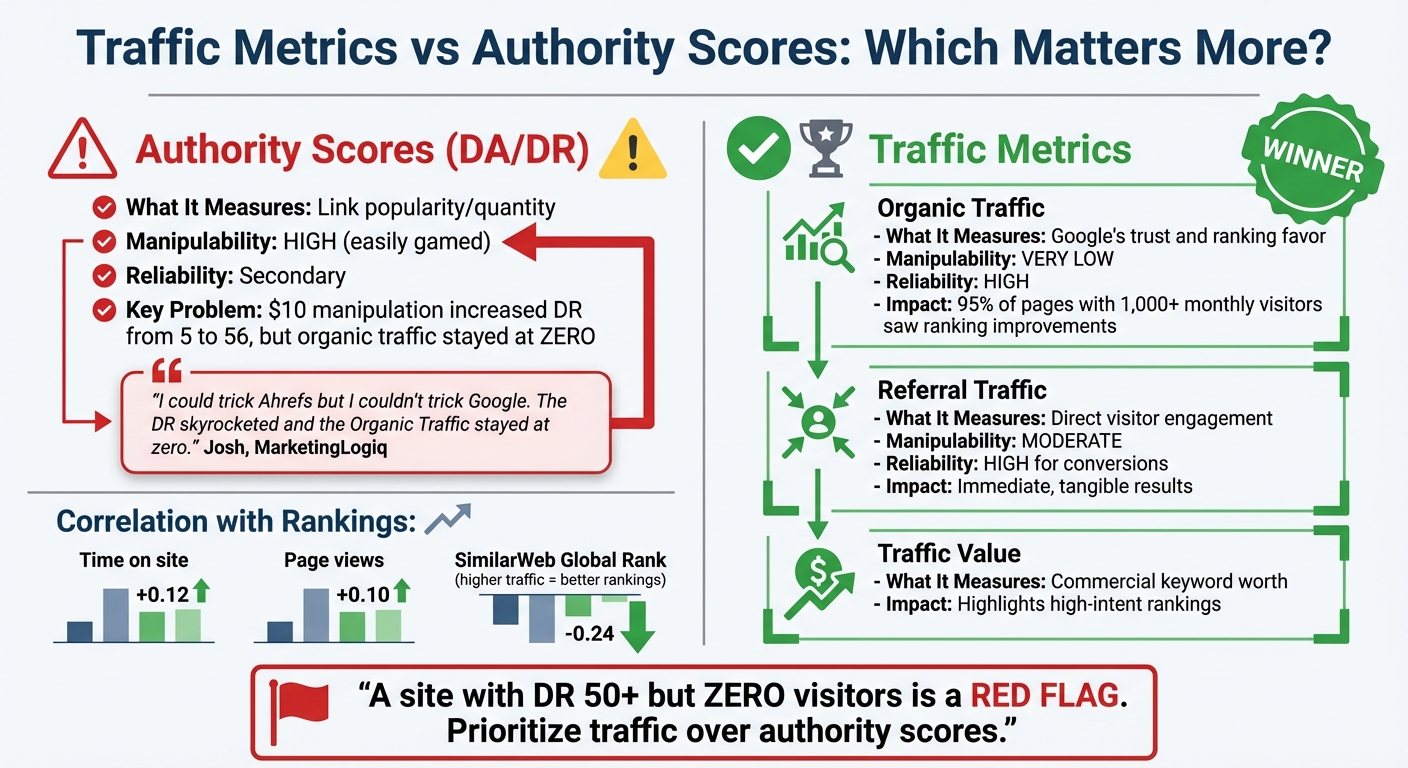
When building links, set a benchmark for organic traffic. For example, guest posting on sites with at least 1,000 organic visitors per month led to ranking improvements for 95% of the pages tested. On the flip side, a site with high authority scores but no traffic is a red flag.
“We’ve seen ‘high traffic’ mean nothing if it’s the wrong traffic. A smaller site with the right audience often sends better leads than a bigger site with random visitors.” Becky Halls, Strategist at 3Way Social
Now, let’s look at referral traffic and its direct impact.
Referral Traffic Measures Direct Link Impact
Referral traffic tracks visitors who click on a backlink and land on your site. This metric highlights links that deliver immediate, tangible results. A link placed on a page that real people visit carries far more weight than one buried on a page no one sees.
The visitors who arrive through referral links are often more engaged because they come from niche-specific platforms, where they already have an interest in your content or industry. Tools like UTM parameters can help you track which links bring the most engaged traffic and even drive conversions. Once you identify successful placements, you can focus your outreach on similar websites.
“In our experience, traffic trends matter more than traffic screenshots. A site that’s steadily growing is usually a safer long-term bet than one that’s clearly sliding.” Ian Naylor, Founder at 3Way Social
Traffic Value Indicates Commercial Worth
Traffic value goes one step further by showing the commercial potential of a site’s traffic. A high traffic value suggests the site ranks for competitive, high-intent keywords. This makes backlinks from such sites more impactful compared to those from sites ranking for less relevant or low-value terms.
| Metric | What It Shows | Why It Matters |
|---|---|---|
| Organic Traffic | Google’s trust | Confirms link value |
| Referral Traffic | Direct visitor impact | Shows immediate engagement |
| Traffic Value | Commercial keyword worth | Highlights high-intent rankings |
Always pair traffic metrics with authority scores for a full picture. A site might boast a Domain Rating of 50+ but have no actual visitors. That’s a clear warning sign. By analyzing traffic metrics, you can make smarter decisions about which link opportunities are worth your time and effort.
Why Traffic Metrics Beat Authority Scores
Traffic Metrics vs Authority Scores for Link Building
Authority scores like DA (Domain Authority) and DR (Domain Rating) can be manipulated with ease. For instance, a recent experiment demonstrated that spending just $10 on low-quality backlinks caused a site’s Ahrefs DR to jump from under 5 to 56, yet its organic traffic remained at zero.
“I could trick Ahrefs but I couldn’t trick Google. The DR skyrocketed and the Organic Traffic stayed at zero.” – Josh, Digital Marketer, MarketingLogiq
These scores primarily measure link popularity, not quality. They are third-party estimates and don’t necessarily align with Google’s perception of a site. On the other hand, organic traffic is far harder to fake – it requires a site to rank for real keywords and earn Google’s trust. This distinction underscores why traffic metrics are far more reliable.
High-Traffic Pages Signal Trust and Credibility
Sites with organic traffic demonstrate that Google already trusts them. Authority Builders Co. tested this by requiring all link placements to come from sites with at least 1,000 monthly visitors. The results were compelling – 95% of pages receiving these links saw measurable ranking improvements.
Beyond trust, high-traffic pages offer social proof. They show real user engagement, which signals credibility to both search engines and visitors. Links from these active, trusted pages carry more weight than links from inactive pages with artificially inflated authority scores. In essence, these pages don’t just validate trust – they turn it into measurable outcomes.
“We’ve noticed the best links do two jobs: they support authority signals and they send real referral visits. If a link never sends even a trickle of clicks, it’s worth questioning.” Becky Halls, Strategist at 3Way Social
Direct Referrals Drive Tangible Results
While organic traffic validates trust, referral clicks provide direct, measurable engagement. Authority scores can’t predict whether a link will drive visitors to your site, but referral traffic can. When a user clicks a backlink and lands on your page, it’s a clear, measurable result. Plus, referral visitors tend to be more engaged since they come from niche-relevant sources.
Unlike static authority scores, referral traffic lets you track conversions, engagement, and ROI from specific links. This makes it a practical metric for gauging link performance.
Traffic Metrics Forecast SEO Success
Traffic metrics don’t just reflect current performance – they also predict future SEO outcomes. A site might see organic growth well before third-party metrics like DA or DR catch up. This makes traffic a leading indicator of SEO success.
Engagement metrics tied to traffic also correlate with higher rankings. For example, studies show a 0.12 correlation between time spent on a site and Google rankings, and a 0.10 correlation between page views and rankings. Additionally, SimilarWeb’s Global Rank, which incorporates both traffic and engagement, shows a -0.24 correlation with search rankings, meaning higher traffic strongly aligns with better positions in search results.
| Metric Type | What It Measures | Manipulability | Reliability |
|---|---|---|---|
| Authority Scores (DA/DR) | Link popularity/quantity | High (easily gamed) | Secondary |
| Organic Traffic | Google’s trust and ranking favor | Very low | High |
| Referral Traffic | Direct visitor engagement | Moderate | High for conversions |
When evaluating link opportunities, prioritize traffic over authority scores. A site with a DR of 50+ but zero visitors is a clear red flag, often indicating toxic backlinks. Instead, focus on sites already rewarded by Google with traffic – these are the links that will actually make a difference. Focusing on these high-quality opportunities is a key part of link diversification for long-term stability.
How to Use Traffic Data in Link Building
Target Sites with Strong Traffic
When identifying sites for link-building opportunities, set a clear minimum threshold – 1,000 monthly organic visitors is a good starting point. But traffic alone isn’t enough. Make sure the site’s keywords align with your niche to ensure the traffic is relevant to your goals.
To streamline this process, tools like Ahrefs’ Batch Analysis feature can be incredibly useful. You can analyze up to 200 URLs at once: upload your list, run the analysis, and filter out sites that don’t meet your traffic criteria.
Once you have a shortlist, manually review the referring pages to confirm they genuinely engage real users. After that, focus on securing fair link exchanges to maximize results.
Use 3Way.Social for Equitable Link Exchanges
3Way.Social simplifies link exchanges by leveraging AI to match you with domains that have authentic organic traffic. This ensures you’re connecting with prospects that meet your traffic requirements.
The platform stands out by facilitating ABC link exchanges – a method where Site A links to Site B, Site B links to Site C, and Site C links back to Site A. This approach creates a natural backlink profile, which search engines tend to favor over traditional reciprocal linking.
Additionally, 3Way.Social incorporates best practices for anchor text diversification. It suggests using a mix of 50–60% brand or URL anchors, 20–30% generic terms, and only 10–15% exact-match keywords. This balance helps prevent over-optimization and keeps your backlink strategy aligned with search engine guidelines.
Track Traffic Metrics Before and After Link Placement
Once you secure backlink placements, tracking their performance is crucial. Start by logging key details in a spreadsheet – include the publish date, URL, target page, anchor text, and follow status. Before the link goes live, record baseline metrics such as keyword rankings, organic traffic, and referral data.
After the link is placed, monitor its impact. Use Google Analytics 4 under the “Traffic acquisition” section to see which backlinks are driving visitors to your site. Pay attention to referral traffic (users clicking through the link) and organic traffic growth (improved search visibility for your page).
Keyword rankings should be checked monthly. While small changes might appear within 1–3 months, more substantial improvements typically take 3–6 months.
“Link building is a key lever in any holistic SEO strategy and so the ultimate KPI for links is to drive revenue via organic performance. The story of outreach is: building links improves page-level authority, which improves rankability, drives rankings, organic traffic, and finally, revenue.” – Laura Slingo, Outreach Manager at Sage
To tie your link-building efforts directly to business outcomes, track conversions and revenue generated from referral traffic in your analytics platform. This approach ensures your link-building campaigns are not just about vanity metrics but contribute to measurable business growth.
Analyze Traffic Trends to Improve Link Building
To keep your link-building strategy aligned with long-term SEO growth, it’s essential to regularly analyze traffic trends and adapt your approach accordingly.
Monitor Traffic Increases from Backlinks
Tracking organic traffic after placing backlinks is key. If you notice consistent growth, it’s a good sign that the links are passing valuable equity. Typically, you’ll see measurable results within 1 to 3 months.
For referral traffic, focus on quality over quantity. Metrics like a bounce rate below 40%, multiple pages viewed per session, and longer session durations signal that the traffic is engaging. You can use a “Backlink Performance” exploration in GA4 to compare how different link sources are converting.
Keep an eye on referring domains for any sudden traffic drops, as these could indicate penalties or a loss of authority. Regularly reviewing your referring domains can help you avoid ranking issues. Once you identify which links are performing well, refine your strategy to align with search algorithms as they evolve.
Adapt to Algorithm Changes
As search algorithms in 2025 and beyond continue to emphasize relevance and authority over sheer link volume, it’s crucial to stay informed. Compare traffic fluctuations against known Google updates. Links from sites without real organic traffic are increasingly ignored or devalued by Google, making it even more important to prioritize high-traffic sources.
Maintain a natural pace of link acquisition by using rolling 30-day averages. Sudden traffic spikes can raise red flags with spam filters, but steady growth suggests a more sustainable approach. Monthly backlink comparison reports can help you spot valuable links that may have disappeared due to site changes or updates. Reach out to reclaim these links when necessary.
Scale Successful Link Opportunities
Once you’ve identified trends and understood the effects of algorithm updates, focus on scaling what works. Analyze the performance of top non-homepage or product pages and create similar content assets to replicate success.
Performing a competitor backlink analysis is another effective benchmarking tactic. Monitor their link velocity and traffic trends to determine the right link volume for your niche. This ensures your scaling efforts are both strategic and efficient.
“In the modern SEO landscape, what you can’t measure, you can’t improve. Metrics aren’t just numbers – they’re the language of strategic decision-making.” – Brandon King, BacklinkManagement.io
Use competitive gap analysis to uncover high-authority domains linking to your competitors but not to you. These domains should be at the top of your outreach list.
Conclusion
Traffic metrics have become the most dependable way to measure the success of link-building efforts. Unlike third-party authority scores, which can be manipulated, organic traffic provides concrete evidence that Google trusts a site enough to send real visitors its way. With much of the web’s content lacking organic traffic, prioritizing high-traffic sources is essential to ensure your backlinks have a meaningful impact.
The data shows that websites with verified organic traffic are less likely to be affected by algorithm updates. They also deliver measurable referral traffic, which can lead to tangible business results. This makes traffic data an invaluable tool for refining your link-building approach.
To apply these insights, start by setting a baseline – target potential link partners with at least 1,000 monthly organic visitors. Use traffic data as your primary filter before considering factors like topical relevance or authority scores. Tools like 3Way.Social can streamline this process by using AI to match you with high-traffic, vetted domains. The platform’s quality control ensures your links are placed on pages Google already values, while ABC exchanges help you avoid the pitfalls of direct reciprocal linking.
Track your organic growth after placing links, and evaluate referral traffic quality by analyzing metrics like bounce rates and session durations. Use this data to continuously refine your strategy. Keeping a close eye on traffic metrics is the key to achieving better outcomes in your link-building efforts.
FAQs
What organic traffic level is “enough” for a link target?
Organic traffic is “enough” when it brings in genuine, engaged visitors who find the content relevant. There’s no universal number that defines this. Instead, it’s about looking at traffic in combination with other key metrics like relevance, domain authority, bounce rate, and click-through rate (CTR). Together, these metrics paint a much clearer picture of whether a site is a good fit as a link target.
How can I tell if a site’s traffic is real or inflated?
To figure out whether your traffic is genuine or artificially inflated, start by diving into engagement metrics, referral sources, geographic distribution, and session quality. Tools and audits can help you detect red flags like bot traffic or spam, which often have odd patterns or come from known malicious sources. Watch for signs such as unusually low engagement rates, unexpected traffic spikes, or visits originating from regions that don’t align with your target audience.
How can I track which backlinks drive leads or sales?
To figure out which backlinks are actually helping you generate leads or sales, start by digging into traffic metrics. Pay attention to key indicators like referral traffic, bounce rate, time on page, and click-through rate (CTR). These metrics give you a clear picture of how visitors from specific backlinks are interacting with your site.
Use analytics tools to monitor how users behave and engage when they arrive through these backlinks. This helps you pinpoint which links are worth your attention. Prioritize backlinks coming from high-traffic, relevant websites with strong performance metrics – these are the ones most likely to drive meaningful results.
If this sounds like a lot to manage, AI-powered platforms can make the process easier, helping you identify the most impactful backlinks faster and with greater accuracy.