Last Updated on March 10, 2026 by Becky Halls
Link exchanges still work in 2026, but outdated tactics are now dangerous. Google’s SpamBrain AI flags manipulative practices in real time, penalizing sites within minutes. To stay compliant and boost rankings, focus on quality links that provide real value to users. Here’s what you need to know:
- Backlinks still matter: Sites ranking first on Google have 3.8x more backlinks than others in the top 10.
- Natural link profiles are key: 50–60% branded anchors, only 5% exact-match keywords.
- Avoid risky practices: AI guest post farms, unmarked paid links, and PBNs are actively penalized.
- Google’s new rules: Excessive reciprocal links (over 20%) or unnatural link spikes (10+ links/week) trigger penalties.
- Audit regularly: Backlink audits every six months are now essential to disavow harmful links.
To succeed, prioritize contextual, editorially-placed links embedded in high-quality content. Tools like 3Way.Social simplify ethical ABC exchanges, helping you build a balanced, penalty-free backlink profile. Ethical link building is no longer optional – it’s the only way forward.
Safe link building in 2026 📱
Google’s 2026 Link Exchange Guidelines
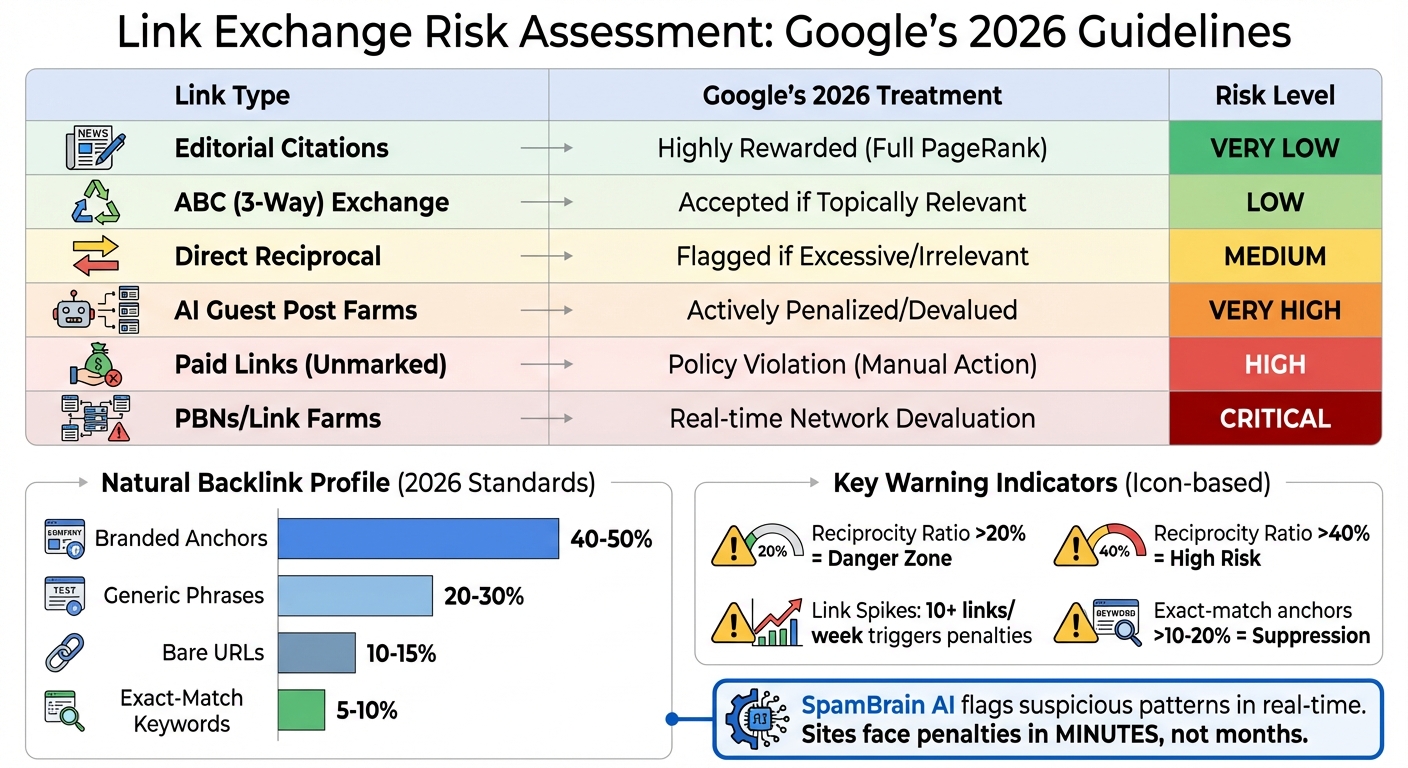
Google’s 2026 Link Exchange Risk Assessment Guide
In 2026, Google has stepped up its game with real-time enforcement of link exchange policies. Thanks to the SpamBrain AI system, link networks are now analyzed continuously, allowing Google to detect and address manipulative practices almost instantly. This means outdated link-building tactics can lead to penalties within minutes, not weeks or months.
Google also places a premium on links embedded in content with clear, first-hand context. On the flip side, links buried in generic, AI-generated summaries are penalized.
“If you’re exchanging links in a way that’s purely for ranking manipulation, that’s something we would consider part of a link scheme.” – John Mueller, Google
One standout change for 2026 is the “BadBackLinks” signal, which actively penalizes sites with spammy backlinks. Unlike past years, where these links were simply ignored, they now act as a negative ranking signal. This shift makes regular backlink audits a must. Experts suggest reviewing your backlink profile at least every six months to disavow harmful links from compromised or spammy sources.
What Changed in 2026
The January 2026 update introduced stricter expectations for backlinks, emphasizing the importance of content with first-hand experience as part of Google’s E-E-A-T framework.
Here’s what defines a natural backlink profile in 2026:
- 40–50% branded anchors
- 20–30% generic phrases
- 10–15% bare URLs
- 5–10% exact-match keywords
Google’s algorithms now flag unnatural link acquisition patterns, such as consistently gaining 20 links per month or more than 10 in a single week. Link placement is also under scrutiny – only links embedded within the main body of an article carry full weight. Links in footers, sidebars, or “link lists” are devalued and may even trigger penalties.
Additionally, expired domain abuse – where old domains are repurposed to boost unrelated websites – has become a red flag. Google’s new signals can detect and penalize these schemes.
Violations That Trigger Penalties
Understanding the updated guidelines can help you steer clear of risky practices that could lead to penalties.
| Link Type | Google’s 2026 Treatment | Risk Level |
|---|---|---|
| Editorial Citations | Highly Rewarded (Full PageRank) | Very Low |
| ABC (3-Way) Exchange | Accepted if Topically Relevant | Low |
| Direct Reciprocal | Flagged if Excessive/Irrelevant | Medium |
| AI Guest Post Farms | Actively Penalized/Devalued | Very High |
| Paid Links (Unmarked) | Policy Violation (Manual Action) | High |
| PBNs/Link Farms | Real-time Network Devaluation | Critical |
Excessive reciprocal linking – where “you link to me, and I link to you” becomes systematic – is a major violation. If more than 20% of your referring domains are reciprocal, you’re in the danger zone. Anything above 40% is considered high risk.
Another risky practice is relying on AI-generated guest post farms, which churn out low-quality, machine-written content to embed backlinks. These are actively penalized. Similarly, unmarked paid links without proper rel="sponsored" or rel="nofollow" attributes can lead to manual actions.
“We’ve seen safe link exchanges come down to one thing: would the link still make sense if SEO didn’t exist? If the answer’s no, it’s probably not worth doing.” Ian Naylor, Founder of 3Way Social
Over-optimization of exact-match keywords is another trap. If these exceed 10–20% of your anchor text profile, expect suppression. Google also devalues sitewide footer or sidebar links, treating them as strong indicators of manipulation.
Private Blog Networks (PBNs) are under intense scrutiny as well. These networks, often built using expired domains, violate core policies. Google’s SpamBrain AI now evaluates entire networks, making it nearly impossible for PBNs to evade detection.
“In 2026, SpamBrain flags suspicious link patterns in real time. Sites using manipulative tactics face algorithmic devaluation in minutes, not months.” – Eric Koellner, SEO Expert
To stay compliant, ensure all link exchanges are topically relevant. Google assesses the “topical cluster” of linking content, giving more weight to links that align contextually with the target page’s niche. Beware of “ghost links” – links from high Domain Rating sites with no organic traffic – as they provide no ranking benefit and may raise red flags.
How to Conduct Ethical Link Exchanges
Here’s a step-by-step guide to conducting ethical link exchanges in 2026 while staying within Google’s guidelines.
Step 1: Find Relevant Partner Sites
The first step in ethical link exchanges is identifying partner sites that are closely related to your niche. Look for websites that operate in the same industry or cover complementary topics. Use tools like Moz or Ahrefs to check their Domain Authority (DA) or Domain Rating (DR), ensuring their score is within 20 points of your own – or at least 30. Beyond metrics, confirm the site has consistent organic traffic and publishes high-quality, original content instead of thin or low-value material.
“In our experience, relevance beats metrics every time. A smaller number of tightly matched exchanges usually outperforms a bigger batch of ‘high DA’ links that don’t fit.” Becky Halls, Strategist at 3Way Social
It’s also important to review a potential partner’s backlink profile for red flags. Sudden spikes, such as gaining over 10 links in a week, or numerous links from unrelated industries can signal manipulative practices. Establish genuine connections by engaging with their content before reaching out. Keep your Reciprocity Ratio – the percentage of reciprocal links compared to total referring domains – between 15% and 20%. Research shows that 73.6% of high-traffic websites use reciprocal links safely, but exceeding 40% reciprocity can put your site at risk.
| Vetting Metric | Target Standard | Tool to Use |
|---|---|---|
| Domain Authority (DA/DR) | Within 20 points of your site (or ≥30) | Ahrefs, Moz, SEMrush |
| Topical Relevance | High (same niche or complementary) | Manual review / 3Way.Social AI |
| Link Placement | Contextual (within the article body) | Manual review |
| Reciprocity Ratio | 15%–20% of total profile | Google Search Console, Ahrefs |
| Traffic | Stable or growing organic traffic | SEMrush, SimilarWeb |
Step 2: Use 3Way.Social for ABC Link Exchanges
ABC link exchanges – where Site A links to Site B, Site B links to Site C, and Site C links back to Site A – are a safer alternative to direct reciprocal linking. This triangular structure looks more natural to Google’s algorithms.
3Way.Social simplifies the process by using AI to match your site with relevant partners based on content, keywords, and authority. The platform ensures all partners meet minimum standards for domain authority, traffic, and content quality. It also secures permanent do-follow links placed within the main content and tracks their status, notifying you if any links are altered to nofollow. With features like secure payment options and advanced link diversification, 3Way.Social helps maintain a balanced and natural link profile while connecting you with verified SEO professionals.
Step 3: Place Links Naturally
Natural link placement is key to staying in line with Google’s 2026 guidelines. Links embedded within the main body of an article carry more weight than those in footers or sidebars. Contextual placement means inserting links where they provide value to readers, such as in blog posts, guides, or case studies.
For instance, if you’re discussing link-building strategies, adding a link to a detailed article on the topic makes sense. Avoid random links to homepages or irrelevant pages. Also, steer clear of sitewide placements, as these can trigger Google’s spam filters. Research indicates that 43.7% of top-ranking pages include reciprocal links, but these are effective only when placed naturally.
Step 4: Vary Anchor Text and Link Building Speed
To avoid over-optimization, use a mix of anchor texts. Combine branded terms (e.g., “3Way.Social”), partial match keywords, and generic phrases like “read more” or “this article.” Rotating anchor text types ensures a balanced profile.
Control your link-building speed to avoid raising red flags. Google’s systems flag sudden increases in backlinks as unnatural. For example, gaining over 10 links in a single week can lead to penalties. A steady pace of 1–3 links per week is seen as natural and sustainable.
| Link Building Speed | Signal to Google | Outcome |
|---|---|---|
| 1–3 links per week | Natural growth | Improved authority |
| 10+ links per week | Manipulation spike | Potential penalty |
Once links are placed, conduct regular audits to ensure compliance.
Step 5: Review and Audit Your Links
Every six months, audit your backlinks to identify and address harmful links. If spammy links exceed acceptable levels, use Google’s Disavow Tool to avoid penalties. Google’s updated systems now actively penalize sites with spammy backlinks instead of simply ignoring them.
Export your referring domains through Google Search Console and look for patterns like keyword-stuffed anchors, sitewide links, or links from unrelated industries. If more than 25%–30% of your outbound links overlap with your inbound links, it’s time to diversify your strategy.
Monitor the status of exchanged links to ensure they remain dofollow and are placed in high-value areas of partner sites. Track referral traffic and engagement metrics – quality link exchanges often result in a 10–25% increase in engaged sessions within six weeks. Keeping detailed records of your link-building activities, including partner details, placement dates, and anchor texts, can help you stay organized and prepared for future audits.
“We’ve noticed the risk builds from repetition, not one exchange. When the same anchors and page types show up again and again, that’s when profiles start looking unnatural.” Becky Halls, Strategist at 3Way Social
sbb-itb-88880ed
Managing Link Exchanges with 3Way.Social
3Way.Social takes ethical link exchange practices to the next level with tools designed to automate and simplify your strategy. By leveraging AI, the platform efficiently handles ABC link exchanges, helping you connect with the right partners and track link placements seamlessly. Below, we’ll dive into how 3Way.Social’s features can streamline and secure your link-building efforts.
3Way.Social Features and Tools
Using AI, 3Way.Social matches your site with relevant, high-quality partners based on factors like content, keywords, and domain authority. This saves you the hassle of manually vetting every potential partner and reduces the likelihood of connecting with low-quality sites. The platform also helps diversify your backlink profile by varying anchor texts and partner sites, keeping your strategy natural and effective.
Another standout feature is real-time link tracking. The platform monitors every link’s status, instantly flagging any changes to ensure compliance with agreed terms. Everything is centralized through a user-friendly dashboard, where you can access key metrics like referral traffic, link placement dates, and partner domain authority scores. For those managing multiple sites or large campaigns, this dashboard provides an organized view of your entire operation.
Additionally, 3Way.Social offers access to guest posting opportunities within its vetted network. This opens up another pathway for building links naturally, complementing your broader SEO strategy.
Choosing the Right 3Way.Social Plan
| Plan Name | Price | Description | Features | Limitations |
|---|---|---|---|---|
| Free Plan | Free | Basic link exchange access | Add domains, find partners, earn/spend credits | Limited to basic features |
| Premium Plan | Custom Pricing | Advanced tools for SEO professionals | All Free Plan features + advanced filters, guest posting, priority support | Pricing varies by usage |
| Enterprise Plan | Custom Pricing | Tailored solutions for large-scale SEO | All Premium features + custom integrations, dedicated account management | Pricing based on enterprise needs |
The Free Plan is ideal for smaller sites or those just starting with ABC link exchanges. It lets you add your domain, discover link partners, and participate in exchanges through a straightforward credit system.
The Premium Plan is perfect for SEO professionals managing multiple projects. It includes advanced filtering options to refine partner searches by domain authority, traffic, or niche. You also gain access to guest posting opportunities and priority support – essential for scaling your efforts.
For larger operations, the Enterprise Plan offers custom integrations with your existing SEO tools, dedicated account management, and fully tailored solutions. This plan is designed for businesses with complex or large-scale SEO needs.
All plans include the core ABC link exchange framework, ensuring your efforts align with Google’s 2026 guidelines. If you’re new to the platform, try the Free Plan to evaluate its partner-matching capabilities. As your strategy grows, you can upgrade to unlock more advanced features tailored to your needs.
Conclusion
Link exchanges continue to be a practical SEO strategy in 2026 when approached with care and integrity. With 73.6% of high-traffic websites successfully using reciprocal links without penalties and 43.7% of top-ranking pages showing some form of link exchange, the numbers speak for themselves. The difference between success and failure lies in focusing on relevance, keeping your reciprocity ratio under 20%, and avoiding patterns that could flag Google’s spam filters. These shifts highlight the importance of smarter, ethical exchanges.
Modern tools like 3Way.Social make this process even easier. The introduction of AI-driven ABC exchanges has streamlined link building, moving away from the risks and inefficiencies of manual swaps. Coordinating three-way exchanges manually can be tedious and error-prone, but platforms like 3Way.Social automate partner matching, ensure natural link placements, and provide real-time tracking – saving time and reducing the risk of penalties.
Ethical link exchanges should always align with your broader SEO strategy. They’re not a standalone solution but a complementary tactic. Pair ABC exchanges with methods like organic outreach, guest posting, and digital PR to create a well-rounded, natural backlink profile. Regularly audit your links using Google Search Console and diversify your anchor text to avoid patterns.
Whether you’re starting with the Free Plan to explore the tool or upgrading to Premium or Enterprise for advanced features, the core principles remain constant: focus on quality over quantity, ensure contextual relevance, and let AI handle the complexities of link management. By sticking to these guidelines and leveraging the right tools, you can build a sustainable, penalty-free link exchange strategy that thrives in 2026.
FAQs
How can I tell if a link exchange is safe in 2026?
Safe link exchanges in 2026 prioritize relevance, authenticity, and steering clear of any manipulative tactics. The key is to exchange links between websites that are genuinely related, use diverse anchor text to keep things natural, and limit the number of exchanges to avoid overdoing it. Tools like 3Way.Social can simplify the process by automating and screening exchanges, ensuring they align with Google’s guidelines. This approach helps minimize risks and boosts SEO through ethical and well-thought-out practices.
What’s the best way to keep reciprocal links under 20%?
To keep reciprocal links under 20%, aim for a natural and balanced link profile by avoiding excessive exchanges. One way to do this is by using strategies like ABC (three-way) link exchanges, which help spread link equity across different sites, reducing the risk of detection. Prioritize building backlinks from high-quality, relevant websites and mix them with organic mentions and partnerships to diversify your link sources.
It’s also essential to regularly monitor your link profile. This ensures that reciprocal links stay below 20% of your total backlinks, helping you stay aligned with SEO best practices.
When should I use Google’s Disavow Tool after an audit?
You should turn to Google’s Disavow Tool when you’ve identified backlinks that could seriously harm your website’s SEO. These include links that are spammy, low-quality, or manipulative in nature. The tool becomes especially critical if Google has flagged your site with a manual action for “unnatural links.” However, it’s important to use the Disavow Tool cautiously and only as a last resort. Always try to remove harmful links manually first, as misusing this tool can actually hurt your SEO efforts.