Last Updated on March 19, 2026 by Becky Halls
When it comes to syncing SEO data across platforms, APIs are the go-to solution. They allow you to integrate keyword rankings, backlinks, and site audits into dashboards and tools like Google Sheets, Looker Studio, or CMS platforms. This means real-time updates, automated workflows, and the ability to monitor competitors without heavy infrastructure. Here’s a quick overview of the 10 best APIs for SEO data synchronization:
- Whalesync API: Bi-directional syncing for platforms like Webflow, Airtable, and Salesforce; ideal for managing large-scale SEO data with real-time updates.
- DataForSEO API: Massive scale with 4.5 trillion backlinks and 75 billion keywords; offers near-instant SERP and backlink data.
- SEMrush API: Provides domain, keyword, and backlink insights; integrates with tools like Tableau and Google Sheets.
- SerpAPI: Real-time SERP results from Google, Bing, and more; strong focus on speed and accuracy.
- Ahrefs API: Advanced backlink, keyword, and site audit data; great for enterprise-level SEO needs.
- Moz API: Simplified integration for Domain Authority, backlinks, and keyword metrics.
- Nimble SEO API: Focuses on fast SERP data retrieval with detailed local SEO metrics.
- Zenserp API: Handles large-scale keyword tracking with geolocated results and robust concurrency.
- Bright Data SEO API: Covers search engines globally with sub-second response times and geo-targeting.
- Whatagraph Integrations API: Push external SEO data directly into reports; combines data from multiple tools for unified views.
Quick Comparison:
| API | Key Features | Real-Time Data | Starting Price |
|---|---|---|---|
| Whalesync | Bi-directional sync, no-code | Yes | Custom |
| DataForSEO | SERP, backlinks, keyword data | Yes | Pay-as-you-go |
| SEMrush | Domain, keyword, backlink insights | Yes | $159/month |
| SerpAPI | Real-time SERP results | Yes | $60/month |
| Ahrefs | Backlinks, keywords, site audits | Yes | Custom |
| Moz | Domain Authority, backlinks | Yes | $20/month |
| Nimble SEO | Fast SERP data, local SEO | Yes | $3/1,000 reqs |
| Zenserp | Geolocated results, concurrency | Yes | $149.99/month |
| Bright Data | Global search, instant results | Yes | $1.50/1,000 reqs |
| Whatagraph | Unified reporting, push model | Yes | Custom |
These APIs cater to different needs, from small-scale projects to enterprise-level data management. Choose based on your integration requirements, data volume, and budget.
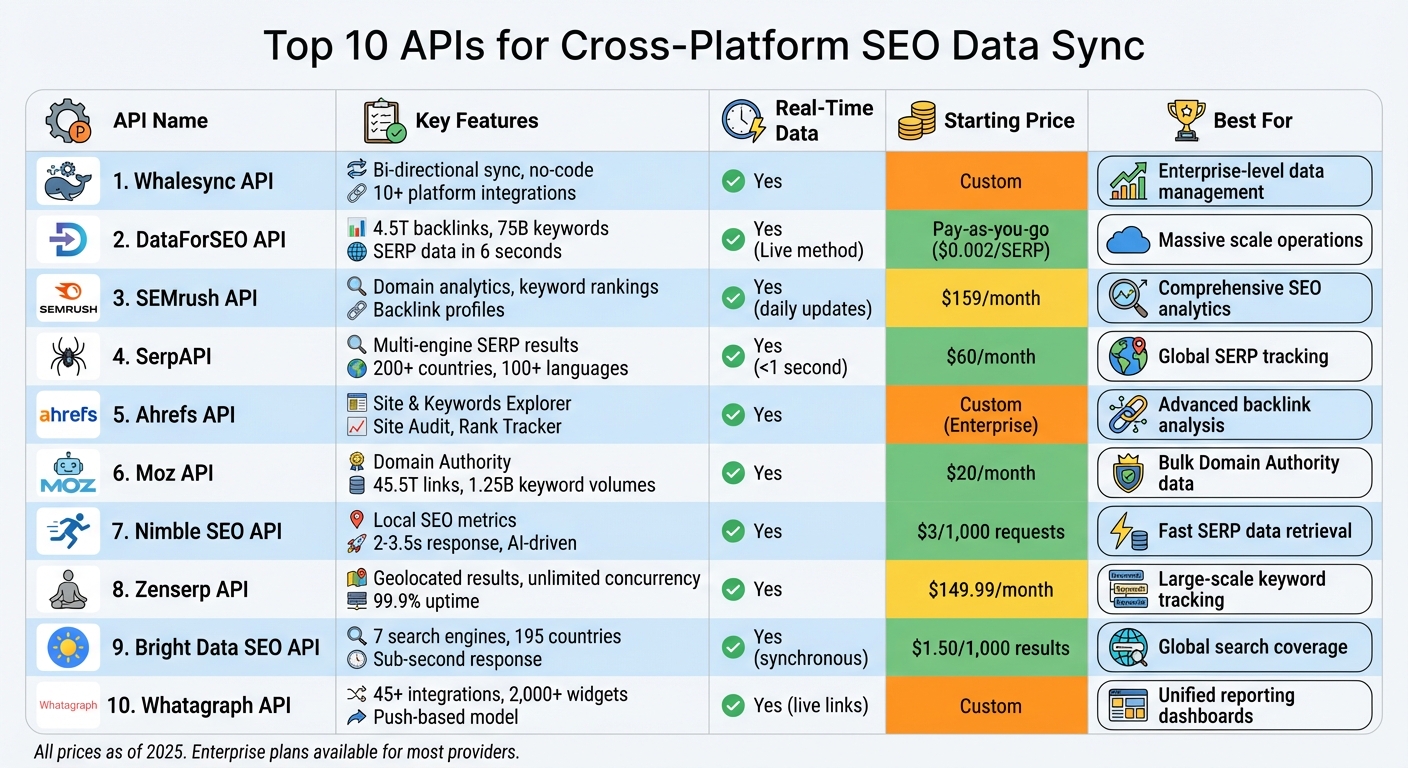
Top 10 SEO Data Sync APIs Comparison: Features, Pricing & Real-Time Capabilities
1. Whalesync API
Real-time Synchronization Capabilities
Whalesync’s bi-directional engine ensures data stays in sync across platforms in real time. Unlike traditional one-way triggers, this system updates, adds, or removes data in both directions. For example, changes made in a source database like Postgres or Google Sheets are instantly reflected in a destination CMS such as Webflow or Wix, and vice versa. It even handles both live and historical data, so you can manage older records while keeping current data up-to-date.
A standout feature is the “Sync Issues” dashboard. It provides real-time status updates and AI-driven suggestions to fix conflicts or API errors. This means teams can tackle synchronization problems as they occur, avoiding delays or overlooked issues.
This real-time syncing capability serves as the foundation for seamless integrations across a variety of platforms.
Integration Compatibility Across Platforms
Whalesync connects with over 10 major platforms, including Webflow, Airtable, Notion, Supabase, HubSpot, and Salesforce. By mapping tables and fields between apps, it simplifies the automation of tasks like managing thousands of SEO landing pages. The “Record Matching” feature ensures no duplicate entries by syncing existing data across tools using a primary key.
For programmatic SEO workflows, Whalesync pairs well with tools like Data Fetcher and OpenAI. Together, they can auto-generate and sync unique SEO descriptions for thousands of pages. With a no-code stack – such as Airtable, Webflow, and Whalesync – you can create thousands of SEO pages for less than $100 per month.
“Whalesync covered all the bases and then some, including things I didn’t know I needed. Like a detailed log that records every change between the synced databases”.
Scalability and Reliability for Enterprise Use
Whalesync is built to handle enterprise-level demands. It’s SOC 2 Type II and GDPR compliant, with encryption at rest monitored by Vanta for added security. Enterprise users benefit from features like dedicated account managers, SSO, and tailored support for critical data integrations.
The “Advanced Filters” feature is particularly useful for large-scale operations. It allows teams to fine-tune data flows and sync only specific subsets of SEO data to the platforms where they’re needed most. This level of precision is essential when dealing with high-volume data management.
sbb-itb-88880ed
2. DataForSEO API
Specific SEO Data Features
DataForSEO handled an impressive 30PB of data and delivered 6PB via API in 2025, showcasing its massive scale in processing SEO data. Its database includes 4.5 trillion backlinks and 75 billion keywords, making it a powerhouse for SEO professionals.
The API offers specialized endpoints for all major SEO data types. For SERP data, it pulls from Google (Organic, Maps, News, Images), Bing, Yahoo, Baidu, and YouTube, tracking features like featured snippets, AI overviews, and local result packs. Keyword research tools provide search volume, CPC, and impressions sourced from Google Ads and Bing Ads, along with trending insights from Google Trends. Its backlink analysis delivers real-time metrics on referring domains, anchor text, and link intersections to help identify competitive gaps. For technical SEO, the on-page analysis evaluates over 100 parameters, including broken links and page speed, in real time.
One success story comes from Twinword, which saw a 35% increase in paid customers after adopting DataForSEO APIs for their keyword research tools. This shift allowed the company to focus on development without worrying about server maintenance or capacity issues.
These features enable fast, real-time operations tailored to modern SEO needs.
Real-time Synchronization Capabilities
The “Live” method stands out for its instant results, delivering SERP, Keyword Data, and Backlinks information in a single POST request – no additional GET calls required. SERP data is returned in just 6 seconds, while backlink data takes only 2 seconds. This method bypasses the slower, queue-based Standard mode, which can take up to 45 minutes.
For bulk tasks, the webhooks feature notifies users automatically when tasks are complete, eliminating the need for constant API polling. The infrastructure is built for reliability, offering 99.99% uptime through adaptive crawling and real-time failover systems.
This speed and reliability make DataForSEO a strong choice for seamless synchronization.
Integration Compatibility Across Platforms
DataForSEO’s real-time data flow integrates easily into both no-code platforms and custom applications. Its RESTful API supports all major programming languages, with official client libraries available for PHP, C#, Java, Python, and TypeScript.
For no-code solutions, the API connects with platforms like Make.com, Zapier, n8n, Airtable, and Google Sheets. It also supports LangChain integration and includes an AI Optimization API for tuning large language model (LLM) prompts and aligning content. The default rate limit allows 2,000 API calls per minute, with options for higher limits tailored to enterprise needs.
“We have been satisfied with the speed, cost, and accuracy… I would recommend to anyone looking for SEO data.” – Kieran Headley, theWebShed
Scalability and Reliability for Enterprise Use
DataForSEO processes over 22 billion backlinks daily, maintaining an index of 2.1 trillion live backlinks across 219 billion live pages. Its pay-as-you-go pricing model is competitively priced at $0.002 per SERP for Live mode and $0.0006 per SERP for Standard mode. Enterprise clients benefit from custom pricing tiers, dedicated account managers, and scalable rate limits.
Important: API v.2 support ends on May 5, 2026. All integrations must transition to API v.3 by this date.
3. SEMrush API
Specific SEO Data Features
The SEMrush API is built around three main endpoints. The Analytics API offers domain overviews, keyword rankings (both organic and paid), backlink profiles, and SERP analysis, all provided in CSV format. The Projects API integrates with SEMrush campaigns, giving access to Site Audit issues and Position Tracking data in JSON format. Meanwhile, the Trends API focuses on market insights, delivering metrics like total visits, traffic sources, bounce rates, and session durations.
For keyword research, the API delivers key data such as search volume, CPC, competition levels, keyword difficulty scores, and search intent classifications (e.g., informational, navigational, commercial, transactional). It also provides backlink insights, including total backlinks, referring domains, referring IPs, TLD distribution, anchor text analysis, and Authority Score metrics. The API can handle up to 100,000 results per request, with a maximum of 4,000,000 lines using the display_offset parameter. For instance, a Python script using the Analytics API can process data for 10 domains in just 1.3 seconds, while the Position Tracking API can export thousands of competitor ranking rows in 6 seconds. Bulk keyword research? It’s possible to analyze up to 50,000 keywords in less than a minute.
These features make SEMrush API a powerful tool for syncing and managing SEO data efficiently.
Real-Time Synchronization Capabilities
The Position Tracking API updates keyword rankings daily. The Trends API provides live website traffic data and AI-driven search visibility metrics, including how often your domain appears in Google’s AI Overviews via columns like FK52 and FP52. Pricing varies by report type: 10 API units per line for standard reports, 50 units per line for historical data, and 40 units per request or line for backlink reports. Outputs are available in both CSV and JSON formats, making the API highly adaptable for use in spreadsheets, BI tools, and custom applications.
“The strongest AI setups I see do not ask the model to ‘do SEO,’ they just use it to summarize, cluster, and prioritize Semrush data so humans can make better calls.” – Joe Fares
Integration Compatibility Across Platforms
The API supports seamless integration with tools like Google Sheets, Looker Studio, Power BI, Salesforce, Tableau, and Microsoft Excel. Additionally, the Listing Management API can automatically sync business location details with store locator tools and storefront systems.
In 2026, the marketplace Flippa incorporated SEMrush Trends API data into their platform, generating $16,662 in additional revenue from traffic report sales. Similarly, Synaptic, an investment platform, used the Trends API to analyze traffic data and performance metrics for over 300,000 businesses, helping investors assess acquisition opportunities.
To optimize costs, use the export_columns parameter to request only the specific data fields you need. For added security, store your API key in “Script Properties” instead of hardcoding it, keeping it hidden from others.
Scalability and Reliability for Enterprise Use
The Trends API allows for up to 10,000 requests per month by default. Accessing the Standard API requires a paid SEMrush Business plan, with API units purchased separately. However, the Map Rank Tracker API is available to all SEMrush users without needing extra units or subscriptions. To conserve units, implement rate limit controls and cache historical data. You can monitor your remaining balance through the “Subscription info” interface or a free API call to avoid running out of units unexpectedly.
DataForSEO Explained | SEO data, APIs, and no-code integrations for automation
4. SerpAPI
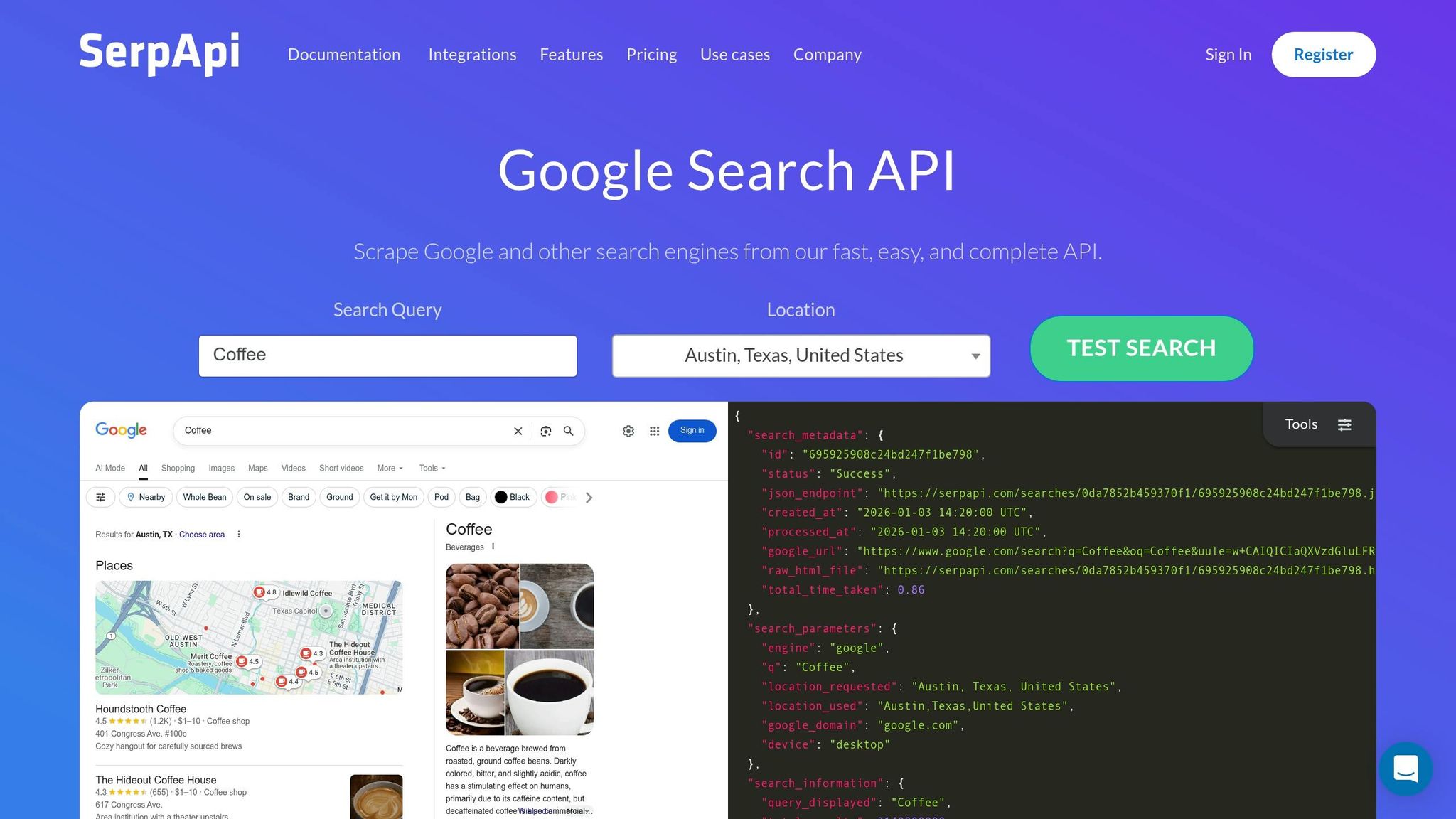
SerpAPI is a powerful tool for syncing SEO data across platforms, offering advanced search result features and an extensive global reach.
Specific SEO Data Features
SerpAPI provides real-time search results from platforms like Google, Bing, Baidu, Yahoo, and Yandex, delivering data in JSON format in less than a second. It identifies complex SERP elements such as knowledge graphs, answer boxes, review stars, and thumbnail images. For keyword tracking, you can use the location parameter to monitor rankings by specific region and device – whether desktop, smartphone, or tablet.
The API also supports specialized searches, including Google Maps, Shopping, News, Images, Finance, and Trends. Dedicated endpoints allow monitoring of AI-generated summaries, adding another layer of visibility to search data. For verification, each request includes a cached HTML version.
| Feature Category | Data Points Provided |
|---|---|
| SERP Metrics | Organic results, Knowledge Graphs, People Also Ask, Pixel Position, Rich Snippets |
| Keyword Data | Search volume, competition metrics, suggestions, long-tail keyword generation |
| Domain Analysis | Backlink data, domain ranking for keywords, Moz domain authority |
| Technical SEO | Page indexation status, on-page audits, WHOIS/DNS stack info |
Real-Time Synchronization Capabilities
SerpAPI boasts an uptime of 99.879% and offers coverage in over 200 countries and more than 100 languages. It supports high-speed modes for large-scale data retrieval and automatically handles CAPTCHAs and proxies to ensure uninterrupted service. The API also integrates seamlessly with LLMs like Claude and OpenAI via Model Context Protocol (MCP), allowing direct SEO data synchronization into AI workflows.
“SerpApi.Org delivers clean, nested JSON that’s incredibly easy to parse in Python. Saved me hours of cleanup work.” – David Thompson
This combination of real-time updates and integration options makes it a versatile addition to any SEO toolkit.
Integration Compatibility Across Platforms
SerpAPI shines in its integration capabilities. It offers official SDKs for over 11 programming languages, including Python, JavaScript, Ruby, Go, PHP, and Java. For non-developers, there’s a Google Sheets extension that simplifies extracting localized search results. Additionally, the beta “Pixel Position” feature provides precise on-screen result placement data, going beyond traditional rank numbers.
Scalability and Reliability for Enterprise Use
SerpAPI is built to scale for enterprise needs. Pricing plans range from a Free Plan offering 500 requests per month to the Super Plan, which supports up to 300 million requests monthly, with costs between $60 and $240. The Enterprise plan comes with features like team management, making it suitable for large organizations managing multiple users. Legal safeguards for scraping activities and ZeroTrace Mode ensure compliance with privacy standards.
Whether you’re a solo SEO professional or part of a large team, SerpAPI combines flexibility, performance, and security to meet diverse needs.
5. Ahrefs API

Ahrefs API v3 takes data syncing and SEO insights to the next level with improved query efficiency and detailed analytics. It provides access to powerful tools like Site Explorer, Keywords Explorer, Site Audit, Rank Tracker, and SERP Overview. The API operates on a unit-based system, starting at 50 units per request, with actual usage depending on the rows and fields retrieved. This makes optimizing your queries a key part of using the API effectively.
Specific SEO Data Features
The Site Explorer endpoint delivers a wealth of data, including Domain Rating (DR), backlink stats (like broken links and referring domains), organic and paid keyword data, and top-performing pages. For keyword research, the Keywords Explorer offers search volume trends, keyword difficulty (KD) scores, country-specific volume breakdowns, and suggestions for related keywords. The API also tracks the top 100 SERP results for any query and monitors keyword rankings through the Rank Tracker endpoint. Technical SEO teams can dive into Site Audit Health Scores and detailed issue reports. Additionally, the Batch Analysis endpoint allows you to analyze metrics for up to 100 targets in a single request, making competitor analysis and link validation much more efficient.
“The Ahrefs API offers many data points no other tool offers. We’ve designed it that way on purpose.” – Despina Gavoyannis, Senior SEO Specialist, Ahrefs
Integration Compatibility Across Platforms
Ahrefs API also shines when it comes to integration. With Ahrefs Connect, an OAuth 2.0-based program, third-party apps can access user data seamlessly. The API works with popular business intelligence tools like Tableau and Power BI and includes native connectors for Google Looker Studio, covering Site Explorer, Rank Tracker, and Site Audit data. For those working with AI tools, the Model Context Protocol (MCP) enables real-time integration with platforms like Claude and ChatGPT, making it easy to pull marketing insights into AI workflows. Developers will find the “API button” particularly handy – it generates cURL commands with pre-applied filters, acting as a dynamic query builder.
Scalability and Reliability for Enterprise Use
Ahrefs API is built for enterprise needs, offering high performance and flexibility. By default, it supports 60 requests per minute, with dynamic throttling to adapt to system load. Enterprise plans allow for additional API units beyond the monthly limit, with pay-as-you-go billing for overages and discounts for prepaid annual add-ons. As of November 1, 2025, API v2 has been fully deprecated, and all integrations now require v3. For development purposes, non-Enterprise plans include free test queries that don’t consume paid units, enabling teams to validate integrations without using up their allocation.
6. Moz API
The Moz API V3 operates on a streamlined JSON-RPC 2.0 architecture, all managed through a single endpoint: https://api.moz.com/jsonrpc. This setup simplifies integration and authentication by using a single API token, which is passed in the x-moz-token header. One particularly handy feature is the Fetch Current Index ID method, which ensures your applications only sync when Moz updates its index with new data.
Specific SEO Data Features
With the Moz API, you gain access to a massive link index – 45.5 trillion links spanning 1 billion domains. It also includes data on 1.25 billion monthly keyword volumes and 25 billion historical SERPs. Key metrics like Domain Authority (DA), Page Authority (PA), and Spam Score are available, alongside the newer Brand Authority™ metric, which evaluates brand strength.
For backlink analysis, the API provides anchor text data, insights into links gained or lost over the past 60 days, and a Link Intersect tool to identify sites linking to competitors but not to your domain. When it comes to keyword data, you’ll find difficulty scores, organic click-through rate (labeled as “Opportunity”), Priority metrics, and AI-driven search intent categorization (covering informational, navigational, commercial, or transactional queries).
“The Moz API is one of the few 3rd party tools I’ve integrated that just works… If your team needs bulk Domain Authority data, then the Moz API is the only option you should consider.”
- Roger Frost, Head of Data Analysis, Intero Digital
Integration Compatibility Across Platforms
The Moz API is designed to integrate effortlessly with custom dashboards, SEO reporting scripts, and SaaS platforms via standard HTTP POST requests. For spreadsheet lovers, there’s “Moz API for Sheets”, and it also connects seamlessly with tools like Screaming Frog. Its JSON-RPC architecture supports request batching, letting you combine multiple calls into a single HTTP request. This makes large-scale data synchronization faster and more efficient.
Scalability and Reliability for Enterprise Use
Moz offers flexible plans tailored to various needs, starting from a free tier with 50 rows per month to Enterprise plans that support up to 40 million rows monthly. The Advanced tier, priced at $20/month, provides around 130,000 rows daily (4 million monthly), making it a practical choice for smaller-scale requirements. Each “row” represents a single response object or report field.
For enterprise users, Moz delivers proven reliability with a strong uptime record and 24/7 online support. Higher-tier plans also include access to Beta methods and bonus quotas that don’t count against the main limits.
“The Moz API is critical to our approach for both our backlink and content audits. We leverage the data to scale our analyses so we can get to the insights our customers need as fast as possible.”
- Mike King, Managing Director and Founder, iPullRank
Thanks to its scalability and robust features, the Moz API stands out as an essential tool for syncing and analyzing SEO data at any scale.
7. Nimble SEO API
The Nimble SEO API delivers up-to-the-minute SERP data with every request, ensuring you have the most accurate and timely insights available. With response times averaging between 2.0 and 3.5 seconds, it uses an AI-driven “Nimble Browser” to navigate anti-bot measures and fingerprinting. This eliminates the need for managing proxies, making it a hassle-free solution for real-time data retrieval.
Key SEO Data Features
Nimble stands out for its ability to extract a wide range of SERP metrics. These include organic result URLs, titles, descriptions, ranking positions, featured snippets, “People Also Ask” questions and answers, and knowledge panel details. It also captures valuable paid search data, such as ad titles, URLs, and positions, along with shopping block information. For those focused on local SEO, Nimble delivers highly detailed local pack data, including business names, ratings, and addresses, all broken down to the city and state level. Data outputs are available in JSON, CSV, and Parquet formats, ensuring compatibility with various tools.
Real-Time Synchronization Options
The API supports batch processing for up to 1,000 URLs per request, making it ideal for large-scale keyword tracking. It can be configured to send structured data straight to Amazon S3 or Google Cloud Storage, simplifying integration with data warehouses or business intelligence tools. These features make it easy to sync data across your existing SEO platforms, improving workflow efficiency.
Scalability and Enterprise-Level Reliability
Nimble is designed to scale effortlessly, handling anything from a handful of requests to millions. Pricing is flexible, starting at $3.00 per 1,000 requests on a pay-as-you-go basis, with monthly plans ranging from $150 to $3,000. The platform adheres to GDPR and CCPA regulations and offers enterprise-grade infrastructure, complete with published SLAs and dedicated support for higher-tier plans.
“Nimble API’s intuitive interface made it easy for us to integrate and pull data from multiple sources without the steep learning curve we faced with other tools”.
- Guy Simhon, Partner
8. Zenserp API
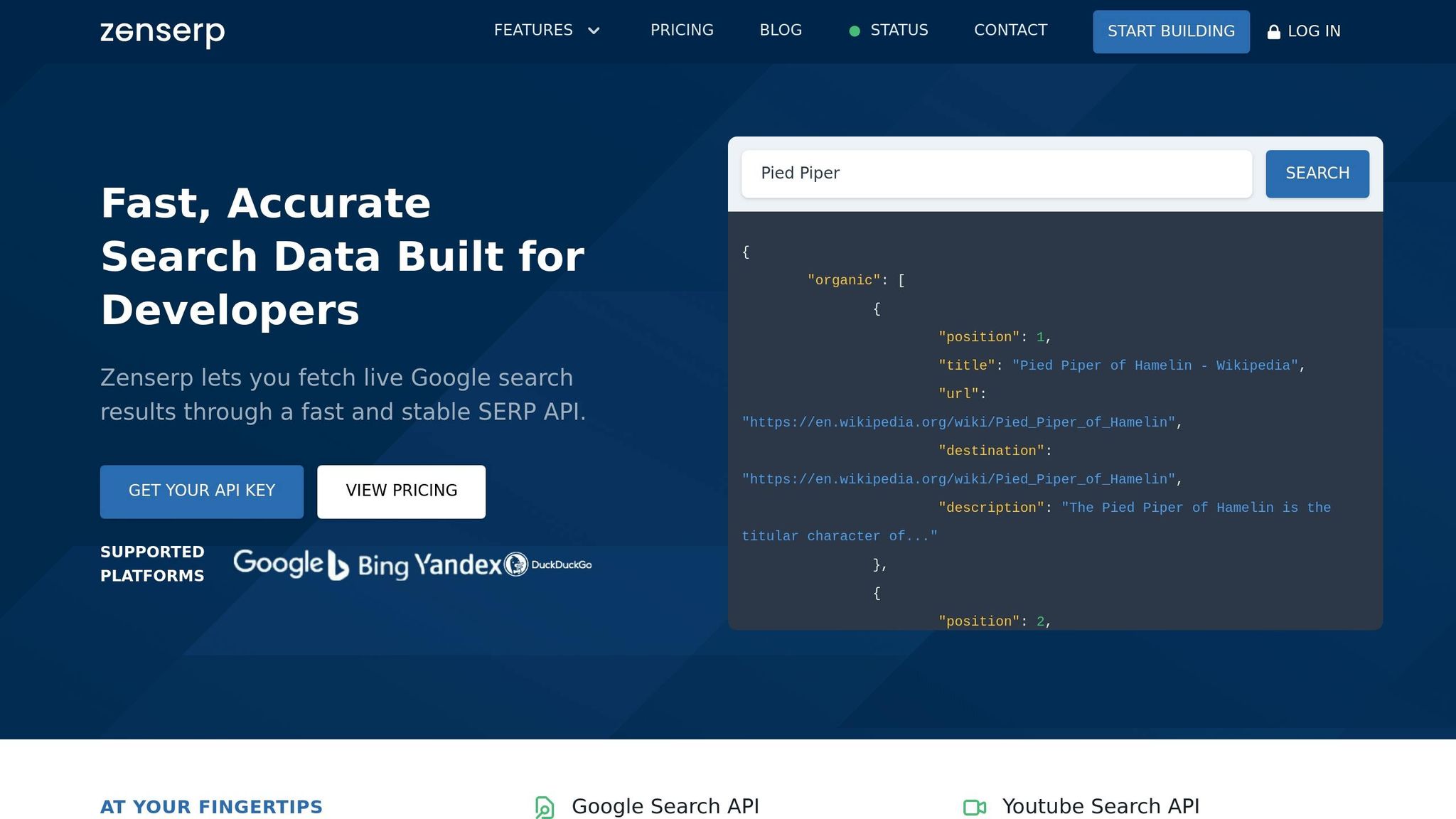
Zenserp offers real-time search results directly scraped from search engines. The API processes millions of requests daily while maintaining an impressive 99.9% uptime over the past year. Even the free plan, which includes 50 monthly requests, supports real-time data retrieval.
Real-Time Synchronization Capabilities
Zenserp features a batch endpoint (v2/batch) designed for handling large datasets efficiently [70, 76]. Paid plans come with unlimited concurrency, enabling as many parallel requests as your application can manage without throttling. Standard plans allow up to 400 concurrent connections [70, 76]. This infrastructure can save up to 80% of the time typically spent on manual search data collection. Such synchronization ensures smooth integration with a wide range of applications.
Integration Compatibility Across Platforms
Built on RESTful API architecture, Zenserp provides outputs in JSON, CSV, or HTML formats, making it adaptable to most modern applications. It also includes a visual Request Builder that generates ready-to-use code snippets in multiple programming languages [70, 76]. For teams transitioning from other tools, Zenserp simplifies the process with a unified /search endpoint and parameter mapping guides.
Specific SEO Data Features
Zenserp goes beyond integration by offering a wealth of SEO data. The API retrieves organic search results, paid ads, local pack listings, featured snippets, Knowledge Graphs, and “People Also Ask” sections – ideal for in-depth SEO analysis. Plans starting at $149.99/month include Keyword Search Volume and CPC data, essential for competitive keyword research. Additionally, the platform supports geolocated results down to city, state, zip code, or even exact coordinates, making it a valuable tool for local SEO tracking [70, 79]. Dedicated endpoints for Google Trends, YouTube Search, Google Shopping, and Google Maps further enhance its functionality.
Scalability and Reliability for Enterprise Use
Zenserp’s pricing ranges from a free tier to an Enterprise plan at $899.99/month for 1,000,000 searches, with a 20% discount available for annual billing. As a fully managed service, it handles proxy rotation, CAPTCHA solving, and browser fingerprinting, eliminating the need for developers to maintain headless browser clusters. Its scalable infrastructure ensures consistent, real-time SEO data synchronization across platforms.
“Zenserp provides up-to-the-minute search results, crucial for applications that depend on the latest information”.
- Christopher Collins, Data/Business Analyst
9. Bright Data SEO API
Bright Data offers search results via a synchronous API endpoint, which delivers data directly in the HTTP response. This eliminates the need for manual downloads or external storage solutions. The system is designed for speed, with sub-second response times, making it ideal for real-time applications like rank trackers or AI-driven tools. For large-scale operations, an asynchronous mode ensures a 99.99% success rate, with responses stored for up to 48 hours.
Real-Time Synchronization Capabilities
The API simplifies technical challenges by automatically managing proxy rotation across its 72 million+ residential IPs, solving CAPTCHAs, and handling browser fingerprinting for uninterrupted data delivery. Synchronous requests are perfect for live applications that need instant results, while asynchronous mode is better suited for batch operations involving over 1,000 queries. The platform guarantees 99.9% uptime and achieves a 99.8% success rate for data retrieval. If a synchronous request exceeds the 1-minute timeout, the system provides a snapshot ID for retrieving the data asynchronously.
Integration Compatibility Across Platforms
Bright Data’s API is built for effortless integration, offering a single endpoint to fetch search results from seven major search engines – Google, Bing, Yandex, DuckDuckGo, and Baidu – covering 195 countries. It provides data in formats like structured JSON, raw HTML, or clean Markdown, with Markdown tailored for seamless use by AI tools like LLMs. Developers can use official SDKs for Python and Node.js, and a “Playground” feature is available for testing. The API is optimized for modern AI frameworks like LangChain and LlamaIndex, ensuring compatibility with enterprise analytics tools and third-party crawlers.
Specific SEO Data Features
The API delivers detailed organic SERP metrics, including page titles, display links, descriptions, snippets, and ranking positions. It also supports rich SERP features like “People Also Ask” sections, Knowledge Graph data, and local map results with business names and reviews. Users can monitor organic and Google Ads keyword rankings, extract title tags and meta descriptions, and gather insights from platforms like YouTube and Facebook. The service enables geo-targeting across 195 countries, down to the city level, and simulates both mobile and desktop browsing environments.
Scalability and Reliability for Enterprise Use
Bright Data’s pricing starts at $1.50 per 1,000 results on a pay-as-you-go basis, with no monthly commitments. Monthly plans range from $499 (Growth) to $1,999 (Premium), while custom Enterprise packages include dedicated account management and premium SLAs. The platform charges only for successful data retrievals, and asynchronous response collection is free. Xiaolong Shi, a Crawler Engineer at Bitget, stated: “Bright Data is trustworthy and compliant, the service is great, the products are flawless and their network is fast and stable”.
10. Whatagraph Integrations API

Wrapping up our review, the Whatagraph Integrations API offers a push-based model that complements the pull-oriented methods discussed earlier.
With its Public API, Whatagraph allows users to push external data directly into the platform, bypassing the need for scheduled pulls. This flexible approach works alongside 45 built-in integrations, including popular SEO tools like Ahrefs, Semrush, SE Ranking, and Google Search Console. Impressively, the platform supports over 58,000 reports monthly for more than 1,000 marketing agencies and brands worldwide.
Real-Time Synchronization Capabilities
Whatagraph’s push-based model supports near real-time insights through various synchronization methods. While most integrations rely on scheduled updates, the platform’s “live links” provide stakeholders with almost instant access to fresh SEO data. Metrics like Semrush backlinks and referring domains even update in real time. For enterprise users managing large datasets, the API integrates with BigQuery, enabling high-speed analytics and automated data flows. It also combines data from multiple tools, such as Ahrefs backlink metrics and Semrush keyword rankings, to create a unified view.
Integration Compatibility Across Platforms
Whatagraph is designed to integrate seamlessly across platforms, ensuring smooth data management. Its native SEO integrations sync automatically, eliminating the need for third-party connectors and maintaining stability as reporting needs grow. The platform also provides over 2,000 pre-made widgets for data visualization, and users can streamline updates across multiple reports using “Linked Reports”.
“I am saving literal hours each week on performance report creation. Our small firm actually managed to onboard 2 new clients as a result of all the time we saved on managing data and reporting.”
- Mindaugas S., Marketing Consultant
Enterprise users can further customize their reports with white-label branding and even host them on their own domains.
Specific SEO Data Features
The API captures critical SEO metrics, including domain rating, backlink counts (dofollow/nofollow), keyword positions, search volume, and site audit errors from major integrations. Reports are divided into “static” formats, showing only the latest data, and “performance” formats, which include historical trends for deeper analysis. The Ahrefs integration alone supports 16 report types, covering everything from organic keyword tracking to impression data. For smooth integration with Semrush, users need a Business Plan with at least 100,000 API units.
Scalability and Reliability for Enterprise Use
To ensure smooth performance in large-scale operations, it’s recommended to organize data sources by client. This prevents delays in fetching data and speeds up widget loading times.
“Having a tool like Whatagraph that can show data from virtually every source we use is hugely important.”
- John S., SEO Strategist
The Custom API requires an Access Token, and the external_id must match the keyword without spaces or special characters. Enterprise users also benefit from BigQuery integration, which facilitates secure long-term storage and faster processing of large datasets. This adaptable, on-demand solution is ideal for modern SEO workflows, ensuring seamless data synchronization across platforms.
API Comparison Table
Here’s a quick rundown of key features for some popular APIs to help you decide which one suits your needs:
| API | Platform Compatibility | Real-Time Data Synchronization | Starting Price | Ease of Use Rating |
|---|---|---|---|---|
| DataForSEO API | PHP, Python, C#, Java, TypeScript, No-code connectors | “Live” method for instant results | Pay-as-you-go | Medium |
| Moz API | JSON-RPC 2.0, Upcoming SDKs | Real-time keyword and SERP metrics | $20/mo | High |
| SE Ranking API | HTTP/REST (cURL compatible) | Real-time data extraction on a usage basis | From $159/mo | Medium |
The Moz API stands out for its simplicity, allowing setup and integration in about 20 minutes. Roger Frost, Head of Data Analysis at Intero Digital, shared his experience:
“The Moz API is one of the few 3rd party tools I’ve integrated that just works… If your team needs bulk Domain Authority data, then the Moz API is the only option you should consider.”
For high-volume workflows, SE Ranking API provides cost-per-record/request guidelines to help manage credit balances effectively. Meanwhile, DataForSEO API offers a “Live” method for instant results, perfect for real-time data needs. Unlike the “Standard” method, which stores results for 30 days, the “Live” method ensures immediate delivery.
For a deeper dive into features and integration tips, check out earlier sections.
Wrapping It Up
After diving into our review of top SEO data sync APIs, it’s clear that picking the right one can transform your workflow. Real-time syncing ensures your data stays up-to-date, which is essential for precise SEO tracking. APIs with “Live” syncing are perfect for instant results, while those offering 30-day storage are better suited for bulk historical data analysis.
Compatibility with your existing tech stack is another big factor. APIs built on modern RESTful architecture easily integrate with popular programming languages like PHP, Python, C#, Java, and TypeScript. Some advanced options even connect directly with Business Intelligence tools like BigQuery, Snowflake, and Looker, making it easier to consolidate SEO metrics with your broader business data.
Features are another area where these APIs stand out. Access to specialized metrics, like Domain Authority or geo-specific SERP data, allows for deeper and more targeted analysis than generic tools can provide. This flexibility ensures you can tailor the API to meet the specific demands of your SEO campaigns, whether they’re local or global.
Budget planning is essential. Calculate your expected usage by multiplying cost-per-record by your domain and keyword volumes, especially if the API uses a credit-based pricing model. Testing the API in a sandbox environment is a smart move to ensure smooth integration and accurate data mapping. And don’t forget to secure your API tokens properly – use environment variables instead of hardcoding them for added security.
Ultimately, the best API for your needs will depend on your technical requirements, budget, and data quality standards. With pricing options ranging from $20/month for basic plans to enterprise solutions offering 99.9% uptime, there’s an API out there for every SEO team. Check out our comparisons above to find the perfect fit for your SEO workflow.
FAQs
Which SEO API is easiest to set up with Google Sheets or Looker Studio?
The API Connector for Google Sheets by Mixed Analytics is a user-friendly option, particularly for those without coding experience. It includes a library of pre-configured APIs, making it simple to integrate tools like Google Sheets or Looker Studio without needing advanced technical skills.
How do I estimate monthly API costs for my keywords and domains?
To get a sense of your monthly API expenses, start by checking the pricing plans of your preferred provider. For instance, SEO Review Tools offers plans starting at $75/month for the Lite plan and $175/month for the Standard plan. If you’re considering a pay-as-you-go model, DataForSEO charges $0.001 per credit for payments ranging from $50 to $1,000. Other platforms, like Morningscore, have pricing that begins at $49/month, while fetchSERP offers custom pricing options. Be sure to review the specific costs tied to the number of keywords or domains you’ll be working with.
Do these SEO APIs support geo-specific and mobile SERP tracking?
Yes, these SEO APIs allow for both geo-specific and mobile SERP tracking. They deliver location-based insights and device-specific results, helping you evaluate SEO performance across various regions and devices. Some examples include GeoRanker, Searlo, Scale SERP, and Nightwatch.