Last Updated on March 24, 2026 by Becky Halls
- AI Citations: Success now depends on being cited by AI tools like ChatGPT, Gemini, and Google AI Overviews. Citations act as trust signals and drive higher-quality traffic.
- Entity Tracking: AI focuses on “entities” (brands, people, concepts), not just keywords. Consistent data across platforms ensures you’re recognized as a reliable source.
- Visibility in AI Responses: Measuring how often your brand appears in AI-generated answers (Share of Voice) is now more important than traditional rankings.
- AI-Driven Traffic: Though AI referrals make up only 1.08% of traffic, they convert 4.4× better than other sources.
- Zero-Click Searches: AI Overviews often satisfy user intent directly, reducing organic click-through rates but boosting brand visibility.
- Sentiment and Accuracy: AI doesn’t just cite your brand – it evaluates how you’re described. Positive sentiment builds trust and authority.
- Post-Click Engagement: AI tracks whether users find your content helpful after clicking. Metrics like dwell time and scroll depth matter.
- Prompt-Level Performance: Optimize for how AI understands and retrieves your content across different user intents.
Key Takeaway:
Success in 2026 SEO isn’t just about rankings – it’s about being trusted, cited, and visible in AI-driven search environments. Focus on metrics AI tracks – like AI citations, entity consistency, and post-click engagement to stay ahead.
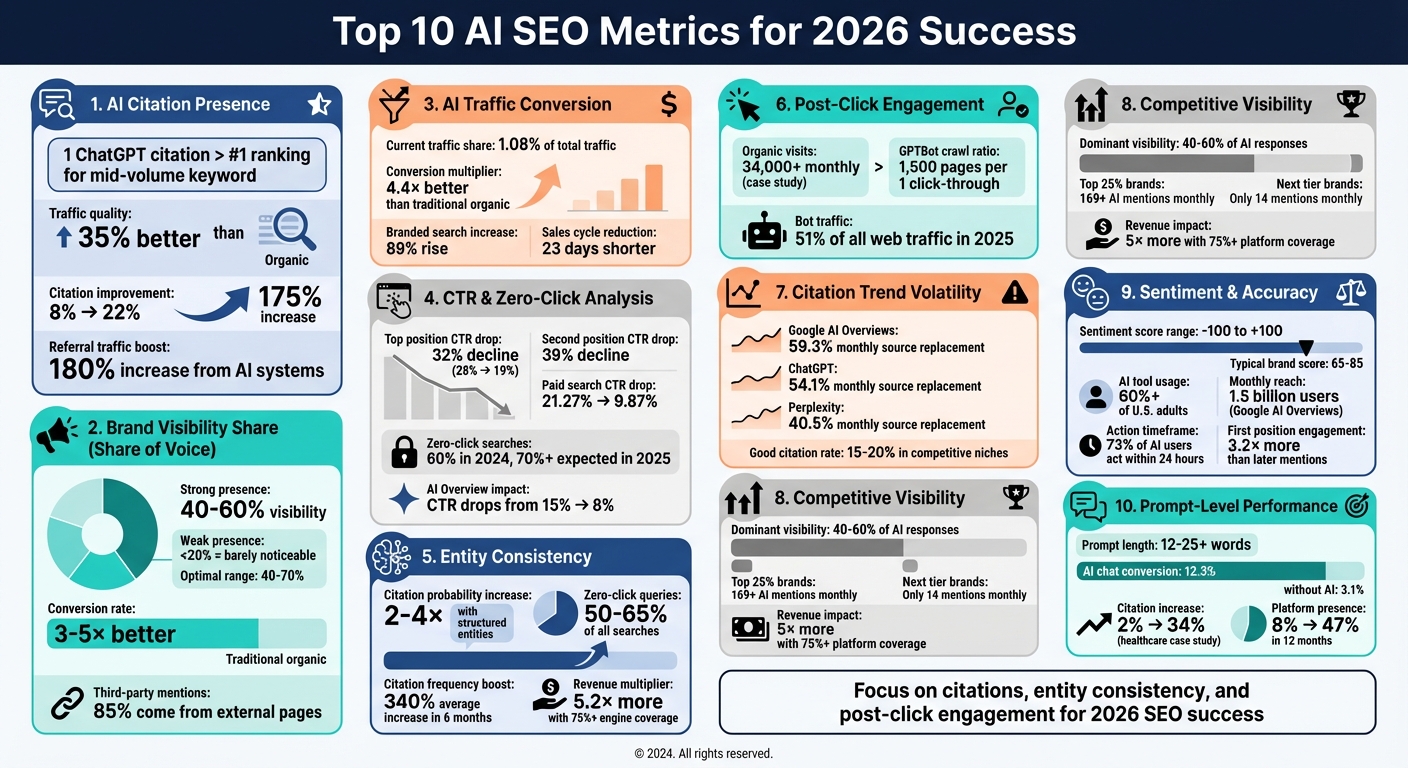
Top 10 AI SEO Metrics to Track in 2026: Key Statistics and Performance Indicators
1. AI Citation Presence and Attribution Frequency
Relevance to AI-Generated SEO Insights
In 2026, AI Citation Share (ACS) has become the new standard for measuring visibility in AI-powered SEO, effectively replacing the old “Page One” benchmark. The key question now is whether AI platforms cite your content. Unlike mentions, which simply reference a brand, citations involve a direct source link or reference. This distinction matters because citations act as trust signals for AI systems.
AI models rely on a process called Retrieval-Augmented Generation (RAG) to evaluate and integrate content. When your content is cited, it means the system trusts your material enough to use it as a factual foundation, reducing the risk of generating inaccurate responses. Citation frequency, which tracks how often your content is referenced across AI platforms like ChatGPT, Claude, Perplexity, and Gemini, has become a critical metric.
These citations don’t just boost visibility – they also improve the quality of traffic and conversions.
Impact on Business Outcomes
A single ChatGPT citation can drive more qualified traffic than ranking #1 for a mid-volume keyword. AI-driven traffic has been shown to convert 35% better than traditional organic traffic. For instance, a B2B SaaS company that implemented an AI citation-focused strategy over six months saw impressive results. By identifying 100 target queries and optimizing their content for citation potential, they increased their citation rate from 8% to 22%, a 175% improvement. This led to a 180% boost in referral traffic from AI systems, with that traffic converting at significantly higher rates.
However, traditional analytics tools often fail to capture this valuable traffic, mislabeling it as “direct” or “dark traffic”. With 50% to 65% of all queries now being resolved without a click-through, in-answer citations have become the most critical visibility channel.
Beyond traffic, frequent citations establish your brand as a trusted authority within AI ecosystems.
Ability to Measure Authority and Visibility in AI Platforms
Kurt Fischman, CEO of Growth Marshal, highlights the importance of citations:
“Citation in LLM-generated answers is not a moral courtesy. Citation is a retrieval signal”.
Frequent citations indicate that AI platforms recognize your brand as a reliable source for specific topics. Structured content – backed by canonical identifiers – has a much higher chance of being cited, outperforming unstructured content by 2 to 4 times.
One example comes from an enterprise mentorship platform that achieved 92% AI visibility in its niche. They used a structured framework to link AI mentions to branded search volume and CRM-tracked demo requests. By being cited, the platform was able to shape buyer decisions and maintain a strong presence within what experts call the “semantic bloodstream” of AI models.
Tracking Accuracy and Consistency Across AI Tools
Visibility on one AI platform doesn’t guarantee visibility on others. To ensure consistency, manually test 20–50 high-intent queries each month across platforms like ChatGPT, Claude, Perplexity, and Gemini. In Google Analytics 4, create custom segments to monitor referrals from AI sources such as chatgpt.com, perplexity.ai, and bing.com/chat.
Pages with clean formatting and Google schema markup are cited 2.8 times more often than poorly organized pages. To improve citation likelihood, use structured H1-H3 headings, clear definitions, and expert quotes that are easy for AI to extract. Additionally, track branded search volume in Google Search Console, as it’s a strong indicator that AI citations are sparking interest.
sbb-itb-88880ed
2. Brand Visibility Share Within Topic Clusters
Relevance to AI-Generated SEO Insights
Measuring your brand’s presence within topic clusters adds a new layer to AI-driven SEO strategies. While citation frequency still matters, Share of Voice (SOV) has become the go-to metric for assessing AI visibility. Instead of focusing solely on keyword rankings, AI tools now calculate visibility by evaluating the percentage of mentions your brand receives within specific topic clusters . Essentially, the goal is to ensure that AI platforms consistently recommend your brand when users ask questions related to your industry.
Topic clusters organize queries into themes like Pricing, Security, or Product Reviews, aligning with how AI models group information based on semantic connections rather than isolated keywords. If your brand dominates a cluster, AI engines perceive it as a trusted authority within that category. While citations help build credibility, owning topic clusters solidifies your position as a market leader. Using prompt packs of 20–50 high-intent queries can help capture the actual search patterns that shape your cluster’s visibility.
Impact on Business Outcomes
If your brand appears in 40–60% of relevant AI responses within a category, it signals a strong presence in your industry. On the flip side, visibility below 20% means your brand is barely noticeable. An AI Share of Voice between 40–70% typically reflects significant influence as a primary source. This visibility doesn’t just boost traffic – it also leads to better conversion rates. Visitors who find your brand through AI discovery convert three to five times more often than those from traditional organic searches. Additionally, higher visibility in AI responses often improves click-through rates across both paid and organic channels.
Interestingly, about 85% of AI-generated brand mentions come from third-party pages like reviews, forums, and news articles, rather than your own website. Moreover, only 20% of brands maintain visibility across five consecutive runs of the same prompt.
Tracking Accuracy and Consistency Across AI Tools
To maintain the advantages of strong AI visibility, consistent tracking across multiple AI tools is critical. Since AI responses are probabilistic, running the same prompt multiple times helps account for variability. Test 15–20 high-impact prompts across platforms like ChatGPT, Perplexity, and Gemini. Group similar queries to ensure consistent association with your brand .
To better track AI-attributed traffic, consider adding a “How did you hear about us?” field to lead forms, allowing customers to select “Recommended by AI” as a source. Traditional attribution methods often misclassify this traffic as “Direct” or “Branded Search” . Use Google Search Console to monitor branded search volume as a secondary metric – improvements in AI visibility often lead to increased branded searches . Regularly audit AI-generated responses in your key clusters to catch outdated pricing, incorrect feature details, or negative framing that could harm enterprise deals . Since most mentions originate from external sources, focus on securing placements in industry roundups and analyst reports frequently cited by AI models .
3. AI Search Traffic Conversion Performance
Relevance to AI-Generated SEO Insights
Understanding AI search traffic conversion is crucial because it reveals how AI-driven visibility translates into tangible business outcomes. While AI referrals only account for 1.08% of overall traffic, they convert 4.4 times better than traditional organic visits. This higher conversion rate can be attributed to the nature of AI-assisted discovery. Users arriving through platforms like ChatGPT, Perplexity, or Google AI Overviews often have a stronger intent and a better understanding of your offerings before they even land on your site.
To accurately track this, you can set up GA4 custom channel groups using regex filters for sources such as (chatgpt|openai|anthropic|deepseek|grok).com, (gemini|bard).google.com, and (perplexity|claude).ai. Additionally, monitoring branded search spikes after periods of frequent AI citations can help uncover indirect influences. For instance, users who see your brand mentioned in an AI summary might later search for it directly, creating a “hidden” conversion pathway.
Impact on Business Outcomes
A case study from early 2026 highlights how impactful AI visibility can be. A B2B SaaS project management company tracked 150 core queries over six months. By increasing its AI citation rate from 11% to 34% and query coverage from 8% to 31%, the company saw an 89% rise in branded search volume and managed to shorten its sales cycle by 23 days. This happened because AI summaries helped educate prospects before they even engaged with sales.
This example also illustrates the “Great Decoupling” phenomenon, where website impressions grow due to AI visibility, but organic click-through rates may drop. Why? Because AI answers often satisfy user intent directly on the search results page.
Tracking Accuracy and Consistency Across AI Tools
To fully capture the benefits of AI-driven traffic, you’ll need to refine your tracking methods. For example, post-conversion surveys can include options like ChatGPT and Perplexity to identify “dark AI” influence – those unseen moments where AI tools guide users to your brand. Behavioral analysis is also key: look for signs of AI-driven visits, such as users landing on deep content pages rather than the homepage, paired with high dwell times and deeper scroll activity. Finally, adopting multi-touch attribution models can help credit AI’s role in the early stages of the customer journey, acknowledging its part in research and discovery rather than just the final conversion click.
4. Click-Through Rate (CTR) and Zero-Click Analysis
Relevance to AI-Generated SEO Insights
CTR tracking has evolved to cover more than just traditional links. It now includes AI Overviews and off-SERP interactions. AI-driven search systems rely on CTR and interaction data as feedback. For instance, if users bypass the AI panel and click on organic results instead, the system interprets this as the AI failing to meet user intent. This creates a new challenge: your content must appeal to both human behavior (to earn clicks) and machine logic (to earn citations).
A new metric, the “CTR-to-Citation Delta”, highlights this balance. If your content gets high citations but low CTR, it may indicate weak titles or poor emotional engagement. On the flip side, high CTR but low citations could mean your content lacks depth, authoritative backlinks, or structured data. Striking the right balance between these metrics is critical for success in AI-driven SEO.
Impact on Business Outcomes
CTR trends have seen significant changes. After the introduction of AI Overviews, Google’s top organic results experienced a 32% drop in CTR, falling from 28% to 19%. The second position saw an even steeper 39% decline in CTR. Paid search CTR also took a hit, dropping from 21.27% to 9.87% in queries featuring AI Overviews. Meanwhile, zero-click searches now make up about 60% of all searches in 2024 and are expected to exceed 70% by 2025.
Brands cited within Google’s AI Overviews enjoy a significant CTR advantage over those that aren’t mentioned. As James Calder, Editor in Chief of The Search Signal, explains:
“In this environment, being retrieved, named, and recalled consistently by AI models can be more valuable than pageviews”.
Ability to Measure Authority and Visibility in AI Platforms
The rise of zero-click searches is directly tied to the drop in CTR. Zero-click analysis helps distinguish whether your CTR drop is due to a ranking penalty or “click compression” – a scenario where rankings stay steady, but CTR drops because AI Overviews fulfill user needs directly on the SERP. Currently, 58.5% of Google searches in the US and 59.7% in the EU end without a click to the open web. When an AI summary appears, CTR for traditional results falls from 15% to 8%.
This shift has led to a “visibility-first” approach, where the focus moves from traffic to brand presence. It’s now essential to measure your “Share of SERP Presence” by multiplying search volume by the number of SERP features where your brand is visible – such as AI Overviews, Knowledge Panels, and “People Also Ask” boxes – rather than only tracking your rank position.
Tracking Accuracy and Consistency Across AI Tools
To adapt to these changes, accurate tracking is key. Start by segmenting your Google Search Console data into “AI-influenced” and “classic” query groups. This allows you to compare performance across different SERP layouts. Additionally, create a 20-query watchlist by manually capturing screenshots of SERPs for your top high-impression queries. This helps identify where AI Overviews are diverting clicks. To maintain visibility, use FAQ, HowTo, and Product schema to secure prominent placements alongside AI modules. These strategies can help you pinpoint how AI affects your visibility and uncover areas for optimization.
5. Entity Consistency and Accuracy Across AI Models
Relevance to AI-Generated SEO Insights
In the world of AI-powered SEO, consistent entity data has become as critical as citation frequency and brand visibility. AI systems don’t just rank web pages; they rank entities. For your brand to stand out, it must exist as a clear, unambiguous entity in an AI’s knowledge network. When models like ChatGPT, Gemini, Claude, or Perplexity encounter your brand, they rely on consistent signals across the web. Discrepancies in pricing, product details, or leadership information create “noise”, reducing your chances of being recognized as a reliable source.
Entity clarity is key. Without it, you risk “entity ambiguity”, where AI models either confuse your brand with another or treat different product names as separate entities. This weakens your authority. AI models use Retrieval-Augmented Generation (RAG) to match user prompts with indexed data. If your brand’s entity data isn’t well-defined in the vector space, the model may default to a competitor with more consistent information. As Irina Shvaya, Founder of eSEOspace, aptly says:
“If you can’t tell a straight story about yourself, the AI is less likely to use you as a source to tell a story to a user”.
Clarity in your entity not only builds AI trust but also leads to stronger business outcomes.
Impact on Business Outcomes
The stakes here are enormous. Structured entities with canonical identifiers can increase citation probability by 2 to 4 times. With zero-click searches now making up 50% to 65% of all queries, being included in AI-synthesized answers has become a primary way to maintain visibility. Brands tracking Generative Engine Optimization (GEO) metrics report an average 340% increase in citation frequency within six months.
Inconsistent entity data doesn’t just reduce visibility – it can hurt your bottom line. AI referral traffic converts at rates 4.4× higher than traditional organic search traffic. When your brand is consistently recognized across AI platforms, you’re more likely to appear in high-intent queries. Brands with 75% or higher engine coverage see 5.2× more AI-attributed revenue than those present on only one platform.
Ability to Measure Authority and Visibility in AI Platforms
To strengthen your position, measuring entity consistency is crucial. Start by using a Factual Accuracy Score, which evaluates how closely AI-generated information aligns with your validated data – such as pricing, product features, and leadership details. Another useful metric is Cross-Engine Consistency, which assesses how uniformly your brand is represented across platforms like ChatGPT, Gemini, Claude, and Perplexity.
You should also monitor Update Latency – the time it takes for AI systems to reflect updates made to your public-facing data. For instance, if you introduce a new product feature or adjust pricing, knowing when AI models will accurately reflect these changes is vital. Brands that frequently appear in conversations across platforms like Reddit, social media, and news sites are more likely to be referenced by AI models.
Tracking Accuracy and Consistency Across AI Tools
To maintain consistency, create a “ground truth” glossary that defines your company name, product descriptions, and key personnel. This ensures uniform messaging across all digital platforms. Use Organization, Product, and Person schema markup (JSON-LD) and secure Wikidata QIDs to explicitly define entities for AI systems.
Regularly audit third-party directory listings and press releases to ensure your brand isn’t being misrepresented or confused with unrelated entities. Periodically sample responses from various generative engines and SEO AI tools and evaluate them for factual accuracy and alignment with your brand narrative. This cross-engine analysis helps identify areas where your entity representation is strong and where improvements are needed. These steps ensure your brand is accurately represented, reinforcing the visibility and authority metrics discussed earlier.
6. Post-Click Engagement Signals from AI-Sourced Visitors
Why Post-Click Behavior Matters
When users arrive at your site through AI referrals, their behavior after the click tells a big part of the story. AI systems, unlike traditional search engines, focus on outcomes. As Dan Taylor, an Enterprise SEO Consultant, puts it:
“AI systems do not operate on proxies. They operate on outcomes. When AI models assess content quality, they are not evaluating how often a page is visited. They are determining whether the content resolves the task that prompted the search.”
Platforms like ChatGPT, Perplexity, and Google’s AI Overviews analyze metrics such as Average Engagement Time, Scroll Depth, and Pages per Session to decide if your content delivered on the promise of the AI summary . If visitors leave quickly or continue searching for answers, it signals to the AI that your content might not be meeting expectations. On the other hand, when users engage deeply, it reinforces your site as a reliable resource, which can lead to tangible business growth.
Business Impact of Engaged AI Traffic
AI-driven traffic often outperforms traditional organic search in terms of quality. A great example comes from Fluentica, a marketing agency, which collaborated with ABA Matrix – a practice management software provider – to transition from compliance-heavy articles to practical “how-to” guides. This shift helped ABA Matrix grow to over 34,000 monthly organic visits and attract leads from across the U.S., enabling them to expand beyond their Florida base. This case highlights how focusing on post-click engagement can directly influence revenue and market reach.
Measuring Authority and Visibility in AI Ecosystems
Tracking post-click engagement is an essential step in understanding how AI platforms view your content. Metrics like Engaged Sessions in GA4 provide clear proof that your site is being referenced for the right reasons. Additionally, monitoring Branded Search Lift – the increase in users searching for your brand after encountering it in AI-generated responses – can reveal how effectively you’re building authority .
To isolate AI-driven traffic in GA4, you can use custom regex filters (e.g., chatgpt|openai|perplexity|gemini) to create a dedicated “AI Traffic” channel. Tools like Microsoft Clarity can also help identify friction points, such as “rage clicks” or “dead clicks”, which may indicate areas where your content isn’t aligning with user needs. Addressing these issues can improve AI’s perception of your site’s authority.
Ensuring Consistency Across AI Platforms
Maintaining consistent engagement metrics across platforms like ChatGPT, Gemini, and Perplexity is key. One way to track this is by monitoring the AI-Influenced Conversion Rate, which measures conversions that occur after users interact with your AI-surfaced content – even if the conversion happens in a later session. Using Assisted Conversions in GA4 allows you to attribute value to content that played a role in influencing users before they converted through another channel .
To dig even deeper, consider adding post-conversion surveys that include an option for users to identify AI as their referral source. This can uncover insights that traditional analytics might miss . And with automated bot traffic making up 51% of all web traffic in 2025, it’s important to filter out non-human interactions to ensure you’re accurately measuring engagement from high-intent, AI-sourced audiences. This refined approach ensures that your data reflects the true value of AI-driven traffic.
7. Citation Trend Analysis and Volatility Monitoring
Relevance to AI-Generated SEO Insights
AI citations operate in a way that’s quite distinct from traditional search rankings. As Krishna Kaanth explains:
“Citations in AI search do not work [like traditional SEO]. They are probabilistic, volatile, and driven by dynamic algorithms.”
Here’s a striking example: Google AI Overviews replace 59.3% of cited sources monthly, while ChatGPT replaces 54.1%, and Perplexity replaces 40.5%. This means that a source cited today might disappear tomorrow, even if the content remains unchanged. Why? AI models rely on “temperature” settings, which introduce randomness into their outputs. This makes citations less about fixed rankings and more about probabilities, creating a dynamic environment that directly impacts visibility and conversions.
Impact on Business Outcomes
Despite this unpredictability, the rewards can be massive. Visitors from large language models (LLMs) convert at a rate 4.4 times higher than those from traditional organic search. Plus, 73% of AI users act on recommendations within 24 hours. However, the challenge lies in the fact that 50% to 65% of searches now end without a click. As a result, tracking citation frequency becomes more critical than monitoring traffic volume.
To help businesses navigate this, tools like Bing Webmaster Tools now offer an AI Performance report. This feature provides timeline charts that highlight spikes, drops, or steady trends in citation activity. Another key metric is “Time-to-Inclusion”, which measures how quickly new content gets picked up by AI systems. This helps gauge whether updates are being recognized promptly. To make sense of these trends, adopting structured measurement frameworks is essential.
Ability to Measure Authority and Visibility in AI Platforms
Measuring citation trends in AI platforms requires a fresh approach. A useful method is the 7/14/30-day framework, which breaks down monitoring into three timeframes: 7 days for spotting sudden changes, 14 days for capturing indexing cycles, and 30 days for evaluating stability. Single-query snapshots are unreliable, so aim for at least 30 sampling runs per query across platforms to gather meaningful data.
To calculate citation frequency, use this formula:
(AI answers citing your URL ÷ total AI answers sampled) × 100.
In competitive niches, a 15-20% citation rate is often seen as a good benchmark.
Tracking Accuracy and Consistency Across AI Tools
Different types of queries require tailored monitoring. Informational queries tend to show the most volatility, while navigational (brand-specific) queries are crucial for managing reputation and often need daily – or even intra-day – tracking. Alerts can be set up to flag issues, such as when the “Jaccard Overlap” (a measure of citation consistency) dips below 0.35 or when the “Drift Rate” (week-over-week changes) exceeds 40%.
For automation, tools like Trackerly.ai (starting at $27/month), Otterly.AI ($49/month), and Keyword.com ($55/month) are available. These tools run “prompt packs” of 20-50 high-intent queries across platforms such as ChatGPT, Claude, Perplexity, and Gemini, making it easier to stay on top of citation trends.
8. Competitive Visibility Positioning in AI Answers
Relevance to AI-Generated SEO Insights
Competitive positioning in AI-driven SEO goes beyond traditional ranking strategies. While earlier SEO efforts focused on surpassing competitors in search rankings, AI search introduces a new layer: share of citations and mentions. Metrics like Share of Voice (SoV) and Citation Share help measure how often your brand is mentioned or cited compared to competitors. SoV reflects the percentage of brand mentions across specific prompts, while Citation Share reveals how frequently AI models source your domain instead of your competitors’. Essentially, these metrics indicate how much trust AI platforms place in your site.
It’s worth noting that brands earning both mentions and citations have a significant edge. They’re 40% more likely to reappear in multiple AI-generated responses than brands that only secure citations.
Impact on Business Outcomes
Visibility within AI-generated answers can directly influence your bottom line. Brands that appear in 40–60% of AI responses tend to dominate the conversation and drive revenue. On the other hand, brands with less than 20% visibility risk becoming almost invisible. This is especially crucial because third-party pages often shape your brand narrative, making consistent monitoring of your competitive positioning a must.
AI-driven clicks boast conversion rates 3–5 times higher than traditional clicks. However, the challenge lies in the low click-through rates from AI tools. For instance, GPTBot crawls approximately 1,500 pages for every single visitor clicking through from ChatGPT to an external site. This underscores the importance of being visible within the AI’s answers rather than relying solely on external clicks.
Measuring Authority and Visibility in AI Platforms
To assess your competitive standing, track metrics like Answer Share and sentiment analysis. Answer Share combines two key elements: how often your brand is mentioned (visibility) and how frequently it’s cited as a source (citation rate). This metric provides a snapshot of your dominance in the AI ecosystem. For perspective, the top 25% of brands receive over 169 AI mentions monthly, while the next tier lags far behind with just 14.
To refine your strategy, create prompt packs – collections of 20–50 high-intent prompts tailored to areas like product comparisons, pricing, or tutorials. These clusters help identify where competitors outperform your brand. Monitoring branded search volume in tools like Google Search Console can also serve as an early indicator of visibility shifts.
Tracking Accuracy and Consistency Across AI Tools
Given that AI platforms pull from diverse datasets, maintaining accuracy and consistency across different tools is essential. Monthly audits of top queries can help ensure AI isn’t relying on outdated information, such as old pricing, discontinued features, or incorrect comparisons. Additionally, look for “Missing Topics” where competitors gain visibility but your brand does not. Identifying opportunities to be cited – especially when AI references sites that mention competitors but not your brand – can help close these gaps.
Sentiment analysis is another critical component. It helps determine whether AI positions your brand as a market leader or simply an alternative to competitors. Pieter Verschueren, Co-founder of Rankshift AI, captures this shift succinctly:
“Visibility is a proxy for brand recognition in the answer era”.
Brands that maintain 75% or greater coverage across multiple AI platforms see over five times more AI-attributed revenue compared to brands visible on just one platform.
9. Brand Mention Accuracy and Sentiment in AI Responses
Relevance to AI-Generated SEO Insights
AI models don’t just track how often your brand is mentioned – they analyze how it’s described. Tools like Peec.ai and Evertune use natural language processing (NLP) to assign sentiment scores ranging from -100 to +100, categorizing mentions as positive, neutral, or negative based on descriptors like “trusted” or “innovative”. Most brands typically score between 65 and 85 on this scale. However, there’s a catch: AI pulls information from across the web, which means outdated forum threads, biased competitor reviews, or even fake review sites can negatively influence your brand’s reputation in AI-generated responses.
Advanced platforms go a step further by distinguishing explicit brand mentions from implicit ones and calculating an Association Score. This score links your brand to specific attributes, reflecting how AI evaluates brands as entities rather than just keywords. This sentiment analysis adds a layer of depth to the citation and visibility metrics discussed earlier, offering a qualitative perspective on how your brand is perceived.
Impact on Business Outcomes
Visibility alone doesn’t drive conversions – trust is essential. As Saood Zafar from ClickRank.ai explains:
“Visibility without trust does not convert. AI SEO Metrics should measure not just presence, but perception.”
With more than 60% of U.S. adults now using AI tools for information searches and Google AI Overviews reaching over 1.5 billion users monthly, inaccurate or negative sentiment can harm your brand on a massive scale. For instance, if AI confidently presents incorrect pricing, discontinued features, or misleading comparisons, these errors – often referred to as hallucinations – can erode trust. Combining sentiment scores with AI citation data provides a more comprehensive view of your brand’s authority and perception.
Ability to Measure Authority and Visibility in AI Platforms
Where your brand is mentioned matters just as much as how often it’s mentioned. Evertune calculates AI Brand Scores using position-based weights: first position (100%), second (90%), and third (81%). Mentions in the first paragraph generate 3.2× more engagement than those appearing later in the text. This position-weighted visibility offers a clearer picture than simply counting mentions.
To measure effectively, it’s crucial to capture the exact text of AI responses – not just the number of mentions. This helps identify inaccuracies, as Josh Gallant, Founder of Backstage SEO, emphasizes:
“If your brand is being positioned poorly or inaccurately because of third-party content that’s either wrong or just outdated, that’s something worth chasing.”
Tracking Accuracy and Consistency Across AI Tools
In addition to citation volatility, monitoring sentiment consistency across different AI platforms is equally critical. AI-generated outputs can vary significantly, so tracking across tools like ChatGPT, Perplexity, Claude, and Google Gemini is essential since each relies on unique data sets and ranking signals.
Conducting monthly audits of your top queries can help you catch when AI relies on outdated or incorrect information. Group related queries using prompt clustering – for example, comparing “best [category] tool” with “[brand] reviews” – to ensure sentiment remains consistent across different user intents. Additionally, analyzing which competitors are mentioned alongside your brand can reveal insights about your market position. Regular checks for brand misclassification are also important to ensure AI models are categorizing your brand correctly within your industry.
10. Prompt-Level Performance and Intent Matching
Relevance to AI-Generated SEO Insights
AI search engines go beyond simple keyword matching – they aim to understand the intent behind each query. This shift means that instead of focusing solely on keyword rankings, brands now need to measure how well they appear across various ways users might phrase a question. This is where prompt-level performance comes in. AI engines use Retrieval-Augmented Generation (RAG) to break down a single user query into multiple sub-questions, retrieving the most relevant content for each part. Metrics like AI Prompt Coverage help evaluate how many variations of a topic include your brand, showing whether you dominate a topic cluster or only show up for specific queries.
Today’s search prompts are often longer, ranging from 12 to 25+ words. This makes it essential to track intent variations – whether informational, commercial, transactional, or navigational – rather than isolating keywords. By understanding these variations, businesses can unlock measurable revenue opportunities.
Impact on Business Outcomes
Tracking performance at the prompt level can reveal competitive gaps before they start affecting revenue. As Lily Ray, SEO Director at Amsive Digital, explains:
“Your share of voice in AI responses predicts market share movements 3-6 months before they appear in revenue. It’s the earliest indicator of competitive displacement.”
For example, a B2B SaaS company monitored 150 key queries over six months and optimized its content for AI platforms. They increased their citation frequency from 11% to 34%, which boosted brand search volume by 89% and shortened their average sales cycle by 23 days. This highlights how influence in AI-driven tools matters more than just clicks. Shoppers interacting with AI chat tools convert at 12.3%, far higher than the 3.1% conversion rate for those who don’t use these tools. These results underline the importance of optimizing for AI visibility and its direct impact on conversions.
Ability to Measure Authority and Visibility in AI Platforms
To make these insights actionable, it’s critical to track prompt performance across all major AI platforms, such as ChatGPT, Gemini, Claude, Perplexity, and Google AI Overviews. Metrics like Query Coverage Percentage reveal how many of your target prompts generate AI responses mentioning your brand. Additionally, the Topic x Persona Matrix helps assess whether your brand appears in AI responses for specific topics tailored to different buyer personas.
Consider the case of a healthcare content publisher that struggled with low AI visibility because models prioritized .gov sources. By adding structured data and physician bylines, they increased their citation frequency from 2% to 34% and their presence across multiple platforms from 8% to 47% over 12 months. Another key metric to monitor is Update Latency, which tracks how quickly AI systems reflect changes in your content.
Tracking Accuracy and Consistency Across AI Tools
Start by defining a GEO Intent Space, which includes 20–100 high-value intents (such as problem, solution, category, and brand-related queries) as your core tracking set. Group prompts into clusters like “Competitive Positioning” or “Trust & Validation” to ensure consistent, actionable data. Regular audits of these clusters can help identify when AI outputs become inconsistent or outdated.
As Rand Fishkin, Founder of SparkToro, advises:
“Start with five core KPIs tracked consistently for 90 days before adding complexity. Most teams fail by measuring too much, too soon.”
To support accurate prompt-level performance, ensure consistency in product documentation, FAQs, and pricing across the web. Use clear H2/H3 hierarchies and proper markdown formatting to make your content easier for AI systems to interpret.
The Workflow That Solved My AI Search Performance Tracking Problem
Comparison Table
Below is a detailed look at various AI SEO tracking tools, highlighting their core metrics, standout features, and starting costs.
| Metric | Primary Tracking Tools | Key Feature | Starting Price |
|---|---|---|---|
| AI Citation Presence | Scrunch AI, Wellows, ZipTie, Qwairy | Provides citation snapshots and source audits | $250/month |
| Brand Visibility Share | Profound, AthenaHQ, Peec AI, AIclicks | Benchmarks share-of-voice against competitors | $99/month |
| Conversion Performance | Analyze AI, RankZero, Rankability | Integrates with GA4/GSC for revenue tracking | $99/month |
| CTR & Zero-Click Analysis | Analyze AI, WriteSonic GEO | Links AI mentions to referral traffic | $99/month |
| Entity Consistency | Waikay.io, RankScale | Detects hallucinations and ensures entity mapping | $20/month |
| Sentiment & Accuracy | Hall AI, Nimt.ai, Profound | Analyzes tone (positive, negative, neutral) | $99/month |
| Prompt Performance | Analyze AI, AIclicks, Rank Prompt | Tests user questions in real-time | $99/month |
| Trend Analysis | SE Ranking, Wellows, Peec AI | Monitors visibility shifts daily or weekly | $141/month |
For teams seeking an all-in-one solution, Analyze AI offers robust features like real-time query testing and integration with GA4 at $99/month. Agencies managing global brands might find Profound a better fit, as it tracks share-of-voice across 18+ countries, starting at $99/month, with premium options reaching $499+/month for deeper insights. On the other hand, RankScale provides a budget-friendly option at $20/month, ideal for entity analysis and hallucination detection.
Several success stories highlight the effectiveness of these tools. In June 2025, Ramp used Profound to boost AI brand visibility from 3.2% to 22.2% in just a month – a sevenfold increase in share-of-voice. Similarly, Runpod utilized Scrunch AI in July 2025 to achieve fourfold growth in new monthly paying customers, tracking an 8% conversion rate from 28,000 AI-driven visitors.
A key differentiator among these platforms is their ability to attribute revenue directly to AI visibility. Many tools, including Analyze AI and Profound, integrate with GA4 and Google Search Console to connect visibility metrics with measurable business outcomes. As Michael King, CEO of iPullRank, puts it:
“Profound has the strongest reporting, and they are rapidly adding additional features like their conversation explorer and bot tracker that help you understand what’s going on”.
This comparison should help you identify the right tool based on your specific goals and budget.
Conclusion
The metrics AI tracks discussed paint a detailed picture of how your brand performs in an AI-driven search environment. While traditional SEO placed heavy emphasis on rankings and clicks, the landscape in 2026 has evolved. Success now hinges on being recognized as a trusted source rather than merely showing up in a list of blue links. As Aleyda Solis aptly states:
“SEOs must rethink how they measure success – AI overviews change what visibility looks like”.
This shift from focusing solely on rankability to prioritizing retrievability requires tracking both your influence and traffic. Even though AI referral traffic accounts for just 1.08% of total visits, its 4.4× higher conversion rate highlights its strategic importance. The trend of increasing impressions paired with declining clicks reflects fundamental changes in user behavior.
With only 20% of brands maintaining visibility across five consecutive AI answer runs, monitoring these fluctuating metrics becomes crucial for making quick, data-driven adjustments. Brands that optimize for Generative Engine Optimization (GEO) metrics have reported an average 340% boost in citation frequency within six months.
Combining traditional metrics with AI-specific ones – such as citation rate and share of voice – into a single dashboard allows for a complete view of the customer journey. This approach doesn’t just track performance but also simplifies the optimization process. Tools like 3Way.Social help SEO professionals by integrating traditional and AI-focused metrics into one platform, ensuring adaptability in the ever-changing search landscape.
As Saood Zafar from ClickRank reminds us:
“If you only track traffic and rankings, you are missing half the picture”.
To thrive in this new era, focus on building authority through link exchanges, staying visible in zero-click environments, and tracking high-intent conversions. These strategies, combined with the outlined metrics, equip you to measure what truly matters in 2026: influence, authority, and conversion performance across both traditional and AI-enhanced search channels.
FAQs
How do I measure AI citations for my site?
To gauge the impact of AI citations, focus on metrics AI tracks such as citation frequency, AI visibility, and share of voice in AI-generated content. These metrics help you understand how often your content is being referenced, its reliability, and how prominently your brand appears in AI-driven responses.
Leverage analytics tools to track these metrics effectively. Additionally, ensure your content is optimized for AI attribution by refining structured data and making updates as needed. This approach can boost citation accuracy and improve your content’s visibility within AI systems, strengthening your overall SEO efforts.
How can I improve entity consistency across AI tools?
To ensure your brand is consistently recognized across AI tools, it’s essential to track metrics that measure how often and accurately your brand is mentioned in AI-generated content. Two key metrics to focus on are the Entity Visibility Score and the AI Overview Inclusion Rate. These metrics help you understand how frequently your brand is recognized and cited.
Additionally, keeping an eye on embedding relevance, citation analytics, and entity recognition is crucial. Regular monitoring of these factors ensures your brand maintains a strong presence across AI platforms, improving its visibility and credibility in AI-driven outputs.
How do I track AI-driven conversions in GA4?
To monitor conversions driven by AI platforms in GA4, you’ll need to set up a custom exploration report. Using regex patterns, you can identify traffic originating from AI tools like ChatGPT or Perplexity. Since standard GA4 reports don’t automatically differentiate AI traffic, this approach helps you isolate and analyze it effectively. Once you’ve segmented this traffic, you can track conversions within these groups to gain insights into how AI-driven users behave and how successful these platforms are in driving engagement.