Last Updated on March 19, 2026 by Becky Halls
When it comes to outbound links, quality matters. Linking to the wrong sites can harm your credibility and SEO, while linking to authoritative, relevant sources can boost your site’s reputation. Here’s a quick breakdown of the 10 key metrics you need to evaluate outbound link quality:
- Domain Strength: Check Domain Rating (DR), Domain Authority (DA), and organic traffic. Look for sites with strong, relevant backlink profiles and at least 1,000 monthly visitors.
- Page Strength: Evaluate the specific page’s URL Rating (UR) or Page Authority (PA) and ensure it has strong inbound links and organic traffic.
- Domain Authority/Rating: Prioritize domains with a DR/DA above 50, but ensure they’re relevant and show real traffic.
- Page Authority/URL Rating: Focus on high-authority pages with fewer outbound links to maximize link equity.
- Relevance: Ensure the linked site aligns with your niche and content topic to reinforce SEO signals.
- Anchor Text Quality: Use natural, varied anchor text that aligns with the linked content. Avoid over-optimized or spammy keywords.
- Trust Flow/Citation Flow: A Trust Flow (TF) to Citation Flow (CF) ratio of 0.5 or higher indicates a healthy link profile.
- Spam Score: Avoid sites with a spam score above 10% to maintain credibility and avoid penalties.
- Outbound Link Density: Pages with too many outbound links dilute link equity and may signal spammy behavior.
- Dofollow Attribute: Ensure links are “dofollow” when possible to pass SEO value, but only from trusted, relevant sites.
Key Takeaway:
Outbound links should strengthen your content’s credibility and SEO. Prioritize links from trusted, relevant sites with strong metrics, and avoid spammy or irrelevant sources. Regularly audit your outbound links to ensure quality and compliance with best practices.
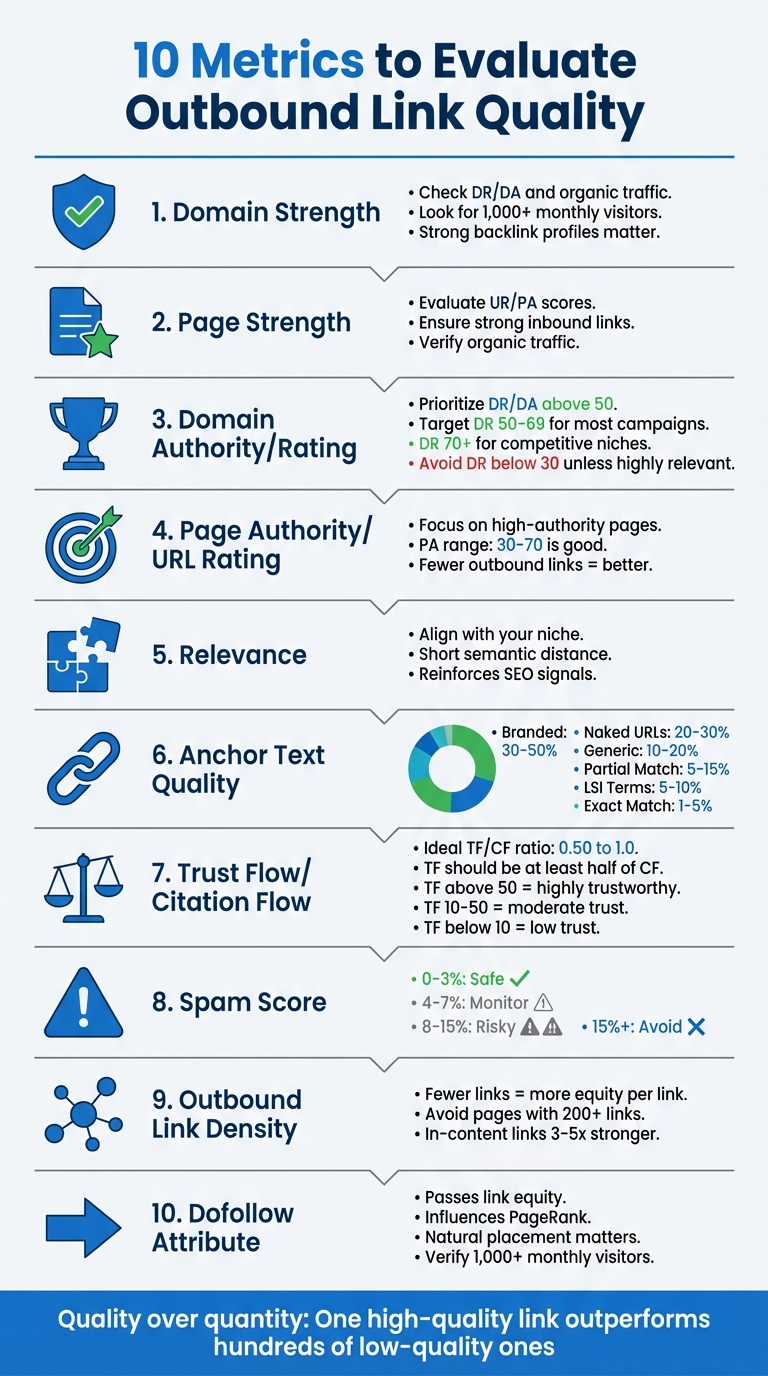
10 Essential Metrics for Evaluating Outbound Link Quality
1. Domain Strength
Authority (Domain/Link Strength)
When you link to another site, you’re essentially endorsing it, and search engines pay attention to the credibility of that endorsement. Metrics like Domain Rating (DR) from Ahrefs, Domain Authority (DA) from Moz, and Authority Score from Semrush are commonly used to measure a domain’s strength. These metrics reflect a domain’s backlink profile and its ability to rank well in search engines.
But numbers alone don’t tell the whole story. For example, a site with a DR of 72 but declining traffic may hold less value than a DR 48 site with 3,500 monthly visitors and growing organic traffic. This is why traffic validation is so important. Strong domains typically attract at least 1,000 organic visitors per month, ensuring they’re not inactive or part of a private blog network (PBN). As alphaserpseoboost explains:
A single highly relevant backlink can outperform five generic high-DR links. Modern tools now use AI to improve link exchange relevance and efficiency.
This highlights the need to evaluate how closely a domain’s content aligns with your niche.
Relevance to Content/Niche
The strength of a domain also depends on how relevant it is to your industry or niche. A backlink from a general news site with a DR of 80 might have moderate value for a SaaS business, but a niche-specific blog with a DR of 45 could provide greater contextual impact. According to Markitors:
The ‘relevance’ of a link determines quality more than any other metric.
When choosing domains to link to, focus on those that are closely connected to your field or cover related topics.
Trust Signals
Authority alone doesn’t guarantee credibility. Trust signals can help confirm whether a domain is reliable. Metrics like Majestic’s Trust Flow (TF) measure link quality, while Citation Flow (CF) looks at link quantity. Ideally, a domain should have a TF/CF ratio of 0.75 or higher, with a Trust Flow score of at least 10. Other indicators of trust include:
- Use of HTTPS
- Consistent and natural ABC link exchanges
- A spam score between 0–3%
As the SEO Backlinks Team puts it:
Trust provides a floor of safety. Authority without trust creates risk.
Additionally, check for transparent ownership, a detailed “About” page, and genuine organic traffic. Tools like the Wayback Machine can help verify that the domain hasn’t been repurposed from an expired site for link-selling.
Link Equity Distribution
The value of a backlink can be diluted if the page linking to you is overloaded with outbound links. To preserve link equity, aim for pages with fewer than 100 outbound links. Also, links placed within the main content of the page – rather than in footers or author bios – are estimated to be three to five times more effective. Thoughtful link placement makes a significant difference in the value passed on.
sbb-itb-88880ed
2. Page Strength
Authority (Domain/Link Strength)
When evaluating links, page strength zeroes in on the specific URL you’re dealing with, rather than the entire domain. Metrics like Ahrefs’ URL Rating (UR) and Moz’s Page Authority (PA) are commonly used to assess the quality and strength of a page’s backlink profile.
Here’s the gist: a strong page, backed by quality inbound links, passes greater link equity. As Andrei Prakharevich from SEO PowerSuite puts it:
“The more valuable a page is the more equity it passes to other pages”.
Before linking to a page, make sure it’s indexed and pulling in organic traffic. These factors are strong indicators of a page’s legitimacy and strength. On the flip side, if a page shows impressive metrics but lacks organic traffic, it could hint at issues like penalties or domain manipulation.
Another important factor? The way link equity is distributed across a page’s outbound links.
Link Equity Distribution
Pages overloaded with outbound links spread link equity thin, reducing the value passed to each link. For better results, aim for pages with fewer, well-placed links. Placement is key here: links embedded within the main content (editorial links) carry more weight than those tucked away in sidebars or footers. To make the most of your ABC link exchange strategy, focus on securing editorial placements within high-quality, original content.
3. Domain Authority or Domain Rating
Authority (Domain/Link Strength)
When evaluating domain strength, two key third-party metrics often come into play: Domain Authority (DA) and Domain Rating (DR). These metrics provide a quick way to gauge the quality of a website’s backlink profile and its potential influence on search rankings.
Domain Authority (DA), developed by Moz, takes into account over 170 factors to estimate a site’s ranking potential. On the other hand, Domain Rating (DR), from Ahrefs, focuses specifically on the strength of a domain’s backlink profile. This evaluation is a critical part of link diversification strategies. Both metrics use a logarithmic scale from 0 to 100, meaning it gets exponentially harder to improve as the score increases.
Websites with high authority – typically those with a DR of 70 or above – tend to pass significantly more link equity compared to lower-scoring sites. As Brittney Fred from Linkflow puts it:
“Domain Rating is the famous Ahrefs metric that shows the strength of a website’s link profile… it isn’t a predictive measure of ranking potential. It’s an objective measure of a domain’s backlink profile.”
While these scores are helpful for filtering potential link opportunities, it’s important to remember that Google does not use DA or DR in its algorithms. These metrics should only serve as a starting point for screening domains.
For most campaigns, aim for domains with a DR between 50 and 69. Reserve DR 70+ domains for highly competitive niches. Domains with a DR below 30 should only be considered if they are highly relevant to your niche and show signs of growing organic traffic.
Always cross-check authority scores with organic traffic data. A high DR paired with zero monthly visitors might indicate manipulation. To avoid this, focus on high-authority sites that attract at least 1,000 monthly organic visitors before pursuing them for backlinks.
4. Page Authority or URL Rating
Authority (Domain/Link Strength)
While Domain Authority evaluates an entire website’s strength, Page Authority (PA) and URL Rating (UR) focus on individual pages. PA, developed by Moz, predicts how well a specific page might rank in search results on a scale from 1 to 100. Similarly, Ahrefs uses URL Rating to measure the strength of a page’s backlink profile.
These metrics operate on a logarithmic scale, meaning it’s easier to improve lower scores than higher ones. Moz’s PA considers over 40 factors, including the quality of links, root domains, and anchor text distribution. As Miriam Ellis of Moz explains:
“Page Authority is a holistic score that is difficult to influence directly. It is made up of an aggregate of metrics that each impact the score.”
A “good” PA score generally ranges between 30 and 70, though this can vary depending on the niche and competition. When building backlinks, prioritize links from pages with higher PA or UR scores. A single strong link often provides more value than multiple weaker ones.
Link Equity Distribution
Page Authority doesn’t just measure ranking potential – it also affects how link equity (or “link juice”) is distributed. Brittney Fred from Linkflow highlights this connection:
“Page Authority measures a specific web page’s potential to rank well in Google search results… which translates directly to the link equity it’ll pass onto your page.”
Even pages with high authority lose value if they contain too many outbound links. Ensure your link is placed in the main content area, as links located there pass significantly more equity than those buried in footers or sidebars. To maximize benefit, aim for links from high-authority pages that feature your link prominently within the primary content, not in less noticeable sections.
5. Relevance to Your Niche
Why Link Relevance Matters
When it comes to SEO, relevance is just as important – if not more so – than raw authority. Google’s algorithm now places a stronger emphasis on the context and intent behind links rather than just focusing on metrics like Domain Rating (DR). For example, a link from a DR 20 SaaS blog to another SaaS company can be more impactful than a link from a DR 60 food blog to that same SaaS site.
Stellar SEO puts it perfectly:
Relevant backlinks are not ‘better links’ because they come from higher metrics. They are better because they reinforce what your site represents in Google’s entity graph and intent clusters.
How to Assess Link Relevance
Relevance boils down to how well the linking site’s topic, industry, and audience align with your own. Think of it this way: a plumbing supplier linking to a plumber creates a “short semantic distance”, which adds value to your SEO. On the other hand, a tech gadget site linking to that same plumber creates a “long distance”, which could make the link less effective – or even devalued.
Here’s a quick way to check a site’s niche relevance:
- Use the search query
site:domain.com [your topic]to see if the site has a history of covering your niche. - Manually review recent posts. If the topics seem scattered or unrelated, the site might be a low-quality link farm.
Elena Rodriguez, a Link Building Consultant, offers a simple litmus test:
If you’d hide it from a boss or client, it’s not quality.
Local Relevance for Businesses
For local businesses, geographic relevance is just as crucial as topical alignment. Links from businesses in your area, even if they’re in slightly different niches, help reinforce local signals to Google. These links strengthen your connection to your region, boosting your local search engine rankings. By balancing geographic and topical relevance, you can ensure your links not only build authority but also support your overall SEO goals.
6. Anchor Text Quality
Relevance to Content/Niche
Search engines don’t just look at anchor text – they also evaluate the context around it. This makes it crucial to choose link text that aligns with the topics of both the linking and target pages. High-quality anchor text ensures relevance across three key areas: the topic, the industry, and the audience. As Stellar SEO explains:
Anchor text determines whether a link reinforces relevance or quietly fades into the background.
Authority (Domain/Link Strength)
Links from high-authority domains (Domain Authority of 70 or higher) carry more ranking power, boosting the impact of anchor text. However, if the linking domain is unrelated to your topic, the value of its anchor signals may be reduced. Page-level authority, often measured by metrics like URL Rating or Page Authority, can provide an even clearer picture because it reflects the specific equity available for transfer. Also, keep in mind that link equity is divided among all links on a page. For instance, a page with over 200 external links will pass much less value per link.
Trust Signals
Trust comes from natural, reader-friendly anchors. Instead of writing anchors solely for search engines, focus on making them flow naturally within the content. A well-rounded anchor profile typically includes:
- 30–50% Branded
- 20–30% Naked URLs
- 10–20% Generic phrases
- 5–15% Partial matches
- 5–10% LSI (Latent Semantic Indexing) terms
- 1–5% Exact matches
Anchors placed within the main content of a page tend to carry more weight. For example, in November 2025, a SaaS company working with OutreachFrog shifted from repetitive exact-match anchors like “project management software” to more varied phrases such as “ways to manage remote projects.” This change led to a 35% traffic increase in just eight weeks.
If your anchor profile looks overly optimized or keyword-stuffed, don’t just delete links. Instead, diversify by adding more branded and generic anchors to create a natural balance. This approach helps ensure better distribution of link equity.
Link Equity Distribution
How link equity flows through your site depends heavily on your anchor text strategy. Repetitive or inconsistent anchors can dilute value. A balanced approach, as outlined below, optimizes equity flow while minimizing risks:
| Anchor Type | Recommended Range | Risk Level |
|---|---|---|
| Branded | 30-50% | Very Low |
| Naked URL | 20-30% | Very Low |
| Generic | 10-20% | Very Low |
| Partial Match | 5-15% | Medium |
| LSI/Related | 5-10% | Low |
| Exact Match | 1-5% | High |
For internal links, you can use more descriptive, keyword-rich anchors to help clarify your site’s structure. On the other hand, external links should prioritize variety and editorial placement to appear natural. When conducting link audits, always review the surrounding text to ensure it provides clear context for search engines.
7. Trust Flow and Citation Flow
Authority (Domain/Link Strength)
Trust Flow (TF) measures the quality of backlinks, while Citation Flow (CF) focuses on the quantity of those backlinks. Both metrics are scored on a scale from 0 to 100. Sites like YouTube or TED Talks often have a Trust Flow above 50, reflecting a high level of trustworthiness. On the other hand, platforms like Reuters or MSN typically fall within the 10 to 50 range, while scores below 10 often suggest low trust, which is common for new or spam-heavy websites.
Think of Citation Flow as an indicator of how many people are linking to a site, while Trust Flow shows how credible those links are. If a site has a high CF but a low TF, it’s a clear warning sign that many of its links come from questionable sources. This pattern often points to link farms or black-hat SEO practices [47, 53].
Trust Signals
The relationship between TF and CF serves as a quick way to assess the health of a site’s backlink profile. A healthy TF/CF ratio is around 0.50, meaning the Trust Flow should be at least half of the Citation Flow. Ideally, a 1:1 ratio is perfect, as it suggests that nearly every backlink is from a trustworthy source.
“If your TF is at least half of your CF, you’re in good shape. If TF is way lower than CF, your link profile may look spammy.” – Citation Forge
Avoid links with a TF/CF ratio below 0.1 or a Trust Flow under 5. Before considering factors like traffic or cost, check this ratio first – imbalances, such as high CF paired with low TF, could indicate links from toxic sources. This ratio not only reflects trustworthiness but also helps assess whether a link aligns with your niche’s authority.
Relevance to Content/Niche
Topical Trust Flow evaluates a site’s authority within specific subject areas, ensuring that links are not only strong but also relevant to your industry. For instance, a highly trusted site in “Science/Astronomy” might not benefit a beauty-focused website much in terms of SEO.
Markitors, for example, aims for a TF/CF ratio of 0.75 and seeks sites with a Trust Flow of at least 10. They emphasize topical relevance, noting that a link from a high-authority site outside your niche is less effective than one from a contextually aligned source.
Link Equity Distribution
The value, or “equity”, of a link is shared among all outbound links on a page. Pages with fewer external links pass more value to each destination [48, 49].
Trust Flow is harder to manipulate compared to Citation Flow because it relies on proximity to manually vetted seed sites like NASA, the BBC, or The Guardian. This makes Trust Flow a more reliable metric for determining whether a site can transfer genuine authority or if it’s likely signaling spam [47, 16].
| Metric | Focus | Ideal Range | Warning |
|---|---|---|---|
| Trust Flow | Quality/Reputation | 20–50+ | Below 5 |
| Citation Flow | Quantity/Power | Balanced with TF | CF more than double TF |
| TF/CF Ratio | Profile Health | 0.50 to 1.0 | Below 0.1 |
| Topical TF | Niche Relevance | High in your category | High in unrelated topics |
8. Spam Score
Trust Signals
Understanding spam score is essential to maintaining your site’s credibility when linking to other websites. This metric shows the percentage of sites with similar characteristics that have been penalized by Google. Developed by Moz, spam score uses machine learning to evaluate 27 specific signals, such as thin content, missing contact details, and low link diversity. It operates on a scale from 0 to 100% and focuses on the subdomain level, where spammy links are most often found.
For 2026, the guidelines are straightforward: 0–3% is safe, 4–7% calls for monitoring, 8–15% is risky, and anything above 15% should be avoided. SEO professionals generally steer clear of sites with spam scores over 10%. Linking to high-spam sites can harm your rankings, risk penalties, or even lead to de-indexing by Google.
| Spam Score Range | Risk Level | Action Recommended |
|---|---|---|
| 0–3% | Safe | Great for outbound/inbound links |
| 4–7% | Monitor | Safe but requires regular checks |
| 8–15% | Risky | Needs detailed review of content and traffic |
| 15%+ | Avoid | High penalty risk; do not link |
This metric ensures your outbound links don’t compromise your site’s integrity or rankings.
Authority (Domain/Link Strength)
Even high-authority sites can pose a risk if their spam score is elevated. A strong Domain Rating (DR) loses value when paired with a high spam score. For example, a site with a DR of 70 but no organic traffic could indicate a private blog network (PBN) or manipulated authority. A link from a high-authority site with a high spam score is often less beneficial than one from a lower-authority site with a clean profile. Always verify traffic and spam score together, rather than relying on authority metrics alone.
Link Equity Distribution
Pages overloaded with outbound links can weaken link equity, making them look like “link farms”. High outbound link density is a common spam signal. Before linking to a page, check how many external links it already has – too many can dilute the link equity significantly. Keeping outbound link density low helps maintain the quality and integrity of your links.
9. Outbound Link Density on Linking Page
Link Equity Distribution
When thinking about outbound link density, it’s all about how link equity – essentially a page’s “power” – is shared. Every page has a set amount of link equity, which gets divided among all the outbound links, even those marked as nofollow. Vince Nero from BuzzStream explains it perfectly:
Think about outbound links like slices of pie. The website’s total available link value is the whole pie. The more outbound links it has, the smaller the slices each person receives.
If a page is overloaded with external links – say 200 or more – it could raise red flags as a potential link-selling site. Such pages can negatively impact SEO.
Trust Signals
Having too many outbound links can also send spammy signals. Pages crammed with links to unrelated sites might be part of a link farm, which search engines frown upon. Google’s “reasonable surfer” model places more weight on links within the main content than those in footers or sidebars. In fact, in-content links are 3–5 times stronger.
Before accepting a backlink, check the linking page’s recent posts. Using a link building client platform can help streamline this vetting process. If the majority of its outbound links are commercial rather than editorial, it’s a red flag and best avoided.
Relevance to Content/Niche
Good pages are selective about their outbound links, linking only when it makes sense within the context of the content. As alienroad SEO points out:
If a page links out to dozens or hundreds of unrelated sites, each link’s value can be diluted and the page may signal link selling.
For instance, if a short article is packed with unrelated outbound links, it could indicate a penalized link farm. To maintain authority and trust, it’s essential to ensure outbound links are relevant and contribute to the content’s overall quality.
Authority (Domain/Link Strength)
Pages with an excessive number of outbound links risk diluting their authority. If those links are to unrelated sites, the page might even be flagged as part of a link farm or private blog network (PBN). Stellar SEO warns:
A high-DR link from a bad neighborhood is more dangerous than no link at all.
Always check that the linking page has real organic traffic. If it has a high outbound link density but little to no traffic, search engines likely devalue its links.
10. Dofollow Attribute
Link Equity Distribution
The dofollow attribute is the default HTML link setting that passes “link juice” – or SEO authority – to the target page. As Adrian K, a link building expert, explains:
Follow links pass link equity (aka “SEO juice”). Nofollow links don’t, but that doesn’t mean they’re useless.
If a page has 10 outbound links, a dofollow link from that page will carry more authority than if the same link was on a page with 200 outbound links. The fewer links competing for equity, the more impactful each one becomes.
Authority (Domain/Link Strength)
Dofollow links also play a key role in boosting a site’s PageRank, which is Google’s measure of a page’s importance. Ajay Paghdal, Founder of Outreach Labs, highlights this point:
Dofollow links directly influence your site’s PageRank – Google uses this algorithm to rank web pages on the importance level.
When assessing a dofollow link, it’s important to ensure it’s naturally placed within the main content. Links buried in less visible areas, like footers or sidebars, are generally less effective.
Trust Signals
A dofollow link acts as an endorsement, signaling that the linked content is credible and valuable. Vince Nero, Director of Content Marketing at Buzzstream, underscores this:
The best type of link to help SEO and ranking is a high-quality, dofollow link from a reputable, relevant site within your industry.
To ensure the link is beneficial, the destination site should attract at least 1,000 monthly organic visitors. Even a high-authority site may not help much if it lacks traffic, and in some cases, it could even harm your SEO efforts. Always consider the overall quality and relevance of the link when evaluating its potential impact.
Relevance to Content/Niche
The effectiveness of a dofollow link is amplified when it aligns with the content’s topic or niche. This alignment helps Google connect related entities. For example, a plumbing supplier linking to a local plumber carries far more weight than a link from an unrelated tech blog, even if the latter has a higher Domain Authority.
For local businesses, dofollow links from local organizations – like a chamber of commerce or community group – can provide strong signals for improving visibility in local search results. In this way, the dofollow attribute not only strengthens authority but also reinforces topical relevance.
How Many Outbound Links is TOO Many? (And What Google Really Thinks) (Dojo #32)
Conclusion
Evaluating outbound link quality isn’t just about focusing on one metric – it’s about finding the right balance of authority, relevance, traffic, and safety. As Link Building Consultant Elena Rodriguez explains:
A single high-quality link can outperform hundreds of low-quality ones.
For instance, a site with 500 quality backlinks can easily outperform another with 10,000 low-quality ones. Why? Because relevance and trust signals often carry more weight than sheer numbers. Links that combine strong domain metrics with real organic traffic (at least 1,000 monthly visitors), topical relevance, and natural placement within the main content are the ones that truly stand out.
Incorporating these metrics into your strategy can make quality control more manageable. Tools like 3Way.Social help simplify this process with AI-powered features that match domains and filter out link farms or low-traffic sites. This allows you to focus on links that genuinely add value. The platform also supports secure ABC link exchanges – where Site A links to Site B, and Site C links back to Site A – ensuring the process looks natural to search engines and avoids penalties from direct reciprocal linking. To streamline your decision-making, use the 60-second test: if a link doesn’t offer clear value, it’s not worth pursuing.
Prioritize links that come from active, growing sites aligned with your niche. Regularly auditing your backlinks can help identify any quality issues early on. Additionally, maintaining a natural anchor text profile – aiming for 40–50% branded anchors and keeping exact-match keywords under 5% – is essential for long-term success.
FAQs
How can I tell if a high-DR/DA site is trustworthy?
When determining if a high-DR/DA site is reliable, focus on key trust indicators such as its history, reputation, and the quality of its content. Look out for any signs of manipulation, like unnatural link patterns or spammy tactics. Additionally, analyze metrics like Trust Flow and the site’s relevance to your niche. These steps can help confirm whether the site is a credible and trustworthy source for outbound links.
What’s the fastest way to check niche relevance before linking out?
To quickly determine if a niche is relevant, tools like Google Search Console, Ahrefs, or SEMrush can be incredibly helpful for analyzing backlink data. Once you have the data, check if the linking site’s content matches your niche and appeals to your target audience. This step ensures your outbound links stay relevant and help boost your SEO efforts.
When should I use nofollow vs dofollow on outbound links?
When deciding how to handle outbound links, use nofollow tags for situations where you don’t want to pass link equity. This includes links to untrusted sources, paid content, or sponsored posts. On the other hand, opt for dofollow links when directing users to relevant, high-quality pages. These links help transfer PageRank, boost the authority of the linked page, and contribute positively to SEO. Each approach has its role, so choose based on the intent of your content and your SEO strategy.