Last Updated on March 19, 2026 by Becky Halls
Efficient link building is one of the most time-consuming parts of SEO, but it’s essential for improving your site’s rankings. The key to success? A structured, repeatable workflow. Here’s a quick summary of the five steps to streamline your process:
- Set Clear Goals and KPIs: Define specific, measurable objectives to guide your efforts, like acquiring 50 backlinks from high-authority domains in 90 days.
- Find and Qualify Prospects: Focus on relevant sites with solid traffic and domain authority. Use tools like Ahrefs or SEMrush to perform a competitor backlink analysis and refine your target list.
- Create Content That Earns Links: Develop high-quality resources like original research, guides, or infographics that others want to link to.
- Automate Outreach: Save time with tools that handle repetitive tasks like email sequences and link exchanges. Platforms like 3Way.Social make this process smoother.
- Monitor Results and Improve: Track metrics like referring domains, traffic growth, and keyword rankings. Use the data to refine your strategy and address weak points.
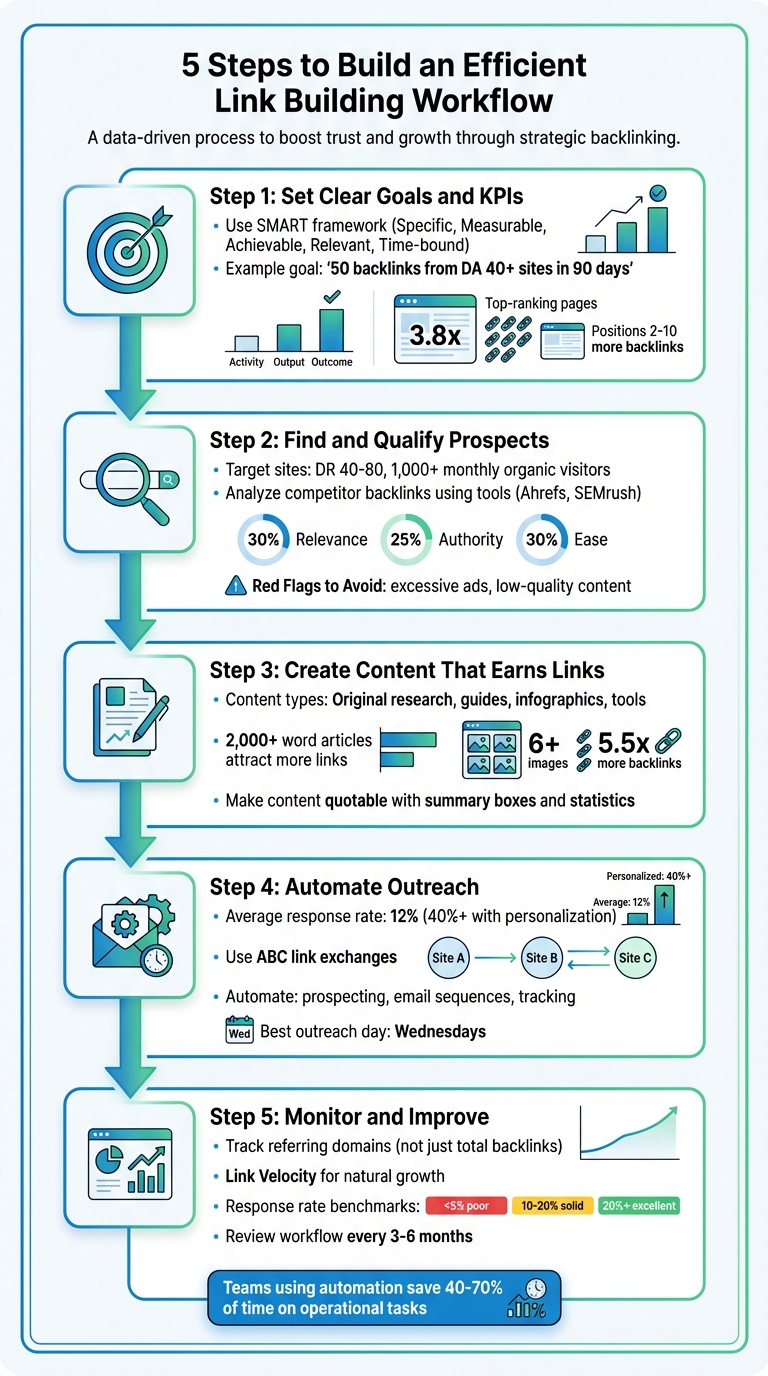
5-Step Link Building Workflow Process for SEO Success
A Link Building Team’s Workflow in Action – 5.3. Link Building Course
For a structured approach to your campaign, follow our SEO link building checklist to ensure no critical steps are missed.
sbb-itb-88880ed
Step 1: Set Clear Goals and KPIs
Before diving into outreach, it’s crucial to define clear goals that guide your efforts. Without them, you risk wasting time on actions that don’t drive results.
“Goals aren’t just ‘nice to have’ in link building; they’re the difference between busy work and winning work.” – Ana Tungdim, Link Building Consultant, Backlink Guys
Having specific objectives helps you allocate resources wisely. For instance, a team working with a $2,000 monthly budget and limited hours will approach link building differently than one with a $10,000 budget and dedicated staff. Clear goals also shape your strategy – whether that means focusing on niche edits to boost domain authority or guest posts to drive referral traffic. Keep this in mind: the top-ranking page on Google often has 3.8 times more backlinks than those in positions 2 through 10.
Create SMART Goals
Using the SMART framework – Specific, Measurable, Achievable, Relevant, and Time-bound – gives your objectives clarity and focus. Instead of setting a vague goal like “get more backlinks”, aim for something precise, such as “acquire 50 backlinks from sites with Domain Authority 40+ in the next 90 days”. Start with one primary goal and break it down into smaller, measurable tasks.
To keep motivation high, define success in three tiers: Baseline, Target, and Stretch. For example, if your target is 50 links, consider 30 as the baseline and 70 as the stretch. This approach ensures progress feels rewarding, even if you don’t hit the ideal number.
Choose Metrics to Track
Tracking Key Performance Indicators (KPIs) ensures you stay on course. Focus on three types of metrics:
- Activity: Emails sent, response rates.
- Output: Links acquired, average domain rating.
- Outcome: Improvements in rankings and traffic.
Pay particular attention to referring domains – unique websites linking to yours – since Google treats each domain as a separate endorsement. Monitor link velocity as well; a steady, natural growth pattern is key, as sudden spikes can raise red flags. A balanced backlink profile typically includes 70–80% dofollow links, with anchor text split into roughly 40–50% branded terms, 20–30% naked URLs, and less than 10% exact match keywords.
Additionally, track referral traffic from your links and keyword ranking changes for target pages. If you’re spending $3,000 per month on link building but see no ranking improvements after 60 days, it’s time to reassess your strategy. Keep in mind, too, that losing 5–10% of your links annually is normal, so plan for some attrition when setting goals.
Step 2: Find and Qualify Link Prospects
Once your goals are set, the next step is identifying websites that can provide valuable backlinks. Keep in mind, not all backlinks carry the same weight. A link from a site that’s relevant to your niche is far more impactful than one from a large, unrelated domain. To maximize your efforts, focus on three key factors: topical relevance, domain authority, and genuine traffic before reaching out.
Start by filtering potential prospects using measurable criteria. For example, a site with a Domain Rating (DR) between 40 and 80 and at least 1,000 monthly organic visitors is typically a good target. On the other hand, a high DR with no organic traffic could indicate a link farm. Be cautious of red flags like excessive display ads, low-quality content, or outbound links to irrelevant industries (e.g., plumbers or online casinos). Competitor analysis and a methodical approach to managing prospects can help refine this process even further.
“We’ve seen link building fall apart when it lives in spreadsheets forever. The moment you track prospects, conversations, and placements in one place, output goes up and mistakes go down.” Ian Naylor, Founder at 3Way Social
Analyze Competitor Backlinks
Looking at your competitors’ backlinks can uncover opportunities you might have missed. Tools like link intersect features can help you find websites that link to several of your competitors but not to you. These “warm prospects” are already aligned with your niche, making them ideal targets. Platforms like Ahrefs (US$99–US$999/month), SEMrush (US$129–US$449/month), and Majestic (US$49–US$399/month) are great for this type of analysis.
Once you’ve gathered the data, take the time to manually review each site’s traffic, content quality, and anchor text distribution. Avoid sites where more than 5% of their anchor texts are exact match keywords, as this can indicate manipulative practices.
Build an Organized Prospect List
After identifying potential sites, the next step is to prioritize them based on relevance, authority, and the likelihood of getting a response. Create a scoring system that weighs factors like relevance (30%), domain authority (25%), and ease of acquisition (30%). To find additional opportunities, use advanced search operators like keyword + "write for us" or keyword + "useful links" to locate guest posting or resource page opportunities.
For outreach, tools like Hunter can help you find direct email contacts. Keep all your notes, contact information, and outreach progress in one place. Establish a clear workflow to streamline the process: Prospecting → Research → Outreach → Negotiation → Won/Lost. By staying organized, you’ll be better equipped to manage your efforts and land those high-quality backlinks.
Step 3: Create Content That Earns Links
Now that you’ve identified your list of qualified prospects, the next step is to focus on creating content that naturally attracts backlinks. Think of it this way: journalists need accurate data, bloggers are always on the hunt for useful resources, and industry experts value reliable tools. Your job is to deliver content that meets those needs.
The best-performing content – whether it’s original research, interactive tools, comprehensive guides, or infographics – stands out because it offers something others can’t easily duplicate. For example, original research and data studies provide statistics that others love to cite. Interactive tools and calculators deliver instant value, making them highly shareable and bookmark-worthy. Comprehensive guides become trusted resources, while infographics simplify complex topics and often earn attribution links.
Prioritize Quality and Relevance
Longer content typically performs better when it comes to earning backlinks. Articles that exceed 2,000 words attract more links on average than shorter ones. Similarly, pages with six or more images earn 5.5 times the backlinks of those with no visuals. But here’s the catch: length and visuals alone won’t cut it. Your content needs to solve a problem or address a specific gap in the market.
“I look for topics with a combination of high relevance, evergreen appeal, and data scarcity.”
– Luke Hickman, Chief Marketing Officer @ Bird Marketing
To make your content quotable, use techniques like summary boxes, highlight key findings, and include statistics that are easy to reference. For example, TikTok for Business created a case study blending storytelling with performance metrics, which earned over 750 links from nearly 400 unique domains. Another example is Good Housekeeping’s guide to homemade cleaning sprays, which attracted links from 1.9k unique websites.
Once your content is polished and relevant, the next step is to customize your outreach strategy to ensure it gets the attention it deserves.
Customize Content for Outreach
Personalizing your content for specific prospects can significantly improve your chances of getting a “yes.” Take the time to research each prospect’s recent blog posts or social media activity. This helps you understand their audience and identify topics they’re already interested in. Then, explain how your content fills a gap in their coverage or updates outdated information in their existing guides.
Here’s a real-world example: In late 2025, the team at Editorial.Link shared early access snippets of their “State of Link Building” report – based on feedback from over 500 experts – with the editorial team at Search Engine Land. This tailored approach resulted in a feature and a DR90 backlink. The secret? They delivered exactly what the publication’s readers needed before anyone else did.
Make it easy for people to link back to your content. For infographics and tools, include ready-to-use HTML embed snippets. And if a full editorial feature feels like a stretch for some prospects, offer simpler options like a social media share or comparing link exchanges vs guest posting to see which fits their strategy best. The goal is to make saying “yes” as effortless as possible.
Step 4: Automate Outreach and Link Exchanges
Once you’ve created content that’s primed for attracting links, the next move is automating your outreach. Automation takes care of repetitive tasks like finding prospects, validating contacts, setting up email sequences, and tracking performance. This lets you focus on what matters most: crafting personalized messages. The result? Faster outreach and the ability to scale as your campaign grows.
Leverage Automation Tools for Outreach
Outreach tools can make a huge difference in simplifying your efforts. Key components like personalized subject lines, short and to-the-point messages (under 200 words), and follow-ups sent at optimal times (Wednesdays often work well) can significantly improve your response rates. While the average reply rate for outreach hovers around 12%, teams that combine automated follow-ups with manually tailored core messages often see response rates climb to over 40%.
Simplify Link Exchanges and Efficient Link Building with 3Way.Social
Manual outreach can be both tedious and inconsistent. That’s where 3Way.Social (https://3way.social) steps in. This platform uses AI to automate ABC link exchanges, which are more natural and effective than traditional direct reciprocal links. Here’s how it works: Site A links to Site B, Site B links to Site C, and Site C links back to Site A. This triangular structure is designed to appear more organic to search engines.
The platform’s AI evaluates your domain, niche, and target keywords to find the most relevant link partners from a carefully vetted network. It also includes a centralized dashboard to monitor your links, ensuring they stay live and retain their dofollow status. If a partner removes your link, you’re covered with either a refund or credit. For SEO agencies or professionals juggling multiple clients, features like white-label reporting and separate dashboards help keep everything organized as campaigns grow.
| Feature | 3Way.Social | Manual Outreach |
|---|---|---|
| Link Structure | Automated ABC (3-way) exchanges | Direct, reciprocal (A-B) links |
| Partner Discovery | AI-driven matchmaking | Manual prospecting and cold emailing |
| Security | Vetted network with active monitoring | Higher risk of link removal or being ignored |
| Efficiency | Centralized CRM dashboard | Scattered spreadsheets and email chains |
| Guarantees | Refunds or credits for lost links | No safety net if a link is removed |
Step 5: Monitor Results and Improve Your Process
Once you’ve automated your outreach, the next step is to track your results and fine-tune your strategy. Monitoring performance is just as important as building links – without it, you could waste time and resources on methods that aren’t working.
“We’ve noticed consistency beats intensity. A smaller weekly workflow you can run every week outperforms big outreach bursts followed by silence.” Becky Halls, Strategist at 3Way Social
Track Performance Metrics
To evaluate success, focus on three areas: Activity (outreach volume), Output (links secured), and Outcome (business impact). Start with activity metrics like the number of emails sent and response rates. If your response rate is under 5%, it’s a sign that your messaging or targeting needs improvement. A response rate between 10–20% is solid, and anything above 20% is outstanding.
For output metrics, prioritize referring domains over total backlinks. For example, securing links from 10 different quality sites is far better than getting 10 links from the same domain. Google values unique domains as individual endorsements. Also, keep an eye on link velocity, which refers to the rate at which you’re gaining new links. A steady pace reflects healthy growth, while sudden spikes might appear suspicious to search engines.
The most critical metrics are outcome-based: look at organic traffic growth, keyword ranking improvements, and referral traffic from your new links. For instance, pages ranking #1 on Google tend to have 3.8 times more backlinks than those in positions 2–10. A great example of this is the streetwear brand REPRESENT CLO. Between 2022 and 2024, they partnered with Outreach Monks to secure guest post links on sites with Domain Ratings (DR) between 20 and 70. Over 20 months, their organic traffic skyrocketed from 70,000 to 355,000 visitors (a 407% increase), their Domain Rating improved from 50 to 57, and their ranking keywords jumped from 3,500 to 24,100. These metrics provide the foundation for refining your link-building process.
Adjust Based on Data
Use your data to identify and fix weak points in your workflow. For example, high outreach volume but low conversions often signals poor targeting or ineffective messaging. On the other hand, good response rates but few secured links suggest that your follow-up strategy might need work. If your links aren’t improving rankings, it could be time to reevaluate your content quality, technical SEO, or even the competitiveness of your niche.
Pay attention to anchor text diversity to avoid over-optimization penalties. Additionally, track link loss – losing 5–10% of backlinks annually is typical, but anything higher could indicate a problem that needs addressing. Consider the cannabis marketplace 420DC as an example. By implementing a targeted link-building strategy, they boosted their organic traffic from 4,792 to 55,723 monthly visitors – a 1,035% increase – and raised their Domain Rating from 21 to 51. These results highlight the importance of continuous monitoring and adapting based on what the data shows. Regular tracking creates a feedback loop that helps refine and sharpen your overall strategy.
Conclusion on Efficient Link Building
Creating an efficient link building workflow is all about working smarter, not harder. The five steps covered in this guide – planning, prospecting, content creation, automation, and monitoring – work together like a well-oiled machine, replacing disorganized manual efforts with a streamlined, structured approach. By setting clear goals, carefully qualifying prospects, crafting content that earns links, automating repetitive tasks, and refining your strategy based on data, you can build a reliable system that drives long-term SEO success.
Teams that integrate automation into their workflows for prospecting and tracking save 40% to 70% of their time on operational tasks, allowing them to focus more on strategy and relationship-building.
“Automation does not replace SEO expertise. It multiplies it.” – Alex Sandro, Senior Product Manager, Serpzilla
This structured approach underscores the importance of consistency. Google values a steady, natural flow of backlinks as a sign of trust and authority. Whether you’re a solo marketer or managing campaigns for multiple clients, treating link building as an ongoing process – not a one-off project – delivers better results over time. Stick to your SMART goals, follow a focused 90-day campaign timeline, and let tools like 3Way.Social handle the repetitive tasks of link exchanges while you concentrate on strategy.
Link building is a long-term commitment. Revisit your workflow every 3–6 months to adapt to algorithm updates and performance insights. By starting with these methods now, you’re not just gaining backlinks – you’re creating a scalable system that boosts your authority, traffic, and rankings for the future.
Efficient Link Building – FAQs
How many links should I build per month?
There isn’t a one-size-fits-all answer to how many links you should build each month. It all comes down to your SEO strategy, budget, and resources. That said, a typical guideline is aiming for 5–10 high-quality links per week, which adds up to around 20–40 links monthly.
The key is maintaining a steady, manageable pace. Overloading on links too quickly can lead to penalties, so focus on consistency. And remember, quality beats quantity every time – strong, relevant links will do far more for your SEO in the long run than a large number of low-quality ones.
What makes a site a “good” link prospect?
A “good” link prospect is a website with strong authority and a clear connection to your niche. These links not only boost your SEO but also help attract the right audience. It’s important that the site is credible, trustworthy, and aligns well with your content.
To make your link-building efforts even more effective, diversify your sources. This could include guest posts, resource pages, or even broken link replacements. By mixing things up, you improve the quality and relevance of your links while building authority within your specific niche.
When should I automate link outreach?
When tasks like prospecting, sending outreach emails, following up, and tracking responses start eating up too much of your time, it’s a good idea to automate your link outreach. Automation helps simplify these processes, allowing you to save time, manage campaigns more efficiently, and focus on higher-level strategies. It’s especially handy when juggling multiple campaigns or aiming for consistent outcomes without overwhelming your team.