Last Updated on May 25, 2026 by Ian Naylor
High-authority backlinks are the cornerstone of a successful SEO strategy. These are links from trusted, relevant websites that boost your search rankings and build credibility. Unlike low-quality links, high-authority backlinks enhance your site’s visibility and align with Google’s focus on E-E-A-T (Experience, Expertise, Authoritativeness, and Trustworthiness).
Key Takeaways:
- Why They Matter: Pages with high-authority backlinks rank higher and attract more organic traffic. The top result on Google often has 3x more referring domains than lower-ranked pages.
- What to Focus On: Relevance, trust, and organic traffic are more important than metrics like Domain Rating (DR) alone.
- How to Get Them: Use tools like Ahrefs and Semrush to analyze competitors, find broken links, and identify content gaps.
- Best Practices: Prioritize links embedded in the body of articles, ensure the linking sites have real traffic, and avoid spammy practices.
- Long-Term Strategy: Build relationships with credible sites, monitor your backlinks regularly, and adapt your approach based on performance.
This guide covers everything from identifying opportunities to executing outreach and tracking results, ensuring your backlink strategy drives sustainable growth.
5 SEO Link Building Tools I Actually Use in 2026 (to Get High Quality Backlinks)
sbb-itb-88880ed
Core Principles of High-Authority Backlinks
Backlink Authority Metrics Compared: DR, DA, AS, UR & Trust Flow
Authority, Relevance, and Trust Explained
High-authority backlinks are built on three pillars: relevance, trust, and authentic visibility. Sahil Ahuja, Founder of Outreach Monks, describes it well:
"Authority isn’t a score. It’s a combination of relevance, trust, and real visibility."
This highlights that relevance within a niche can sometimes outweigh an overall domain authority score. Trust, on the other hand, comes from a site’s track record – consistent publishing, genuine organic traffic, and content that resonates with real readers. When these elements align, the resulting backlink holds considerable influence.
A truly valuable backlink should stand on its own, even without search engines. As Jeremy Ellens explains:
"A high authority backlink should still provide value even if Google did not exist. If a link would never be added for users alone, it carries long-term SEO risk."
These principles are the foundation for evaluating a domain’s authority using a link building checklist. Next, we’ll explore how to quantify this authority using key metrics.
Key Metrics for Measuring Authority
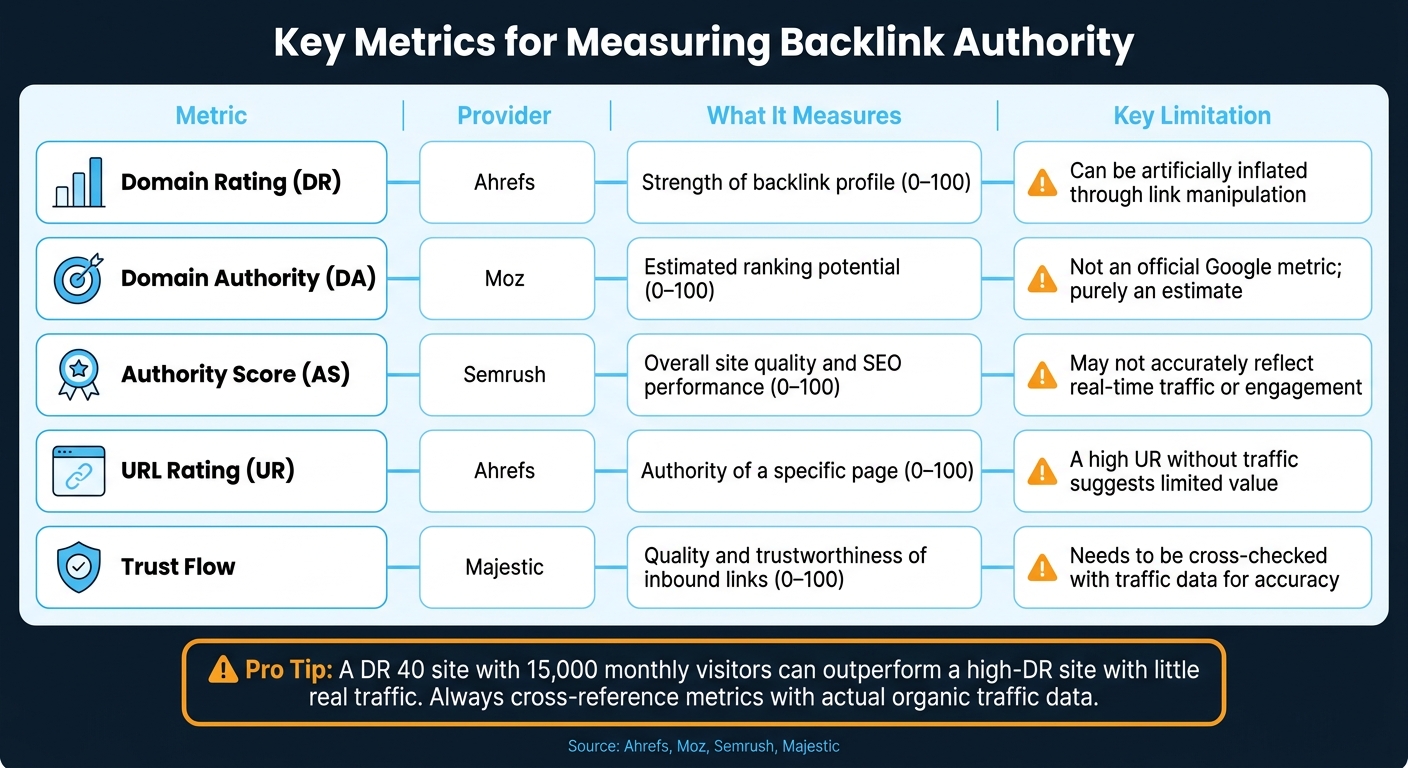
Various metrics can help assess the quality of a domain, though no single measure is flawless. Here’s a breakdown of the most common metrics and their limitations:
| Metric | Provider | What It Measures | Key Limitation |
|---|---|---|---|
| Domain Rating (DR) | Ahrefs | Strength of backlink profile (0–100) | Can be artificially inflated through link manipulation |
| Domain Authority (DA) | Moz | Estimated ranking potential (0–100) | Not an official Google metric; purely an estimate |
| Authority Score | Semrush | Overall site quality and SEO performance (0–100) | May not accurately reflect real-time traffic or engagement |
| URL Rating (UR) | Ahrefs | Authority of a specific page (0–100) | A high UR without traffic suggests limited value |
| Trust Flow | Majestic | Quality and trustworthiness of inbound links (0–100) | Needs to be cross-checked with traffic data for accuracy |
A common mistake is chasing high DR or DA scores without considering organic traffic. For instance, a domain with a DR of 40 and 15,000 monthly visitors can offer far more value than a higher-rated site with little to no real audience engagement. Always cross-reference these metrics with actual traffic data to ensure you’re targeting meaningful backlinks.
Understanding these metrics is crucial before diving into how editorial practices influence link quality.
How Editorial Standards Affect Link Value
The strongest backlinks come from websites with clear editorial practices – such as named authors, visible author bios, defined content guidelines, and a history of consistent publishing. In contrast, platforms that accept anonymous submissions or lack meaningful review processes often provide little SEO value.
Google’s systems, including SpamBrain AI, are increasingly adept at detecting low-quality sites. These platforms, which may appear legitimate at first glance, often lack real organizational credibility. Links from such sources are frequently ignored – or worse, devalued – during algorithm updates. This explains why low-quality backlinks tend to decay faster in value.
Before pursuing a backlink, ask yourself: Would this content still be worth reading even without my link? If the answer is no, it’s likely the site’s editorial standards – and SEO value – are lacking. Maintaining high editorial standards not only builds user trust but also ensures long-term SEO benefits.
How to Research and Source High-Authority Backlinks
Using SEO Tools to Find Link Prospects
Studying your competitors’ backlinks can help you build a strong prospect list. Tools like Ahrefs, Semrush, and Moz make this process much easier. A good starting point is a backlink gap analysis. For example, you can use Ahrefs’ Link Intersect tool or Semrush’s Backlink Gap tool by plugging in 3–5 competitors. Filter the results for dofollow links from domains with a minimum Domain Rating (DR) of 50 or at least 1,000 monthly visitors. As Despina Gavoyannis, Senior SEO Specialist at Ahrefs, explains:
"If a site links to all your competitors and not to you, it’s likely worthwhile for you to get a link from it."
Another effective strategy is broken link building. Use Ahrefs to find broken links on competitor domains by navigating to the Broken Links report and sorting by DR. If you discover a page with strong inbound links that’s now broken, reach out to the linking sites and suggest your live content as a replacement. This method not only helps fix broken links but also earns you valuable backlinks.
Additionally, Ahrefs’ Best by Links report is a great tool to identify competitor pages that attract the most backlinks – such as tools, original studies, or data-driven content. Creating an updated or improved version of such content can naturally draw links to your site.
These tools are essential for identifying and verifying high-quality link prospects.
How to Verify Legitimate Domains
Once you’ve built your list of prospects, it’s critical to confirm the credibility of each domain. A high DR score isn’t enough on its own – some domains inflate their metrics using link schemes or expired domains. To ensure legitimacy, check for:
- Organic traffic levels
- Named authors with bios
- Relevance to your niche
- Links placed within the main article body
Visit the site’s About page to look for physical addresses, real team members, and active social media profiles. Be cautious of sites that accept submissions without editorial review or prominently feature a "Write for Us" link in their navigation. These are often signs of link farms or private blog networks that provide little SEO value.
Niche-Specific Targeting Approaches
After verifying a site’s credibility, focus your outreach on opportunities tailored to your niche. Broad, generic outreach lists often fail to deliver results. Instead, honing in on industry-specific targets can improve both the quality of your prospects and your acceptance rates.
For SaaS and B2B brands, try search operators like intitle:[keyword] inurl:resources to uncover curated resource pages that might not appear in standard tool results. Similarly, use site:competitor.com "guest post" to find guest posting opportunities your competitors have already utilized. If you’re targeting local businesses, search for competitors in other major U.S. cities within your niche to discover high-authority directories or overlooked industry-specific sites.
A helpful way to prioritize prospects is by using the Proximity Ladder:
- Rung 1: Direct topical peers (high relevance, but lower acceptance rates)
- Rung 2: Adjacent topic publishers (strong relevance with better acceptance rates)
- Rung 3: Audience-aligned generalists (broader reach but lower topical relevance)
Focusing on Rung 2 often delivers the best balance between relevance and response rate. Research shows that 60–70% of links acquired through standard campaigns come from sites outside the target page’s topical neighborhood, which can limit their SEO impact.
How to Evaluate and Qualify High-Authority Domains
Checking Technical Quality and User Experience
Once you’ve got your list of verified prospects, it’s time to dig deeper into quality. A site’s technical health often reveals whether it’s a legitimate publishing platform or just a domain designed to sell links. Start by testing the site on both desktop and mobile. Issues like slow loading speeds, overwhelming ads, or poor mobile readability are red flags. These problems suggest a lack of investment in user experience, which can undermine the site’s overall credibility.
Next, take a close look at the content. High-authority sites typically publish consistently, credit named authors with clear bios, and stick to a specific subject area. If you notice posts jumping between unrelated topics, the site might lack the focus needed to deliver a strong relevance signal. This lack of focus could indicate lower editorial standards.
Reviewing Backlink Profiles for Risks and Opportunities
After confirming the site’s technical quality, dive into its backlink profile. This step helps ensure the domain’s authority isn’t artificially inflated. Tools like Ahrefs and Semrush are great for analyzing backlink data. Pay attention to the diversity of referring domains and the spread of anchor text. A healthy backlink profile shows links coming from a variety of independent sources. If most of the links originate from similar domains, it could suggest the use of a private blog network (PBN) or other artificial link schemes.
Anchor text distribution is another key metric. Research suggests that exact-match keyword anchors should make up no more than 5–10% of a site’s anchor text profile. A natural profile leans more on branded terms and plain URLs. Over-reliance on exact-match anchors, especially for commercial keywords, is often a sign of manipulation, which could put your link at risk.
Also, keep an eye out for sudden spikes in link velocity. If a domain shows a rapid increase in referring domains over a short period, it might indicate unnatural link-building rather than organic growth.
Link Placement and Context: What to Look For
Once technical and backlink checks are done, focus on where and how your link will be placed. Links embedded naturally within the body of an article – known as in-content, contextual links – carry the most SEO weight. Search engines interpret these as genuine editorial endorsements. On the other hand, links found in footers, sidebars, or author bios are often seen as navigational or boilerplate, offering less SEO value.
When evaluating a prospect, check how outbound links are typically integrated. If most links are crammed into footers or sidebars, your link might end up in a less valuable position. Ideally, your link should be woven into a relevant paragraph, surrounded by content that reinforces its relevance and editorial intent.
| Placement Type | SEO Value | What It Signals |
|---|---|---|
| In-body contextual link | Highest | Editorial endorsement |
| Resource page (in-content) | High | Curated recommendation |
| Author bio link | Low | Personal attribution |
| Footer or sidebar link | Minimal | Navigation/boilerplate |
Finally, don’t just evaluate the domain as a whole – look at the specific page where your link will appear. A link on a page with strong organic visibility is far more valuable than one buried on a low-traffic or orphaned page. Use tools to check if the linking page is indexed and actively receiving visitors. A well-trafficked page can amplify the impact of your link significantly.
Outreach and Collaboration for High-Authority Backlinks
How to Write Outreach Emails That Get Responses
Once you’ve identified your target domains, the next challenge is getting a response. Many outreach emails fail, not because the offer isn’t appealing, but because they come across as generic. Research backs this up: emails with personalized subject lines see reply rates jump by about 30%, and shorter subject lines (36 characters or fewer) tend to grab more attention.
A strong outreach email doesn’t need to be complicated. Here’s a simple formula:
- Start with a specific, personalized subject line.
- Open with a genuine reference to something the recipient has published.
- Briefly explain what you’re offering.
- End with one clear call to action.
Keep it under 200 words. Editors at high-authority sites are busy, so a concise and relevant pitch shows you value their time.
The best pitches focus on offering something useful to the recipient’s audience. This could be original data, updated statistics, fixing a broken link, or a guest post that fills a gap in their content. Instead of saying, "please link to my article", try something like: "Your post on technical SEO for e-commerce doesn’t mention how crawl efficiency changes with page speed – we conducted a study on 500 stores that might fit well as a reference." It’s specific, relevant, and immediately helpful.
Follow-ups are key. Data from Mailshake shows that sending 2–3 follow-ups, spaced 3–7 business days apart, can double your reply rate. Each follow-up should be shorter than the last, and after three total attempts, it’s best to stop. You want to maintain a good reputation with editors for future opportunities.
For added efficiency, consider using AI platforms to streamline your outreach efforts.
Using AI-Powered Platforms for Link Exchanges
While personalized emails remain essential, AI-powered platforms can make the process of finding and vetting link exchange partners much easier. These tools save time by matching your site with relevant, pre-screened collaborators.
One example is 3Way.Social, a platform designed for structured link exchanges. Its AI-driven matching system connects you with sites that are both authoritative and relevant to your niche, eliminating much of the manual work. The platform specializes in ABC (three-way) link exchanges, where Site A links to Site B, Site B links to Site C, and Site C links back to Site A. This approach avoids the direct reciprocal linking that search engines might flag.
The platform includes features like spam checks, domain metrics, and a vetted network of SEO professionals to ensure quality. It also offers tools for creating diverse, permanent follow and nofollow links, helping to keep your backlink profile looking natural. However, while AI can streamline the process, it’s still important to use human judgment to ensure the links are topically relevant and a good editorial fit.
Building Long-Term Relationships With Authority Sites
Effective outreach isn’t just about getting a single backlink – it’s about building relationships that last. When you establish trust with editors, future pitches become easier, your placements improve, and your brand is more likely to be cited organically on relevant topics.
After a link is published, show your appreciation. A simple thank-you email and sharing the piece on your own channels can go a long way. It shows you’re invested in a mutually beneficial relationship, not just link-building for your own gain. When you have something genuinely new to offer – like updated research, fresh benchmarks, or expert commentary – it’s a natural way to reconnect without coming across as pushy.
To maintain these relationships, keep a record of your interactions. Include details like the editor’s name, the topics they cover, past collaborations, and their preferred pitching style. Over time, a small network of trusted, high-authority partners will outperform a scattershot approach. These relationships lead to better-quality links and a more stable backlink profile overall.
Monitoring and Maintaining Your Backlink Results
How to Track Backlink Performance
Keeping tabs on your backlink performance is essential for maintaining their effectiveness over time. To get a full picture, use Google Search Console (GSC) alongside a paid tool like Ahrefs or Semrush. GSC offers insights into how Google views your links, including indexing and organic clicks. Meanwhile, Ahrefs provides deeper metrics like Domain Rating (DR), URL Rating (UR), and the organic traffic of linking pages. Be cautious of high DR links with little to no traffic – this could indicate issues like a penalized domain or a link network.
As SEO expert Jeremy Ellens explains:
"A high authority backlink should still provide value even if Google did not exist. If a link would never be added for users alone, it carries long-term SEO risk."
It’s also important to monitor your link velocity – the rate at which you gain or lose links. Sudden spikes might indicate viral content or, on the flip side, a spam attack. Additionally, check your anchor text distribution. A balanced profile often includes 30–50% branded anchors, while exact-match anchors should stay below 5% to avoid being flagged for manipulation.
Set up automated alerts in tools like Ahrefs or Semrush to get notified when you gain or lose high-authority links. Don’t wait for quarterly audits to discover that a valuable link has disappeared.
Dealing With Link Decay and Reclaiming Lost Links
Backlinks aren’t permanent. Pages get restructured, content gets removed, and URLs change, leading to a phenomenon known as link decay. This can weaken your backlink profile over time if left unchecked.
To combat this, run a broken link report in Ahrefs to identify links that now lead to 404 errors. If the content is still live, reach out to the webmaster and request the link be restored . For links lost due to changes on your own website, use 301 redirects to point the old URL to a relevant live page. This helps retain the link equity without requiring outreach.
Be cautious when disavowing low-quality links. Tools like Semrush or Moz can flag links with high spam scores, but always review flagged links manually before taking action. Incorrectly disavowing a legitimate link can harm your SEO more than leaving a questionable one intact.
Regular maintenance ensures your backlink profile remains strong.
Refining Your Backlink Strategy Over Time
Once you’ve tracked and addressed your link performance, use the insights to fine-tune your strategy. Conduct a full profile audit quarterly and compare your performance month-over-month. Identify which types of content are attracting the most high-authority links. Content like original research, in-depth guides, and free tools often outshine generic blog posts. Use Ahrefs’ "Best by Links" report to find your top-performing pages and focus on creating similar content.
To uncover new opportunities, try tools like Link Intersect or Backlink Gap analysis. These tools help you locate high-authority domains that link to your competitors but not to you. Since these domains are already linking to content in your niche, they’re more likely to link to your content as well. Refresh your outreach list monthly to keep your strategy dynamic.
| Frequency | Tasks |
|---|---|
| Weekly | Check for new or lost links; monitor competitor activity |
| Monthly | Compare profiles month-over-month; update opportunity list |
| Quarterly | Conduct a full audit; review strategy; update gap analysis |
Your backlink strategy should evolve as your niche changes. What worked a year ago might not be as effective today. By staying consistent with monitoring and adapting your approach, you can ensure your backlink profile continues to grow in value rather than diminish over time.
Conclusion and Key Takeaways
Building high-authority backlinks isn’t about chasing large quantities or obsessing over Domain Rating scores. It’s about earning genuine endorsements from websites that real people visit and trust. As Henry, Head of SEO at BuildingBacklinks.io, explains:
"Google does not reward link volume. It rewards real endorsements from websites people actually read, trust, and cite."
Here’s the reality: 85% of top-ranking pages on Google have at least one editorially earned backlink. And the #1 result? It typically has three times more referring domains than the pages ranked in positions two through ten.
To identify strong link prospects, rely on a 4-factor validation approach:
- Ensure the site has consistent organic traffic (1,000+ monthly visitors).
- Look for clear editorial quality, such as named authors.
- Confirm the site’s topical relevance to your niche.
- Prioritize in-content link placements.
These metrics provide a solid starting point for evaluating opportunities, but they shouldn’t be your only guide.
Keep in mind, it can take 3–6 months for high-quality backlinks to show measurable results. A steady, sustainable pace of 5–20 placements per month is ideal . Tools like 3Way.Social can simplify this process by using AI to facilitate vetted link exchanges that focus on domain compatibility and high-quality do-follow links – helping you grow your backlink profile naturally and avoid penalties.
The key is to invest in original research, maintain high editorial standards, and approach link building the right way. As Palm Interactive puts it, "The playbook for getting mentioned by AI is the same playbook for building search authority". Both search engines and AI systems will reward these efforts.
FAQs
How can I tell if a high-DR site is legitimate?
To determine if a high-DR (Domain Rating) site is trustworthy, it’s important to look beyond just the DR score. Start by examining organic traffic patterns – consistent and relevant traffic is a good indicator of legitimacy. Next, consider whether the site’s content aligns with its niche and if it maintains strong editorial standards and high-quality content.
Technical details matter too. Check for HTTPS security, visible contact information, and a clear privacy policy – all signs of a credible website. While tools like Trust Flow or Toxicity Score can provide additional insights, manual checks are equally important. Look for engaging content, natural backlinks, and evidence of audience interaction to confirm the site’s credibility. These steps ensure you’re not relying solely on metrics but also assessing the site’s overall trustworthiness.
What are the safest types of backlinks for long-term SEO?
The most reliable backlinks for maintaining long-term SEO success are editorial, contextual, and naturally integrated links from reputable, relevant websites. Examples include guest posts on well-regarded platforms, links embedded within high-quality content, and links featured on curated resource pages. Steer clear of low-quality backlinks, such as those from expired domains, link farms, or bulk link purchases, as they can lead to penalties. Instead, prioritize building high-authority, relevant backlinks that adhere to Google’s guidelines for sustainable SEO growth.
How long until new backlinks improve rankings?
New backlinks start to make an impact on rankings within 2 to 3 weeks, but noticeable improvements often take longer – around 3 to 6 months. The timeline depends on factors like competition, your site’s authority, and the quality of your content. While you might see some changes within 6 to 12 weeks, achieving stable ranking improvements for highly competitive keywords usually requires consistent effort over 4 to 6 months. This allows search engines time to assess and redistribute authority effectively.