Last Updated on June 5, 2026 by Becky Halls
Multi-tiered link building uses a structured approach to strengthen backlinks across tiers:
- Tier 1 links: Directly connect to your website, boosting authority.
- Tier 2 links: Support Tier 1 links by linking to them.
- Tier 3 links: Help Tier 2 links get indexed.
In 2026, the focus is on quality over quantity, as Google’s SpamBrain system can now detect spam links 200x better. Poor execution, like using low-quality or automated links, risks penalties. Here are the 7 key tips for success:
- Build high-quality Tier 1 links: Use guest posts, digital PR, and editorial links from sites with a Domain Rating (DR) of 60+.
- Define goals for each tier: Allocate resources wisely, focusing 80% on Tier 1.
- Use contextual Tier 2 links: Ensure they are relevant and come from DR 30–50 sites.
- Limit Tier 3 links: Use sparingly and prioritize manual placement over automation.
- Diversify link sources: Combine tiered links with earned media, HARO mentions, and niche directories.
- Track indexation and equity flow: Monitor links across all tiers using tools like Google Search Console and Ahrefs.
- Stay compliant with Google guidelines: Perform monthly audits, avoid spammy practices, and diversify anchor text.
Key Stats:
- 62% of SEOs prioritize link quality.
- High-quality guest posts on DR 60+ sites cost $500–$3,000.
- A 1:3:9 ratio is ideal for Tier 1, Tier 2, and Tier 3 links.
Focus on building a natural, balanced link profile that aligns with search engine guidelines.
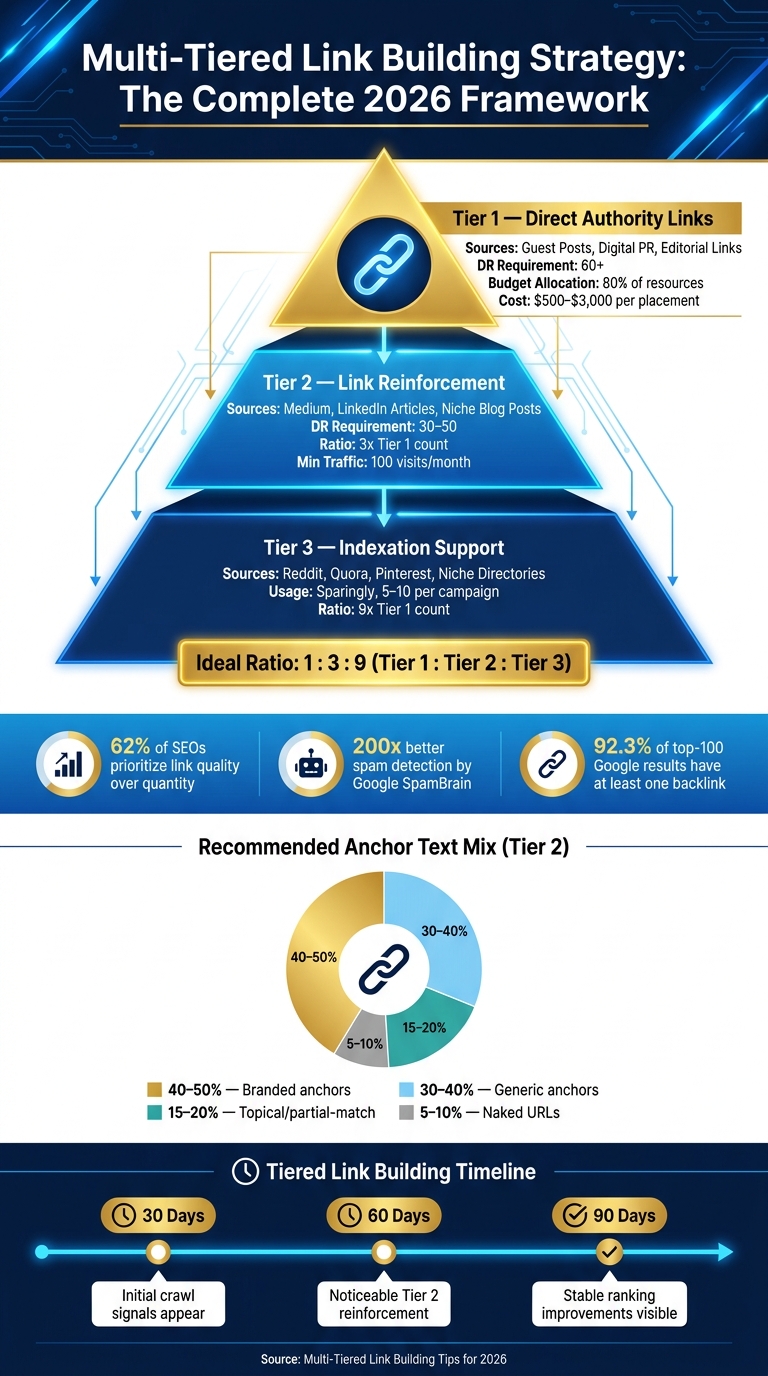
Multi-Tiered Link Building Strategy: The Complete 2026 Framework
Link Building That Works in 2026 (James Dooley Interviews Charles Floate)
1. Build a Strong, High-Quality Tier 1 Foundation
Your Tier 1 links are the backbone of a multi-tier link-building strategy, playing a key role in boosting search performance. In fact, by 2026, 92.3% of the top-100 Google results included at least one backlink, with the top-performing sites showcasing diverse and well-maintained link profiles.
To build a solid Tier 1 foundation, focus on acquiring high-authority, niche-relevant backlinks from domains with a Domain Rating (DR) of 60 or higher. Use white-hat techniques like guest posting, digital PR, and editorial insertions to secure these links.
“Tier 1 links move the ranking needle. They influence search results more than any other factor.” – Muhammad Zain Shabbir, Founder & CEO at Brimcove
For instance, fitness and SaaS companies have successfully earned guest posts on high-DR sites like Healthline, ProductHunt, and G2. These efforts not only improve rankings but also enhance domain authority. Keep in mind, high-quality guest posts on DR 60+ domains typically cost between $500 and $3,000, depending on the site’s authority and traffic.
The Role of Anchor Text
Anchor text diversity is critical for maintaining a natural link profile. Use a mix of branded, partial-match, and contextual anchor texts to avoid over-optimization. Overusing exact-match anchors can trigger Google’s SpamBrain, so aim for balance. Additionally, spread out your link acquisition efforts over time to avoid appearing unnatural.
Streamlining the Process
Platforms like 3Way.Social can simplify the process of finding and securing high-quality Tier 1 links. With features like AI-powered domain matching and guest posting tools, it’s easier to identify opportunities that align with your niche.
Once you’ve built a strong Tier 1 foundation, the next step is to define the purpose of each tier in your strategy to maximize its effectiveness.
2. Plan a Clear Purpose for Each Tier
For a multi-tiered link-building strategy to succeed, each tier must serve a distinct purpose. Without this clarity, you could end up wasting resources on links that don’t deliver results – or worse, trigger Google’s SpamBrain by creating unnatural patterns. The table below highlights the main goal of each tier and suggests suitable sources.
| Tier | Primary Goal | Recommended Sources |
|---|---|---|
| Tier 1 | Build direct authority for your site | Guest posts, editorial links, digital PR |
| Tier 2 | Boost the authority of Tier 1 links | Articles on platforms like Medium or LinkedIn, niche blog posts |
| Tier 3 | Ensure Tier 2 links get indexed | Social bookmarks, forum mentions (use sparingly) |
Here’s a real-world example: In March 2026, a SaaS product review site used guest posts on ProductHunt (DR 91) and G2 (DR 90) as Tier 1 links. To reinforce these, they published a comparison blog post linking to the G2 review and shared the ProductHunt link through LinkedIn articles as Tier 2 support. This approach led to noticeable ranking improvements for their main article within 6–8 weeks.
When allocating resources, focus heavily on Tier 1. At least 80% of your budget should go toward securing high-quality links. A single DR 50+ editorial link can deliver more impact than multiple lower-tier links. As Brandon Schroth, Founder of Reporter Outreach, puts it:
“The smart money in 2026 goes toward making every Tier 1 placement as strong as possible – not propping up weak links with artificial tiers below them.”
For Tier 2, prioritize manual acquisition through genuine content promotion, such as authentic blog mentions or social sharing. Many SEOs now avoid Tier 3 altogether due to its limited authority boost and potential risks of penalties.
Platforms like 3Way.Social can simplify your efforts by connecting you with reliable sources for guest posts and digital PR. Setting clear goals for each tier lays the foundation for strategies that enhance and protect your link equity.
3. Use Contextual Tier 2 Links to Strengthen Tier 1
Think of a Tier 1 link as a vote of confidence for your website. A Tier 2 link, on the other hand, reinforces that vote by signaling that the source page is trustworthy. When Tier 2 links are naturally placed within relevant content, they channel link equity directly to your Tier 1 pages, boosting their impact on your rankings. This strategy helps maximize the effectiveness of your Tier 2 links.
Topical alignment is key. A Tier 2 link in unrelated content adds minimal value. The source of the Tier 2 link should align with the topic of your Tier 1 page. For instance, if your Tier 1 guest post is about SaaS project management tools, Tier 2 links should come from tech or business-related content – not something like a lifestyle blog. Research shows that backlinks from topically relevant domains can lead to an average of 2.8 times greater ranking improvements compared to links from unrelated domains with similar authority.
When selecting Tier 2 sources, aim for sites with these characteristics:
- Domain Rating (DR): 30–50
- Monthly organic traffic: At least 100 visits
- Toxic score: Under 5%
- Active content: Regularly published
These benchmarks ensure that your Tier 2 links provide meaningful support to your Tier 1 links. As Brijesh Vadukiya, Co-Founder of Outreach Desk, explains:
“Tiered link building works when each tier is defensible on its own. If your genuine editorial Tier 1 links are supported by legitimate Tier 2 social shares and secondary content, you’re strengthening an already-natural structure.”
Anchor text matters. Misusing anchor text can harm your credibility. Overusing exact-match anchors creates patterns that spam filters can detect. Instead, adopt a natural mix like this:
- 40–50% branded (e.g., company name)
- 30–40% generic (e.g., “click here”, “read more”)
- 15–20% topical or partial-match
- 5–10% naked URLs
A gradual rollout of links is also essential. Start with 3–5 contextual links during the first two weeks, then add 3–4 niche edits in the following two weeks. Keeping this pace ensures your link-building process appears organic and avoids triggering spam filters. A good rule of thumb is to create 3–7 Tier 2 links for each strong Tier 1 link. This steady, natural approach strengthens your multi-tiered link structure and enhances your overall SEO strategy.
4. Test and Limit Tier 3 Link Activity
Tier 3 links form the base of your link pyramid. Their primary role? Helping search engines find and index your Tier 2 pages. These links don’t directly boost your main site’s authority. As Muhammad Zain Shabbir, Founder & CEO of Brimcove, explains:
“Tier 3 links are too far down the chain to move rankings directly. They only matter if Tier 2 is solid. Build garbage Tier 3 links, and you’ve wasted time and money.”
The risks at this level are worth noting. With SpamBrain detecting 200 times more spam than manual reviews, an overload of automated Tier 3 links can quickly lead to a “silent devaluation.” This means Google’s algorithm may nullify those links without any notification in Search Console. To avoid this, focus on creating trusted, manually placed Tier 3 links.
Keep Tier 3 efforts small and deliberate. Instead of flooding the web with automated links, stick to 5–10 high-quality, manually placed links per campaign. Use legitimate platforms like Reddit discussions, Quora answers, Pinterest posts, or niche-specific directories. Placing just a few links each week will help replicate natural growth patterns.
For a balanced link pyramid, aim for a 1:3:9 ratio of Tier 1 to Tier 2 to Tier 3 links. To ensure your Tier 2 pages are indexed, use tools like the “site:URL” search operator or Google Search Console. Generally, initial crawl signals appear within 30 days, noticeable Tier 2 reinforcement happens around 60 days, and stable ranking improvements can be seen by the 90-day mark.
sbb-itb-88880ed
5. Combine Multi-Tiered Links with a Range of Link Sources
To make your multi-tiered link strategy more effective, avoid relying solely on tiered link campaigns. If your link profile looks overly manufactured, it can raise red flags with Google’s SpamBrain system. Instead, mix tiered links with a variety of link sources to create a profile that mirrors how websites naturally gain links.
Think of your Tier 1 links as the core of your strategy. Strengthen these with earned media – things like HARO (Help a Reporter Out) pitches, mentions from journalists, and editorial coverage in respected industry outlets. These types of links carry genuine authority and are tough for competitors to replicate. In fact, 40.7% of marketers used content marketing in 2025 to passively gain links. By offering original data, free tools, or templates, you can naturally attract citations without needing constant outreach. This earned media approach integrates seamlessly with a range of other link sources.
“Tiered link building works best when Tier 2 and 3 links come naturally through promotion – not coordinated outreach campaigns.” – Muhammad Zain Shabbir, Founder & CEO, BrimCove
Another way to boost your strategy is by building strong entity signals. Complete profiles on platforms like LinkedIn, Crunchbase, YouTube, and GitHub to establish credibility for your brand. Search engines are increasingly flagging thin or inactive “Web 2.0” profiles, so filling these out is more important than ever in 2026. Platforms like 3Way.Social can also help diversify your links. Their AI-powered three-way link exchanges (Site A → B → C → A) avoid the typical patterns of direct reciprocal linking, adding an extra layer of authenticity to your Tier 1 links.
Anchor text optimization is another key element. Use a mix of branded anchors, partial-match phrases, and naked URLs across your tiers. This diversity in anchor text and link sources makes your strategy look natural and well-rounded.
| Link Source Type | Role in Your Profile | Risk Level |
|---|---|---|
| HARO / Digital PR | High-authority Tier 1 foundation | Low |
| ABC Link Exchanges | Adds contextual diversity for Tier 1 | Low |
| Niche guest posts (DR 60+) | Strengthens Tier 1 within a mixed-source strategy | Low–Medium |
| Medium / LinkedIn articles | Reinforces Tier 2 links | Low |
| Social shares (LinkedIn, Pinterest) | Helps with indexing for Tier 2/3 links | Very Low |
| Niche directories (e.g., Avvo, Healthgrades) | Provides local and industry-specific citations | Low |
6. Track Indexation and Link Equity Flow Across Tiers
Once you’ve diversified your links, the next step is ensuring they’re indexed and passing equity as intended. Why does this matter? Because link equity only works if a link is crawled and recognized. That’s why monitoring indexation is a critical piece of the puzzle. This step ties directly into the earlier tiers, confirming that every link is doing its job.
To check if your links are indexed, start with Google Search Console. For deeper insights into Tier 2 and Tier 3 links, tools like Semrush (which covers 43 trillion links) or Ahrefs (35 trillion links) can help you track visibility. If you’ve built a strong Tier 1 link but notice no ranking improvement after 4–6 weeks, it’s likely not being crawled enough.
“The sites holding rankings in 2026 aren’t the ones with the most links. They’re the ones that know exactly what their link profile looks like right now.” – Michael Vale, SEO Expert
One thing to keep in mind is the lag time in equity flow. For Tier 2 links, this lag can range from 8 to 16 weeks. If you don’t see results within this timeframe, it’s worth reassessing your strategy. Also, remember that links from irrelevant or unindexed sources don’t just fail to add value – they can actually create noise. As Brijesh Vadukiya, Co-Founder of Outreach Desk, explains: “If a Tier 1 link goes offline, the entire support structure beneath it loses its purpose.”
To stay on top of things, consider using a tracking sheet. Log details for each link, including:
- Source URL
- Target URL
- Anchor text
- Follow/nofollow status
- Publish date
- Indexed status
You can monitor these through manual checks, site:URL searches, Google Search Console reviews, and GA4 referral reports. Referral traffic, especially from a contextual placement, is a strong sign that a link is delivering real-world value – not just theoretical SEO equity.
With Google’s Authenticity Update in 2026, it’s become tougher for low-quality Tier 3 properties to stay indexed. Catching underperforming or de-indexed links early allows you to refocus your efforts where they’ll make the most impact. One final tip: avoid automated disavow tools unless you’ve received a manual penalty. Disavowing healthy links can harm your profile far more than leaving questionable ones alone.
7. Keep Your Link Building Safe and Within Google Guidelines
Staying within Google’s rules isn’t a one-and-done effort – it requires consistent attention. Google’s SpamBrain now identifies unnatural links in real time, cutting spam by 99%. And with Google rolling out 500–600 algorithm updates every year, a link profile that seems fine today could become risky tomorrow if you’re not staying vigilant. Regular link audits are essential to keep things in check.
Make it a habit to perform monthly link audits using tools like Google Search Console or Ahrefs. These tools can help you detect sudden spikes in link velocity or signs of link farms. Don’t forget to monitor your Tier 2 and Tier 3 properties as well, since low-quality signals from these tiers can harm your Tier 1 links. With Google’s 2026 Authenticity Update, the focus on quality has intensified, targeting thin Web 2.0 properties and empty profiles designed solely for link-building purposes.
“Creating 20 empty profiles in one afternoon and never touching them again is worse than having no profiles at all. Each one should look like a real human set it up for a real business.” – Palm Interactive
When auditing, flag any abandoned profiles or content properties. Keeping every tier of your link structure strong is crucial. If you can’t regularly update a property with genuine content, it’s better not to create it at all. Each Tier 2 or Tier 3 property should include at least 2–3 pieces of meaningful content and have a complete, branded profile. To save time, consider repurposing content into formats like slide decks, PDFs, or blog posts.
Be cautious when using the disavow tool – only disavow harmful Tier 2 or Tier 3 links. Also, diversify your anchor text across all tiers. A healthy mix of branded anchors, URL-based anchors, and naturally phrased text helps your link structure look organic and reduces the risk of penalties.
Conclusion
In 2026, successful multi-tiered link building isn’t about creating the largest pyramid – it’s about building the right one. The strategies outlined here emphasize a simple truth: quality, relevance, and compliance are non-negotiable. These elements form the backbone of an effective link-building structure, ensuring every tier contributes meaningfully to your site’s authority.
Google’s SpamBrain has slashed spam by 99% compared to older detection systems. This highlights why a single editorial link from a high-authority site (think DR 80+) can have a much greater impact on rankings than dozens of low-quality links from generic blogs. It’s no surprise that 62% of SEOs now prioritize quality over quantity.
What sets a tiered strategy apart in 2026 is its thoughtful execution. A solid Tier 1 foundation is key, supported by purposeful Tier 2 efforts that focus on genuine, human-driven engagement. Tier 3 should be used sparingly and strategically. When all tiers work together, your link-building approach remains adaptable and effective.
Tools like 3Way.Social align with this philosophy, offering vetted ABC link exchanges and domain-specific do-follow placements. These kinds of platforms make it easier to build a quality-first Tier 1 structure that can withstand algorithm updates.
The biggest takeaway? Link building has evolved into brand building. With AI-driven search tools like Google’s AI Overviews and large language models scrutinizing backlink profiles for trust signals, a clean, editorial, and relationship-based link strategy isn’t just smart – it’s essential for staying competitive. Follow these strategies consistently, and you’ll create a backlink profile that search engines trust.
FAQs
How do I choose Tier 1 links that are worth the cost?
To make sure Tier 1 links deliver real value, prioritize quality over quantity. Focus on domains with low spam scores, natural backlink profiles, and strong authority within your industry. Ideally, aim for sites with a Domain Rating of 50+ and verified organic traffic. Tools like 3Way.Social can assist in identifying permanent, do-follow, and contextually relevant links. This approach helps you get better results while steering clear of low-quality or risky link setups.
What’s the safest way to build Tier 2 links without triggering SpamBrain?
To create Tier 2 links without setting off SpamBrain alarms, the key is sticking to organic, high-quality sources that genuinely align with your content’s topic. This means focusing on strategies like:
- Engaging with niche communities where your content naturally fits.
- Writing secondary guest posts for smaller, relevant websites.
- Leveraging social signals through platforms like LinkedIn and X (formerly Twitter) to amplify your content.
Steer clear of risky automated methods like link farms or spammy Web 2.0 tactics. Each link placement should feel like a natural editorial mention, not a forced or artificial connection. Tools such as 3Way.Social can be useful for managing secure and fair link exchanges while keeping your strategy authentic.
How can I tell if my tiered links are indexed and passing equity?
To make sure your tiered links are indexed and effectively passing link equity, start by confirming that the linking pages are live, followable, and returning a 200 OK status. Use tools to ensure the links are dofollow and not restricted by robots.txt files or noindex tags. Keep an eye on the organic traffic of the linking pages – pages with relevant, high-traffic content tend to improve equity flow. Platforms like 3Way.Social can automate link status checks, helping you maintain an efficient tiered link structure.