Last Updated on June 22, 2026 by Ian Naylor
A backlink helps more when the page, paragraph, and anchor all match your topic. In this piece, I’d sum it up like this: a link in the main body, inside related copy, can beat a stronger-looking link that sits on an off-topic page. The article points to data like 2.8x more ranking improvement for topically matched DR 50+ links and 3–5x higher click rates for contextual links in main content.
Here’s the short version:
- Context matters more than link count
- Topic match beats raw authority in many cases
- Paragraph-level relevance helps search engines judge the link
- Main-content links often carry more weight than footer or sidebar links
- Weak placements look forced, off-topic, or stuffed with keywords
- Good outreach starts with subject fit, not DR alone
- After placement, you still need to check the page, anchor, and nearby copy
In other words: I wouldn’t judge a backlink by “is it live?” alone. I’d ask:
- Does the source page match my topic?
- Does the section around the link make sense?
- Does the anchor read like a normal part of the sentence?
- Would a reader actually want to click it?
The article also makes one point very clear: Google looks past the link itself. It reads the words around it to decide whether the link feels like a natural reference or a forced add-on. That means an off-topic link may pass little value, even if it comes from a strong domain.
If I had to boil the whole piece down to one line, it would be this: the best backlinks don’t just exist – they fit.
Footer Backlinks Vs. Contextual Backlinks (2024 Update)
sbb-itb-88880ed
What Contextual Relevance Means in SEO
Contextual relevance is the fit between the linking page, the anchor text, the copy around the link, and the page it points to. Put simply, a link gets its value from context, not just where it sits on the page.
The paragraph around the link matters most. It helps search engines decide whether the link feels like a natural editorial reference or a forced add-on , such as those found in ABC link exchanges.
How Search Engines Read Surrounding Content
Search engines look at the sentences around a link to figure out why it was added. They use related terms and nearby references to understand how the two pages connect. If a paragraph is about email outreach, for example, and the link points to a page about technical SEO, that mismatch can look off.
Google’s SpamBrain AI now catches 50x more link spam sites than earlier versions by checking whether a link makes topical sense in its setting. So if a link doesn’t match the topic of the paragraph, it’s more likely to be ignored.
Why Context Improves Rankings and Click Quality
Topical proximity has a stronger relationship with rankings than raw authority alone, and contextual links tend to get more clicks because they feel useful instead of salesy. That’s the big idea here: a link on a niche-relevant page can beat a higher-authority link dropped into content that has nothing to do with the target page.
There’s a user side to this too. When a link shows up exactly where a reader expects it, they’re more likely to click. In fact, contextual links have a 3–5x higher likelihood of clicks than the same anchor placed outside the main content.
When the topic around the link doesn’t line up with the destination page, search engines have a much easier time discounting it.
Why Some Backlinks Deliver Less Value
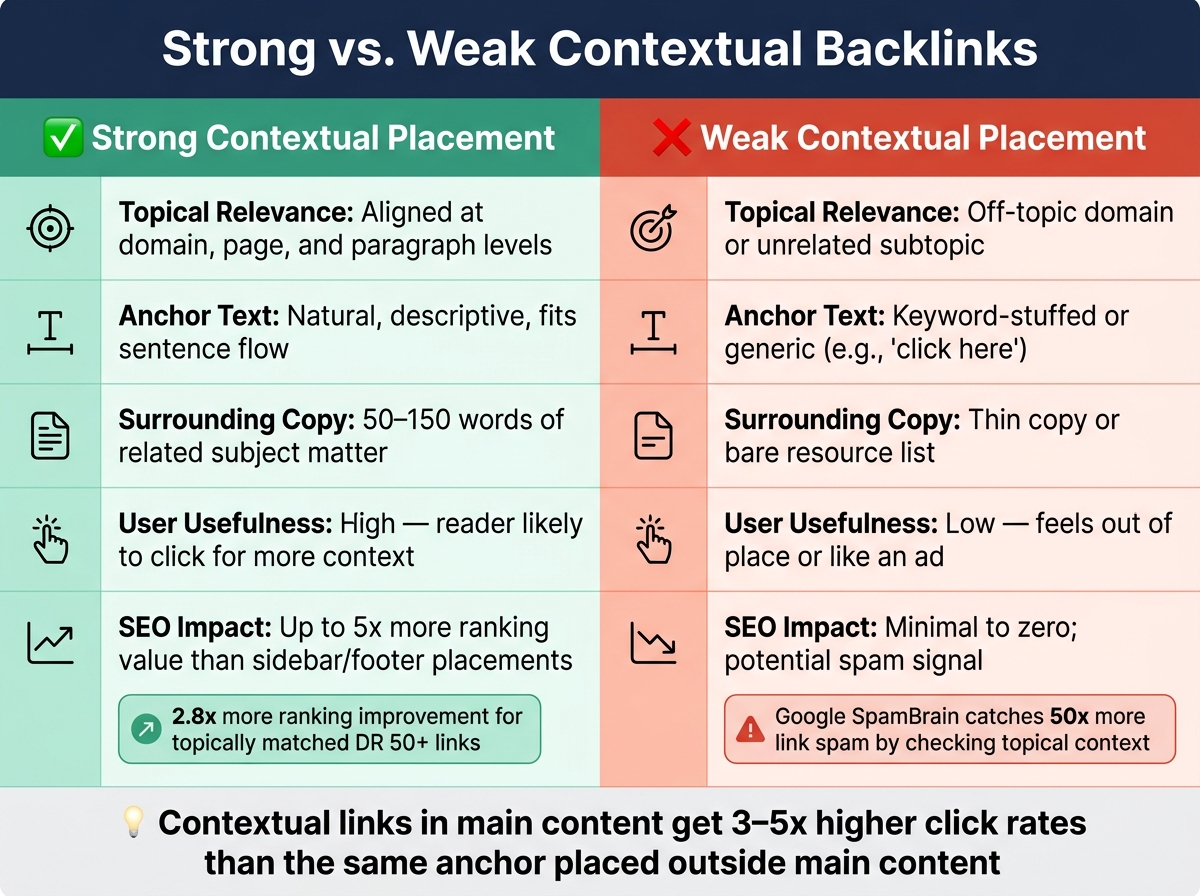
Strong vs. Weak Contextual Backlinks: Key Differences & SEO Impact
Not every backlink helps rankings in the same way. Even a high-authority link can fall flat when the source page has little to do with the page it links to. In fact, topically matched DR 50+ links drive 2.8x more ranking improvement than off-topic links with similar strength. So no – authority by itself doesn’t decide link value.
Common Signs of a Weak Contextual Placement
The biggest warning sign is a topical mismatch. That happens when the source page and the destination page don’t have a clear connection. Picture a cooking blog linking to a B2B SaaS product page. It feels forced. There’s no clear editorial reason for the link, and the topical signal is weaker.
A few other patterns can also hint at a poor placement:
- Anchor text feels jammed into an awkward sentence
- The link sits inside thin copy with no explanation around it
- The page is just a bare resource list with little context for search engines
Keyword-stuffed anchors are another red flag. If a sentence seems to exist only to squeeze in a keyword, it looks manipulative.
Strong vs. Weak Contextual Links: A Comparison
| Feature | Strong Contextual Placement | Weak Contextual Placement |
|---|---|---|
| Topical Relevance | Aligned at domain, page, and paragraph levels | Off-topic domain or unrelated subtopic |
| Anchor Text | Natural, descriptive, fits sentence flow | Keyword-stuffed or generic ("click here") |
| Surrounding Copy | 50–150 words of related subject matter | Thin copy or bare resource list |
| User Usefulness | High; reader is likely to click for more context | Low; feels out of place or like an ad |
| SEO Impact | Up to 5x more ranking value than sidebar or footer placements on the same domain | Minimal to zero; potential spam signal |
These are the weak signals to watch for when picking outreach targets. Using a link building planner can help you track and avoid these low-value placements.
How to Build Contextually Relevant Backlinks
Once you know what weak placements look like, the next move is to build links that fit the topic around them from the beginning. If the surrounding copy feels thin or drifts off-topic, the steps below help you catch that before a link goes live. The aim is simple: build backlinks with relevance and authority, not just more links.
Build Pages Around a Clear Topic Cluster
The easiest way to earn contextually relevant backlinks is to give other sites a clear reason to link to you, such as by using a guest post topic generator to find unique angles. That starts with your own site structure.
When your guides, case studies, and service pages all support one subject area, publishers can place your URL inside copy that makes sense. That makes the link feel natural instead of forced. It also gives publishers cleaner options when they decide where your link should go.
Pick Outreach Targets Based on Subject Match, Not Just Metrics
Your prospect list should start with relevance, not authority scores. Topic match matters more than DR by itself.
A 2025 study of 18,000 backlinks across 320 business niches found that links on topically matched DR 50+ domains produced 2.8x greater ranking improvement than same-authority links placed in off-topic content.
Before you contact a publisher, check three things:
- Domain match
- Page match
- Audience match
If all three line up, you likely have a strong target. If the DR looks good but the subject fit is weak, move on.
You can also search "write for us" or "contributor guidelines" + [your niche] to find publishers that already cover your space.
Use Vetted Matching to Find Relevant Link Placements
Vetted matching can cut down the time it takes to build a strong prospect list without losing topic fit. Manually checking domains, pages, and audience alignment across dozens of sites takes time most teams just don’t have. That’s where AI-powered matching can help with prospecting.
3Way.Social supports this process with AI-powered domain matching and a vetted network of SEO professionals. Pre-screening placements for topical relevance reduces guesswork in placement selection.
After placement, the next step is checking whether the source page still supports the link context.
How to Check Link Context After Placement
After placement, the job changes. Now it’s about keeping relevance in place. A permanent do-follow link is only the start. Pages get edited, articles get updated, and a link that once fit well can slowly lose its place.
Review the Source Page, Anchor Text, and Nearby Copy
When you review a live backlink, look at three layers: the page, the section, and the paragraph. First, make sure the source page topic still lines up with your destination page. Then check the heading where the link appears, because search systems read links in the context of the section around them. After that, read the 50–150 words around the link. The link should feel like a natural reference, not something stuffed in after the fact.
Read the sentence like a normal visitor would. If the link feels helpful, that’s a good sign.
Live links can drift as pages change, so performance signals matter too. If referral visitors stick around and click into other pages, the link likely matched intent. If one backlink brings a high bounce rate, that often points to a mismatch between the source page and your page.
A simple way to sort them:
- High-context: main content, natural anchor, topic match
- Low-context: sidebar/footer, generic anchor, weak topic match
Context isn’t something you set once and forget. You have to check it again after the link goes live.
FAQs
How much does topical relevance matter?
Topical relevance matters a lot. In many cases, it predicts ranking impact better than old-school domain authority scores.
Google looks at relevance on more than one level:
- The domain
- The article
- The paragraph around the link
That means placement isn’t a small detail. It can change how much a link helps.
Links inside closely matched content tend to line up much more strongly with rankings. And a contextual link can pass up to 5 times more value than a sidebar or footer link on the same page.
What makes a backlink look natural?
A backlink tends to look natural when it shows up in the main body of editorial content instead of a sidebar, footer, or navigation menu.
It also needs topical alignment. That means the linking page, the paragraph around the link, and the destination page should all be about the same subject. The link should fit the sentence without feeling forced, and the anchor text should be clear and natural instead of vague or stuffed with keywords.
How can I audit link context after placement?
Audit three things: placement, surrounding content, and anchor text.
Put the link in the main body of the page, not in the footer, sidebar, or author bio. That’s where it has the most context and the best chance of being seen as part of the page’s core topic.
Then look at the 50 to 150 words around the link. Those nearby words should connect clearly to the topic of your destination page. If the link points to a page about email outreach, for example, the surrounding copy should talk about outreach, prospecting, or reply rates, not something off-topic.
Anchor text matters too. It should sound natural, describe what the reader will get, and avoid looking stuffed with keywords. Good anchor text blends into the sentence while still giving a clear clue about the linked page.
3Way.Social can help monitor link health and identify strong, contextually relevant placements.