How To Find High-Authority Backlinks for Niche Sites
Find and qualify niche-relevant, high-DR backlinks using traffic, topical fit, and targeted outreach to boost rankings.

Last Updated on October 9, 2026 by Ian Naylor
If I want better backlinks for a niche site, I don’t chase more links – I chase the right ones. The best links usually come from relevant sites with steady search traffic, in-body editorial placement, and a clear tie to my topic.
Here’s the short version:
- I look for sites with topical fit first
- I check for at least 1,000 monthly organic visits, and often 10,000+ in harder niches
- I prefer contextual links inside articles, not footers, sidebars, or bios
- I review competitor backlinks to find domains that already link in my space
- I screen out weak sites with traffic drops, spammy outbound links, or poor niche match
- I pitch specific assets like data, tools, templates, or expert input
- I track rankings, traffic, referral visits, and conversions after the link goes live
A few numbers stand out. In one data set, the median linking site sat at DR 81, and 89% of those sites had at least 10,000 monthly organic visits. Cold outreach often gets 5%–10% reply rates, while tighter niche outreach can reach 15%–25%.
What this means for me is simple: a small set of well-placed, relevant links can do more than a long list of random ones. The process comes down to picking better targets, pitching with a clear fit, and tracking which link types move rankings and traffic.
This article breaks that process into a simple workflow I can repeat each month.
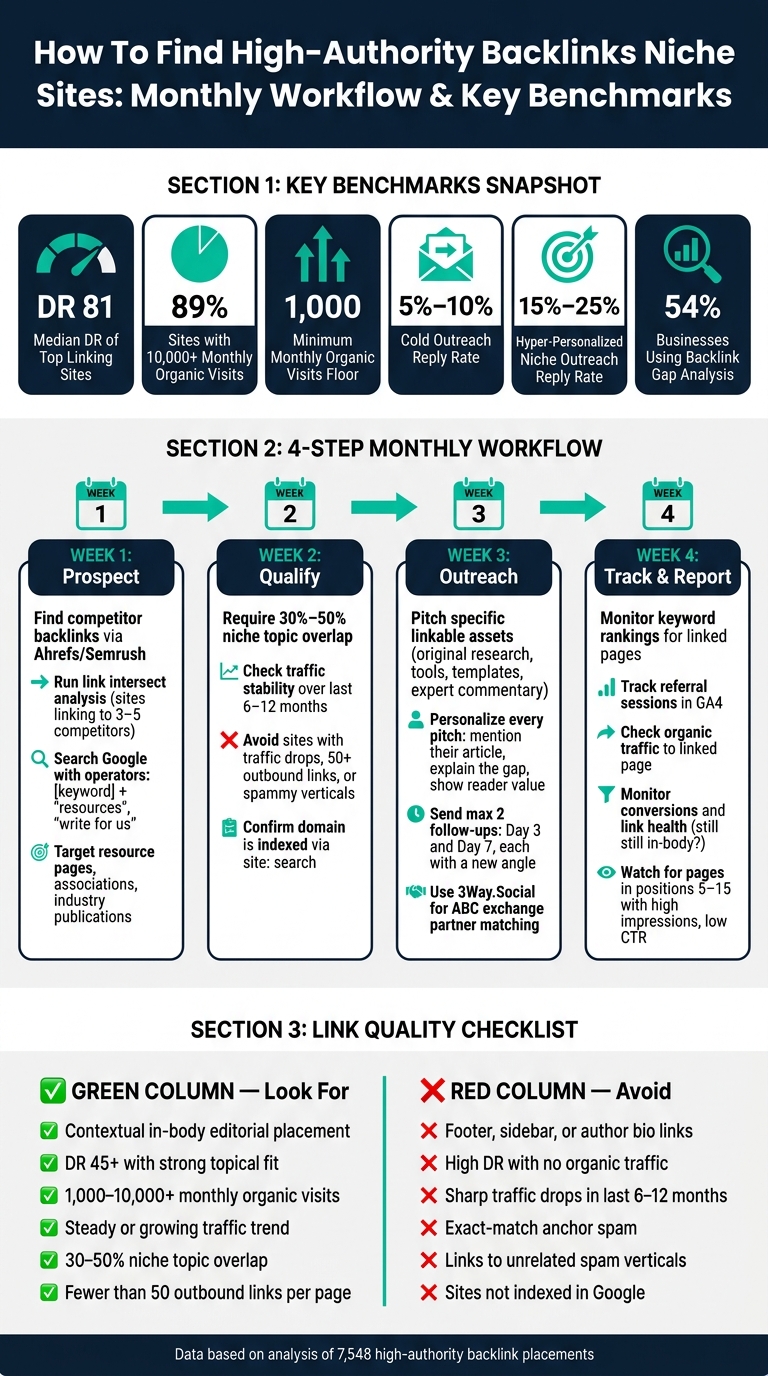
High-Authority Backlink Building: Monthly Workflow & Key Benchmarks
Steal These 3 High-DR Tactics for High-Authority
Before you start, review our checklist for securing high-authority backlinks to ensure your site is ready for outreach.
sbb-itb-88880ed
Define What High Authority Looks Like in Your Niche
Turn that definition into a screening rule.
Use Authority Metrics, Traffic, and Relevance Together
Score prospects using three signals: authority, organic traffic, and topical fit.
Domain Rating (DR) from Ahrefs, Domain Authority (DA) from Moz, and Authority Score from Semrush are good starting points. But a high DR on its own doesn’t tell the whole story. If a site has little or no steady organic traffic, that score can look better on paper than it does in practice.
Research across 7,548 high-authority placements found that the median DR was 81, and 89% of those linking sites pulled at least 10,000 monthly organic visitors. A solid floor is 1,000 monthly organic visitors. If you’re in a competitive niche, aim for 10,000+.
Relevance often matters more than raw authority. A DR 45 site that covers your exact topic can move rankings more than a DR 80 general-interest site with no clear tie to your niche. That’s why topical fit can’t be an afterthought.
Placement matters too. Prioritize contextual in-body links. Links in footers, sidebars, and author bios tend to carry less weight. It also helps to check outbound link density. Pages with 50+ outbound links can water down ranking value and may point to weak editorial standards.
Use these benchmarks to reject weak prospects fast.
Set Realistic Benchmarks from Competitor Backlink Profiles
Next, set those thresholds against the sites that already rank in your niche.
Tools like Ahrefs, Semrush, Moz Pro, or Majestic can help you view competitors’ backlinks and spot patterns fast. Focus on a few things:
- The DR range that shows up most often among their strongest referring domains
- The monthly traffic those domains get
- Whether the links are contextual editorial placements or paid/sponsored insertions
One of the fastest ways to do this is a backlink gap analysis. This shows you domains that link to two or more of your competitors but haven’t linked to you yet. These sites are already open to your niche, so your outreach starts with less friction. 54% of businesses find link opportunities this way.
Use competitor profiles to set your floor before outreach.
How to Find High-Authority Backlink Opportunities
With your benchmarks in place, the next move is to build a prospect list that fits your niche and gives you a fair shot at landing links.
Reverse-Engineer Competitors and Search Google for Niche Prospects
Start with what’s already working for competing sites. Export their referring domains from Ahrefs or Semrush, then sort them by niche fit, organic traffic, and link type.
Next, run a link intersect analysis. If a site links to three to five of your competitors, move it to the top of your list. That’s a strong sign the site already links out in your space.
Then go one level deeper. Instead of stopping at the domain, look at the exact pages where those links live. This helps you find listicles, resource pages, and guest posts that already feature competing brands. Those are the placements you can pitch for yourself.
After you’ve mapped competitor links, expand the list by using advanced techniques to find backlinks on Google:
[keyword] + "resources"or"write for us"to find resource pages and guest post spots"best [category] tools"or"[keyword]" + "top blogs"to find roundups and listicles
Run this process every quarter. That helps you spot new domains your competitors picked up, along with links they lost, which can open the door for your site.
Target Resource Pages, Associations, and Trusted Industry Sites
Resource pages are a smart place to start because linking out is the whole point of the page. A search like keyword + "useful links" can turn up solid prospects fast.
After that, look for stronger trust signals from formal industry groups. Trade organizations, chambers of commerce, and professional associations can support your topical credibility and show that your site belongs in the niche. Search [keyword] + "association" or [keyword] + "directory" to find them.
You can round out this group with niche publications and educational resources.
Use 3Way.Social to Find Vetted ABC Exchange Partners
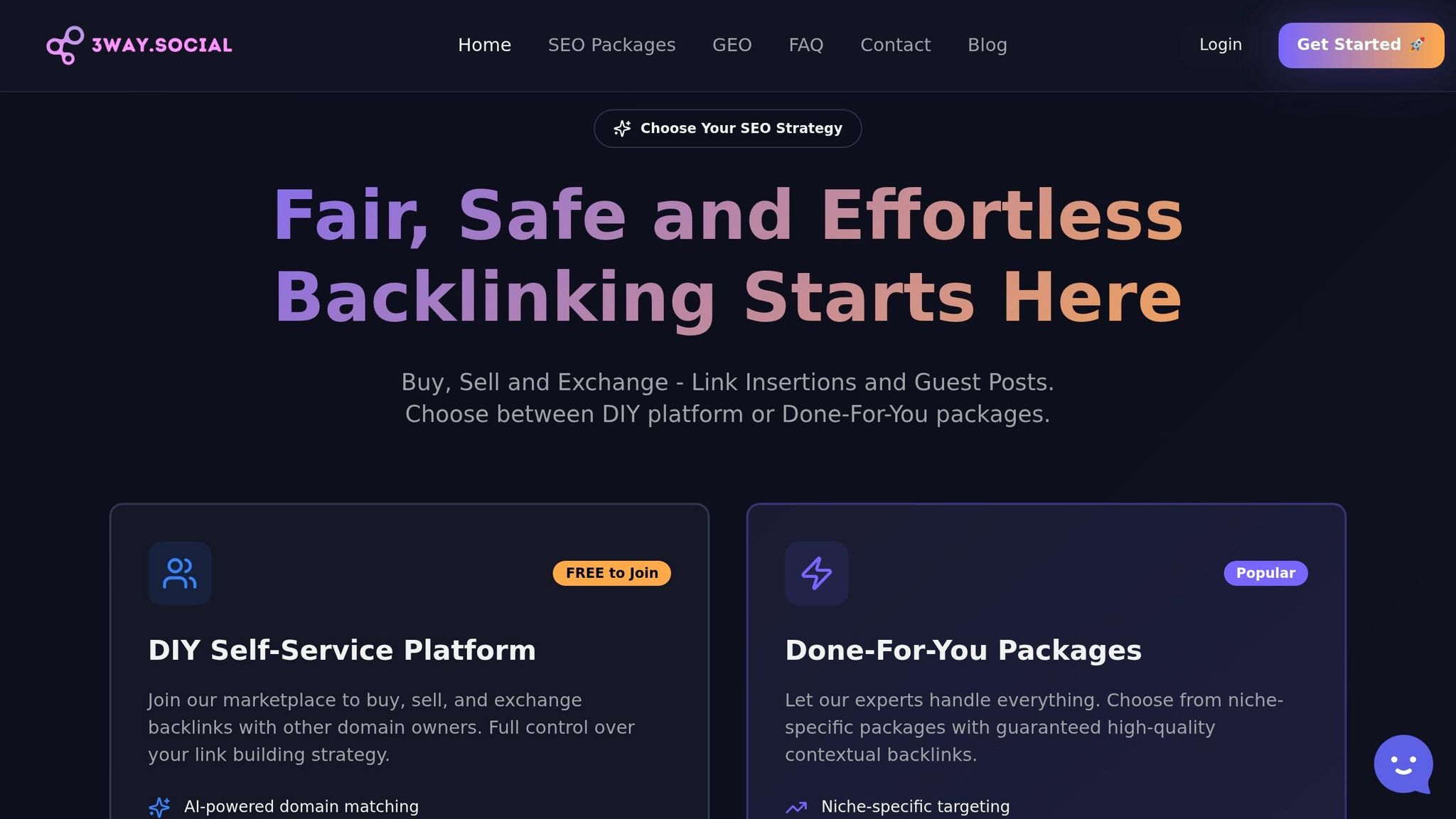
When manual prospecting starts to feel slow, vetted ABC partners can give you a more scalable path. 3Way.Social uses AI-powered domain matching to find relevant link partners in your niche, including adjacent shoulder niches that reach the same audience without direct competition.
The platform supports ABC link exchanges – Site A links to Site B, and Site B links to Site C. That creates a less reciprocal linking pattern. All links are permanent dofollow links, which helps with long-term authority building.
How to Qualify Prospects and Secure the Link
Screen Sites for Relevance, Traffic Stability, and Risk
Once your prospect list is built, qualify it fast before you send a pitch.
A big list means nothing if most of the sites are weak or off-topic. The two things that matter most are topical fit and traffic stability. Go after sites with 30%–50% niche overlap and traffic that has stayed steady or grown over the last 6 to 12 months. A sharp drop is a major red flag.
Score each prospect based on:
- topic fit
- traffic trend
- outbound links
- content quality
Skip sites that lean on exact-match anchors or link out to unrelated spam verticals. Also run a site:domain.com search to make sure the domain is indexed.
Prepare Linkable Assets and Pitch Specific Topics
The best niche links usually come from assets that help people in a clear way. Original research, benchmark studies, free tools like calculators and templates, and expert commentary tend to perform best for niche outreach. If you don’t have one yet, make that first move before you start pitching.
When the asset is ready, tailor every pitch to the site you’re contacting. Mention a real article they published, point out the gap your resource fills, and explain how it helps their readers – not just your rankings. For resource pages, show the exact section where your link belongs. For guest posts, pitch a topic angle that fits their audience and still connects naturally to your site’s subject matter.
Keep the CTA simple. A direct question like "Would it make sense to include a link here?" tends to work better than a long request.
Average cold outreach response rates are around 5% to 10%, but hyper-personalized niche outreach can hit 15%–25%. If no one replies, send no more than two follow-ups – one on day 3 and one on day 7. Each follow-up should add a new angle or data point instead of just bumping the thread.
Build a Repeatable ABC Exchange Workflow with 3Way.Social
Manual outreach still works, but it gets slow when you’re trying to do more of it. Apply the same filters when you review vetted ABC partners. Use 3Way.Social to pre-screen ABC partners by niche, authority, and language, then move qualified matches into outreach.
A simple way to run this is with a four-week monthly cycle:
- Week 1: prospecting
- Week 2: qualification
- Week 3: outreach
- Week 4: placement tracking and reporting
Use 3Way.Social alongside manual outreach during Weeks 2 and 3.
Track Results and Scale What Works
Monitor Links, Rankings, Traffic, and Link Health
Once your placements are live, the next step is simple: check whether they’re moving the pages you targeted earlier.
Use Google Search Console to spot pages ranking in positions 5–15 with high impressions and low CTR. Those are often your best opportunities. They’re already close enough to page one to matter, but they still have room to move.
After a link goes live, track:
- keyword movement
- organic traffic to the linked page
- referral sessions in GA4
- conversions
It also helps to check link health from time to time. Run a site: search on the referring page to make sure it’s still indexed and that the link hasn’t been pushed into a footer or sidebar. Look for steady month-over-month growth, and keep an eye on odd spikes. Search engines may discount patterns that look unnatural.
Refine Your Mix of Safe Link Building Strategies Like Guest Posts, Resource Links, PR, and ABC Exchanges
Once you know which link types are working, put more of your outreach there.
If guest posts on closely related sites are driving referral traffic and ranking gains, give that channel more attention and build more linkable assets around it. If ABC exchanges through 3Way.Social are leading to faster ranking gains for certain content clusters while mastering topical authority, expand that workflow inside the platform’s domain matching and niche filters.
Start with unlinked brand mentions. If a site already mentions your brand or a proprietary framework, the hard part is often done. The editor has already shown interest, which can lead to higher conversion rates. Add those opportunities to your monthly process alongside structured prospecting.
The goal isn’t raw volume. It’s better fit and stronger authority. For niche sites, that usually means putting more effort into the guest posts, resource links, PR placements, and ABC exchanges that are measurably improving rankings, traffic, or conversions.
FAQs
How many backlinks should a niche site build each month?
In competitive niches, aim for 10–20 relevant backlinks per month and build them at a steady pace. The goal isn’t to pile up links. It’s to get links that make sense for your site: good quality, a mix of sources, and close topic fit. That’s what helps your backlink profile look natural.
Don’t ramp up link building all at once. Sharp jumps in new links can trip spam filters and damage rankings. 3Way.Social can help by connecting you with vetted SEO professionals and matching domains for fair link exchanges.
What anchor text should I use for niche backlinks?
Use a natural mix of anchor text for niche backlinks. That usually means blending branded anchors, partial-match anchors, and plain URL-based text.
Don’t overdo keyword-heavy anchor text. If every link looks forced, it can hurt your rankings instead of helping them.
3Way.Social can help you manage link building with AI-powered link diversification, so your backlink profile stays balanced and high-quality.
How long does it take for a high-authority backlink to affect rankings?
On average, high-authority backlinks take about 3.1 months to drive noticeable ranking changes. The timeline can shift based on topical fit, editorial quality, and where the link appears on the page.
SEO works best as a long game. A steady, natural-looking link profile tends to do more for rankings than short bursts of links that show up all at once. 3Way.Social supports that approach with equitable link exchanges and domain matching inside a vetted network.