Last Updated on July 20, 2026 by Becky Halls
For fifteen years, the answer to “how do I rank higher?” had a reliable second sentence: get more links. Backlinks were the closest thing SEO had to a law of physics. Then AI search showed up, started quoting brands that had barely any links at all, and sneakily rewrote the rulebook while everyone was busy arguing about whether AI Overviews would kill their traffic.
So here’s the interesting question for 2026: the brand mentions vs backlinks AI debate in a nutshell: when ChatGPT, Perplexity, and Google’s AI Overviews decide who to cite, do they care more about your backlinks or about how often your brand gets talked about? The early data is leaning one way, and it’s not the way most link-building budgets are pointed.
The number that started the argument
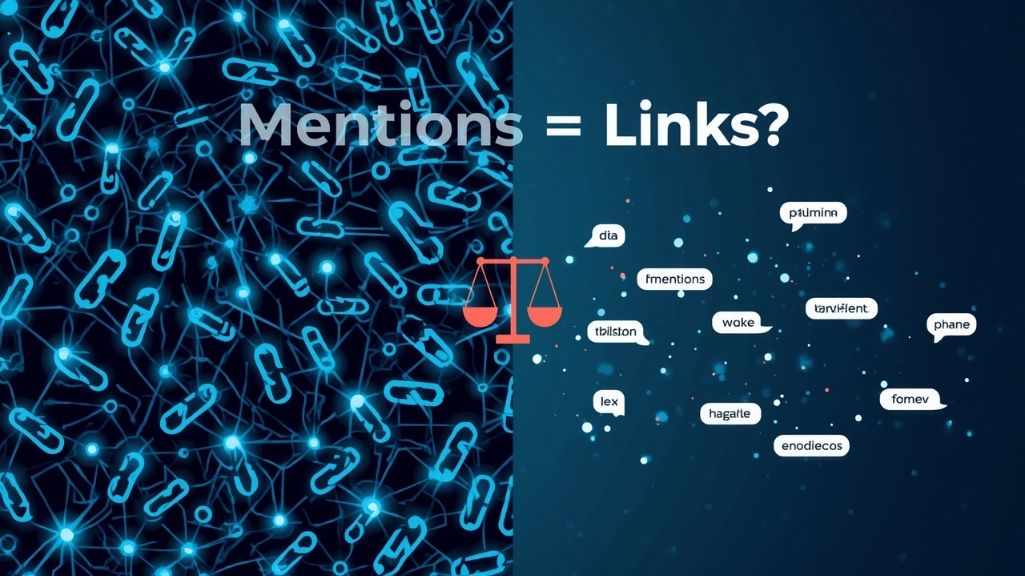
Let’s get the headline stat out of the way, because it’s the one doing the rounds in every SEO Slack channel right now. According to survey data compiled by Reporter Outreach, brand mentions correlate far more strongly with AI search citations than backlinks do — roughly 0.664 for mentions versus 0.218 for links. In plain English: if you want an AI to name-drop you in its answer, being mentioned around the web appears to matter about three times as much as being linked to.
That doesn’t mean links are dead. The same body of research found that 73.2% of professionals still believe backlinks influence AI search results. Links haven’t stopped working – they’ve stopped being the only thing working. And that’s a genuinely new situation.
“For years we optimised for the crawler. Now we’re also optimising for a model that’s trying to figure out whether real people actually trust you. A pile of links can’t fake that on its own anymore – you need to be part of the conversation, not just part of the link graph.” Becky Halls, Strategist at 3Way.Social
Why AI engines think differently to the blue-links algorithm
Classic Google ranking treats a link as a vote – a page pointing at you saying “this is worth reading.” Large language models don’t crawl a link graph the same way when they generate an answer. They’re pattern-matching across enormous volumes of text, looking for entities (your brand, your product, your founder) that show up consistently, in context, alongside the topic someone asked about.
If your company name appears in fifty industry roundups, three podcast transcripts, a Reddit thread, and a couple of comparison articles — even without a single followed link – the model has learned that you’re associated with your category. That association is what gets you quoted. It’s less “who’s linking to you” and more “who’s talking about you, and in what context.”
Google’s own spokespeople have been softly signalling this shift for a while. As John Mueller put it back in 2022, “my guess is over time, it won’t be such a big factor as sometimes it is today” — talking about the weight of links dropping as Google gets better at understanding content in context. He later added that over-focusing on links “will often result in you wasting your time doing things that don’t make your website better overall.” When the person who fields SEO questions at Google keeps gently pointing away from links, it’s worth listening.
But before you cancel your link building…
Here’s the nuance everyone skips. The strongest brand mentions and the strongest backlinks come from the same places. When a respected publication writes about you, you usually get both the mention and the link in one go. Digital PR — the discipline of earning coverage on real sites — is now the highest-leverage activity precisely because it feeds both machines at once: the traditional ranking algorithm and the AI models.
The 2026 data backs this up. 48.6% of experts now rate digital PR as the single most effective link-building strategy, nearly double the vote for guest posting. And tellingly, 66.2% of digital PR practitioners now track AI citations as a KPI — a metric that basically didn’t exist two years ago.
“The teams winning in AI search aren’t choosing between links and mentions – they’re earning both from one strong piece of coverage. The old link-building playbook of chasing anything with a DR number attached is finally, mercifully, dying. What replaces it is just… being genuinely worth mentioning.” Ian Naylor, Founder of 3Way.Social
What to actually do about it
Enough theory. Here’s where to spend your energy this quarter.
Get quoted, not just linked. Contribute expert commentary to journalists (services like Featured, Qwoted and Help a B2B Writer are still the quickest route). A named quote in an industry article creates a contextual brand mention even when the link is nofollow — and AI models don’t care about the nofollow tag.
Feed the models structured, quotable facts. Princeton researchers found that adding quotations, statistics and citations to your content lifts AI citations by up to 40%, with direct quotes (+41%) and statistics (+32%) producing the biggest gains. Put your best data near the top and make it easy to lift.
Show up where the conversations happen. Reddit, niche forums, industry Slack and Discord communities, YouTube. These are increasingly part of AI training and retrieval. You can’t spam your way in, but you can be genuinely helpful in the places your buyers already gather.
Build entity consistency. Use the same brand name, the same founder names, the same product descriptors everywhere. Mixed signals confuse the model about who you even are. Consistency is boring and it works.
Keep earning quality links anyway. They still influence traditional rankings, they still drive the referral traffic that converts, and they usually arrive bundled with the mention you actually want.
The shift isn’t “links are over.” It’s “links were never the goal – trust and association were, and now we have a second engine that reads them more directly.” Optimise for being genuinely notable, and both machines reward you.
Brand Mentions vs Backlinks AI – FAQ
Brand mentions vs backlinks AI – which matters more for getting cited?
New 2026 survey data suggests brand mentions correlate about three times more strongly with AI citations than backlinks do. But links still influence traditional Google rankings and usually arrive bundled with the mention, so the smartest play is earning both from one piece of coverage rather than choosing.
What’s the difference between a brand mention and a backlink?
A backlink is a clickable hyperlink pointing to your site. A brand mention is any reference to your name, product or people — linked or not. AI engines can pick up unlinked mentions, which traditional SEO tools historically ignored.
How do I track brand mentions for AI search?
Use media-monitoring tools (Brand24, Mention, Google Alerts) for the mentions themselves, and AI-visibility trackers (Profound, Peec, Otterly and similar) to see whether ChatGPT, Perplexity and AI Overviews are actually citing you.
Does nofollow matter for AI citations?
Not really. A nofollow link tells Google not to pass ranking authority, but the surrounding text still creates a contextual brand mention that language models can learn from.
Is digital PR better than link building now?
Digital PR is a form of link building — it’s the version that earns editorial coverage on real sites, which produces both links and mentions at once. That dual benefit is why 2026 surveys rank it the most effective approach.
How many mentions do I need to get cited by AI?
There’s no magic threshold. It’s about consistent, contextual association with your topic over time across credible sources — not hitting a specific count.
Becky Halls is a strategist at 3way.social and founder of BeckyHalls.com, where she helps brands earn the kind of coverage that both search engines and AI models actually pay attention to.