Last Updated on January 26, 2026 by Becky Halls
Anchor text placement directly impacts your SEO success. Contextual links in the main content outperform those in sidebars or footers, boosting rankings by up to 150%. The right mix of branded, partial-match, and exact-match anchors helps avoid penalties under Google’s Penguin update. Tools like 3Way.Social streamline anchor text diversification and placement, ensuring a natural backlink profile while saving time.
Key Takeaways:
- Context matters: Links in the main body are more effective than in sidebars or footers.
- Anchor diversity: Use 30–50% branded, 20–30% partial-match, and <10% exact-match anchors.
- Avoid penalties: Overusing exact-match anchors across domains increases penalty risk by 340%.
- Automation tools: Platforms like 3Way.Social simplify managing anchor text ratios.
Whether you choose manual placement for precision or automation for scalability, focus on maintaining a balanced and natural anchor text profile.
“We’ve seen the same link perform completely differently depending on where it sits. A contextual link inside a relevant paragraph usually beats the exact same link stuck in a sidebar or author bio.” Ian Naylor, Founder of 3Way Social
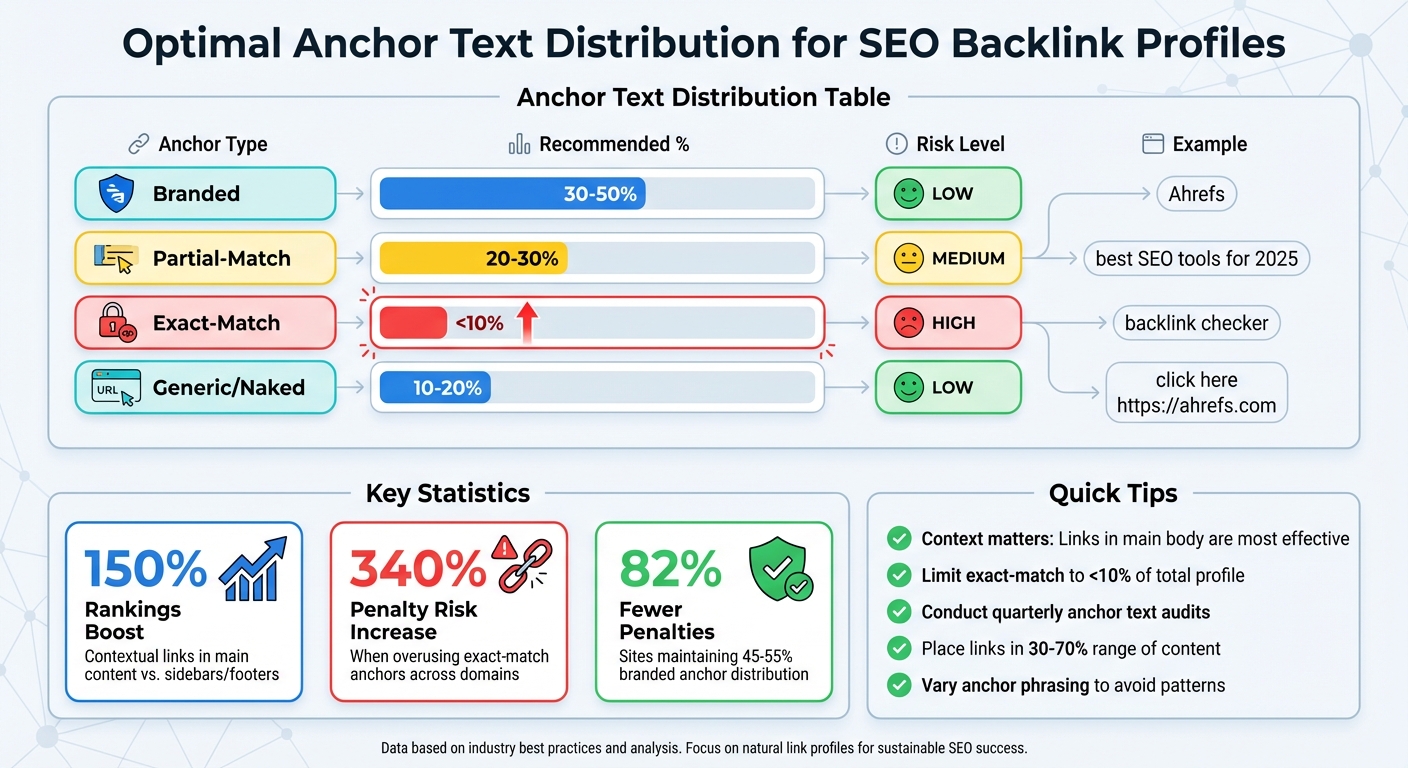
Optimal Anchor Text Distribution for SEO Backlink Profiles
Anchor Text: How I Optimize it (Step-by-Step)
1. Manual Anchor Text Placement Methods
Manual anchor text placement gives SEO experts the ability to fine-tune backlink profiles. Strategies like guest blogging, outreach, and editorial partnerships allow for precise control over anchor text distribution.
Backlink Quality
The quality of a backlink often depends on its semantic alignment – how well the anchor text matches the content of the target page. When anchors are carefully crafted, they serve as a “relevance multiplier”, amplifying the SEO impact. For instance, a study of 13,002 landing pages revealed a 69.6% increase in semantic similarity when manual anchor text placement was employed strategically. Additionally, descriptive anchors improve “information scent”, leading to better click-through rates and higher-quality referral traffic.
“Google uses anchor text to help understand the context of the link and thus, it may be a ‘ranking factor.'” – John Mueller, Senior Search Analyst, Google
Domain Authority Impact
New backlinks can significantly boost keyword rankings. For example, pages receiving fresh backlinks saw their keyword counts jump from 12 to 30. This highlights the importance of strategically balancing branded, partial-match, and exact-match anchors. A well-rounded backlink profile in 2025 typically includes 30–50% branded anchors, 20–30% partial-match anchors, and less than 10% exact-match keywords. Top-tier sites like Ahrefs maintain around 50% of their referring domains using their brand name as anchor text. It’s best to reserve exact-match anchors for high-quality, high-Domain Rating (DR) editorial placements, where Google’s trust is strongest.
Anchor Text Diversification
A diverse anchor text profile is just as important as optimizing its distribution. Manual placement allows for strategic variation, such as rotating between branded, URL, generic, partial keyword, and exact keyword anchors. This approach mimics the way real users naturally link to content. Even within partial-match anchors, varying the phrasing – like using “managing LinkedIn messages” in one instance and “LinkedIn outreach tools” in another – helps avoid detection by pattern-recognition algorithms. Research analyzing 23 million internal links found that URLs with more anchor text variations tend to attract more Google search traffic.
| Anchor Type | Recommended % | Risk Level | Example |
|---|---|---|---|
| Branded | 30–50% | Low | “Ahrefs” |
| Partial-Match | 20–30% | Medium | “best SEO tools for 2025” |
| Exact-Match | <10% | High | “backlink checker” |
| Generic/Naked | 10–20% | Low | “click here”, “https://ahrefs.com” |
Risk Mitigation
While manual anchor text placement offers precision, it also comes with risks. For example, in 2025, a law firm built 120 backlinks over six months, with 72% of them using the exact-match keyword “personal injury lawyer NYC.” After a Google spam algorithm update, the firm’s organic traffic dropped by 80%. Recovery required a complete overhaul of their backlink profile, shifting to branded and phrase anchors.
To avoid such pitfalls, conduct quarterly audits with tools like Ahrefs or SEMrush. Ensure no single non-branded anchor exceeds 20% of your total profile. A study of 10,000 guest posts found that 67% of penalty-free backlinks were placed in the middle third (30–70%) of the content. Furthermore, sites maintaining a branded anchor distribution of 45–55% experienced 82% fewer penalties. Always prioritize natural-sounding anchors.
“In our experience, anchor text works best when it matches the sentence, not the keyword plan. If it reads awkwardly to a human, it usually looks forced to search engines too.” Becky Halls, Strategist at 3Way Social
2. 3Way.Social
3Way.Social takes manual SEO techniques and supercharges them with automation, focusing on precision and efficiency. By combining AI-driven domain matching with strict quality checks, the platform simplifies the process of building effective backlink profiles without losing the strategic edge. It automates many tedious tasks while sticking to proven SEO principles, ensuring a balance between efficiency and control.
Backlink Quality
At its core, 3Way.Social’s AI matching algorithm ensures backlinks are topically relevant. For example, when a digital marketing page links to another marketing resource, it sends a stronger signal to search engines compared to an unrelated link. To keep placements natural, the platform recommends positioning links within the 30–70% range of the content and requires 2–3 supporting sentences for proper context.
Domain Authority Impact
The platform uses a vetting network to focus on high-quality domains, prioritizing those with a Domain Authority (DA) score of 40 or higher. Why? Backlinks from these sites deliver 4.3× more ranking power compared to links from sites with DA scores in the 20–30 range. To maintain optimal link density, 3Way.Social sets a standard of one contextual link for every 800–1,500 words and offers the option of including an author bio link.
Anchor Text Diversification
Anchor text diversity is another area where 3Way.Social shines. Its automated diversification tool helps users maintain healthy ratios by recommending the following distribution: 40–50% branded anchors, 20–30% partial-match anchors, 15–25% semantic or long-tail anchors, and 5–10% generic anchors. This built-in guidance prevents the overuse of exact-match keywords, which can hurt SEO. While anchor text variety strengthens SEO efforts, the platform emphasizes that quality is always the top priority.
Risk Mitigation
To minimize risks, 3Way.Social employs quality control filters that flag over-optimized patterns. For instance, it limits exact-match anchors to less than 10% of total backlinks, as using identical anchors across five or more domains can increase penalty risks by 340%. The platform also encourages users to review their anchor text profiles every 90 days with automated audit reminders. Additionally, it varies publication timing and author bio formats across exchanges to avoid creating patterns that could attract unwanted algorithmic scrutiny.
“We’ve noticed placement and proximity matter: links surrounded by related entities and terms tend to have more impact than links dropped into generic intro copy.” Ian Naylor, Founder at 3Way Social
sbb-itb-88880ed
Pros and Cons
Placing anchor text manually gives you complete control over each backlink. But let’s face it – this method can be a serious time sink, especially when you’re juggling a large number of links. On top of that, keeping track of anchor text diversification by hand gets harder and harder as your backlink portfolio grows. That’s where automated solutions step in, offering a balance between control and efficiency.
Platforms like 3Way.Social tackle these issues head-on by automating the process while maintaining a strategic edge. With AI-driven quality filters, the platform reduces the risk of over-optimization – a common pitfall with manual anchor text management – and helps maintain a natural-looking backlink profile.
The real debate comes down to scalability versus control. As your backlink portfolio grows, automation becomes an essential ally to complement the precision of manual efforts.
“Your best bet for creating a natural anchor text ratio in your backlink profile – which is what Google wants to see – is simple: Don’t try to manipulate your anchor text ratios at all.” – Joshua Hardwick, Head of Content, Ahrefs
This quote highlights why automation becomes indispensable as your backlink strategy scales. For example, keeping exact-match anchors below 5% of your backlink profile is critical to avoid penalties from search engines. Automation makes this much easier to achieve.
Conclusion
To wrap things up, let’s revisit some of the key takeaways. Proper anchor text placement plays a crucial role in creating a reliable backlink profile. Research shows that strategic positioning and maintaining balanced anchor ratios can significantly lower the risk of penalties from search engines.
The choice between manual methods and tools like 3Way.Social largely depends on your resources and the scale of your backlink strategy. If you’re working with just a handful of backlinks and have the time to review your anchor ratios every 90 days, manual methods give you the ability to fine-tune each anchor. This means crafting natural placements with 2–3 sentences of supporting context. As mentioned earlier, manual management offers precision, but scaling up efficiently without compromising quality becomes difficult as your backlink portfolio grows.
Once you’re dealing with 20–30 or more links, automation becomes a game-changer. Tools like 3Way.Social use AI-driven filters to handle domain matching, diversify anchor types, and ensure exact-match anchors remain within safe limits. This allows you to shift your focus to broader content strategies without worrying about triggering patterns that search engines might penalize. Ultimately, whether you choose manual methods or automation, the goal remains the same: maintaining a natural and balanced anchor profile.
A good rule of thumb is to reserve exact-match anchors for high-authority placements only. Repeating identical anchor text across multiple domains – five or more, for instance – can raise red flags and lead to severe penalties. Both manual and automated approaches should stick to strategic practices that align with search engine guidelines.
As your site grows, your anchor text strategy should adapt accordingly. Start by building trust with branded and generic anchors, then gradually incorporate partial-match and carefully chosen exact-match links as your domain authority increases. This phased approach mimics the way natural link profiles develop and aligns with search engines’ expectations.
FAQs
How does placing anchor text in the main content affect SEO performance?
Placing anchor text directly within the main content of your page can have a noticeable impact on your SEO efforts. Why? Search engines give more weight to links embedded in the main body of a page because they’re considered more relevant to the surrounding content. This helps search engines grasp the topic of the linked page and evaluate its relevance more effectively.
On top of that, strategically positioned anchor text plays a role in building a natural and diverse backlink profile, which can strengthen your domain authority and, in turn, boost your rankings. To make the most of it, ensure your anchor text is not only relevant to the context but also varied and seamlessly woven into your content.
How should anchor text be distributed to maintain a natural backlink profile and avoid Google penalties?
To keep your backlink profile looking natural and steer clear of Google penalties, it’s crucial to mix up your anchor text. Here’s a good rule of thumb for distribution: branded anchors (like your website or company name) should make up roughly 30-50%. Partial-match anchors (phrases that include your target keywords) should fall in the 20-30% range. And for exact-match anchors (those that perfectly match your target keyword), aim to keep them under 10% to avoid coming across as manipulative.
Having a diverse and balanced anchor text strategy not only minimizes the risk of penalties but also boosts your site’s credibility and helps improve its SEO performance.
How can AI tools like 3Way.Social improve anchor text diversification?
AI-driven tools like 3Way.Social simplify the process of diversifying anchor text by automatically creating varied and contextually appropriate options. This approach prevents the repetitive use of specific keywords or generic phrases, resulting in a more natural backlink profile. The outcome? Better alignment with SEO guidelines and a reduced risk of penalties for over-optimization.
What’s more, automation ensures that anchor texts are customized to match the relevance of each link. This not only boosts search engine rankings but also enhances the user experience. By constantly analyzing and fine-tuning anchor text patterns, 3Way.Social strikes the perfect balance between industry-related keywords, branded terms, and natural language. The result is a stronger domain authority and increased traffic over time.